Expand
The MiG-29, Briefly
The history of the MiG-29 starts in Vietnam. During the Vietnam War, the more modern and advanced American aircraft became vulnerable to the older yet lighter and more agile MiGs of the VPAF. In 1965 this spawned the F-X program for a next-generation air superiority fighter with an emphasis on a high thrust-to-weight ratio and low wing loading, eventually resulting in the F-15.
This program became known to the Soviets in 1969, so in 1971, the PFI (Perspektivnyy Frontovoy Istrebitel, “Advanced Frontline Fighter”) program was initiated to develop a fourth-gen aircraft capable of matching the performance of the F-X. The PFI was expected to destroy enemy fighters within visual range using advanced dogfight missiles and high maneuverability, intercept enemy aircraft at long range with advanced BVR missiles and a powerful look-down shoot-down radar, and also perform secondary ground strike missions using unguided bombs and rockets. The PFI would eventually result in the Su-27.
While the F-X was intended to apply the lessons of Vietnam, there were those among the US DoD that felt it didn’t go far enough. The “Fighter Mafia” saw the F-X as too large and expensive to be effective, and in 1972 pushed through the Lightweight Fighter Program, a much lighter, shorter-range fighter-bomber intended to complement the F-15 and be offered for export. The result of this program would be the F-16, and indirectly the F/A-18.
The Soviet fourth-gen fighter program would follow a similar path. In 1972 it was determined that the PFI would be too complex and expensive to be produced in sufficient quantities, and a lighter, cheaper counterpart would be needed. The PFI programme was split into the TPFI (Tyazholyi PFI, “Heavy AFF”) and LPFI (Lyogkyi PFI “Light AFF”). These names would later be changed to PFI and LFI (Lyogkyi Frontovoy Istrebitel, “Lightweight Tactical Fighter”). Mikoyan would be selected to develop the LFI, and the configuration of the izdeliye 9.11 fighter was finalized in 1974.
The izdeliye 9.11 MiG-29A was to be an interim variant, utilizing a derivative of the Sapfir-23 radar, a SUV-23ML-2 WCS both derived from the MiG-23’s systems, though otherwise the avionics suite was advanced including the new SPO-15 Beryoza RWR and OEPS-29A IRST. Armament was to be a AO-17A 30mm cannon, two R-24 MRAAMs, four R-60, R-60M, R-13M, R-13M1, or R-14 SRAAMS, as well as unguided bombs and rockets.
Alongside the izdeliye 9.11 was developed the izdeliye 9.12 MiG-29 sans suffix, the intended production version of the aircraft. With an identical airframe, propulsion, and structure to the 9.11, the 9.12 would use all-new avionics: most notably the N019 pulse-doppler radar (a first for the Soviets), SUV-29 WCS, OEPrNK-29 IRST, and RLPK-29 RTS. The air-to-air missile armament would also be all-new, excluding backwards-compatibility for R-60Ms. The main air-to-air missiles would be the cutting-edge R-27 LRAAM and R-73 SRAAM. In 1977 the MiG-29 izdeliye 9.12 was approved for production and the 9.11 was abandoned. The MiG-29 entered service in 1983.
An early design of the MiG-29A with a more conventional layout than that of the final configuration. The RP-23 was found to be too large for the MiG-29 airframe and so the MiG-29A prototypes were never completed
The first and third MiG-29 prototypes currently reside at the Central Air Force Museum in Moscow
MiG-29s in Poland
Poland was, naturally, a member of the Warsaw Pact. During the 1980s the primary fighter of the SP (Siły Powietrzne “Air Force”) was the MiG-21bis with smaller numbers of MiG-23MFs and MiG-21MFs. In 1984 two export version of the MiG-29, the izdeliye 9.12A for WarPac nations and izdeliye 9.12B for other countries, were developed with slightly different avionics. East Germany would be the first to acquire the 9.12A, receiving 20 starting in 1988. Czechoslovakia followed with nine aircraft also in 1988, and third Poland received nine 9.12As and three twin-seat izdeliye 9.51A trainers in 1989 through 1990. Five more 9.12As were ordered in 1990, but this order was cancelled as Poland during this time was rapidly distancing itself with the fracturing USSR and towards the West. This meant that the SP was limited to only the initial order of 12 aircraft and the majority of the outdated 3rd gen aircraft remained in service.
Poland would receive its next batch of MiG-29s secondhand from Czechia in late 1995 and early 1996, nine 9.12As and one 9.51A in exchange for 11 W-3 Sokół helicopters. These two batches comprised the entirety of Poland’s MiG-29 fleet at the turn of the millennium.
38 and 89, two of the former Czech MiG-29s. Aircraft from this batch retained their original Czech camo scheme, only having the insignia and tactical numbers replaced
The MiG-29G, Briefly
With the reunification of Germany, the inventory of the East German LSK was incorporated into the West German Luftwaffe. Most of the LSK aircraft were outdated compared to their western counterparts and were quickly stored, scrapped, or sold off. The one notable exception were the 20 MiG-29 9.12As and four MiG-29UB 9.51As which were in many ways superior to the F-4F ICE then in service. In 1991 October 1990 to WTD 61 for evaluation. The results were glowing the MiG-29 handily outflew the F-15 and F-16, its radar was considerably more powerful and ECM resistant, and the R-73 massively outperformed the AIM-9L(I) and M. With the EF-2000 still quite a long ways off it was clear that such an impressive fourth gen fighter could not be passed up on, even if such a fighter was of Russian origin and used Russian weaponry. So in 1991 the decision was made to accept the MiG-29 into service, provided it underwent some modifications to meet NATO standards, intended to serve for 12 years.
With the assistance of MiG the MiG-29s would be refitted with new avionics, most notably new IFFs, radios, GPS navigation, and English-unit instruments. The MiG-29A 9.12As refitted to this standard were redesignated MiG-29G 9.12G (for German) and the MiG-29UB 9.51As to MiG-29GT 9.51GT (for German Trainer). These aircraft were assigned to the newly reformed Jagdgeschwader 73 and primarily flown by former LSK pilots who were already familiar with the Fulcrum.
Initially the MiG-29G retained the camo schemes they wore in LSK service. It was only in 1992 that they would be repainted in a grey scheme similar to that of the F-4F
The other German MiG-29 model, the MiG-29GT. It is a twin-seat trainer based on the MiG-29UB. The MiG-29GT retains all the same armament and capabilities as the MiG-29G except the radar and radar missiles. Poland also acquired these aircraft
MiG-29Gs in Poland and Beyond
This brings us to 2002. The lifetime of the MiG-29G/GT was coming to an end and the EF-2000 was about to enter service. Germany needed to figure out what to do with these soon-to-be-retired MiGs.
Simultaneously, Poland was still looking to modernize the SP, in particular looking for MiG-29s. Having relatively recently joined NATO, ideally these aircraft would already feature NATO-standard avionics. The acquisition of the MiG-29G was ideal for both parties. So, Germany and Poland negotiated what essentially amounted to the donation of the majority of the 24 MiG-29G/GTs. One MiG-29G had been previously lost in 1996 and another was deemed to be in too poor condition to fly, and was kept in Germany as a museum piece. This left 18 MiG-29Gs and four MiG-29GTs, all of which were “purchased” for one Euro each, this symbolic price making the donation a legally binding transaction rather than a gift. The MiG-29 acquisition was tied to the purchase of 128 Leopard 2A4s for 25 million Euros- so Germany didn’t exactly get nothing from the arrangement! Alongside the MiG-29s the SP would receive Germany’s stock of Russian air-to-air weapons, as without the MiG-29 they’d have no launch platform. This stockpile included a mix of R-27R1s, R-60MKs, and R-73Es totaling 740 missiles and several thousand rounds of 30mm ammunition. Also received were spare parts for the MiGs and 78 RD-33 engines.
Each MiG-29G and GT was inspected for wear and fatigue before being overhauled and accepted into service. Only the airframes in the best condition were to be used. After all these MiG-29s had had quite a long service life; even after two major overhauls fatigue was a serious concern. 10 MiG-29Gs and 4 MiG-29GTs were initially accepted, though 2 of those MiG-29Gs and 1 GT would shortly be withdrawn from service in 2006 and 2007 due to wear. This leaves a total of 8 MiG-29Gs and 3 MiG-29GTs in service, with the remaining 10 Gs and one GT being used for spare parts and put on display.
These aircraft would be sent to the 41 ELT (41 Eskadra Lotnictwa Taktycznego, “41st Tactical Air Squadron”), replacing the woefully outdated MiG-21MF. The aircraft were numbered 41XX. In 2016, aircraft 4101 would be written off following an engine fire during routine maintenance. In 2018, aircraft 4103 would be lost in an unfortunately fatal crash. The service history of the MiG-29G in Poland was otherwise largely uneventful, and the type was intended to be replaced in the late 2020s by the F-35A.
Then in 2022 Russia invaded Ukraine, and Poland was one of many countries to offer support. The Ukrainian Air Force operated a large number of MiG-29s of various versions, and with Poland having the largest MiG-29 fleet in NATO it made sense to donate some amount of those MiGs. The MiG-29G/GTs were to be retired soonest so they were the first to go. Between 2022 and 2023 all available MiG-29Gs and GTs, 8 and 3 respectively, were transferred to Ukraine. Some of these aircraft are to be used in action while others are to be used for parts. For the SP, these aircraft were replaced partially by an early delivery of 4 F-35As and partially by 12 FA-50GFs. Other Polish MiG-29s followed, and the current plan is to donate the remaining MiG-29 fleet in the coming years, as soon as replacement aircraft become available. More specific details of the service of the MiG-29G in Ukraine is beyond the scope of this suggestion.
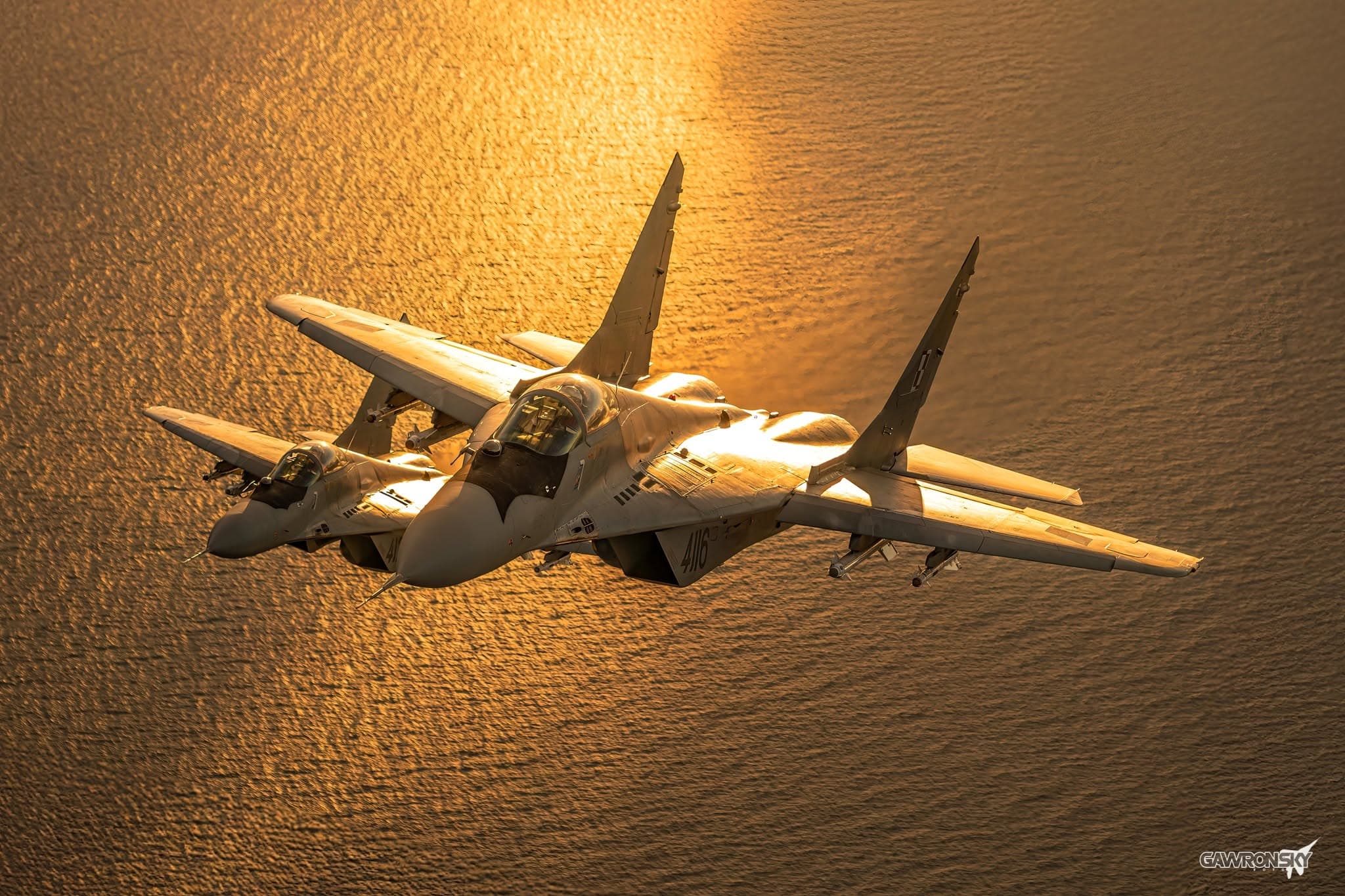
The MiG-29G is often overshadowed by the much more advanced F-16 Jastrząb purchased soon after. However, the two have served side-by-side and the cooperation of Eastern and Western aircraft is what makes the Polish Air Force so effective
A MiG-29G in Ukrainian colours. Visible is the location where the Polish roundel was painted over