I have been looking more into why the MiG-35 feels so bad once you go supersonic at medium and high altitude.
The current FM might be giving the MiG-35 too much drag, or at least too little excess power, once you get past Mach 1 around 5 to 13 km.
I am not saying the MiG-35 should have exactly the same drag as the MiG-29M. Obviously it has a different wing, different airframe details, MAWS sensors, different external equipment and a few aerodynamic changes.
The question is whether all of those differences are enough to justify the huge loss of acceleration that we currently see.
If we compare the MiG-29M 9-15 and the MiG-35 in the current FM at almost exactly the same mass:
MiG-29M 9-15
Mass: 13,058 kg
Static thrust: 15,974 kgf
Maximum thrust shown: 28,363 kgf at 1,800 km/h
Maximum acceleration: around 13.76 m/s²
Sea level top speed: 1,655 km/h
MiG-35
Mass: 13,050.5 kg
Static thrust: 17,270 kgf
Maximum thrust shown: 30,378 kgf at 1,800 km/h
Maximum acceleration: around 14.65 m/s²
Sea level top speed: 1,472 km/h
So the mass is basically identical, but the MiG-35 has around 8 percent more static thrust and around 7 percent more maximum thrust in this comparison.
At low and medium speed this actually makes sense. The MiG-35 initially accelerates better.
The problem starts when speed increases.
Once the aircraft gets into the supersonic region, especially at medium and high altitude, the MiG-35 starts losing its excess power much faster than the MiG-29M.
The basic physics is simple:
a = (Thrust - Drag) / Mass
Since the mass is almost identical, if the MiG-35 has more thrust but eventually accelerates much worse, then the difference has to come from the amount of drag being generated, unless there is some very large reduction in effective engine thrust at those exact Mach numbers.
There are also some pretty interesting differences inside the actual WT FM.
MiG-29M 9-15
Wing span: 11.36 m
Wing reference area in the FM: around 38
Wing Oswald efficiency: 0.65
Wing CdMin: 0.0074
Fuselage reference area in the FM: 38
Fuselage CdMin: 0.0076
Main fuselage transonic multiplier: around 2.8
MiG-35
Wing span: 11.9 m
Wing reference area in the FM: around 45
Wing Oswald efficiency: 0.68
Wing CdMin: 0.0076
Fuselage reference area in the FM: 45
Fuselage CdMin: 0.0084
Main fuselage transonic multiplier: around 3.1
The important thing is the relative difference.
The MiG-35 is being given a noticeably larger aerodynamic area and slightly higher basic drag values, especially around the transonic region.
Some increase absolutely makes sense.
The MiG-35 has a larger wing and also has external sensors and aerodynamic changes that the original MiG-29M did not have.
For example, the MAWS sensors and other external equipment are obviously not completely drag free.
But I seriously question whether those relatively small external changes should create enough additional drag to completely cancel the thrust advantage of the RD33MK once the aircraft gets past Mach 1.
This becomes even more interesting when looking at real MiG-29 aerodynamic documentation.
The Soviet 1987 Practical Aerodynamics of the MiG-29 manual gives actual energy climb performance for the aircraft.
For a MiG-29 at around 15,000 kg, with two R60MK missiles and two APU470 launchers, in full afterburner:
At 11,000 m and around Mach 1.7 to Mach 1.8, maximum energy climb rate is around 160 to 180 m/s.
The same manual specifically says that above 9,000 m, energy climb performance at Mach 1.7 to Mach 1.8 is better than when maintaining Mach 0.9 to Mach 0.95.
It also uses a supersonic climb profile where the aircraft accelerates around 12,000 m to approximately Mach 1.6 before continuing the climb.
That is very important because this is basically the exact altitude and Mach region where the MiG-35 feels extremely weak in WT.
This was already achievable by the original MiG-29.
For some perspective, 160 to 180 m/s of specific excess power at around Mach 1.75 and 11 km corresponds to roughly 3.0 to 3.4 m/s² of equivalent horizontal acceleration if that excess energy was used purely for acceleration instead of climbing.
Obviously this does NOT mean the MiG-35 must have exactly the same value.
The MiG-35 has a larger wing, a different airframe and different external equipment.
But it is still very interesting that an older MiG-29 with the original engines retained that much excess power in exactly this flight regime, while the much more powerful MiG-35 in WT seems to lose a huge amount of energy once it becomes supersonic.
The official UAC specifications for the MiG-35 also give:
2 × RD33MK engines
9,000 kgf bench thrust per engine
12 m wingspan
2,100 km/h maximum speed at 12,500 m
Again, top speed is not really the issue here.
The issue I am talking about is HOW it reaches that speed.
An aircraft can have a roughly correct maximum speed and still have an incorrect drag curve or incorrect excess power during acceleration.
That is what I think might be happening here.
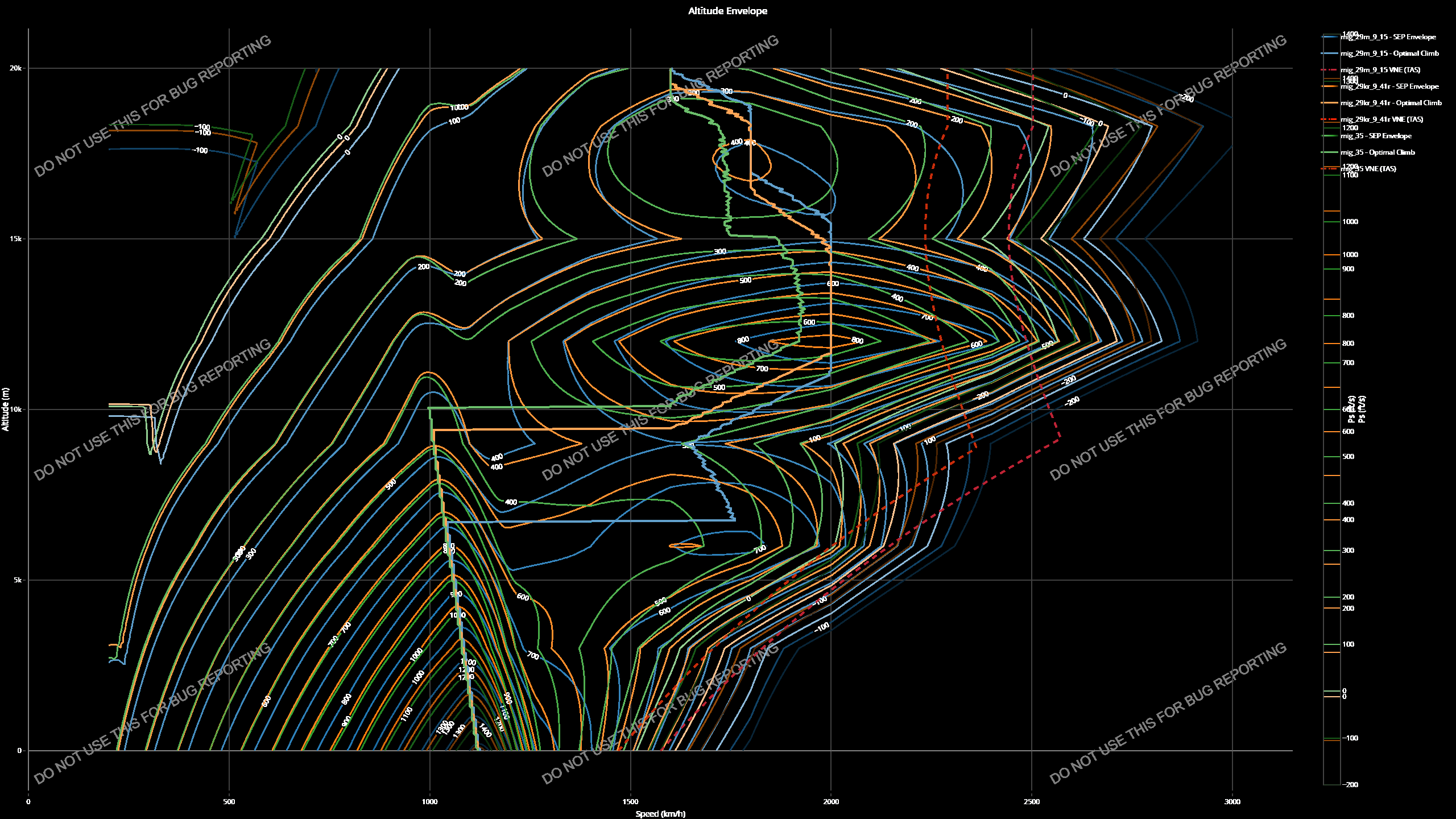
This graph is particularly interesting because it shows the SEP envelope.
The green curves are the MiG-35.
The blue curves are the MiG-29M 9-15.
The orange curves are the MiG-29KR 9-41R.
What interests me is the region around 9 to 13 km once speed becomes supersonic.
The MiG-35 envelope starts becoming significantly worse even though the aircraft has more thrust than the MiG-29M and, in this comparison, almost exactly the same mass.
This is why I think the current FM might be applying too large a supersonic drag penalty.
My theory is basically this:
At lower speed, the extra RD33MK thrust compensates for the larger airframe and the MiG-35 accelerates very well.
Around the transonic region, drag increases strongly, which is normal.
But after entering the supersonic region, the current MiG-35 FM seems to keep such a large drag penalty that the additional engine thrust gets completely cancelled.
The result is extremely poor excess power and very slow acceleration at medium and high altitude.
I am not saying the MAWS sensors, larger wing or external equipment should have zero drag.
They obviously should add some drag.
I am questioning whether their combined effect should be large enough to produce what we currently see.
The real MiG-29 aerodynamic manual also explains that zero lift drag rises strongly around the transonic region because of wave drag, but after entering the supersonic region the drag coefficient starts reducing progressively as Mach increases.
So I would expect the MiG-35 to suffer during the transonic transition, but I am not convinced that it should remain this weak once it is already well past Mach 1.
This is why I think the MiG-35 supersonic drag and thrust balance deserves another look.
I just think the current loss of specific excess power above Mach 1 at around 5 to 13 km looks excessive compared with what we know about the real MiG-29 family and the additional thrust available from the RD33MK.