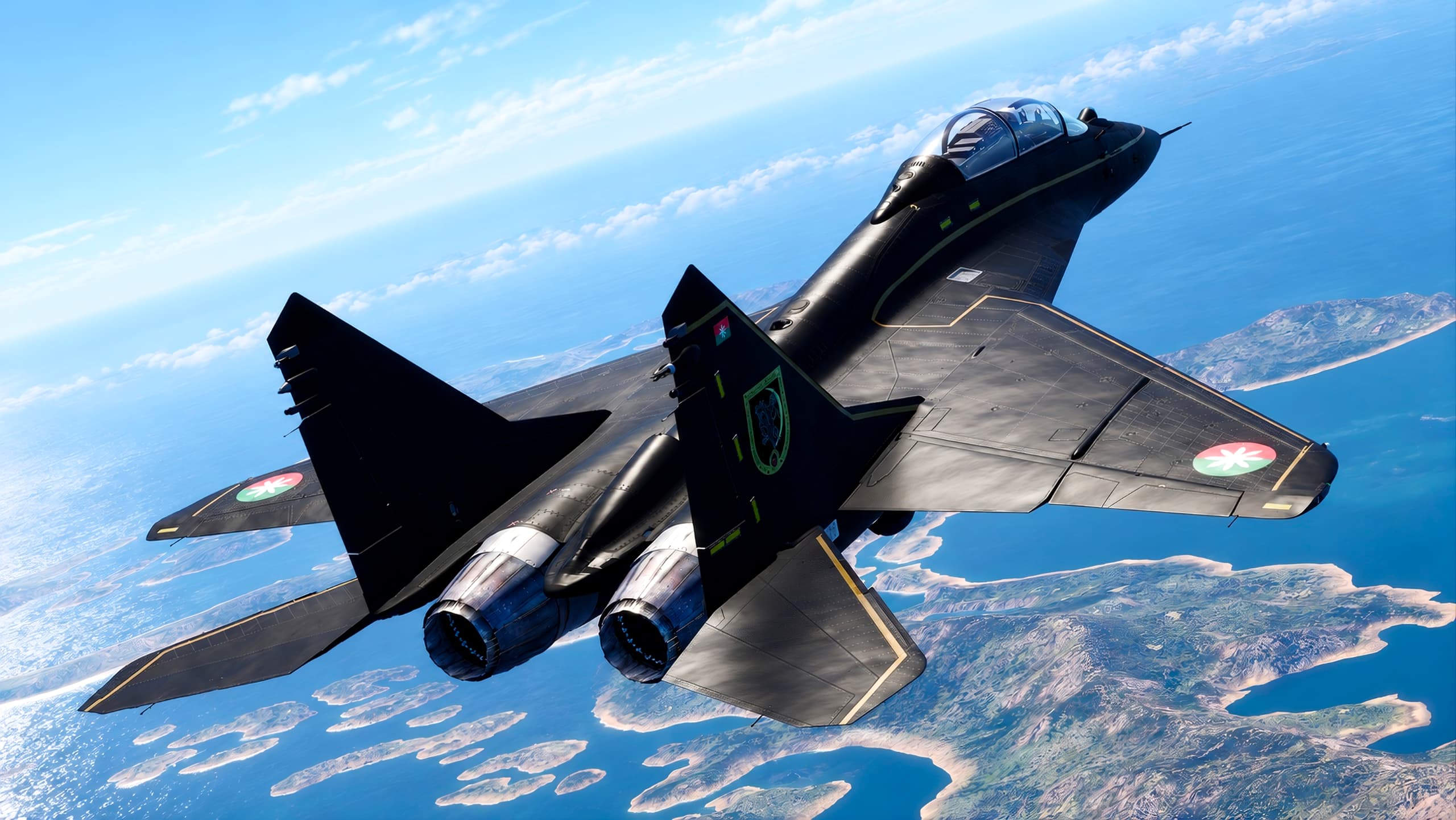
The main thing is the aerodynamic difference between the 9.15 and 9.41 airframes, and especially why the MiG-35S 9.41SR has more drag than the MiG-29KR 9.41R in the FM.
What I am more interested in is the airframe itself, mainly the fuselage polar and the Mach dependent drag.
Fuselage FM diff values
| Parameter | MiG-35S 9.41SR | MiG-29KR 9.41R | MiG-29M 9.15 |
|---|---|---|---|
| FuselagePlane.Areas.Main | 45 | 45 | 38 |
| FuselagePlane.Polar.CdMin | 0.0084 | 0.0082 | 0.0076 |
| MultMachMax1-7 | 3.10 / 1.15 / 0.80 / 0.80 / 1.20 / -0.20 / 1.00 | 3.10 / 1.15 / 0.80 / 0.80 / 1.20 / -0.20 / 1.00 | 2.80 / 1.15 / 0.80 / 0.80 / 1.20 / -0.20 / 1.00 |
For those who don’t know.
Areas.Main changes the aerodynamic reference area used for the fuselage. Higher area = the fuselage drag has a larger overall effect.
CdMin changes the base drag of the fuselage. Higher value = more drag even before the Mach effects kick in.
MultMachMax1 changes how strong the drag increase is around the transonic region. Higher value = stronger transonic drag rise. Change: 2.80 to 3.10: It makes the peak of the aerodynamic correction around Mach 1 higher, so the 9.41 gets a stronger transonic drag penalty.
So the 9.41 has more base drag, a larger effective fuselage area and a stronger transonic drag curve than the 9.15.
So it is not just one value. There are several changes in the FM that are increasing the fuselage drag contribution of the 9.41 compared with the MiG-29M 9.15 .
Obviously the 9.41 is a much better airframe at low speed and high AoA, and in game you can clearly feel that in a dogfight. But I do not think that automatically means it should also receive such a large high speed and medium to high altitude drag penalty.
Those are two different things.
The only real difference here is the base fuselage drag:
MiG-29KR 9.41R: CdMin = 0.0082
MiG-35S 9.41SR: CdMin = 0.0084
Even if it doesn’t look like much, changing this value even slightly has quite a noticeable effect because we’re dealing with very small values to begin with.
So what I would really like to know is what aerodynamic evidence supports the MiG-35 having more base fuselage drag than the MiG-29KR.
The MiG-35 does have external sensors and other installations which can obviously add some parasitic drag, but the MiG-29KR is also a naval aircraft with its own aerodynamic compromises.
Without actual aerodynamic data or performance data showing that the complete MiG-35 configuration has more drag, I do not think we should automatically assume that 0.0084 is correct just because the aircraft has additional external equipment.
There is also the engine difference between the MiG-29KR and MiG-35 for those who don’t know.
The KR receives the additional Mode 7 on its RD-33MK while the MiG-35 does not, giving the KR roughly 9% more available thrust .
The engine is therefore not the root of the investigation, but it amplifies the airframe difference.
Since the MiG-35 also uses the RD-33MK , this is particularly questionable because both aircraft use the RD-33MK . There is clear evidence that the MiG-35 uses this engine, while I have not seen public documentation demonstrating that the MiG-35 installation is specifically prevented from using the additional high power regime represented by Mode 7 in the KR FM.