Expand
Predecessor Programmes: a Short-Range Fighter, a Comet, a Baby, a Plaice, and the 302
The I-270 was the culmination of nearly half a decade of Soviet rocket-powered interceptor development.
The oldest definitive ancestor of the I-270 was the BI, Blizhnii Istrebitel “Close-Range Fighter”, also a reference to the names of the two primary designers, Aleksandr Bereznyak and Aleksei Isaev. This plywood-and-fabric aircraft may already be familiar to War Thunder players- extremely small and lightweight it was designed for point-defense of airfields and industrial complexes. The BI had unrivalled speed, acceleration, and climb rate as well as excellent maneuverability and was simple and cheap to manufacture, requiring little strategic material. Development of the BI started in early 1941 with glide testing starting in September 1941. In October, development was evacuated to the Urals. The BI’s RD-1-A-1100 motor was found to produce just over half the thrust it was required to, and the nitric acid used as an oxidizer was extremely volatile and dangerous. First powered flight would occur on 15th May 1942. This was the only powered flight of the BI-1 prototype; the airframe was found to have corrosion damage from the nitric acid and two more prototypes (the BI-2 and BI-3) were produced for further testing. At the same time, a pre-production batch of BI-VS (VS for Voyskovaya Seriya, “Service-Test Series”) were ordered into production. In addition to the 20mm cannons on the prototype BIs these aircraft would carry ten 2.5kg bombs, intended to be dropped on bomber formations. BI-3 would be lost on 27 March 1943, plunging into a lake during a test of maximum level speed. Transonic aerodynamics were not understood at the time, and it turns out the BI would experience extreme control surface compression upon nearing 800km/h. This catastrophe resulted in the cancellation of BI-VS production with the incomplete airframes destroyed. More airframes up to BI-9 were produced, but only for experimental purposes as the safety issues of the BI combined with its miniscule range and the disappearing threat of German bombers made it no longer desirable as a fighter.
To address the short range of the BI, a second rocket fighter was developed concurrently. Designated the 302, this aircraft would be considerably larger than the BI and would mount a more powerful rocket engine, in addition to a pair of ramjets for cruising flight. The 302 would be armed with four 20mm cannon, double that of the BI, as well as provisions for rockets and 250kg of bombs, an interesting choice to make such an aircraft a fighter-bomber. By early 1943 it became clear the the 302’s ramjets would not be ready for some time, and the aircraft was redesigned as the 302P (P for pererabotannyy, “reworked”) with smaller wings and only the rocket motor. Only this version would be constructed, with the sole prototype completed in October 1943. After many unpowered flights the 302P would make a single powered flight in late 1944. Without its ramjets, the 302P had a powered endurance of only 2.7 minutes- better than the BI, but still unacceptably low.
Another rocket fighter project at this time was the Polikarpov Izdeliye 51 Malyutka (“Baby”). Created by the designer of for example the Po-2, this aircraft was relatively similar in design to the 302P. It would never be built. However, for the aircraft a new dual-chamber RD-2M3V rocket engine was designed. This engine had a primary combustion chamber with a maximum thrust of 10.79kN and a smaller secondary chamber with a thrust of 2.94kN. Both chambers would be used for takeoff and climb, and then the primary chamber would be shut off for cruise and combat.
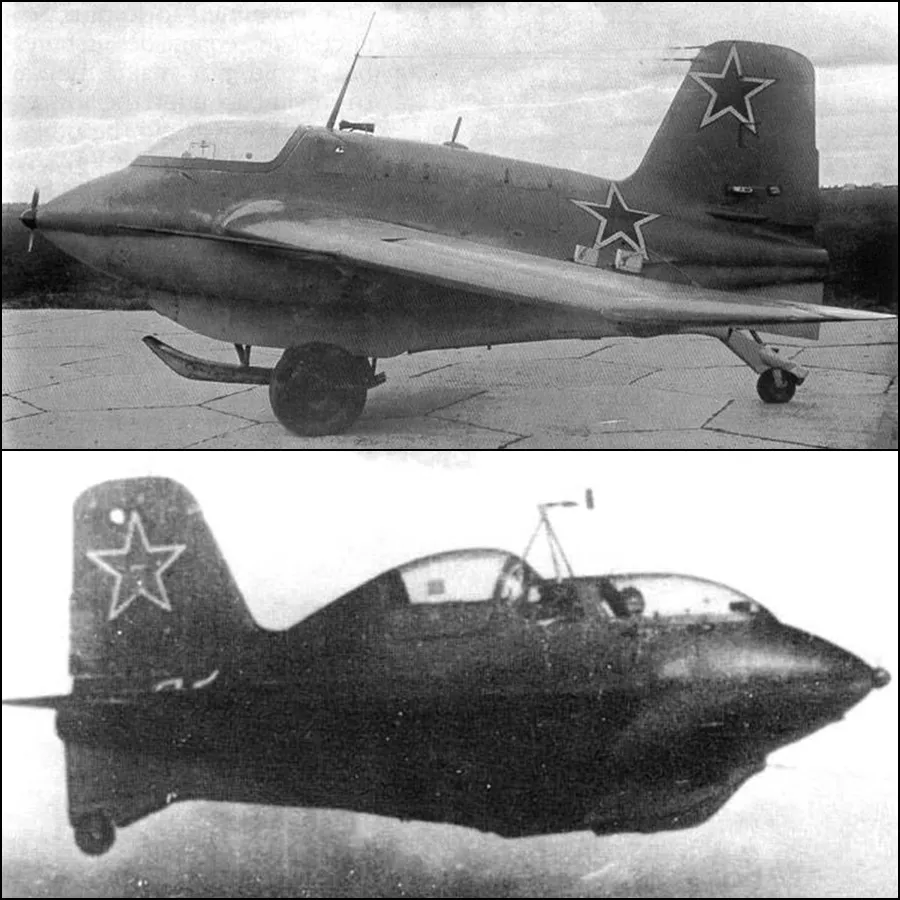
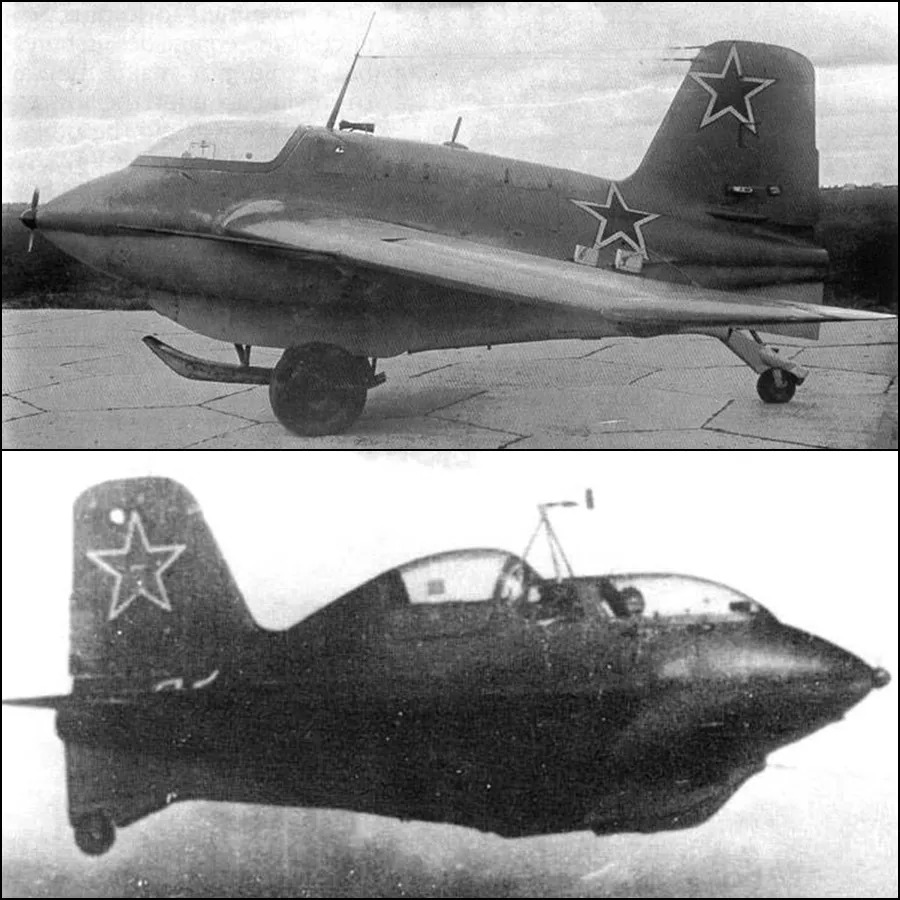
Now, the Soviets were not the only ones working on rocket-powered interceptors. The Germans also invested considerable development in the field. The Messerschmitt Me 163 Komet (“Comet”) was the first and only manned rocket-powered fighter to enter service, becoming operational in late 1944. With the rapid Soviet offensive in 1945, much German equipment would be captured. This included three Me 163Bs and seven Me 163Ss. These aircraft were carefully studied, tested, and disassembled. Also acquired in 1945 was one of the prototypes of the Me 263 Scholle (“Plaice”), an improved version of the Me 163, provided by the Americans.
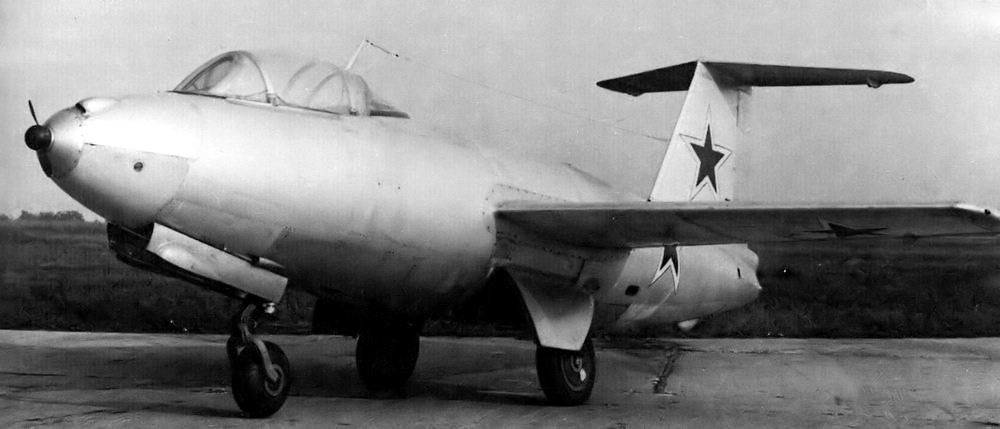
The 302P, the other other Soviet rocket fighter
The Soviets captured a number of Me 163Bs (top) and Me 163Ss (bottom)
Mikoyan’s Rocket
In November 1945, Artyom Mikoyan began development of a single-seat rocket-powered interceptor, building on the experience and technologies of the previous Russian and German rocket fighter experiments. The aircraft, designated the Izdeliye Zh, would have swept wings like the Me 163, use the RD-2M3V motor, and would be armed with 23mm canons. Based on the promise of this initial design, in February 1946 the NKAP issued a requirement for Mikoyan to develop an aircraft to be designated the I-270, a point-defense interceptor for the protection of industrial complexes and airfields. The I-270 was required to have a maximum speed of 1,100km/h at sea level and 1,000km/h at 10km altitude, 5 minute endurance at maximum thrust and an 18 minute endurance at minimum thrust, a climb time of 3.2 minute to the service ceiling of 17km, and an armament of twin 23mm cannon. The first prototype was expected in only 9 months. This last requirement would prove particularly troublesome. With limited experience in swept-wing design and a very tight deadline, Mikoyan had to redesign the I-270 with conventional straight wings.
A mockup of the I-270 was completed in May, and production of two prototypes was authorized. Flight performance of these prototypes was expected to fall somewhat short of requirements, with a maximum speed of 1,000km/h at sea level and 925km/h at 11km, with a time to service ceiling of 15km of 3 minutes. The I-270 was intended to be developed further with a new swept wing and more powerful, longer-endurance RD-2M3V variant, and armament was to be supplemented with eight small-calibre rockets.
The I-270 underwent numerous design changes as construction was already underway, so much so that the design wasn’t completely finalized until 2nd October 1946. This was less than a month before the prototype was expected to be complete. To make matters worse development resources for the I-270 were reallocated to the MiG-9. Naturally, it was impossible for the I-270 to be ready on time and the first prototype Zh-1 was completed on 28th December 1946.
The first prototype was found to weigh over 20% above specification, at 1,893kg empty mass instead of the design 1,564kg. As the RD-2M3V was still not flight-cleared, Zh-1 was fitted with a dummy motor for glide testing. The aircraft would be towed behind a Tu-2 for the first of 11 unpowered test flights on 3rd February 1947.
On 8th May, the second I-270 prototype Zh-2 would be completed and fitted with the RD-2M3V. Like the I-270 itself, the RD-2 was overweight, with a mass of 340kg compared to its design mass of 225kg. Flight testing was expected to begin in August, but during ground testing on 16th July the upper chamber of the RD-2M3V exploded, damaging the the Zh-2. After undergoing repairs the Zh-2 would make its first and only flight on 2nd September 1947, taking off under its own power for a seven-minute flight that showed no issues until the pilot overshot the airfield, resulting in a rough landing that damaged the aircraft but left the pilot unharmed. The aircraft was never repaired.
Because of the loss of the Zh-2, Zh-1 would be used for all further flight testing. It was fitted with a live motor in August and made its first powered flight on 4th October. After a 12-minute flight, the landing gear failed to deploy but the aircraft was successfully belly-landed with minimal damage to the airframe. The aircraft was repaired by January, but flight testing could not go forward due to the lack of cold-weather procedures for operating the RD-2M3V. In short, because of the dangers of nitric acid the RD-2 needed to be extensively flushed and washed with water before and after each flight. In the frigid conditions of the Russian Winter TM, this was unfeasible. The decision was made to shelve the I-270 programme until March.
In March, it was discovered that the Zh-1 had suffered corrosion damage during its time in storage. After repairs, the Zh-1 would make its last flight, an uneventful one, on 31st May 1948. By this time the I-310 was nearing completion and promised comparable speed and climb performance to the I-270 while having a much greater endurance and much higher safety and reliability. The I-270 was cancelled; I-320 would be standardized as the MiG-15.
The I-270 was doomed by a number of factors. The RD-2M3V was prone to explosions and could not be throttled nor restarted once shut off; the I-270 could not be used during the winter; its range was unacceptably low; airframe lifetime was very limited due to the corrosive nature of nitric acid; and the nitric acid oxidizer was dangerous and difficult to handle. The I-270’s role of point-defense would be filled by jet aircraft and especially by surface-to-air missiles starting in the 1950s.
Zh-1
Zh-2