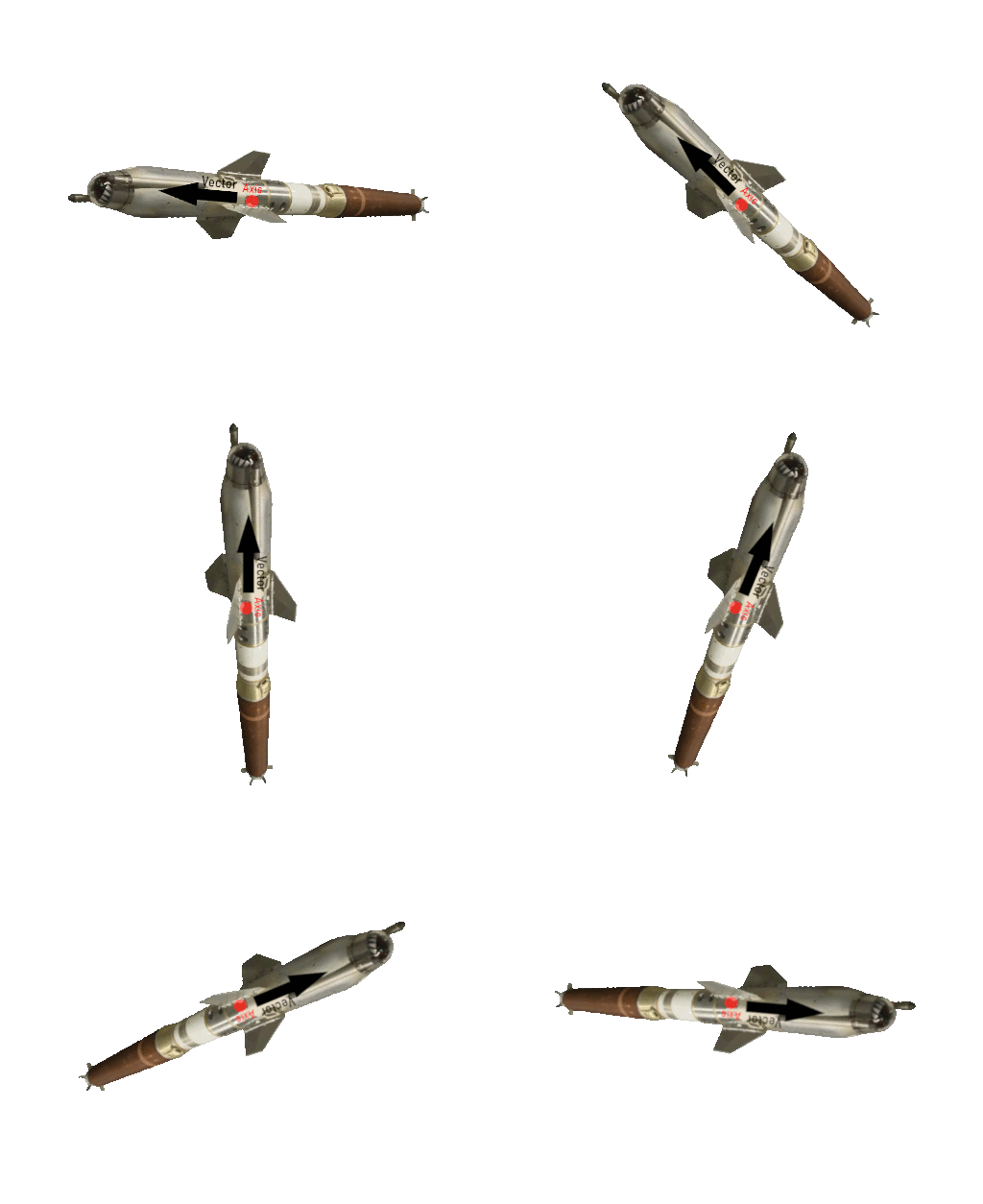
Pardon for the bump but it’s really disappointing not seeing a adequate counter for the initial case made here. I read through a crap ton knowing full well that if I could find a response it would have to be good like good good but I was sadly disappointed to find nothingburger into… more nothingburger. I did however learn something I’d like to share as I think many people here fail to understand the concept of a rolling airframe missile.
Here is a crude GIF I made to demonstrate since using your hands is kinda hard on the wrist lol.
Let’s assume 90 degrees rotation is the angle in which you intend to maneuver, in this image straight up.
The 2 rules of rolling airframe missiles is:
You are always rotating
Positive pitch>zero pitch>negative pitch
Assuming you start at 0 degrees(left in the image) maneuvering is initiated positive yaw is becoming positive pitch then positive pitch(+0-90 degrees/left to up) is becoming negative yaw(+90-180 degrees/up to right) and diminishing positive pitch.
Naturally this means that there is little point in deflecting the fins before +180 degrees(right) because then all you’ve accomplished is turning diminishing positive pitch with negative yaw into diminishing negative pitch(breaking rule 2.) with positive yaw. Yaw only helps you maneuver if its contributing to positive pitch, otherwise it isn’t useful at all. This means in order to generate maximum pitch(maneuver) you deflect the fins in the opposite direction at around +180 degrees(right) and this again creates positive yaw(0 degrees/left) which instantly will contribute to positive pitch(+0-90 degrees/left to up).
There is a few ways to understand it but it’s basically repeating the same 180 degree loop using the fins, you may spin 360 degrees but as long as you pitch for the same 180 you are maximizing your maneuvering.
From the sole perspective of maneuvering RAM missiles achieve maximum maneuverability using a Bang-Bang control input, this is good because cheap missiles will maneuver just as quickly(max g) as ones that use PID controllers. The downside however is that those PID controllers allow for more efficient maneuvering that reduces drag and thus allows for a longer range and higher speeds. Technically it increases accuracy as well but not noticeably if the missile already has the velocity needed for any given target.
In short: The technical mods are 100% correct and I don’t think many of the people trying to prove them wrong actually understand what they are trying to disprove in the first place.
If anyone has a better argument against this I would genuinely like to hear it but so far it’s been a whole lot of nothingburger and honestly a real eye sore to read.
This argument works under the assumption that a rolling airframe missile is aerodynamically stable and corrects back to neutral/zero angle of attack attitude without active control input. The Stinger and Mistral switched from an open to a closed loop control circuit, which makes an aerodynamically unstable design possible. That allows the missile to retain angle of attack (AoA) for the full revolution, with the control surfaces first kicking it into a high AoA to initiate the turn, and then only performing fairly minor inputs to stabilise the missile’s attitude, until the turn is ready to be terminated, at which point they actively have to turn the missile back into a zero AoA attitude.
The report @Zannafrancy linked you to explains this in more detail, but is fairly dense due to the character limit.
The thread is sadly flooded with garbage, so any productive discussion got drowned out.
Them being aerodynamically unstable is the actual reason they use PID. If bang bang were just as good as PID controlled missiles (aside from slightly better range - which btw mistral has a lower usable range than IGLA in game), then no one would use it.
Yes, though you need both variable incidence control surfaces and a closed loop guidance scheme to control an aerodynamically unstable missile. People were quick to point out that the Stinger uses PID controlled control surfaces, but it took a while for anyone to find the other half of the basis for how the Stinger manages to turn even when the control surfaces are at a 90° angle to the intended direction of turn.
That shouldnt have needed to happen, the context of the original documents was clearly insofar as capability to pull, gaijin rejecting it on the basis of their belief shouldnt have happened its terrible precedent for the game.
Its good conversation, not good precedent for the game, gaijin rejecting what sources in favour of their own beliefs, its not sustainable to need this degree of research and evidence for a game as large as war thunder. If we sturt distrusting primary and secondary sources then the game is cooked.
I don’t know, I don’t find the assumption that the difference between maximum overload in the maneuvering plane and average overload exists for all rolling airframe missiles to be unreasonable. It took quite a while for someone to figure out that this difference just doesn’t exist for Stinger/Mistral, so it’s not like they overlooked basic information. And if you work from that understanding of rolling airframe missiles, a 22 G overload seems extremely unreasonable, as that’d mean a ~35 G peak overload in the maneuvering plane.
They gave us a good explanation for their reasoning too, which is nice. And allows to actually engage with their argument. The problem is that they haven’t reacted at all to getting proven wrong.
Keep in mind were already in the territory of heavily classified information and no matter how we swing it we are working with the substandard tools for the task.
You know this makes a lot of sense when you consider how instability plays out, excellent explanation.
If anything is certain I would reckon the Stinger would be capable of much quicker and tighter turns but if that kind of thing happening at peak airspeed seems like it’d obliterate the missile itself owing to the fact its spinning on top of peak G load.
Buffing them doesn’t bring you anything good because those AAs will then fight better CAS, considering such a significant buff would make them skyrocket in BR.
strela is 10.3 it is still better than a buffed stinger at taking out aircraft as its harder to flare and has longer lock range and range overall. lav wouldnt go up as stingers are useless against 10.3 aircraft that arent blind. this is it.
Strela is basically a bathtub that has missiles strapped to it. If Stingers received all of their buffs they would definitely be on par, which would put them way higher up than Strela because of other things they have.
Thinking that LAV-AD wouldn’t go up after the buff is ridiculously delusional.
No problem, but thanks should mainly go to the guy that figured it out and wrote the bug report. I was on the same page as you until that point. Take a look at the patent from the report, it has some nice graphs on what the control surfaces actually do and what overload that results in.
I don’t care too much, but if they want to do that they should just say that they’re keeping it nerfed for gameplay purposes. The entire point of this thread was to provide an explanation of why they think their interpretation of the data is the realistic one, and it turns out it just isn’t.
In terms of gameplay impact, it’d really only hurt the Ozelot and Gepard 1A2, I think. And personally, I’m not much of a fan of low BR fire and forget SAMs in the first place. The LAV-AD would probably have to go up a bit, but the main US lineup is 10.7 anyways. And the helicopters would really benefit from having anti air missiles that are decent, the Stinger completely falls off a cliff at top tier.
i dont think you have put the slightest bit of thought into what youre saying lmao, the lavad is at the tier it is because of its Anti Tank capability, against aircraft its wholly outmatched but just about every other anti air at the br, if stingers got fixed it would just mean its better against aircraft which would do absolutely nothing to make it go up in br because its perfectly in line with other systems, and again the strela would be better because it has both more lock range and better flare resistance.