- Yes
- No
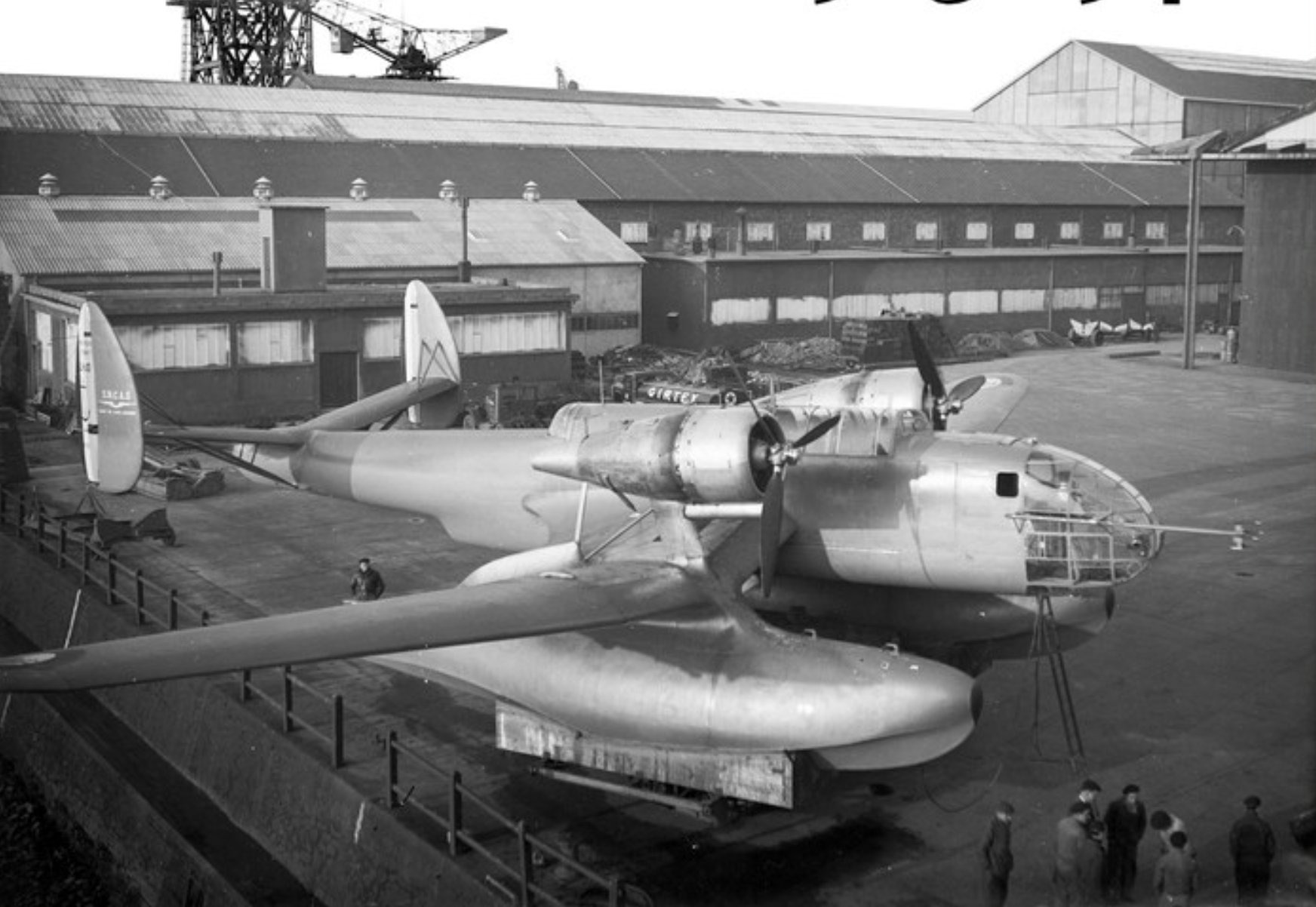
Loire Nieuport LN 10
History
Spoiler
The Loire Nieuport LN 10 originated from the MT-CPT 9 seaplane program in 1935. Adapted to the aviation policies and tactical doctrines of the era, this program aimed to create a twin-float seaplane capable of performing multiple types of missions while ensuring its own defense. This is a perfect example of applying the famous “BCR” dogma — a program requiring the same aircraft to perform often conflicting missions, posing obviously complex aerodynamic and layout problems for manufacturers. These manufacturers were then forced to find a compromise that gave birth to an “average” aircraft — not optimal in any of its roles. Two years later, in March 1937, when no prototype had yet been actually built, and after nationalization, the MT-CPT 9 program was slightly modified at the required performance. The aircraft resulting from these new standards were then designated “combat reconnaissance.” The Loire factory in Saint-Nazaire was nationalized on January 16, 1937, and integrated into SNCACO, which decided to abandon the original Loire 240 project in favor of a more evolved LN 10.
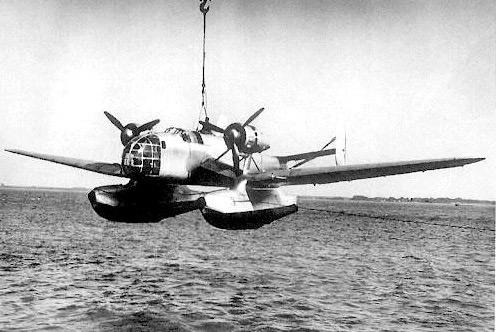
The construction of the LN 10-01 was completed in April 1939, but due to the long and delicate development of the Gnome & Rhône engines, delivery had to be awaited until June of the same year for the prototype to make its first flight. This took place on July 21, 1939, taking off from the estuary of the Loire. On December 10th, the Ministry of Air informed the manufacturers that the Admiralty had decided to abandon the MT-CPT 9 torpedo seaplane program, choosing to use only land-based aircraft for this role, specifically a modified version of the LéO 451. Having made their decision, the Navy ordered the three competing aircraft—LN 10, NC 410, and MB 480—to proceed to the Saint-Raphaël test center to undergo various operational tests. On June 10, it reached Hourtin in 25 minutes of flight for a series of official certifications, and remained at Hourtin until the end of the month, then was deliberately sunk to evade the invader, after a short life of approximately 150 hours of flight.
Technical data
Structure
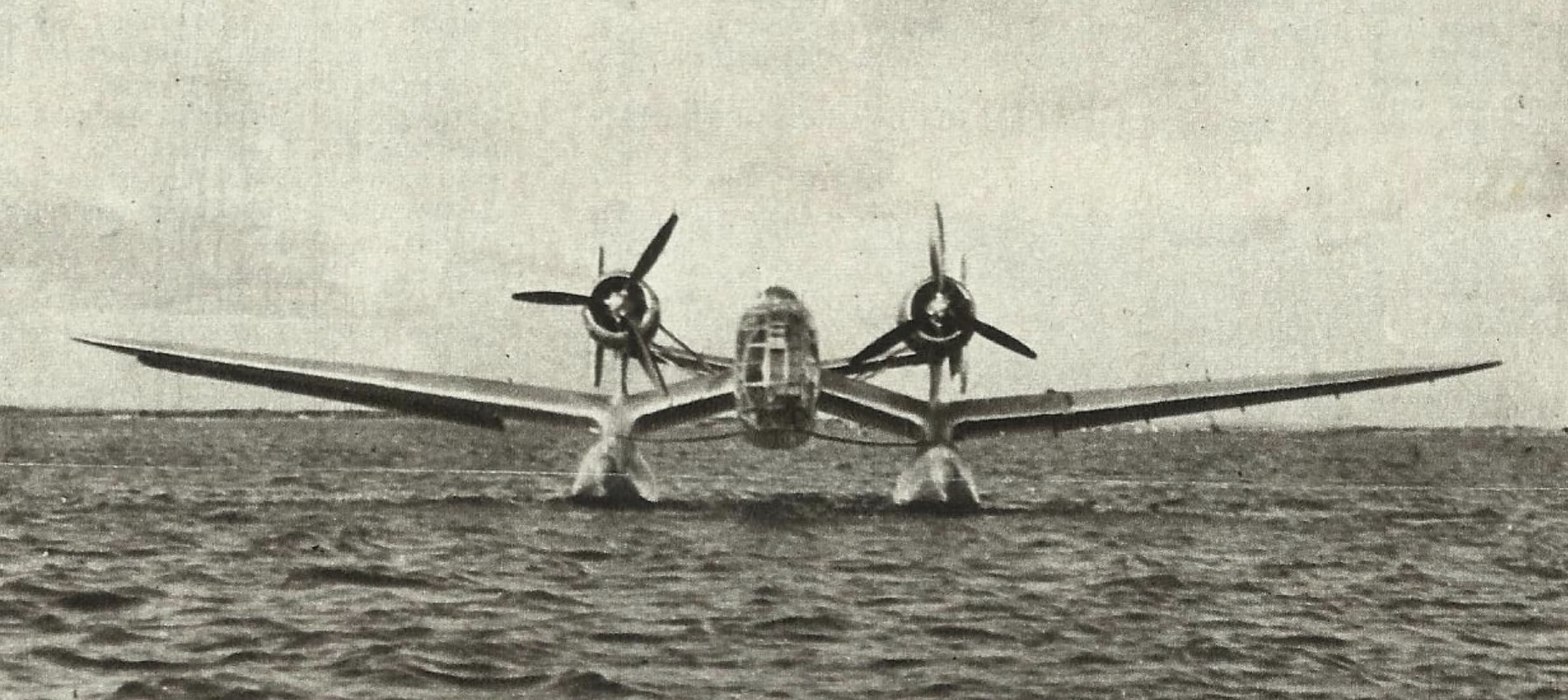
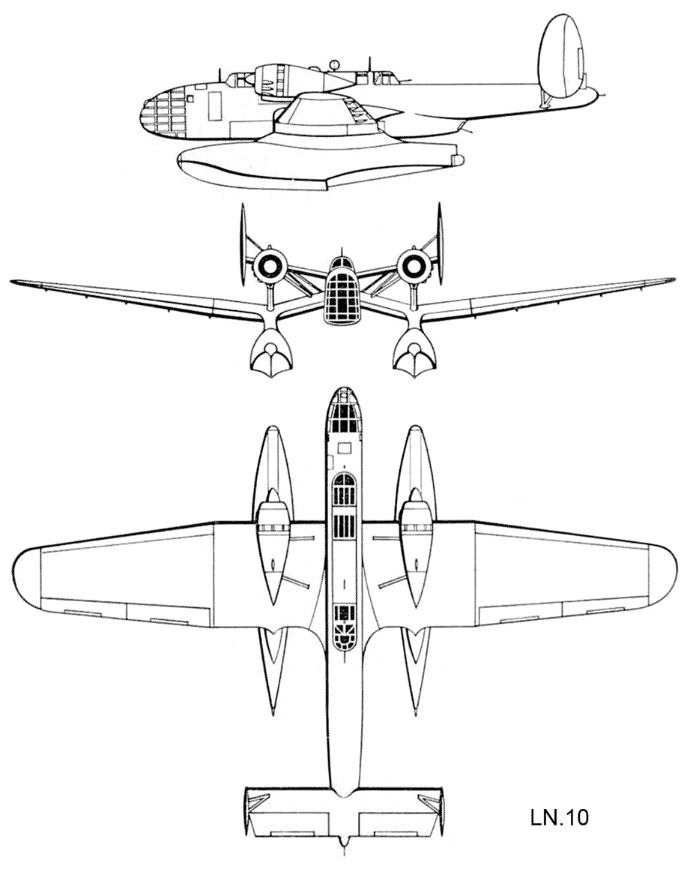
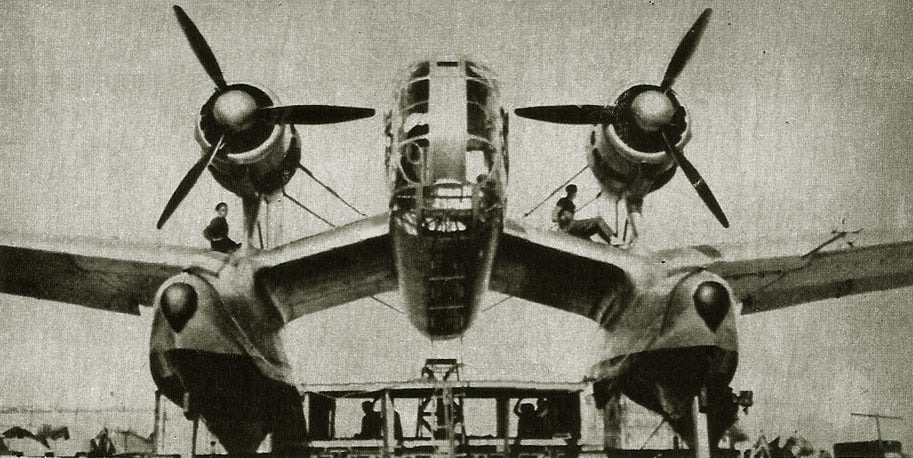
The Loire Nieuport LN 10 is a twin-engine float seaplane featuring cantilever wings and a large-volume fuselage, incorporating a torpedo and bomb bay such that all these weapons remain constantly faired. Its W-shape wings allow the floats to be directly connected to the wing and lowering the aircraft’s center of gravity on the water.
The fuselage, with a flattened oval cross-section, is built in five sections. The forward section is made of plexiglass and steel tubing and houses the commander/bombardier station. This station is spacious and extensively glazed, featuring observation windows in both the floor and ceiling, skids for mounting one or two 7.5 mm Darne machine guns, and an Alkan TA-35 bombsight.
The central section consists of four duralumin longerons, pinewood frames, and reinforced duralumin skin. It contains a tandem two-seat cockpit equipped with a Jaeger-Smith autopilot, followed by a radio station with a Bronzavia M 150A set, a Sadir 512 HF station, and an LMT RC5B radio compass compartment. Beneath the floor of this central section is the bomb and torpedo bay, closed by two hydraulically operated doors.
The rear section is assembled from two half-shells joined by two rows of rivets, housing the mechanic’s position, a three-berth crew rest area, a lower firing position with a 7.5 mm Darne machine gun on a BP-20 mobile mount, and an upper Samm AB-15 turret armed with a 20 mm HS404 cannon. This is followed by a duralumin box structure supporting the tail surfaces, and finally a purely fairing tail cone.
The W-shape wing is entirely metallic with two I-shape spars. Engines and floats are mounted on two central rectangular V-shape sections, each containing a 2,175-liter fuel tank. Beyond the floats, there are two straight trapezoidal sections whose structure forms integrated tanks of 1,000 liters per wing. The Y-shaped ribs are made from the same pine profiles as the leading and trailing edges, and the skin is reinforced duralumin sheet. Behind the forward spar, within the wing’s thickness, a tunnel provides access to the engines from the fuselage.
The highly developed high-lift devices include: flaperons formed by four coupled segments, with metal structure and fabric covering, statically balanced, equipped with automatic flaps, serving both for camber change and as slotted flaps (limited to 15° deflection); inner flaps, located between the flaperons and the floats, are metallic and divided into four elements, deflecting up to a maximum of 25°; finally, eight-element slotted leading-edge slats run along the leading edges of the outer wing sections, actuated via mechanical linkage and hydraulic rams. The empennage is of a metallic cantilever construction.
Powerplant
The Powerplant of Loire Nieuport LN 10 is two Gnome et Rhône 14 R 00/01 engines with two-speed superchargers. These engines receive a NACA cowling with adjustable exhaust flaps in flight, BG type 14C magnetos, a Bronzavia 140 carburetor, and two oil tanks of 140 liters each. The propellers are Ratier metallic three-bladed constant-speed propellers with electrically controlled pitch variation, 4 meters in diameter.
Technical data
Specifications
Wingspan: 27 m
Length: 18.10 m
Height: 6.70 m
Wing area: 90 m²
Empty weight: 9970 kg
Gross weight: 13950 kg
Overload: 2000 kg
Maximum speed at sea level: 338 km/h
Speed at 1,500 m: 350 km/h
Speed at 5,000 m: 400 km/h
Rate of climb: 5.5 m/s
Powerplant: 2 x Gnome et Rhône 14 R 00/01
950 mm Hg, 2400 rpm:
1250 metric horsepower at S.L.
1300 metric horsepower at 1300m
1150 metric horsepower at 4500m
1000 mm Hg, 2450 rpm:
1300 metric horsepower at S.L.
1440 metric horsepower at 2200m
Armament
Defensive weapons:
- Two retractable Darne 7.5 mm machine guns at the front
- One Hispano-Suiza HS404 20 mm cannon in a dorsal turret
- Two Darne 7.5 mm machine guns in lower positions
Suspended weapons:
- 5 × 235 kg Type K bombs
- or 3 × 410 kg Type L bombs;
- or 2 × 670 kg 1926 DA torpedoes;
- or 1 × 1300 kg large-caliber (500 mm) torpedo;
- or 15 × 75 kg Type G2 bombs.
Images
Spoiler
Sources
Spoiler
Aviation Magazine n°742
Les derniers moteurs Gnome & Rhône par Alain Breton
GNOME-RHONE MOTEURS 14M/14S/14P/14R/18L/18R