This material and russian modern armour in general is a contentious topic. I hope I can share some inconsistencies i’ve noticed with the textolite based armours of russian tanks.
This year T-64A had its armour corrected based on a document displaying its armour protection, and importantly, weight efficiency metrics for its armour.
Spoiler
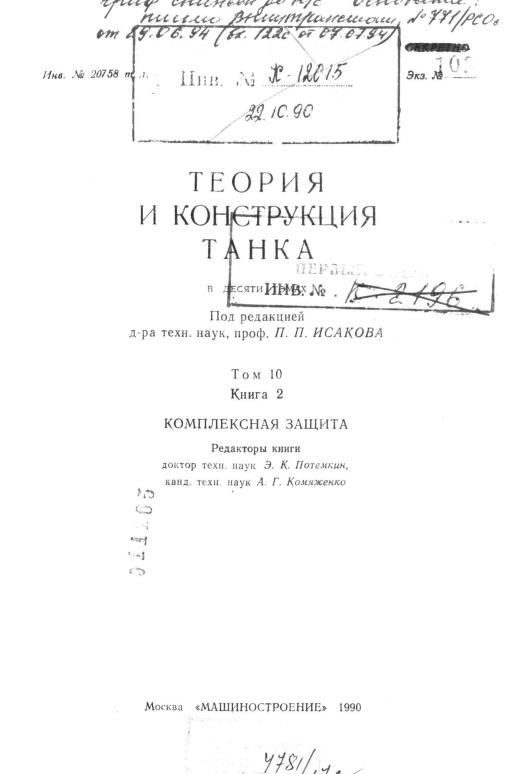

There are two important things we can acertain from this document.
Firstly, the effective line of sight thickness of the armour is 305mm against kinetic projectiles. Additionally, for the same armour array mass, the protection offered against kinetic projectiles would be 335mm, this is important, it tells us the textolite has a mass efficiency less than 1. The composite array has a total mass efficiency of 0.91(rounded to 0.9, derived from 305/335).
We can work out three things from this data.
Firstly, the kinetic modifier for the textolite: Y
Secondly, the thickness of steel that is added with the same weight as 105mm of textolite: T
Lastly, the density of Textolite.
To do this we can construct some equations:
2.67(100X + 105Y) = 305mm
2.67(100X + TX) = 335mm
Where X = 1 (making all values relative to RHa)
2.67 comes from the gain in path length thickness due to the 68 degree slope angle.
We can solve for T and Y as 0.1355 and 25.47mm respectively.
This tells us that Textolite in this armour array is 0.1355* as effective as RHa for the same thickness.
And that 25.47mm of RHa is the same MASS as 105mm of Textolite, since density = mass/volume.
Mass = density * volume.
Where volume is area * thickness, density will be equal to the ratio’s of thicknesses, for the same area.
This means the density of textolite, assuming an RHa density of 7850kg/m^3 is 1880kg/m^3.
A density ratio of 0.242, and a kinetic ratio of 0.1355, we can see that Textolite in this array is less efficient per unit mass than standard RHa, with a mass efficiency of 0.56.
The issue is other tanks in game use this same Textolite material, and although the arrays differ by varying degrees. Textolite can be found to vary hugely in terms of kinetic efficiency and thus mass efficiency in game.
Take the T-80U tank.
Since textolite is used in each vehicle it’s material properties will be the same, we can assume the same density of 1880kg/m^3.
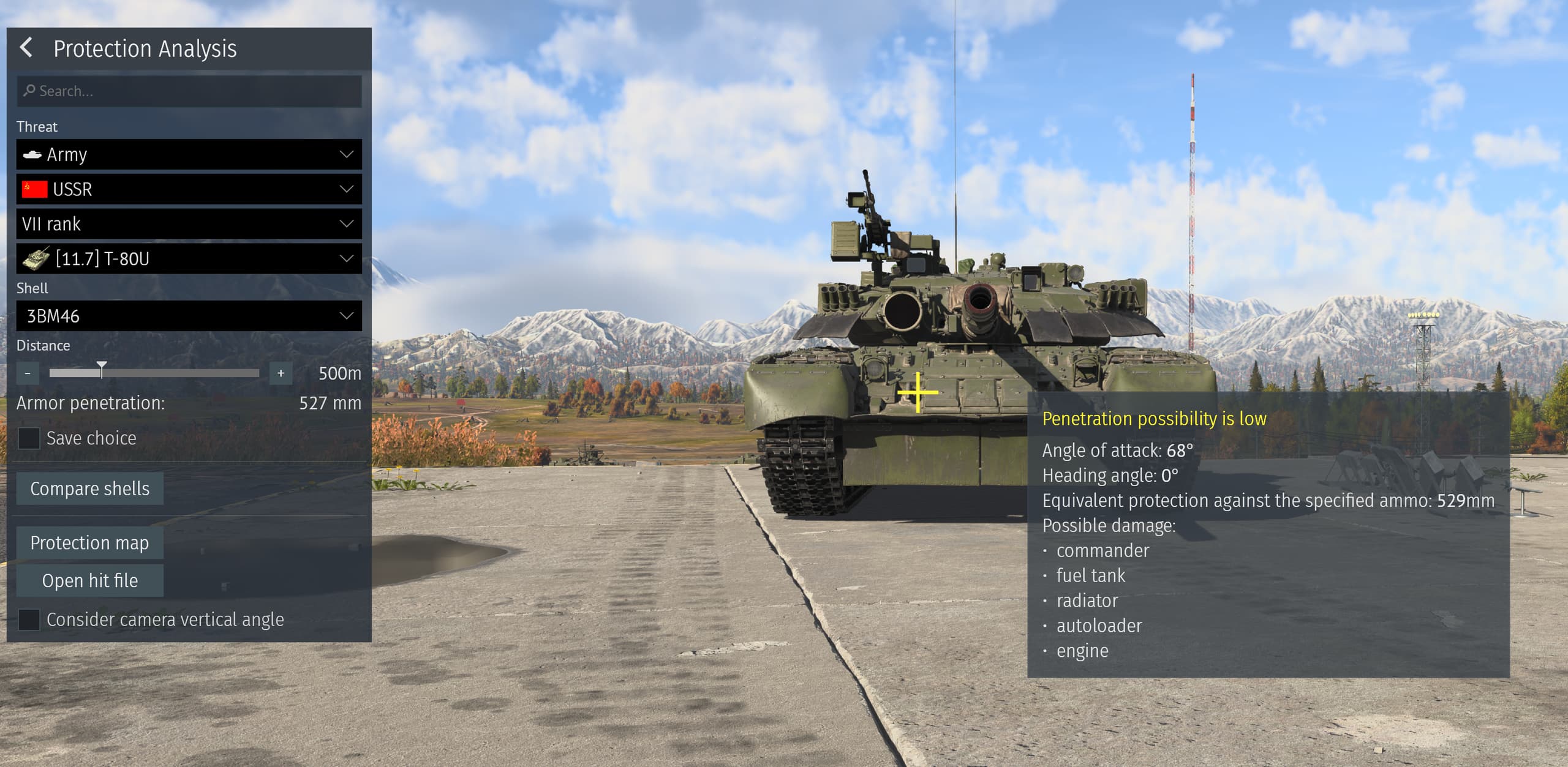
The armour array for T-80U is different, and can be evaluated using the same method:
530mm is the 0° kinetic protection I found in game. Therefore we must use the slope modifier for APFSDS at 68 degrees, which is approxmitely 1.173. Meaning the line of sight thickness of armour at 68 degrees is reduced by a factor of 1.17.
2.67(150X + 60Y)/1.173 = 530mm
Where X = 1.2 for High Hardness Armour.
Thus Y can be found via (530 x 1.173/2.67 - 150 x 1.2)/60 giving: 0.88
For T-80U in game, textolite is nearly as effective against kinetic threats as basic RHa.
This gives a mass efficiency of 0.88/0.242, which is 3.63…
In this new array using the same materials, T-80U’s textolite has gone from being less mass efficient than RHa to over 3.6x more efficient!
I can understand the use of complex arrays will create differences in the textolites performance between armour arrays, however a difference of 540% using the same exact material is so surely a red flag?
Lets take the T-64B tank.
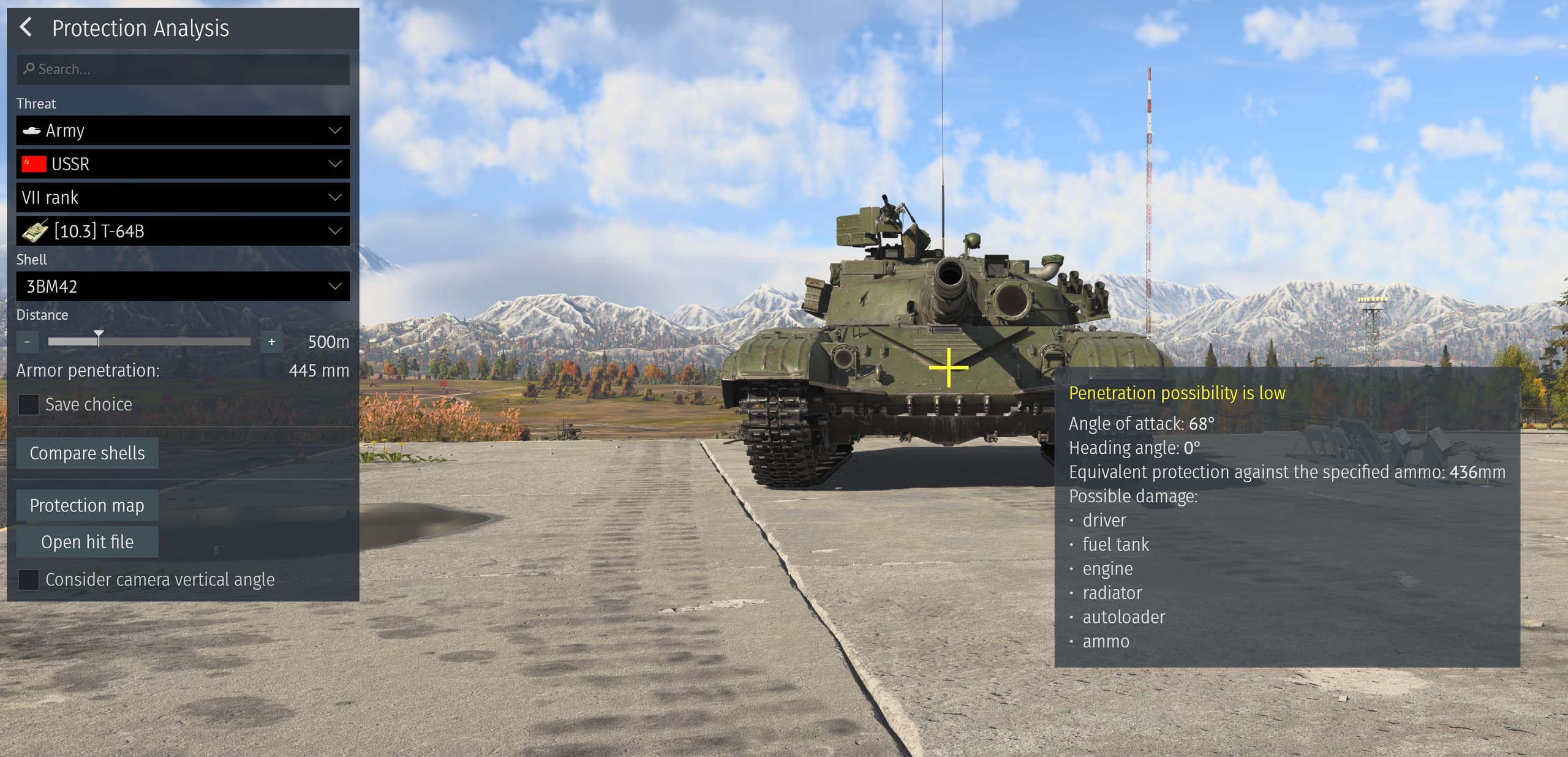
The armour array for T-64A is also different, and can be evaluated using the same method:
433mm is the 0° kinetic protection I found in game. Therefore we must use the slope modifier for APFSDS at 68 degrees, which is approximately 1.173. Meaning the line of sight thickness of armour at 68 degrees is reduced by a factor of 1.17.
2.67(135X + 70Y)/1.173 = 433mm
Where X = 1 for Rolled Homogenous Armour.
Thus Y can be found via (433 x 1.173/2.67 - 135 x 1)/70 giving: 0.789
For T-64B in game, textolite is nearly as effective against kinetic threats as basic RHa.
This gives a mass efficiency of 0.789/0.242, which is 3.26…
In this new array using the same materials, T-64B’s textolite has gone from being less mass efficient than RHa to over 3.2x more efficient! Another 480% increase over the capabilites of textolite in T-64A!
Once again the difference between the T-64B and T-80U’s mass efficiency can be explained by the differences in armour array design. However both are massively higher than a sourced value from the T-64A, and it is this difference that cannot be explained by differences in armour array arrangement.
I think this suggests these vehicles should have their armour arrays re-evaluated by the developers to ensure correct sources are used for the armour values produced in game, because the current protection values offered by textolite on specific vehicles are not possible from a materials and physics perspective, which the developers have shown they are willing to consider in their recent M1A2 SepV3 dev blog.
Fin.
