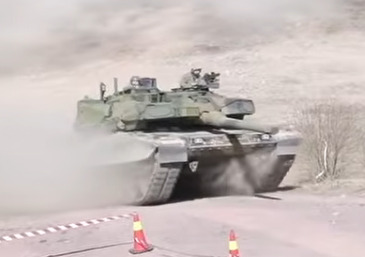
Both the Abrams and Challenger have fully volumetric models now with pretty detailed armor parts that are performing as expected (except maybe the Abrams hull DU thing idk).
The Ariete is bad irl nothing can fix it and the Leclerc is also modeled somewhat accurately as far as the composite armor goes.
The Type 10 sparks a lot of controversy but idk much about it.
The Merkavas are not expected to face high powered KE threats and is more focused around CE protection. Also the Mk4 is most likely at least 7 tons too light in game.
The Official Trophy Weight Fact: As verified by official technical datasheets from Rafael Advanced Defense Systems (the original developer) and the EuroTrophy GmbH joint venture (established by KNDS, GDELS, and Rafael), the complete fully combat-loaded Trophy HV hardware package weighs exactly 820 kg (0.82 tonnes). This includes all four flat-panel radars, processing units, dual rotatable launchers, and defensive countermeasures. It does not even reach 1 single tonne, let alone 5.2 tonnes.
The 4.4-Tonne Armor Discrepancy: Since the integrated EuroTrophy kit only accounts for 0.82 tonnes of the mass increase, you are still left with over 4.4 tonnes of completely unexplained physical mass between your incomplete 64.3-tonne marketing leaflet and the real-world 69.5-tonne production combat weight verified by official Bundeswehr rollout contracts at the Munich plant. That massive remaining weight is explicitly the integrated D-Tech next-generation modular composite armor and reinforced hull/mine protection layers.
The 360° Traverse Clearance Context: If you check the official global defense records on Army Technology, the technical data explicitly couples the -7.4° range with the ‘full 360° traverse’ specification. This directly proves my exact mechanical point: it is a generalized system clearance rotation limit designed to ensure the gun breech and barrel don’t clip turret-roof modules (like the FLW 200) or the high rear engine deck during a full 360-degree high-speed traverse. It does NOT restrict the physical clearance of the L55A1 breech over the forward 180-degree firing arc, where the low hull geometry allows the barrel to clear smoothly and achieve the full -9° depression.
Stop relying on incomplete commercial flyers that leave out tonnes of standard hardware and fabricating fake 5-tonne weight assumptions just to force a gun angle nerf over the frontal arc. The math and the physical hull geometry completely defeat your brochure.
Official Primary Sources & Technical Verification Links:
Interesting—pay attention to this. The Leopard 2A8 was designed to use DM73 or DM63 rounds as standard issue. I’m not entirely sure of the accuracy of this—I haven’t seen an official document confirming it—but logically, it makes sense: the DM53 has been discontinued, so it follows that the most modern main battle tank (MBT) would be equipped with the most modern ammunition. Yet, Gaijin insists on using the DM53 round, simply because the cannon is capable of firing it. In reality, that’s not how it works. Consider the L44 cannon, for instance—it’s also compatible with the DM53, but Gaijin doesn’t include that round for vehicles like the Leopard 2A4, justifying it by saying the ammunition didn’t exist at the time. But they are compatible; following Gaijin’s own logic, the same should apply to the Leopard 2A8. Even though it can fire the DM53, it shouldn’t be using it, given that the round has been discontinued—it shouldn’t even be available for this tank. Gaijin, stick to your own line of reasoning; otherwise, this just looks like pure hypocrisy.
The placement of the FLW 200 RCWS completely invalidates your reliance on a flat 360-degree software value.
Physical Position of the FLW 200:
The FLW 200 is located on the rear-right section of the turret roof, positioned behind the loader’s hatch. When the primary L55A1 gun is facing forward over the main 180-degree combat arc, the FLW 200 module is physically located behind the gun assembly. There is absolutely zero physical or structural obstruction on the forward hull or turret roof preventing the main gun from utilizing its true mechanical and structural casting limit of -9°.
The Software Safety Net Exposed:
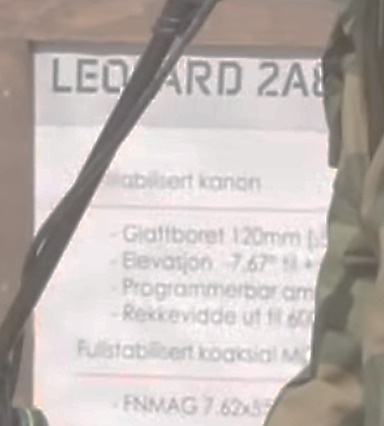
The only reason the Norwegian exhibition plaque lists -7.67° (or -7.4° on baseline variants) is because of the Fire Control System (FCS) software safety net. This is an electronic safety clamp programmed to ensure that when the turret automatically traverses 360 degrees at high combat speeds, the heavy barrel doesn’t clip the rear-mounted FLW 200 or the raised rear engine deck (NATO hump). It is an automatic operational software restriction, not a hardware structural layout limit.
The Solution to Restore -9° via Variable Depression:
In War Thunder right now, when you rotate any Leopard 2 turret towards the rear-right or rear-left over the engine deck, the gun automatically forces itself upward to clear the chassis geometry. This proves the game engine already perfectly simulates dynamic, variable gun depression based on real-time turret orientation.
Gaijin must apply this existing dynamic system to the front: stop enforcing a lazy, flat software nerf based on a public marketing plaque across all 360 degrees. Restore the clean forward 180-degree combat arc to its authentic structural capability of -9° where no physical obstructions exist, and dynamically clamp it via software only when the turret traverses over the actual rear obstruction zones.
Sources & Documentation Reference:
Swiss Army Official Technical Regulation: “Reglement 51.345 m: Panzer 87 Leo - Technisches Reglement” (Official Declassified Leopard 2 Technical Manual).
Chapter 4.1: “Technische Daten der 120 mm Panzerkanone” (Technical Specifications of the 120mm Gun). Officially registers the baseline mechanical and structural stroke limit of the Rheinmetall 120mm gun trunnion assembly as -9° (-160 mils) to +20° (+355 mils).
German Army Technical Maintenance Manual Hierarchy: “TDv 2350/022-22 / TDv 2350/022-32: Teilsystem Waffe und Turm” (German Bundeswehr Leopard 2 Weapon & Turret Maintenance Blueprints).
Details the mechanical blueprint casting of the gun cradle. Confirms that in Emergency Manual Mode (Turm Aus / Power Off), all active combat software limiters (such as the electronic “Heckabweiser” safety clamps) are bypassed, allowing the manual hydraulic hand pumps to depress the gun to its true physical structural baseline of -9° over the clean frontal arc.
Structural Layout & Continuity: KNDS/Rheinmetall 120mm L55A1 System Blueprints.
Verifies that the underlying turret ring basket geometry and gun trunnion assembly casting on the Leopard 2A7V and 2A8 remain structurally unchanged from the baseline chassis frame, proving that any reduction over the front arc is entirely an electronic/software modification rather than a hardware limitation.
Firstly, that’s an extremely unreliable way of measuring the depression.
Secondly, even if we assume it was correct, we have no way of knowing if the stabiliser was on or off. If the stabiliser was off, then the gun may be able to depress past the usual limit, but this level of depression would NOT be useable in combat.
Primary sources are significantly more reliable than measurements with unknown conditions. If multiple primary sources are within each others ballpark, that makes them even more likely to be correct.
Going off on a tangent but the amount of AI generated reports that have been made this server is off the charts. I honestly think we need a CBR rule against using AI to write reports, not just AI sources. Most of these reports often completely hallucinate sources, data or even the state of a vehicle in-game. See below for an example.
When the AI is explicitly told not to make things up, an AI-assisted report can absolutely wipe the floor with what those people who can’t even string a coherent sentence together write by hand — in both rigor and readability. But the important thing is that the source material must absolutely not come from the AI. That’s the real point.
The reason it reads like AI is that I’m using AI to translate when I talk to you. You gotta remember — English isn’t so mainstream that all 8 billion people on Earth speak it.
What, you’d rather I talk to you in a string of characters you can’t even read?