- Yes
- No
Hello everyone, and welcome to this new suggestion.
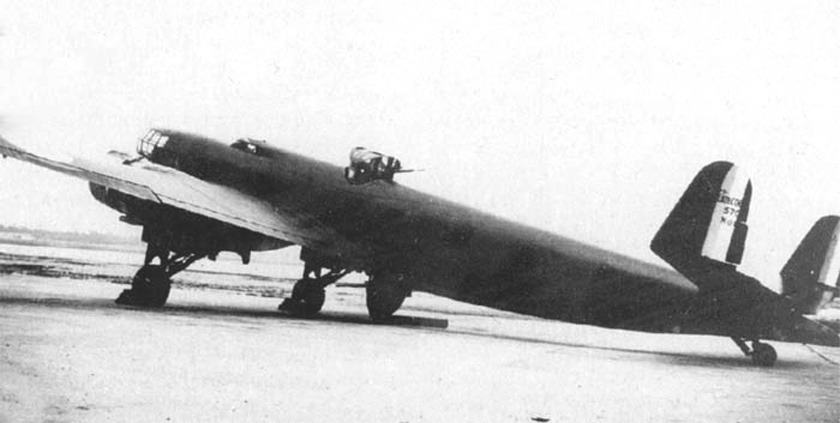
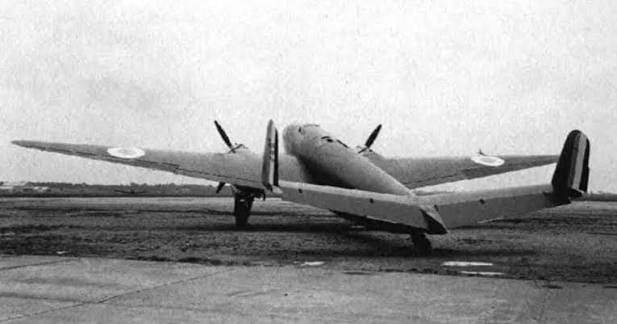
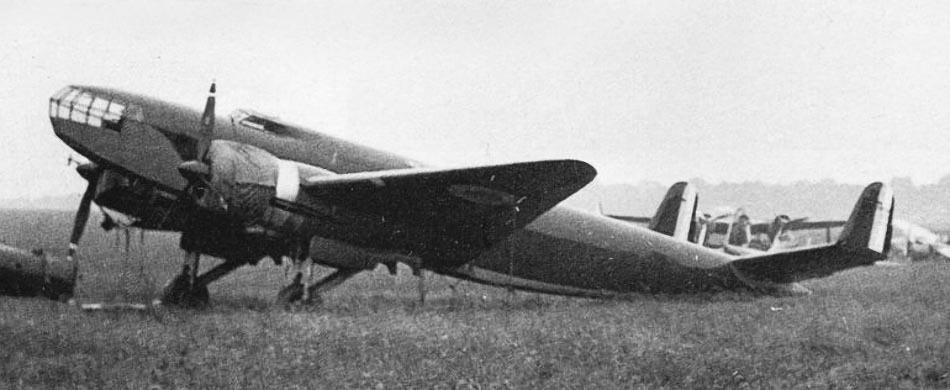
Today, I am presenting a new French interwar bomber prototype: the Latécoère 570.
In November 1934, the French Air Force issued a requirement for a new medium bomber with a crew of four, intended to modernize and complement its existing bomber fleet. The competition attracted many of France’s leading aircraft manufacturers, including Latécoère, Lioré-et-Olivier, Amiot, and Romano, all eager to secure what promised to be one of the largest military aviation contracts of the decade.
Latécoère responded by designing an entirely new all-metal twin-engine bomber that incorporated several advanced features for its time. Like many of its competitors, the aircraft closely followed the Air Force’s demanding specifications, which resulted in many of the proposed bombers sharing a similar overall layout. The Latécoère 570 featured a streamlined airframe, retractable landing gear, and a defensive armament centered around two 20 mm cannons, giving it considerably greater firepower than many contemporary bombers. Despite these qualities, the project progressed slowly, while rival aircraft advanced more rapidly through development. By the time the Latécoère 570 was nearing completion, competitors such as the Lioré-et-Olivier LeO 451, the Amiot 350, and the Romano R.120 had already undergone extensive testing, and the LeO 451 had been selected for mass production and had begun entering service with the French Air Force.
The sole Latécoère 570 prototype finally performed its maiden flight in 1939. Flight testing demonstrated satisfactory flying qualities and confirmed that the aircraft was a capable design, but it arrived far too late to influence the outcome of the competition. With the French Air Force already committed to other bomber programs, there was no remaining requirement for another aircraft in the same category. As a result, no production order was placed, and the prototype remained the only example ever completed.
Following the end of its flight trials, the aircraft was placed in storage at the Latécoère factory while the company concentrated on more urgent wartime production. When German forces occupied France in 1940, they discovered the abandoned prototype but showed little interest in an aircraft that had never entered production and was already obsolete compared with more modern bombers. The Latécoère 570 was subsequently scrapped, bringing an end to the project before it had any opportunity to prove itself beyond the prototype stage.
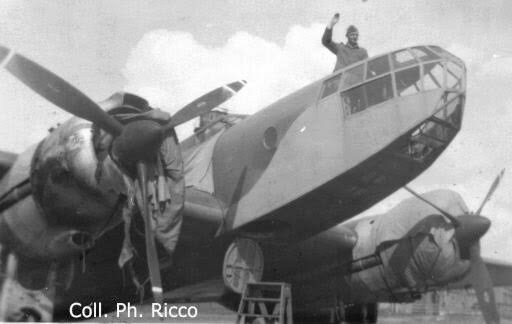
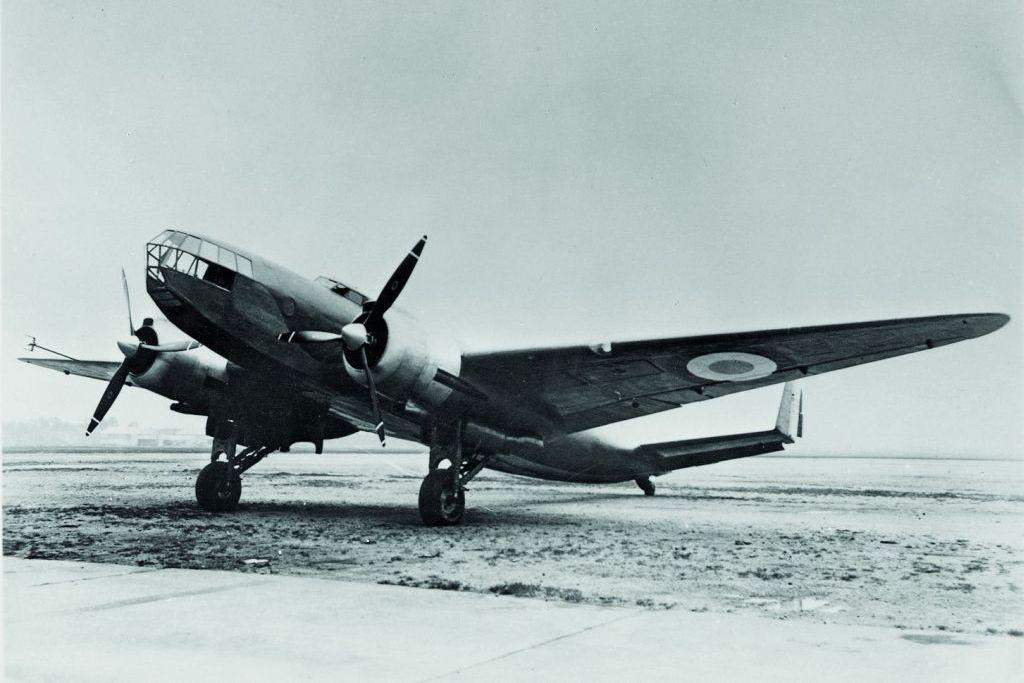
Characteristics
Length : 18.80 m
Width : 23.40 m
Height : 6.51 m
Mass :
- Empty : 5 841 kg
- Max : 9 767 kg
The aircraft is powered by two Hispano-Suiza 14Aa-08 engines, each developing 1,125 hp, enabling it to reach a maximum speed of 560 km/h at an altitude of 5,600 m. It has a service ceiling of 8,800 m and a range of 1,500 km.
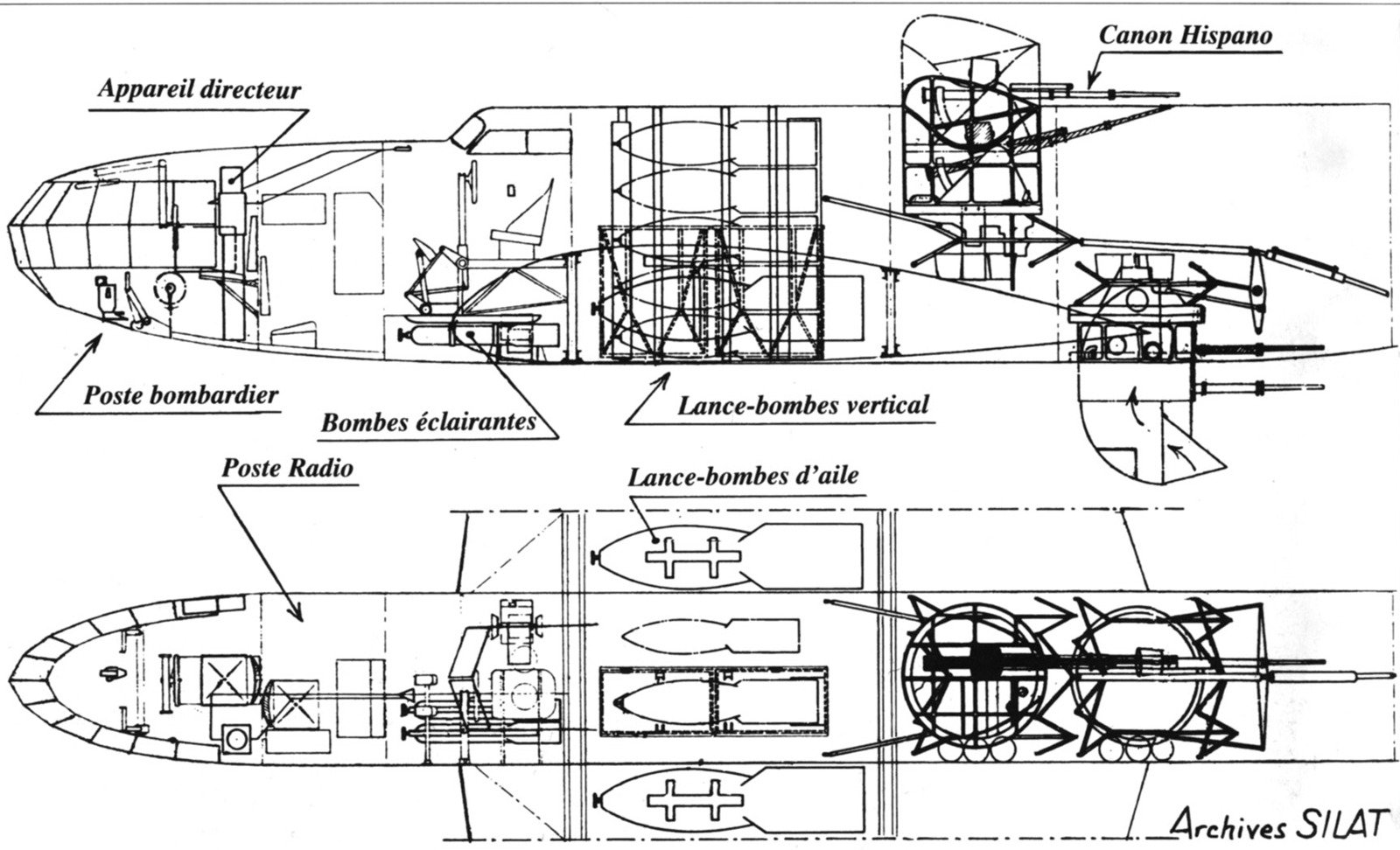
The crew consists of four personnel: a pilot, an observer/gunner operating the upper turret, a navigator/bombardier responsible for dropping bombs, and a radio operator/gunner manning the lower turret.
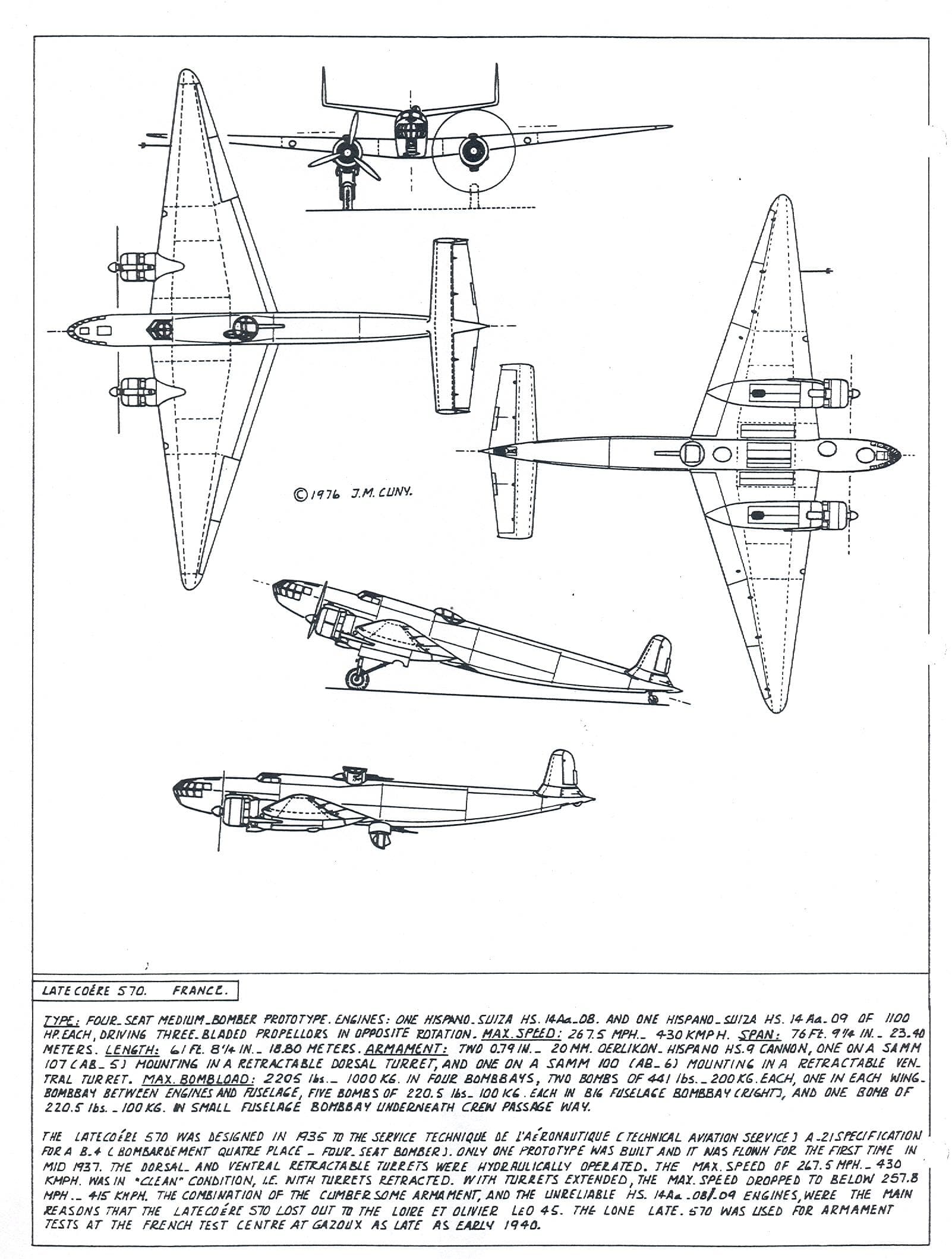
Weapons
The aircraft’s armament meets the specifications required by the military command in the tender and is consequently similar to that found on other aircraft of the type.
Defensive armament:
- 2 x 20mm Hispano HS9 cannons (one cannon in each turret: lower and upper)
Offensive armament:
- 4 bomb bays (one under each wing, one beneath the pilot, and a main bay behind the pilot); maximum payload of 1,000 kg
- Maximum payload: 2 x 200 kg + 1 x 100 kg + 5 x 100 kg
In-game, this aircraft would be an interesting addition to the French tree, complementing the existing LéO 451s with a similar machine that nevertheless offers different flight performance.
Pictures
Sources
- Latécoère 570 - Bombardier moyen - Un siècle d’aviation française
- Latecoere 570 | Secret Projects Forum
- Latécoère 570 1939 (France). Bombardier moyen. En 1934, l’état français lança la spécification B 4 dans le programme A-21 qui réclamait un avion bimoteur qui pouvait emporter 1000 kg de bombes sur une distance de 1 500 km, avec une vitesse maximale de 400 km / h à environ 4 000 m et pouvant atteindre cette altitude en 15 minutes. Les derniers dispositifs les plus modernes ont été spécifiés, tels que des hélices à pas variable, un train d’atterrissage rétractable et des tourelles rétractables dorsales et ventrales. Neuf fabricants ont proposé leurs projets mais seuls Latécoère et trois autres ont produit des prototypes. Il s’agit de l’ Amiot 341, du Lioré et Olivier LeO 45 et du Romano 120 Le Laté 570 se présentait comme un avion bimoteur, monoplan à aile basse de construction entièrement métallique. Il possédait un train d’atterrissage classique rétractable, un empennage à double dérive et deux moteurs Hispano-Suiza 14Aa-04/05 à 14 cylindres de 1 125 CV chacun. Sa défense était assurée une tourelle rétractable dorsale et une ventrale. Celles ci étaient équipées avec un canon Hispano HS9 de 20 mm. La construction du prototype démarra assez tardivement car celle ci ne débuta qu’en avril 1937. Après des problèmes de production, le prototype ne prit l’air qu’en août 1939 et fut envoyé au CEMA à Orléans Bricy au début de 1940, alors que le LéO 45 et l’Amiot 351 entraient en service. Les essais le jugèrent un peu inférieur vis à vis de ses deux concurrents et en juin 1940, il fut capturé par les troupes allemandes et démantelé peu après car jugé de peu d’intérêt… - Avions moches, bizarres, ratés, projets abandonnés et aviation insolite. | Facebook
- Latécoère 570
