- Yes
- No

Kawanishi H8K4 Model 23 (仮称二式飛行艇二三型)
The Kawanishi H8K4 Model 23 is a Japanese prototype flying boat that was developed in the spring of 1945 from rebuilt Kawanishi H8K3 Model 22. Two aircraft of this type were made. Both H8K4s were lost in March 1945.
History
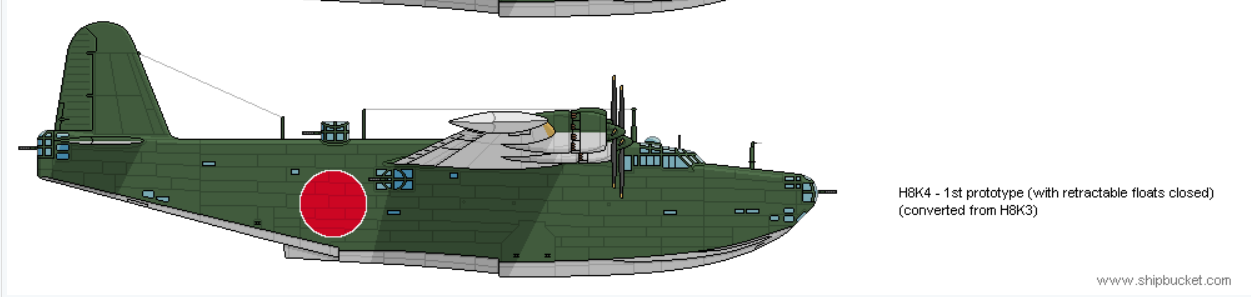
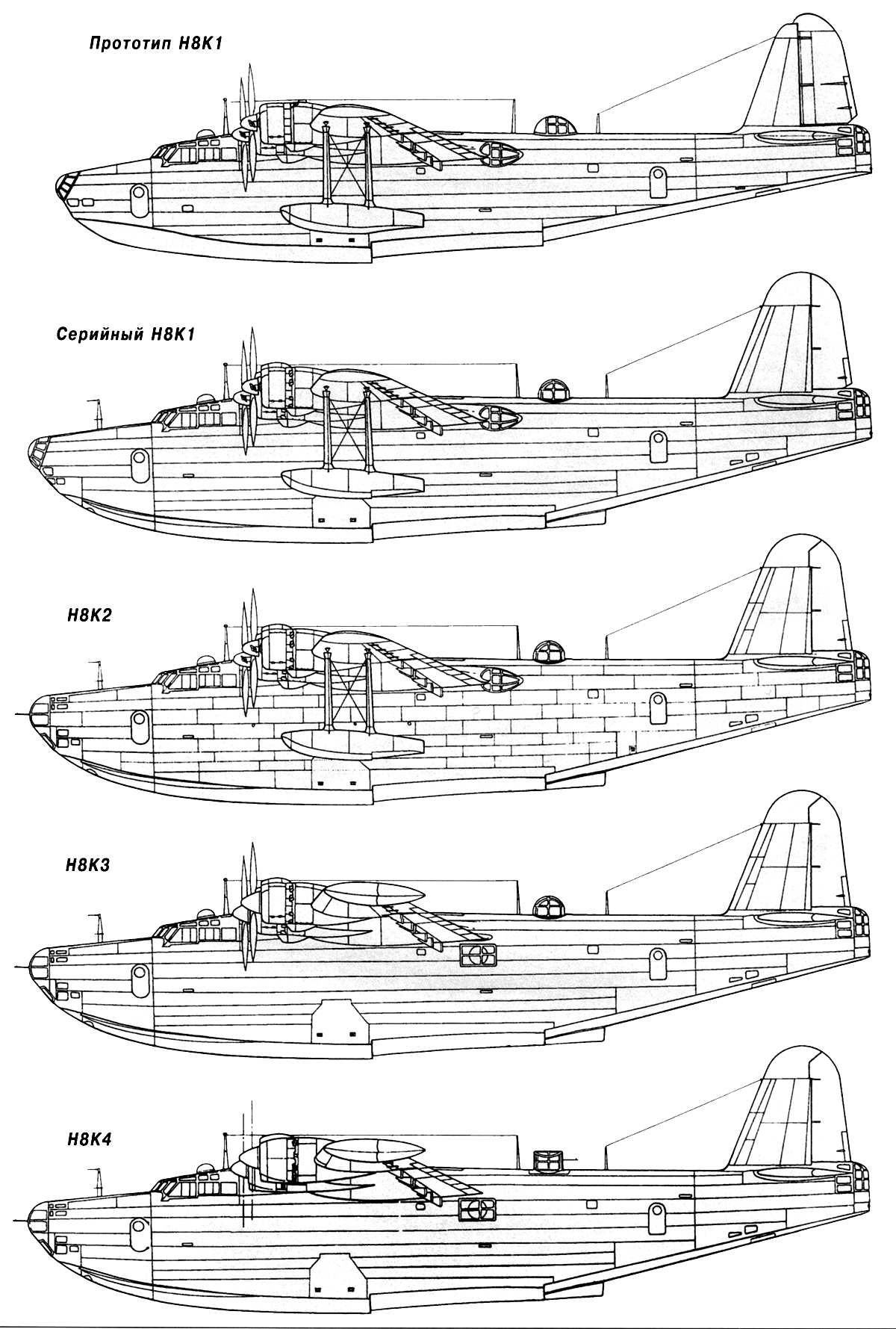
After the rejection of the Kawanishi H8K3 Model 22 prototype in 1943 and its non-introduction into mass production, the Japanese did not want to scrap the Kawanishi H8K3 prototype, so it was assigned to the equipment of the 801st Naval Air Squadron, where the aircraft bore tail numbers 596 and 597. During service, they were sometimes mistaken for Consolidated B-24 aircraft. However, as Japan’s war situation worsened, it became increasingly difficult to conduct low-altitude reconnaissance operations, and the Japanese Navy began losing more and more H8K seaplanes. Therefore, at the end of 1944, a decision was made to rebuild the Kawanishi H8K3 aircraft, which had better high-altitude performance than the H8K2, to provide them with even better performance. It was decided to install Mitsubishi MK4T-B Kasei 25 Otsu (Ha-32-25 Otsu) engines, equipped with fuel injection, in the modified H8K4 aircraft. These engines had a lower takeoff power of 1,825 hp compared to the Mitsubishi MK4Q Kasei 22 (Ha-32-22) engine used in the H8K3, which had a takeoff power of 1,850 hp, but they were more effective at high altitudes and more ergonomic for the declining economy of the Japanese Empire. Additionally, one of the developing H8K4s (just like the H8K3) had a different arrangement of side gunners. The aircraft removed the teardrop-shaped side gunner positions, which provided a good view for the gunners but significantly increased air resistance. Instead, new positions were installed under the main wing, which were square windows with a bulge at the end where the Type 99 cannon was mounted (a similar change can be seen in the G4M2 Model 22 compared to the G4M1). Furthermore, to further improve the aerodynamic capabilities of the H8K4 (just like the H8K3, which is not in the game), the dorsal turret can be retracted into the fuselage when not needed and extended when a threat appears. There are reports that one of the H8K4s received a new dorsal turret with a new shape. It was cylindrical with a convex roof, which, when retracted into the fuselage, smoothly blended into the fuselage’s outline. These modified H8K3 aircraft were ready in the winter of 1944-1945 and received the temporary designation Kawanishi H8K4 Model 23 or Flying Boat Type 2 Type 23. After short tests, they were sent back into service with the 801st Naval Squadron. On March 1, 1945, the Kawanishi H8K4 flying boat number 596 took off from the Takuma base on Shikoku Island on a rescue mission or a night reconnaissance mission (sources differ) and never returned. Then, on March 11, H8K4 number 567 set off on a mission to guide kamikaze aircraft from the Asuza unit, which were to attack American ships off the coast of Iwo Jima. After guiding the kamikaze pilots, the flying boat went on a reconnaissance flight, from which it also never returned. When the Kawanishi H8K4 aircraft still existed, work was underway to convert them into transport aircraft designated H8K4-L, which would have been very useful for Japan, but both H8K4 aircraft were lost in March 1945, which forced the suspension of work on the H8K4-L project.

Construction description
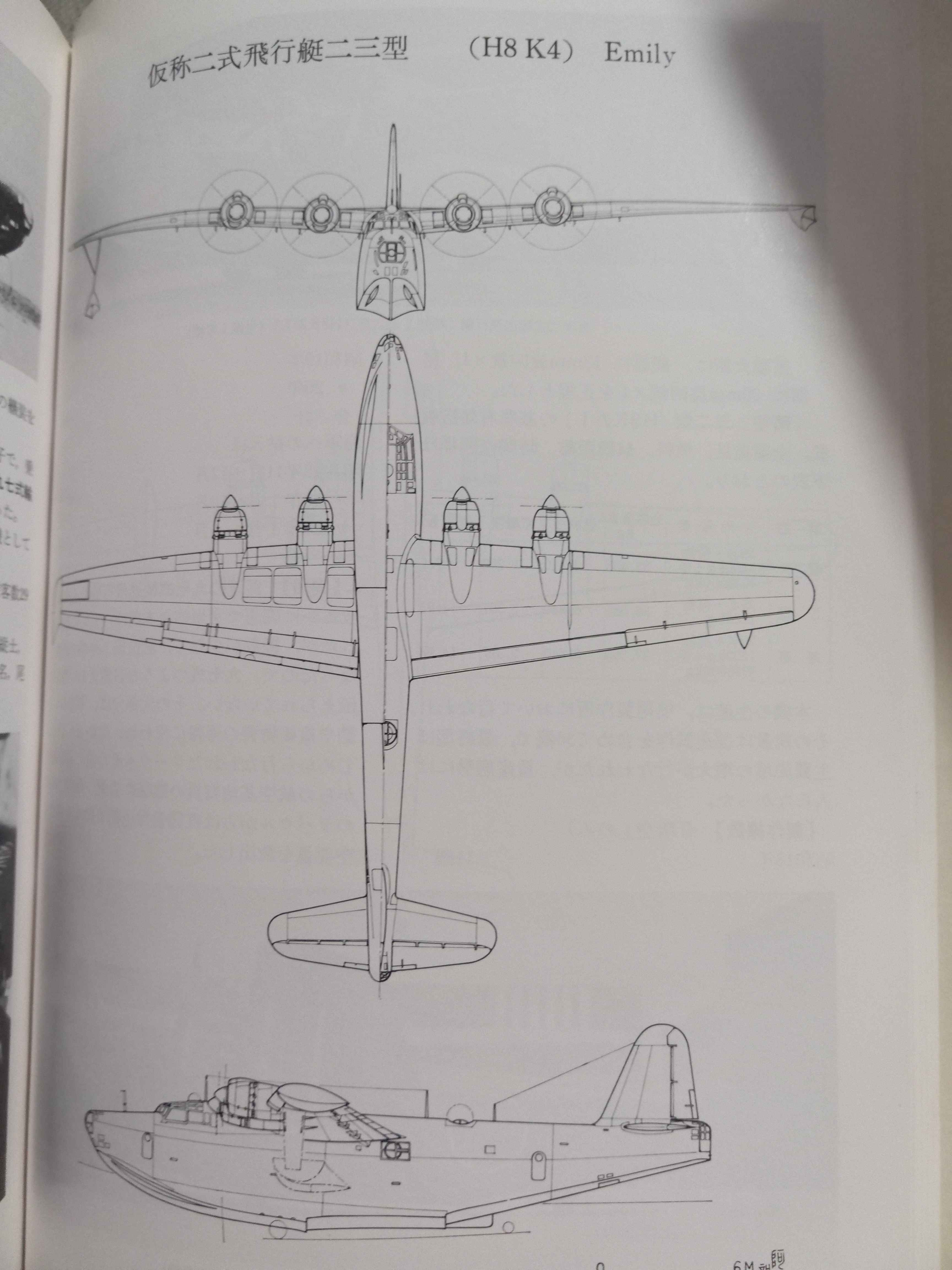
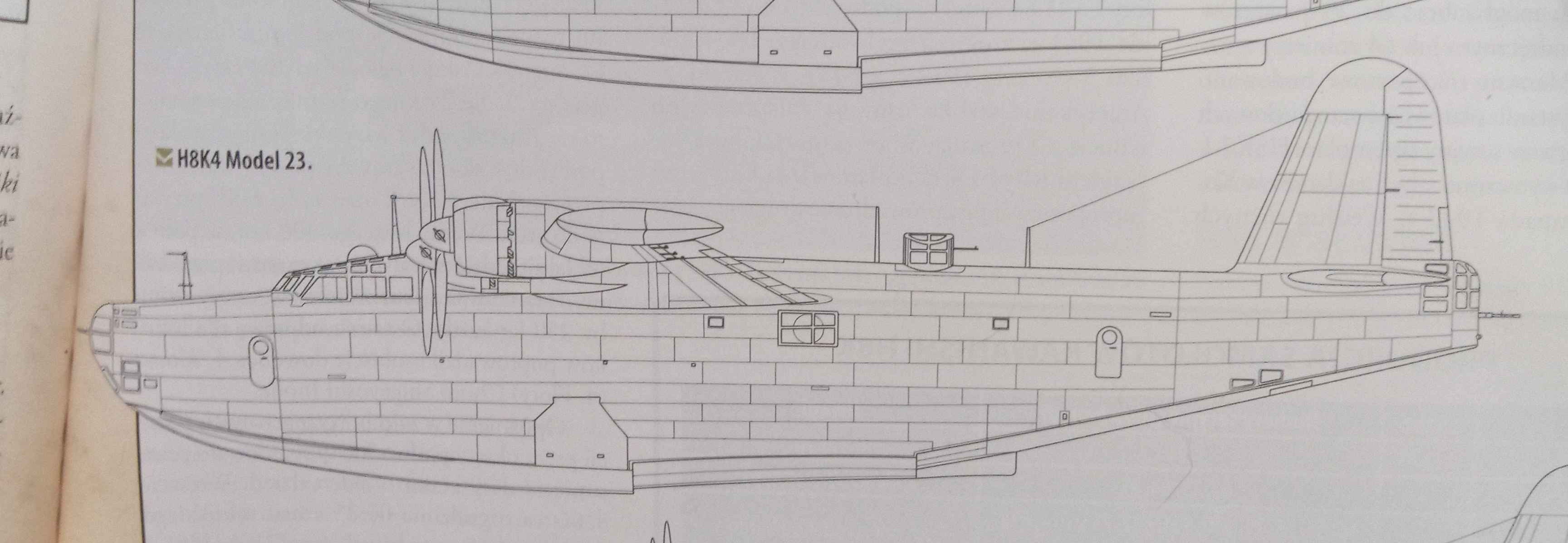
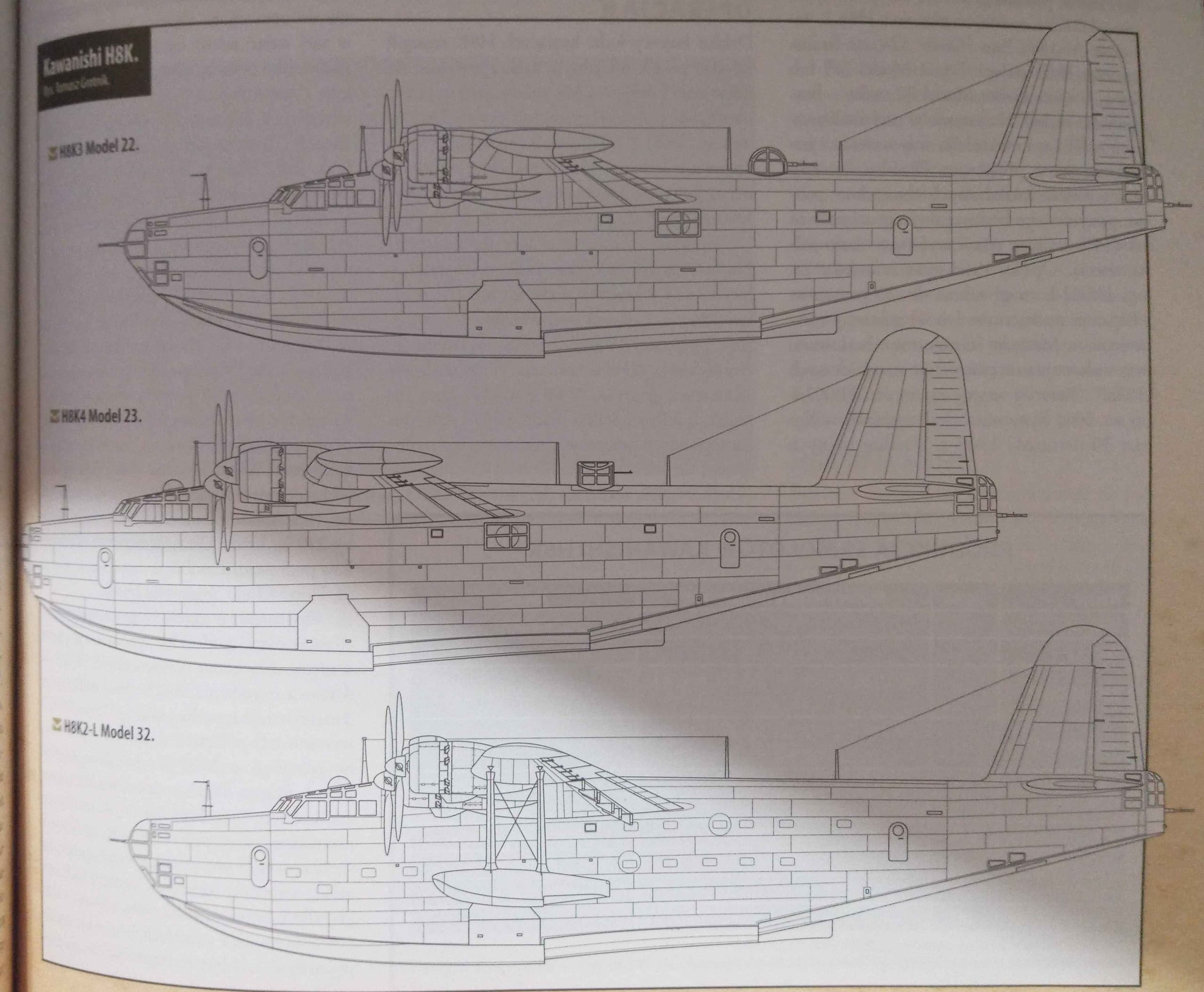
The Kawanishi H8K4 Model 23 is similar to the H8K3 Model 22 from the game, but there are important design differences between them.
- Use of Mitsubishi MK4T-B Kasei 25 Otsu (Ha-32-25 Otsu) engines with fuel injection and a starting power of 1,342 kW (1,825 hp) instead of Mitsubishi MK4Q Kasei 22 (Ha-32-22) engines with a starting power of 1,361 kW (1,850 hp)
- Engine covers have been modified
- New larger propeller hubcaps were installed
- New side gunner positions were implemented, placed under the main wing with a new shape (similar to the side gunner windows in the Mitsubishi G4M2).
- The upper turret is retracted into the hull
- Optionally, the upper turret has a new shape in the form of a cylinder with a convex roof, to fit smoothly with the hull when retracted.

General characteristics
- Crew: 10-13
- Length: 28,130 m
- Wingspan: 38 m
- Height: 9,150 m
- Wing area: 160,00 m2
- Empty weight: 18200 kg
- Take-off Weight: 24500 kg
- Maximum Take-off Weight: 32500 kg
- Powerplant: 4 x Mitsubishi MK4T-B Kasei 25 Otsu (Ha-32-25 Otsu) air-cooled, two-row, fourteen-cylinder engine with fuel injection, with a starting power of 1,342 kW (1,825 hp), each
- Propellers: Four-blade metal propeller with variable pitch and a diameter of 3,900 m
Performance
- Maximum speed: 454 km/h
- Cruise Speed: 296 km/h (?)
- Range: 4700 km
- Maximum Range: ?
- Service ceiling: 9120
- Time to Climb to: 10,2 min to 5000 m
- Climb Rate: ?
Armament
- Guns:
- 1 x Type 99 Model 1 20 mm nose cannon (225 rounds)
- 2 x Type 92 7.7mm machine gun in cockpit (970 – 1,064 rounds, each) (Optional)
- 1 x Type 92 7.7mm machine guns on the hull top in front of the first wing spar (970 – 1,064 rounds) (Optional)
- 2 × Type 99 Model 1 20mm guns in side mounts under the wings (360 rounds, each)
- 2 x Type 92 7.7mm machine guns under the wings (970 – 1,064 rounds, each) (Optional)
- 1 x Type 99 Model 1 20mm gun in a dorsal turret (450 rounds)
- 1 x Type 92 7.7mm machine guns on the bottom of the hull (970 – 1,064 rounds) (Optional)
- 1 x Type 99 Model 1 20 mm cannon in tail gun (225-315 rounds)
- Bombs:
- 2 x 800 kg bombs (under the wings)
- 2 x 500 kg bombs (under the wings)
- 8 x 250 kg bombs (under the wings)
- 16 x 60 kg bombs (under the wings)
- 2 x 800 kg torpedo (under the wings)
Armor
- Self-sealing fuel tanks
- 5 mm thick armor plate pilot seats
- 5mm armor plate behind the fuel tanks in the hull
- 5mm armor plate behind the gunner of the dorsal turret
- 20mm armor plate in front of the tail gunner
Special thanks
Summary
The Kawanishi H8K4 Model 23 is an interesting flying boat for Japan in War Thunder. This aircraft would make an excellent well-armed bomber with good performance at high altitudes. The Kawanishi H8K4 should perform well in air, ground, and naval battles thanks to its large bomb load, good performance, and excellent defensive capabilities. This aircraft could be added to the folder with the Kawanishi H8K1 and H8K2 or be a premium or event plane (not a recommended option). I encourage you to discuss in the comments and to share your own knowledge on this subject.
Finally, I apologize for the linguistic and logical errors because unfortunately English is not my main language and I had to use google translator.
Internet sources
Kawanishi H8K - Wikipedia
二式飛行艇 - Wikipedia
Japanese Aircraft of WWII: Kawanishi H8K
Kawanishi H8K Type 2 (Emily) Info
Kawanishi H8K
Warplanes of Japan: Kawanishi H8K
Full Frame: The Last Emily : Kanoya’s Nishikawa H8K2 Type 2 Flying Boat
二式飛行艇/川西Kawanishi H8K | 大日本帝国軍 主要兵器
Kawanishi H8K ‘Emily’
Уголок неба ¦ Kawanishi H8K
Kawaniši H8K4 23 [Emily] : Kawaniši / Šin-Meiwa
Book sources
- 野沢正『日本航空機総集 川西・広廠篇』出版協同社 - page 126-133
- Japońskie Samoloty Marynarki 1912-45 część II (Japanese naval aircraft 1912-45 part II) page 102-106
- Japanese Aircraft of Wolrld War II : 1937-1945 ,Thomas Newdick, Edition 2 2017, page 82-84, 101
- JAS Japanese Anti-Submarine Aircraft In The Pacific War page 43-50
- Japanese Aircraft of the Pacific War page 307-317
- Technika wojskowa historia Nr. 6/2014 (Military Technology: History No. 6/2014) page 50-69

Thank you for reading the suggestion, see you in the next one. Good luck pilots
