- Yes
- No
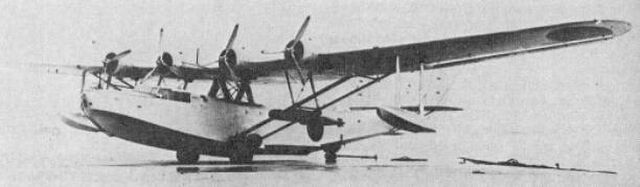
Kawanishi H6K1 Model 1 (early)(九七式一号飛行艇)
The Kawanishi H6K1 (early) is a Japanese flying boat developed in 1936. This note focuses on aircraft equipped with Nakajima Hikari 2 engines. Four to five aircraft of this version were produced, which were later equipped with Mitsubishi Kinsei 43 engines.
History
In the 1930s, the Japanese Navy faced major problems. The Washington and London naval treaties severely limited the size and development capabilities of the Japanese Navy. Additionally, after the end of World War I, the Japanese were granted the South Seas Mandate, which included the islands of Micronesia. Japan was prohibited from building military bases in the mandated territories, which, due to the restrictions imposed on the Japanese Navy, left these territories defenseless. As a result, the Japanese focused on the significant development of naval aviation and the army. In 1933, to ensure the ability to patrol and defend the territory of the South Seas Mandate, the Japanese Navy requested that the Kawanishi factories create a long-range flying boat, 8-Shi. In response to the 8-Shi requirements, the Type R and Type Q flying boat designs were developed. By the end of 1933, the Japanese Navy was unsure whether the Type Q (with four push-pull engines) or the Type R (with three engines) was better. In January 1934, impressed by the projected performance of the civil flying boat Sikorsky S-42 and the military flying boat Consolidated P2Y, which was capable of flying nonstop from San Francisco to Hawaii, the Japanese Navy requested Kawanishi to create a flying boat that would surpass both of these aircraft. The new 9-Shi flying boat was to meet the following design requirements:
- The crew is supposed to consist of nine people
- The range must be over 4625 km
- Cruise speed 230 km/h
- Maximum speed at least 296 km/h or more
- The plane can carry two torpedoes
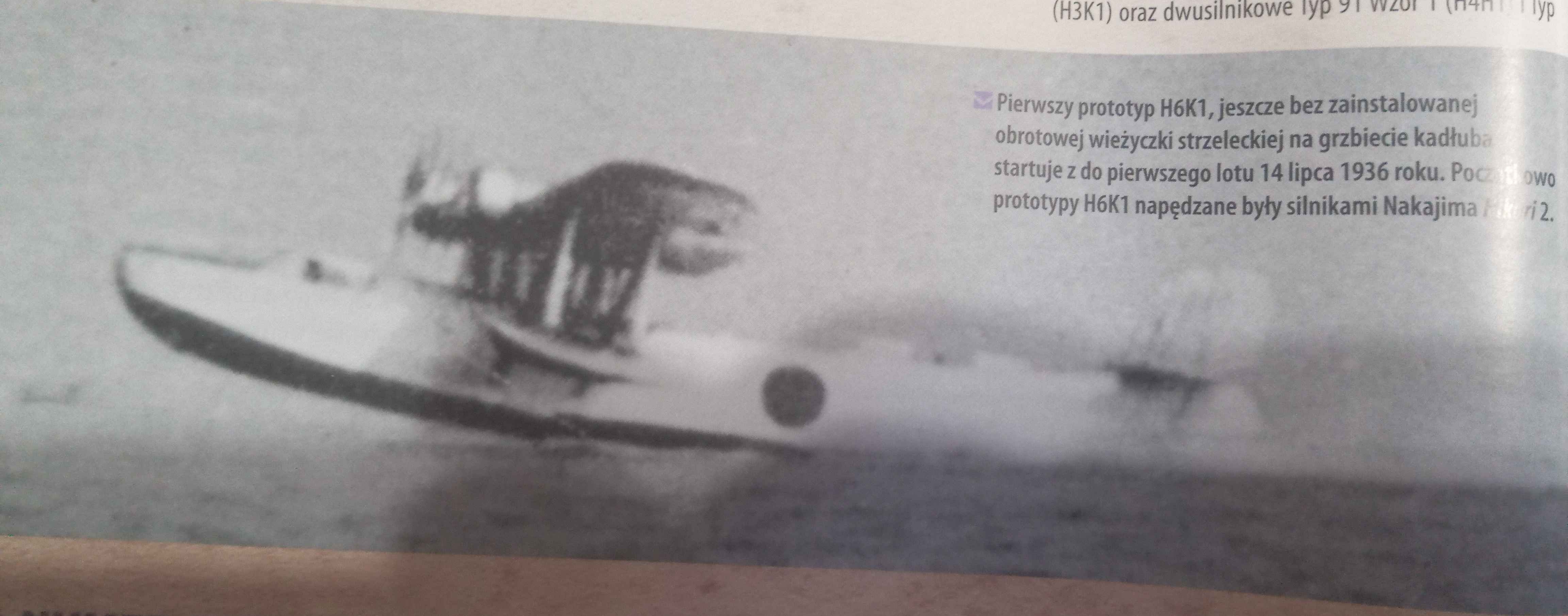
These requirements exceeded the performance of the Sikorsky S-42 and Consolidated P2Y aircraft and were similar to the requirements for the Hiro G2H1 and Mitsubishi G3M1 bombers. The project for the future Kawanishi H6K was entrusted to the experienced engineer Yoshio Hashiguchi and engineer Shizuo Kikuhara. Work on the Type S flying boat (the in-factory designation of the H6K aircraft) began in November 1934. In January 1935, due to the delivery of the Consolidated P2Y-1J aircraft to Japan, which required assembly, work on the Kawanishi H6K was halted for a few months. On April 17, 1935, when the P2Y-1J made its first flight, work on the Type S flying boat resumed. The first prototype of the Kawanishi H6K was completed in July 1936. On July 14, the H6K took off for the first time, piloted by Katsuji Kondo. After receiving news of the successful first flight of the Kawanishi H6K, the head of the Naval Aviation Command himself, Isoroku Yamamoto, arrived at the Kawanishi factories and personally thanked those involved in the project. On July 25, 1936, the aircraft was handed over for testing to the Japanese Navy. During the tests, the aircraft proved that the H6K flying boat was a very good design. The Navy only required minor improvements to lateral stability, control in roll, and hydrodynamic capabilities. However, the biggest problem was the Nakajima Hikari 2 engines, which were underpowered. For these reasons, the Japanese Navy ordered an additional three or four H6K prototypes to resolve the issues of the first prototype. Due to technical reasons, the additional prototypes were initially to be equipped with Nakajima Hikari 2 engines, but later they were to be equipped with more powerful Mitsubishi Kinsei 43 engines. At the beginning of 1937, the second prototype of the Kawanishi H6K was built, and the first prototype was modified. Both were sent for additional testing to the Japanese Navy in the middle of the same year. After these modifications, although the H6K1 still had weak engines, after analyzing the projected performance with better engines, it was decided in January 1938 to adopt the Kawanishi H6K into service as the Type 97 Flying Boat No. 1, or Kawanishi H6K1 Model 1. In January, the third prototype of the Kawanishi H6K1 was also built, followed later in the same year by the fourth prototype. In 1938, production of the Kawanishi H6K2 Model 11 was also introduced, which was equipped at the factory with Mitsubishi Kinsei 43 engines. In the same year, all H6K1s (except for the second prototype) were equipped with better engines.
Construction description
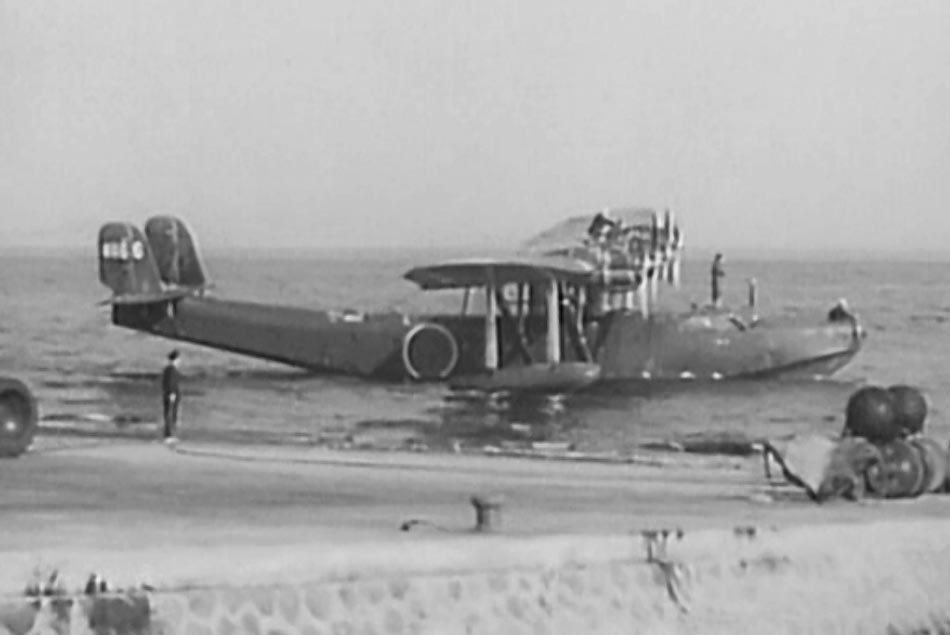
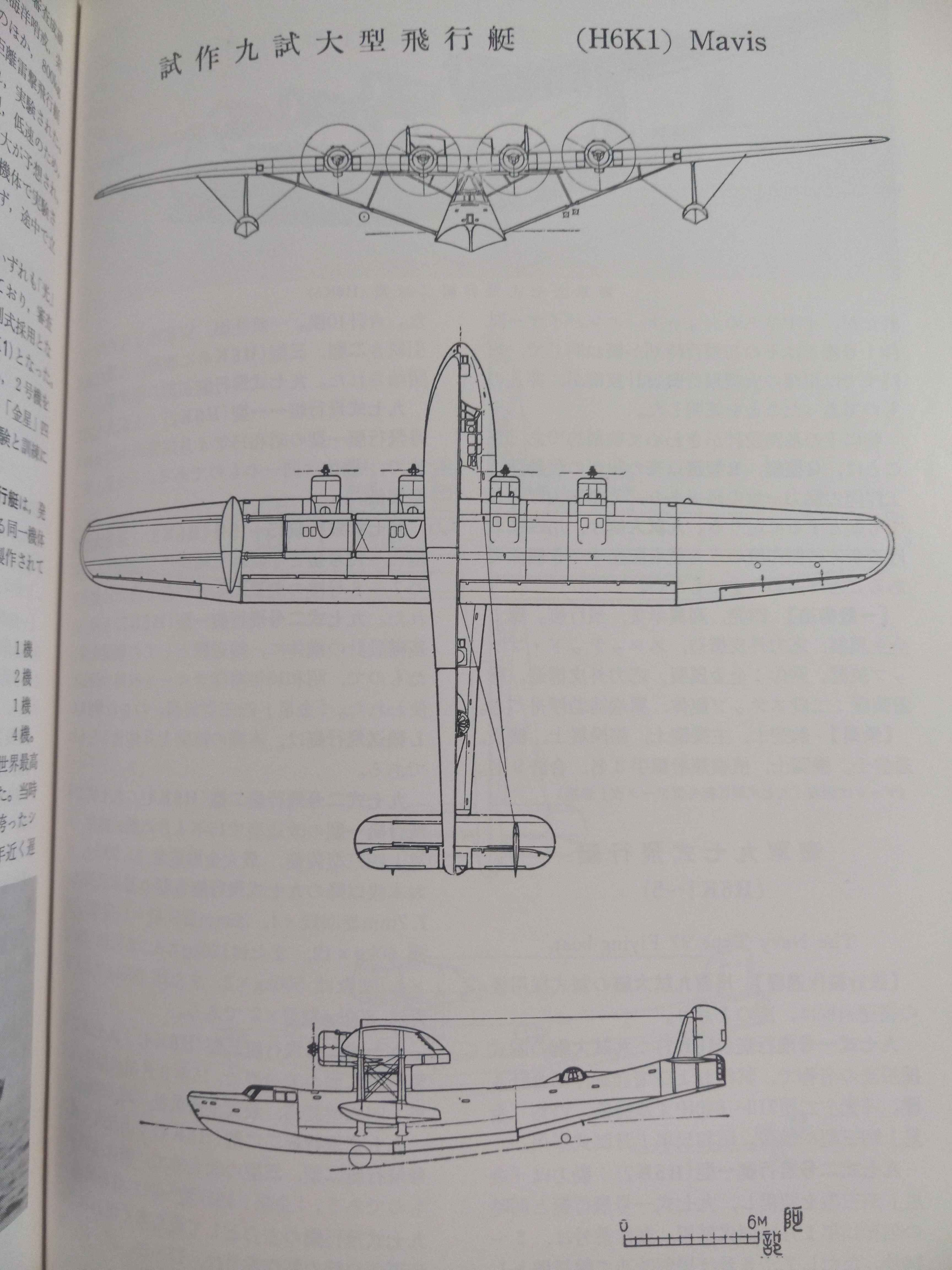
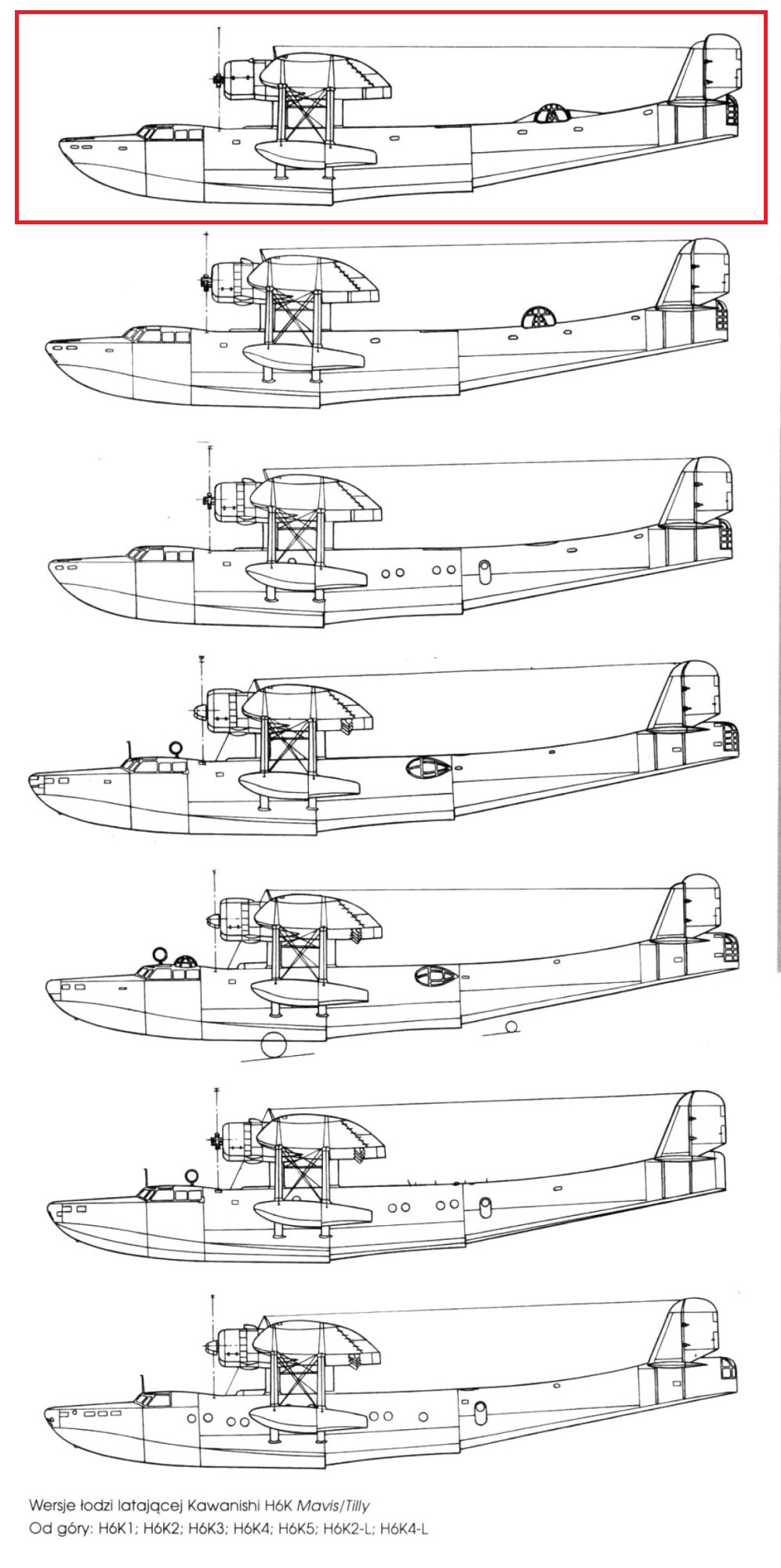
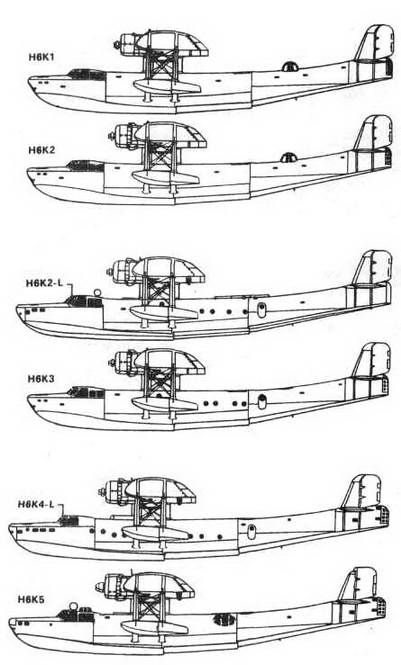
The Kawanishi H6K1 Model 1 (early) is a flying boat with a metal construction and tail surfaces covered with fabric. The aircraft has a parasol wing mounted to the fuselage using struts. The aircraft is equipped with a dual vertical tail. The fuselage contains four watertight bulkheads. The aircraft is equipped with two auxiliary floats under the wings. It is powered by four Nakajima Hikari 2 engines, air-cooled nine-cylinder radial engines with a takeoff power of 618 kW (840 hp), with the inner engines spaced 4.20 m apart and the outer engines located 4.0 m from them. The Kawanishi H6K1 is fitted with three-blade metal propellers with a diameter of 3.10 m. The aircraft is armed with three Type 92 machine guns: in the nose, in a dorsal turret (based on French designs), and at the tail end of the fuselage. Up to 1000 kg of bombs or two Type 91 torpedoes can be installed on the wing struts.
General characteristics
- Crew: 9
- Length: 24,900 m
- Wingspan: 40,0 m
- Height: 6,27 m
- Wing area: 170,00 m2
- Empty weight: 10025 kg
- Gross weight: 15700 kg
- Powerplant: 4 x Nakajima Hikari 2 engines, air-cooled nine-cylinder radial engines with a takeoff power of 618 kW (840 hp)
- Propellers: Three-blade metal variable-pitch propeller CS-16 type Hamilton Standard with a diameter of 3,10 m
Performance
- Maximum speed: 311 km/h
- Cruising speed: 240 km/h
- Range: 3640 km
- Maximum Range: ?
- Service ceiling: 5200 m
- Climb Rate: ?
- Rate of climb: ?
Armament
- Guns:
- 1 × Type 97 7.7mm machine gun in the nose
- 1 x Type 97 7.7mm machine gun in a turret on the back
- 1 x Type 97 7.7mm machine gun in the tail
- Bombs
- 12 x 60 kg bombs
- 4 x 250 kg bombs
- 2 x 500 kg bombs
- 2 x Torpedo Type 91
Special thanks
Summary
The Kawanishi H6K1 Model 1 is an interesting flying boat for Japan in War Thunder. This aircraft would be a good lowest-era bomber with a satisfactory bomb load, but with poor bombing capabilities. The Kawanishi H6K1 would be useful in naval battles since it is a flying boat. This aircraft could be placed in the same folder as the Kawanishi H6K4 in the game (as well as H6K2 and H6K5), or be a premium or event vehicle. I encourage you to discuss in the comments and to share your own knowledge on this subject.
Finally, I apologize for the linguistic and logical errors because unfortunately English is not my main language and I had to use google translator.
Internet sources
九七式飛行艇 - Wikipedia
Kawanishi H6K - Wikipedia
Kawaniši H6K1 9-Ši : Kawaniši / Šin-Meiwa
Kawanishi H6K
Kawanishi H6K5 - War History
Kawanishi H6K (1936)
Warplanes of Japan: Kawanishi HK6
Уголок неба ¦ Kawanishi H6K
九七式飛行艇/川西Kawanishi H6K | 大日本帝国軍 主要兵器
Book sources
- Japanese Aircraft of Wolrld War II : 1937-1945 ,Thomas Newdick, Edition 2 2017, page 79-80
- Japanese Aircraft of the Pacific War page 301-307
- Japońskie Samoloty Marynarki 1912-45 część II (Japanese naval aircraft 1912-45 part II) page 97-101
- 野沢正『日本航空機総集 川西・広廠篇』出版協同社 - page 113-122
- Technika wojskowa historia numer specjalny 2/2017 (Military Technology: History Special Issue 2/2017) page 24-27

Thank you for reading the suggestion, see you in the next one. Good luck pilots
