- Yes
- No
- Tech Tree
- Premium
- Event
- Battlepass
- Squadron
- I said no
- 5.7
- 6.0
- 6.3
- 6.7
- Other (comment)
- I said no
Jagdpanzer 1-3: A New Dog’s Old Tricks
History:
Following the end of the Second World War, Germany was divided between the Western Allies and the USSR, drawing the boundaries for the future West and East German states. Both would remain without a military for their first few years, having only police and light paramilitary forces due to fears of a potential resumption of violence. But by the mid-1950s, it was decided by the Western Allies that a West German military was needed to counter any potential force from East Germany and the USSR. As such, the Bundeswehr was founded on November 12, 1955.
The newly-formed Bundeswehr, for better or worse, was dominated by former Wehrmacht officers. As a result, many of the tactics, concepts, and ideas from the Wehrmacht would make it into the early years of the Bundeswehr. One of these ideas was that of the casemate tank destroyer.
Having had significant success with the StuG III/IV series and the various Jagdpanzers used by Nazi Germany during the Second World War, it should come as no surprise that the legacy Wehrmacht officials now leading the Bundeswehr were eager to replicate that success with modern vehicles. At the time, the Bundeswehr relied exclusively on imported armor, namely the American M47 Patton II and M41 Walker Bulldog tanks and the French Hotchkiss SP1A (SPz Kurz 11-2) and Swiss Hispano-Suiza HS.30 (SPz Lang 12-3) infantry fighting vehicles. The latter of those is of particular interest, as it would serve as the basis for the first domestic Cold War West German tank destroyer prototype.
Considered the very first IFV in military service, the HS.30 bucked the trend of previous “battle taxi” APCs, such as the French AMX-VCI or American M59 and M113, being designed to not just get infantry into the battle but also to stay there and support them with heavier weapons. Armed with a 20mm HS.820 autocannon in a one-man turret at the front, the HS.30, designated the Schützenpanzer Lang 12-3 in West German service, could provide fire support for the six dismounts it carried. While innovative, it was plagued with issues, such as unreliable transmission and tracks, weak suspension, and poor engine access. Perhaps worst of all, though, were the roof hatches used for troop dismount. This meant that troops had to climb out over the top and sides of the vehicle, exposing them to enemy fire and making falls common.
Spoiler
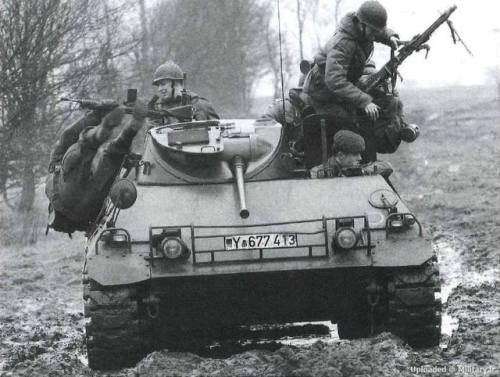
That’s gonna hurt…
In spite of its shortcomings, the HS.30 would remain in service with the Bundeswehr from its introduction in 1960 through the 1980s when it was fully replaced by the Marder 1. Some were exported to Peru in the 1970s.
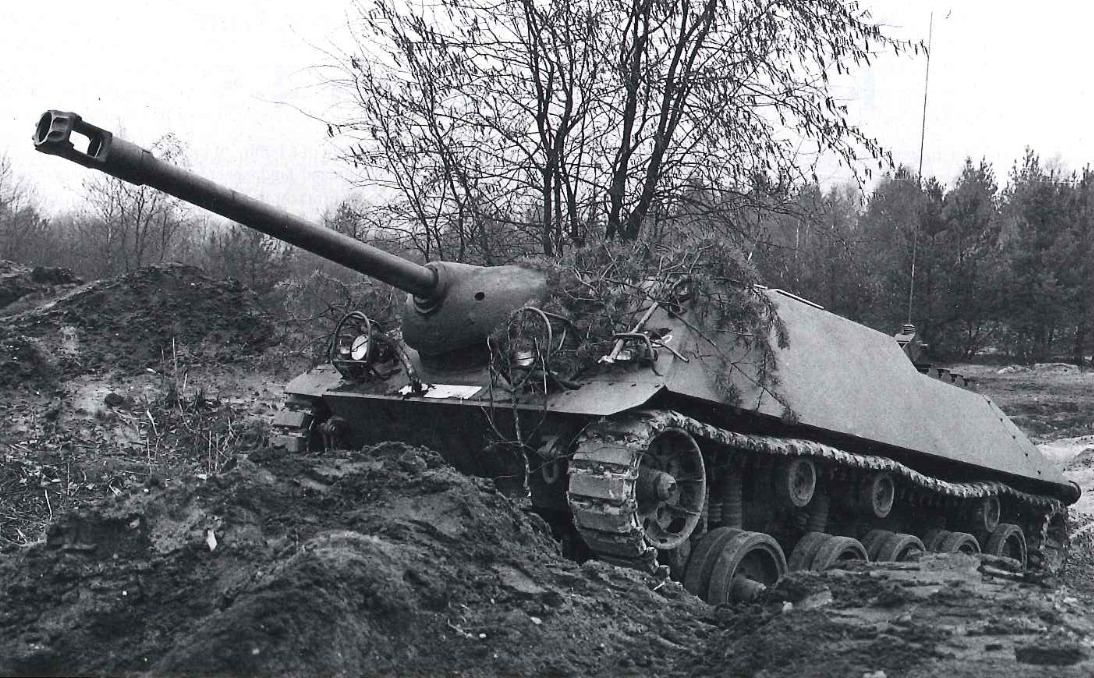
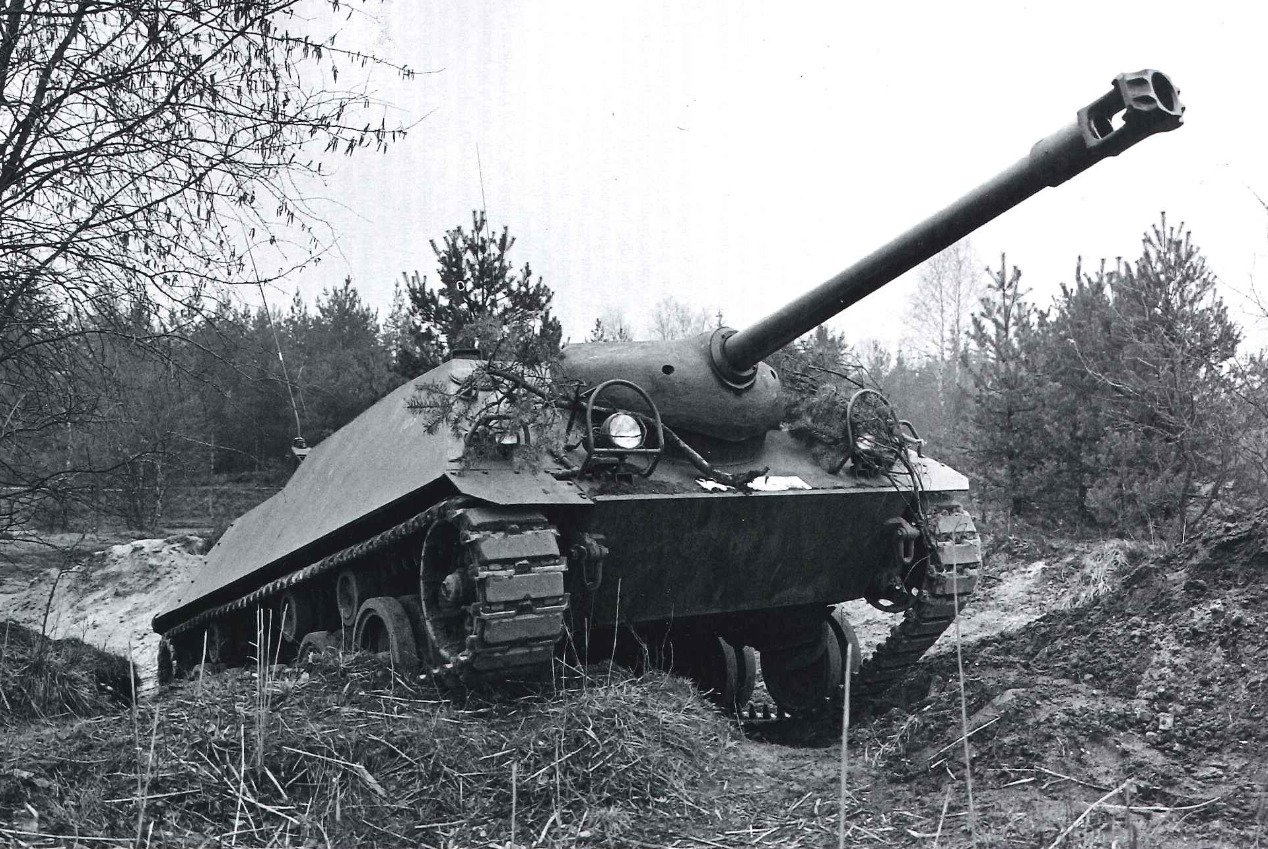
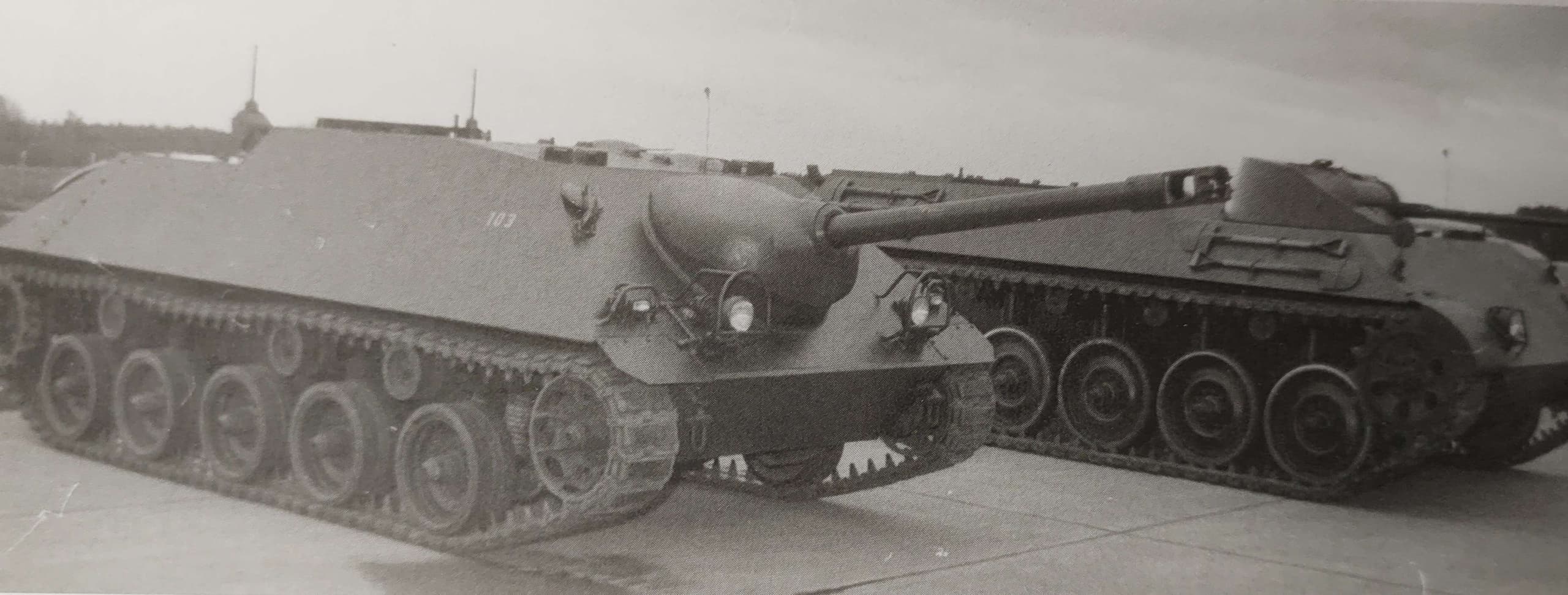
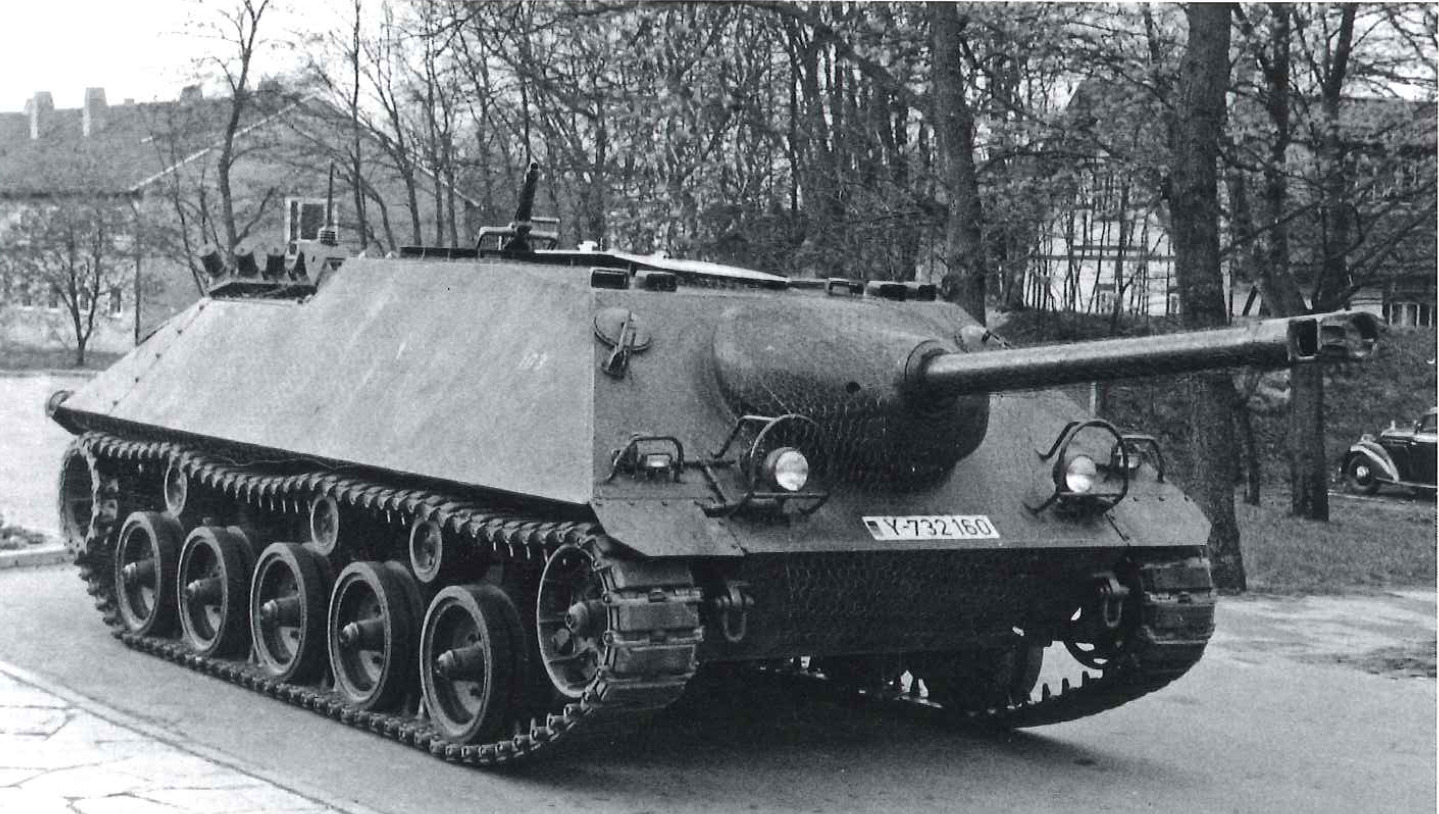
At the same time as the early trials of the HS.30, a proposal was put forward to develop and adopt a tank destroyer armed with a 90mm gun. This would be the first domestically-developed armored vehicle from West Germany following World War Two, so lessons learned from the war were used during the design. The HS.30 was chosen as the base for the new tank destroyer, and the project began officially in 1957. By 1959 a mild steel prototype had been built to test the overall design of the vehicle with a full armor prototype being completed later that year. Tests would show several issues, many of which were endemic to the HS.30 platform. The new armament, a 90mm DEFA D915 low-pressure gun, took up far too much room in the already cramped fighting compartment. Traversing it all the way to one side made it impossible to drive properly, and all the way to the other made it impossible to fire the gun. The loader was supposed to operate the radio but could not comfortably reach it and perform his duties. The DEFA D915 was considered inaccurate and too short-range for the job, and the ammunition was not NATO-standard, complicating logistics. There were also issues with ventilation, as the vehicle had no fan for removing projectile gases from the fighting compartment. Additionally, there was no NBC protection to speak of. Lastly, the gun being placed so far forward cause such a severe weight imbalance that it affected mobility and even broke the running gear. Overall, the design was insufficient on all fronts, and so was not put into service.
This would not be the end of the Jagdpanzer 1-3, neither physically nor spiritually. Physically, one of the prototypes (likely the mild steel one) would be rebuilt into the first prototype of the Jagdpanzer 3-3, later known as Raketenjagdpanzer 1. It remains on display at Panzermuseum Munster and can be identified by the circular metal patch welded over the former location of the gun.
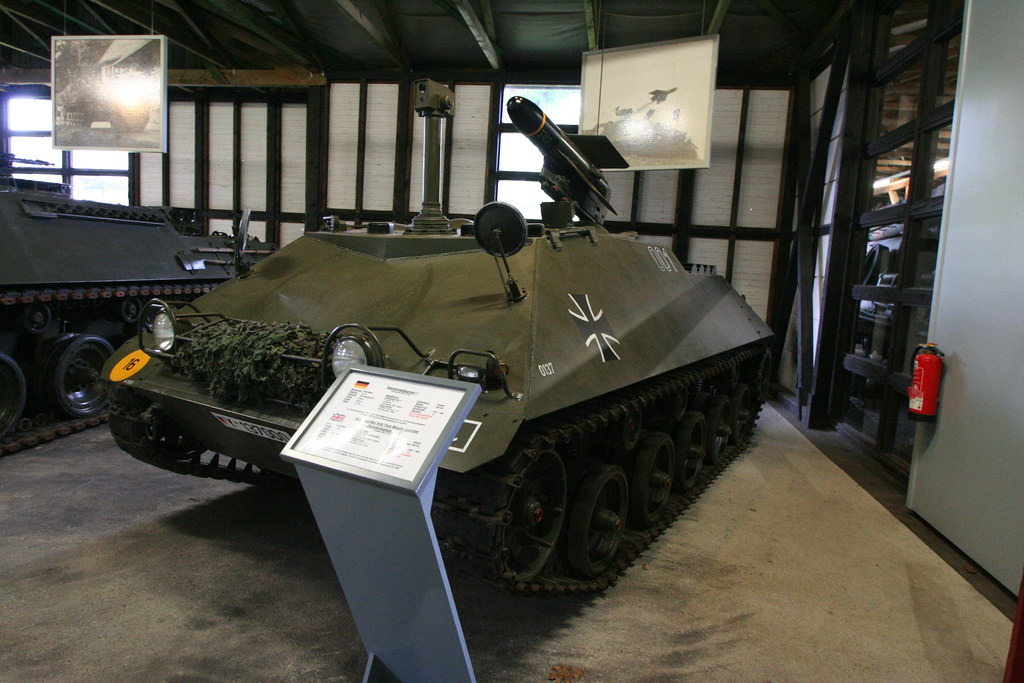
Spiritually, the lessons learned from the Jagdpanzer 1-3 would influence the design of the Jagdpanzer 4-5, essentially being an enlarged 1-3 with a more powerful gun. It would enter service in 1965 and serve until 1991 when the final cannon-based Jagdpanzer would finally be retired, marking the end of an era that began all the way back in 1940 with the Panzerjäger 1.
Description:
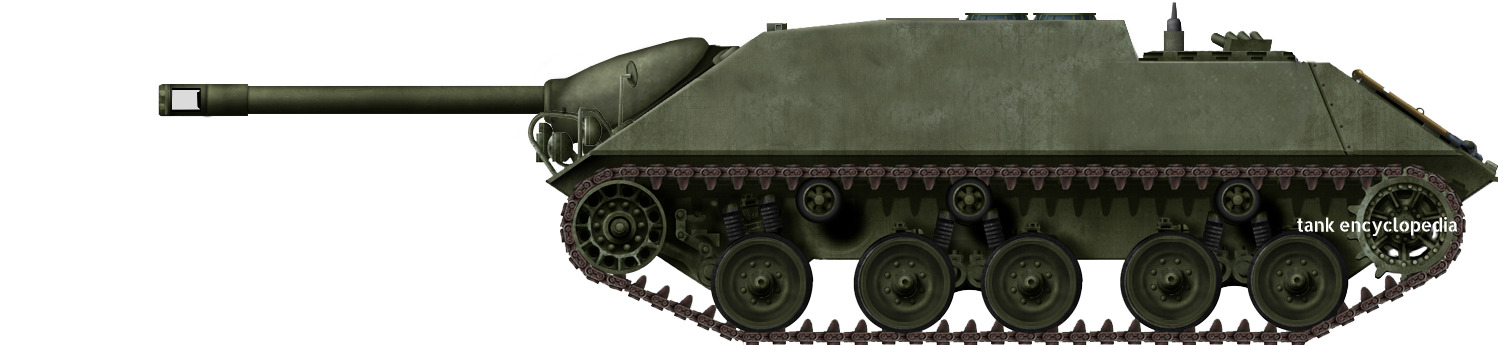
In terms of overall design, the Jagdpanzer 1-3 shares almost all the same characteristics as the HS.30, save for the main armament and fighting compartment configuration. The HS.30 chassis is already in-game as the SPz 12-3 LGS, so it should be familiar to many players. Weighing in at 13.72 metric tons, the dimensions are 7.06 m long by 2.5 m wide by 1.75 m tall (23.16 x 8.20 x 5.74 ft), quite a bit smaller than the final Jagdpanzer 4-5. Powered by a 220 hp Rolls-Royce B81 MK80F inline-8 gasoline engine coupled to a four-speed planetary gearbox (with one reverse gear), it had a ratio of 16 hp/tonne and could reach a top speed of 51 km/h (32 mph). Sources differ on fuel capacity, which was either 280 or 340 liters (74 or 90 gallons). Whichever fuel amount it had, its range was 270 km (168 mi). Featuring torsion bar suspension, the ride was decent enough and it could cross a trench of up to 1.5 m (5 ft).
As armament, it used the French 90mm DEFA D915 low-pressure cannon, already found on the AMX ELC bis. Firing HEAT-FS shells, the Jagdpanzer 1-3 was able to penetrate up to 350mm of armor, though its accuracy past 1 km left much to be desired. HE and smoke shells were also available. The gun could traverse 30 degrees to each side and had elevation angles of +15/-8 degrees. The ammo count is not known, nor are the specifics on the gun sight. What is known is that there was no provision for a rangefinder, though night vision equipment was present. For secondary weapons, two 7.62mm MG 1 machine guns were present, one mounted coaxial to the main gun and another on the roof in a pintle mount.
For armor, the Jagdpanzer 1-3 largely shared the same protection as the base HS.30. This meant that it was protected by 30mm of steel at the front and 20mm on the sides. The gun mantlet thickness is unknown, but using estimates and data from the later Jagdpanzer 4-5 it would probably be somewhere between 32-40mm of cast steel. Four smoke launchers are positioned in an arc on the right side of the engine bay roof, all firing towards the right side at varying degrees.
Four crew manned the vehicle: a gunner, a loader/radio operator, a driver, and a commander.
Specifications:
Spoiler
Main Armament: 90mm DEFA D915 low-pressure cannon
Secondary Armament: 2x 7.62mm MG 1 machine guns (coaxial, roof)
Armor: 32-40mm (gun mantlet, cast steel), 30mm (hull front), 20mm (hull sides)
Engine: 220 hp Rolls-Royce B81 MK80F inline-8 gasoline
Transmission: Planetary, 4 forward/1 reverse
Top Speed: 51 km/h (32 mph)
Gun Movement: 60° traverse, +15/-8° elevation
Crew: 4 (gunner, loader, commander, driver)
NVDs: Passive IR for gunner and commander
Smoke: 4x smoke launchers on right side of engine deck