how does an HE round shatter?
If any part except the fuse hits the target first
Whatever the case of overpressure vs hull break, I just watched my CR2 HESH go through the turret ring of a Pantsir at 2km and not even detonate.
You think that’s crazy? I once had the windshield of a Pantsir deflect APFSDS from my Type 90 way back.
Neither of which should’ve happened but you know - Gaijin can’t code.
“oVeRpReSsUrE iS oP”
New patch and…
75mm HE to Marder III? Hit.
57mm HE to So-Ki? Hit.
75mm (and lower) HE does no damage to light vehicles unless it hits in a specific spot.
Are you happy now?
The cold war derp guns should never have been allowed to see WW2 heavies. Ever. PZH2000 especially could easily be 10.7.
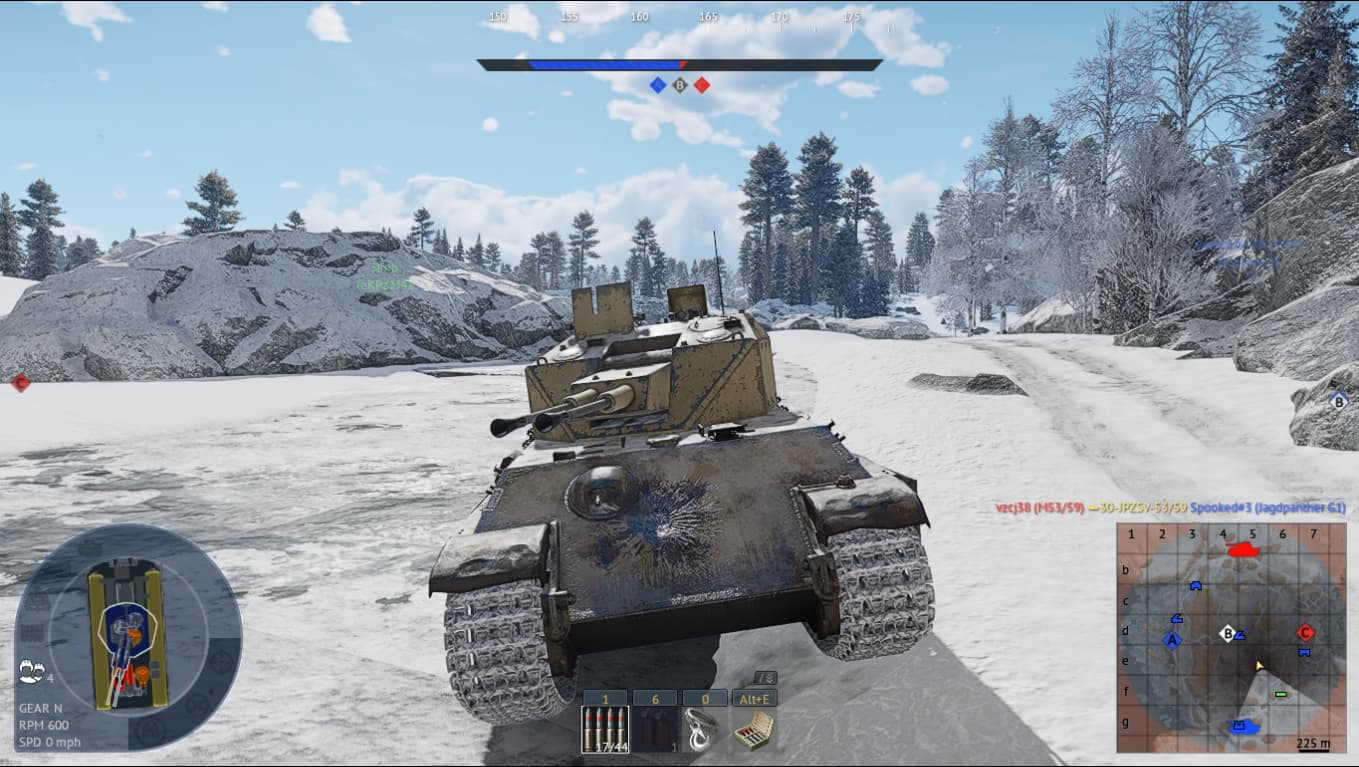
The result of a 183mm HESH shell to the UFP of my Coelian.
Destroyed transmission, one dead crewman, two destroyed tracks.
Hull Break is gone, but this would be the prime candidate. The tank should not even be identifiable anymore.
Nope - that’s pretty reasonable - cf 165mm HESH hit to front plate of Tiger 2 tested after the war - almost exactly the same damage -
Shot 1
The first round stuck the upper glacis plate some 26 inches above the centreline. This hit caused an 18 x 14-inch wide dent 1 inch deep on the outside, pitted the gun heavily, broke the upper glacis/hull roof weld seam and dislodged the drivers’ plates.

Upper glacis plate after shot 1.
The drivers’ scopes were damaged and the hull roof plates had fractures, while the hull machine gun fixture had a 28-inch crack. Finally the weld seams between the upper and lower glacis were broken.
Internally the story was even worse. The round broke off a 15.5 x 13 inch scab 1.5 inches thick and weighing 61lb (27.6kg). This scab went through the steel mockup final drive – which would have rendered any real vehicle immobile. Fragments damaged the bow machinegun but not the gunner, and the driver would have lost an arm and a leg.
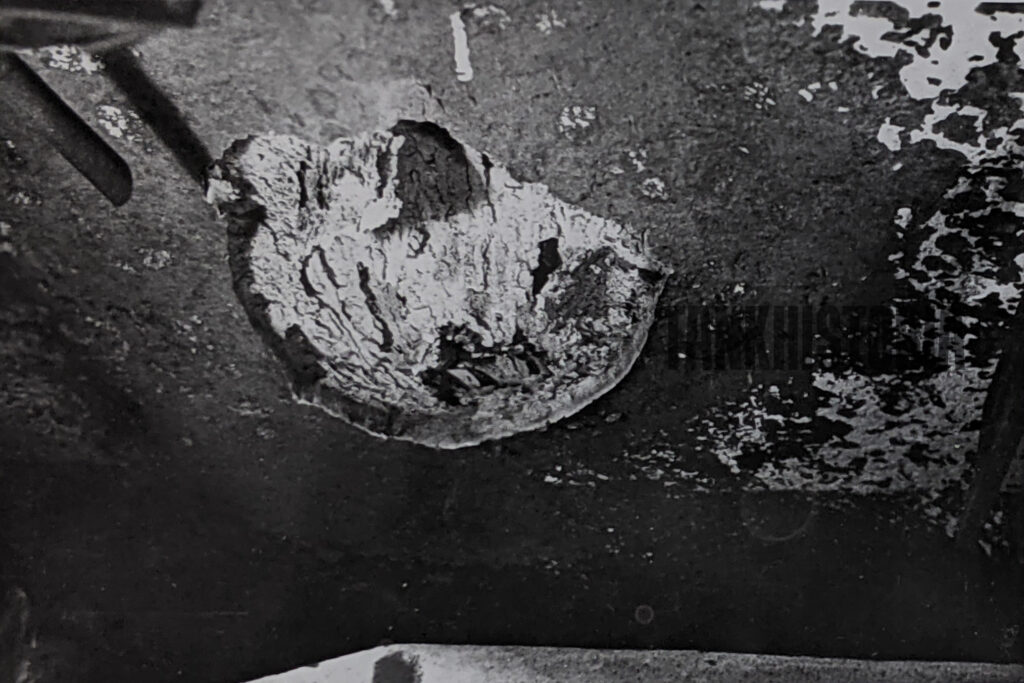
Inside view of shot 1, showing the area the scab detached off the 150 mm thick upper glacis plate.
However, the turret crew was untouched by the round.
This single strike, although not completely fatal, would have rendered any tank immobile and the hull requiring a factory rebuild to fix.
1 Like
And shot 2 - destroyed the mock-up transmission and severely cracked the hull plates - but no crew casualties at all
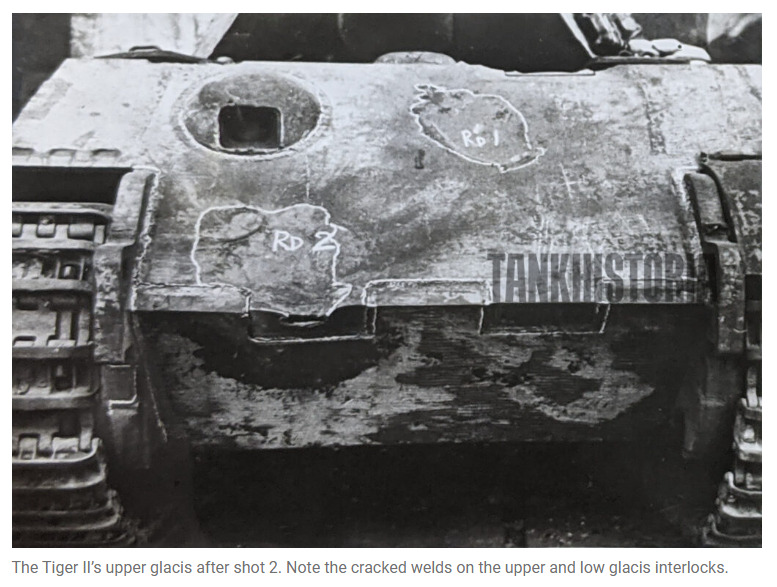
Internally a 15 x13 inch scab 1.5 inches thick and weighing 74 lbs formed and shot into the forward steel mockup transmission destroying it. Internally, cracks and distortions were present and daylight could be seen through the gaps, however the witness plates indicated that apart from a mobility kill the crew would have survived this shot.
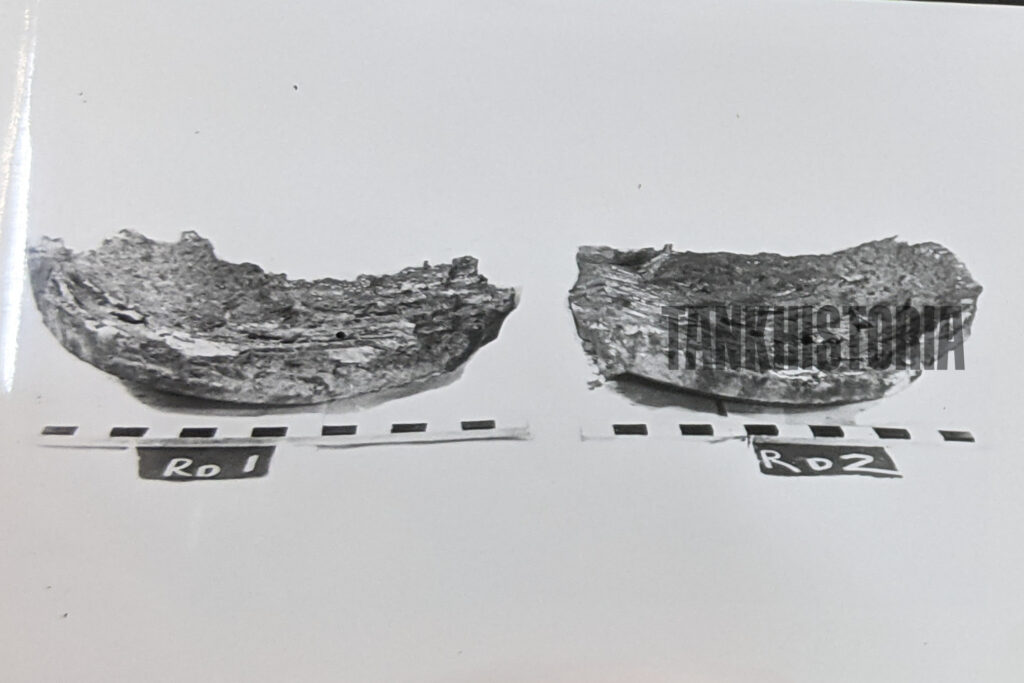
The scabs that broke off inside the tank from shots 1 and 2.
1 Like
That’s a 150mm plate vs an 80mm plate, almost half the thickness - and with another 18mm of shell diameter.
Interesting read nonetheless.
yes but the mechanics are going to be the same - a big scab mostly eaten by the transmission
In the case of a naval gun hitting the UFP of essentially a Panther, using a HESH shell, I think the tank would be completely blown apart at the seams.
“Naval guns” come from 6.5mm calibre upwards - not sure why that is relevant at all.
But just in case, 183mm is 7.2", which has never been a naval calibre - it is a land artillery calibre tho -BL 7.2-inch howitzer - Wikipedia
But in any case, as far as evidence goes, your opinion is worth exactly what we have paid for it.
Must be quite embarrassing to have such a mouth after making a completely false comparison.
Dunno - you’d be the expert at making assumptions with no evidence at all.
ETA: it is obviously not a perfect comparison, but it is verifiable evidence, and it does not descend to ad hominem…
Because I’m the one stating that a 150mm plate marginally surviving a 165mm HESH round, means an 80mm plate would protect against a 183mm HESH round. Ingenious.
Feel free to discuss the point at any time.
I mean if you had any actual evidence I would have expected you to present this, but clearly you never even bothered to look…

Which is against only 51mm armour of course, and that armour is less well supported structurally than the front glacis of a Tiger 2 or Panther…
Also of interest:
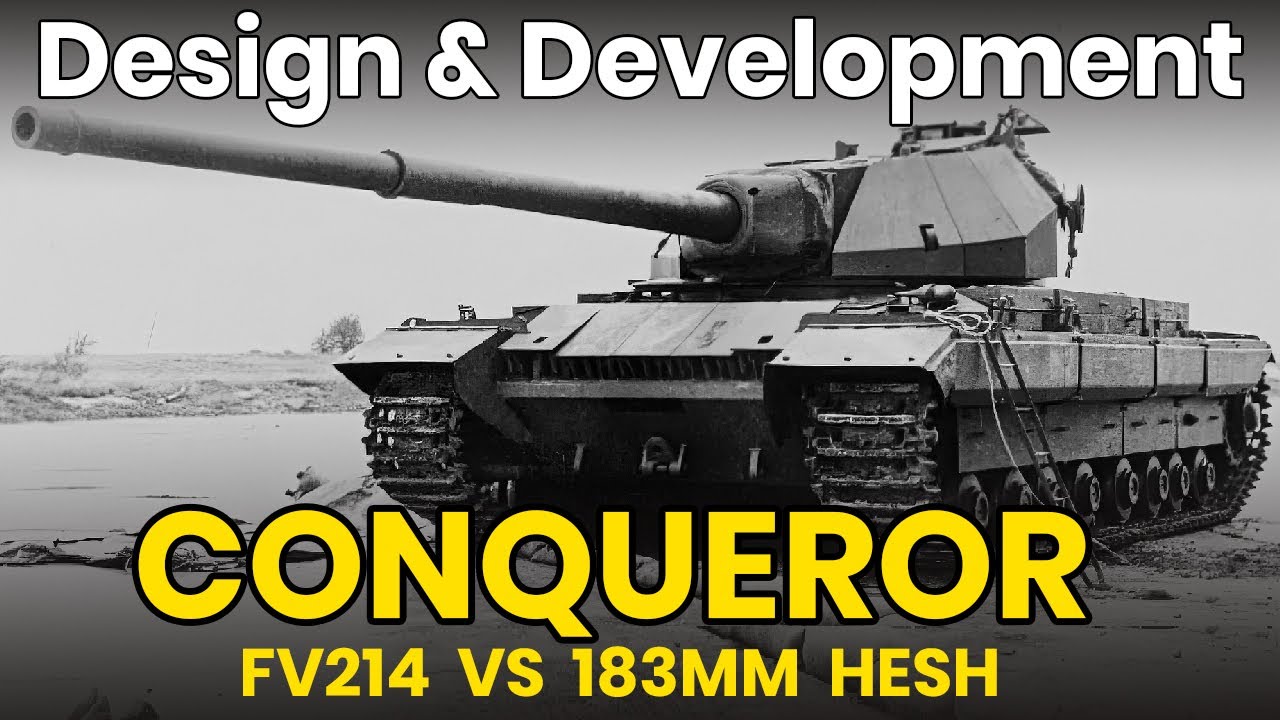
ETA: the side which is also vs 51mm armour - same as on the Centurion, and although a definite kill there’s a lot less damage.
Also the 183mm HESH round only had about 1.1kg more explosive than the 165mm HESH for about 1.5kg more TNT equivalent - 21.8 vs 20.3 kg. Being a much longer gun meant the shell had to withstand more stress, so most of the extra weight went into making the shell casing thicker to withstand that.
There was no point to reply to in the first place. Metrics such as shell diameter and armour thickness are immensely sensitive in discussions like these, and both of yours were completely separate to the situation at hand. Had the difference been 10mm or below for both shell size it would be understandable - we’re talking about that armour being double the thickness.
The argument holds as much weight as suggesting a glacis made of apples could protect against DM53.
I mean… That still sounds like a “target destroyed” to me. No AFV is staying operational with that amount of damage.
Bro i feel like this shit is really broken atm. I understand how it could work for small open topped vehicles or thinly armoured ones.
But i got overpressured with the maus multiple times today.
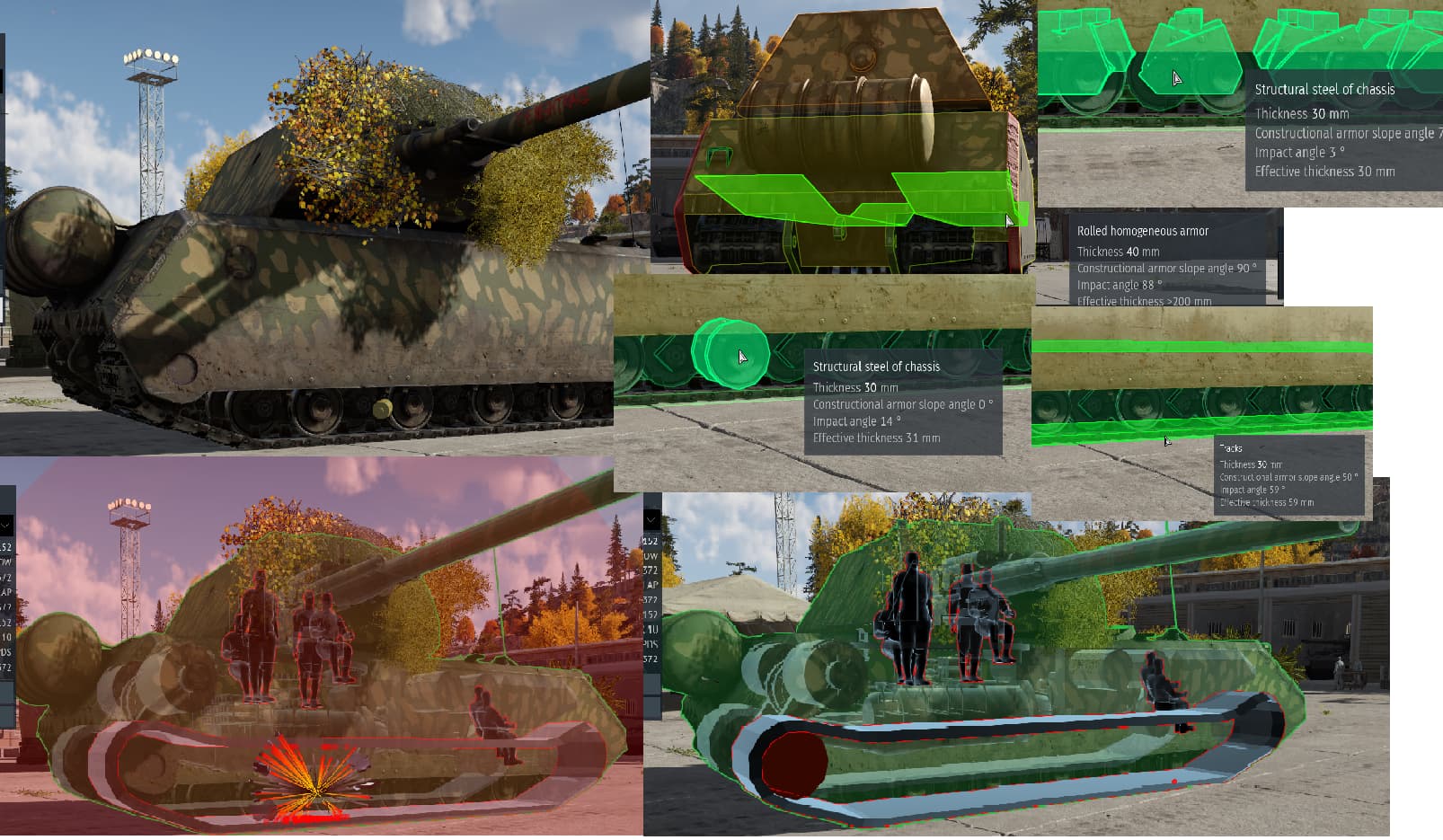
Example 1: T58 shot my roadwheel with a hesh round at around 250 meters. Somehow all crew got knocked out, even with the ACE qualification. How does a Hesh round thats hits an external roadwheel, blow up, go through a 30mm roadwheel, 30mm suspension part, 30mm thick track overhead, followed by a 40mm armour plate overhead end up inside the tank where it then proceeds to go through a not 1 but 2 20mm thick internal armour plates, an engine the size of fiat 500 and part of a huge transmission kiling the driver and machine gunner up there? Like what?
Example 2: Just got out of a match where the british nuke barn landed a hesh round on the triangle in front of the turret that kinda guards the radiator vents. However instead of detonating and my turret etc. catching the shrapnell, my entire crew got killed. If the driver, machinegunner and barrels would die i’d be okay with that. but how do 4 crew members die in a part that was never hit by the explosion? the only way in would be schrapness that bounces from the turret, inside the engine bay, go through a 20mm internal armour plate and then i’d have to go up somehow to get them. But this shit just feels out of place.
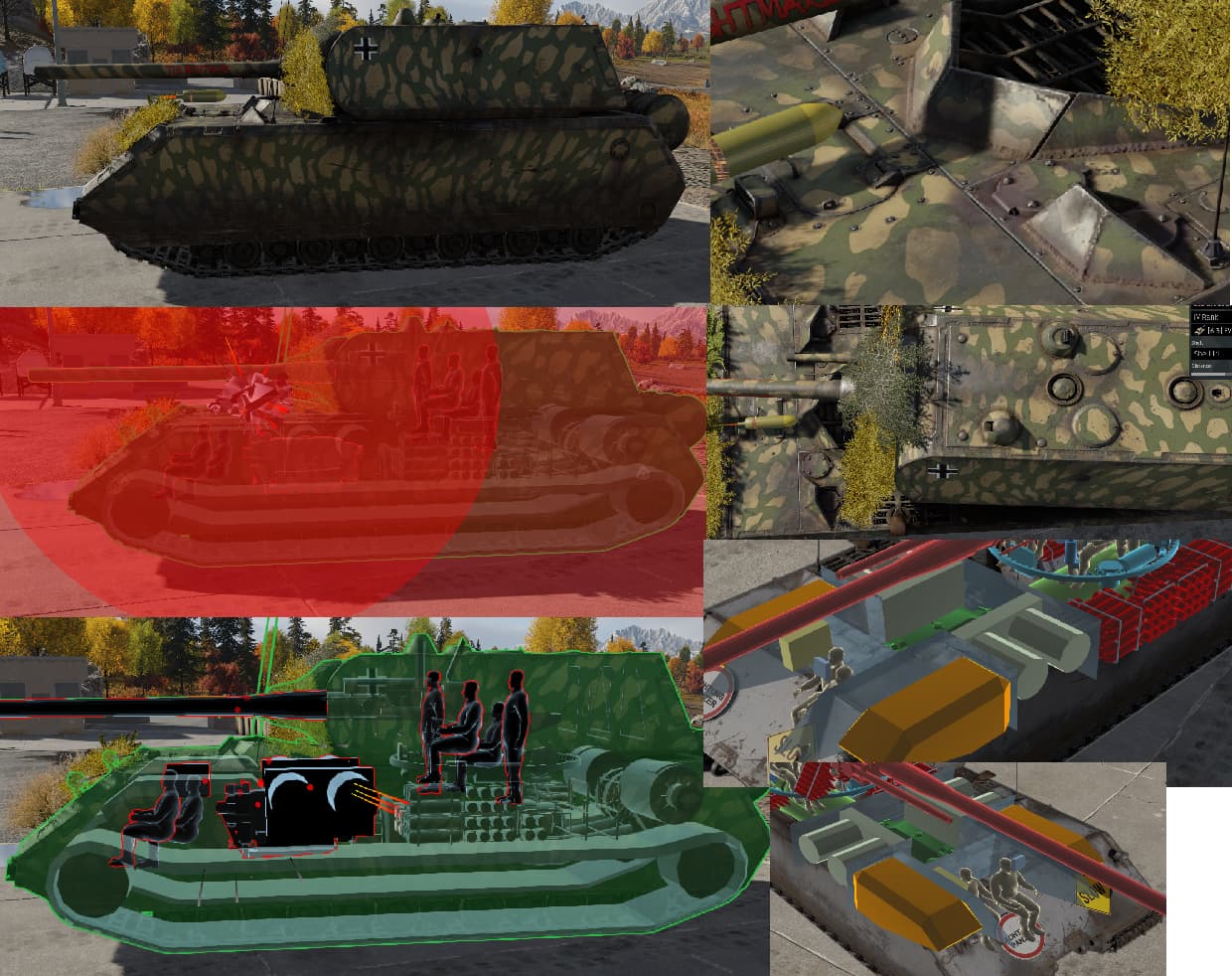
After playing around in the hangar with the simulate shot thing, i noticed hesh is acting way to strange in general. like how tf do some of these mean a total kill on the crew when explosion should have been absorbed largely by the ground? Mind you that this thing sometimes eat up to 3x 1000lb bombs when they come to revenge kill you and fail, yet a hesh yeets you to the hangar.
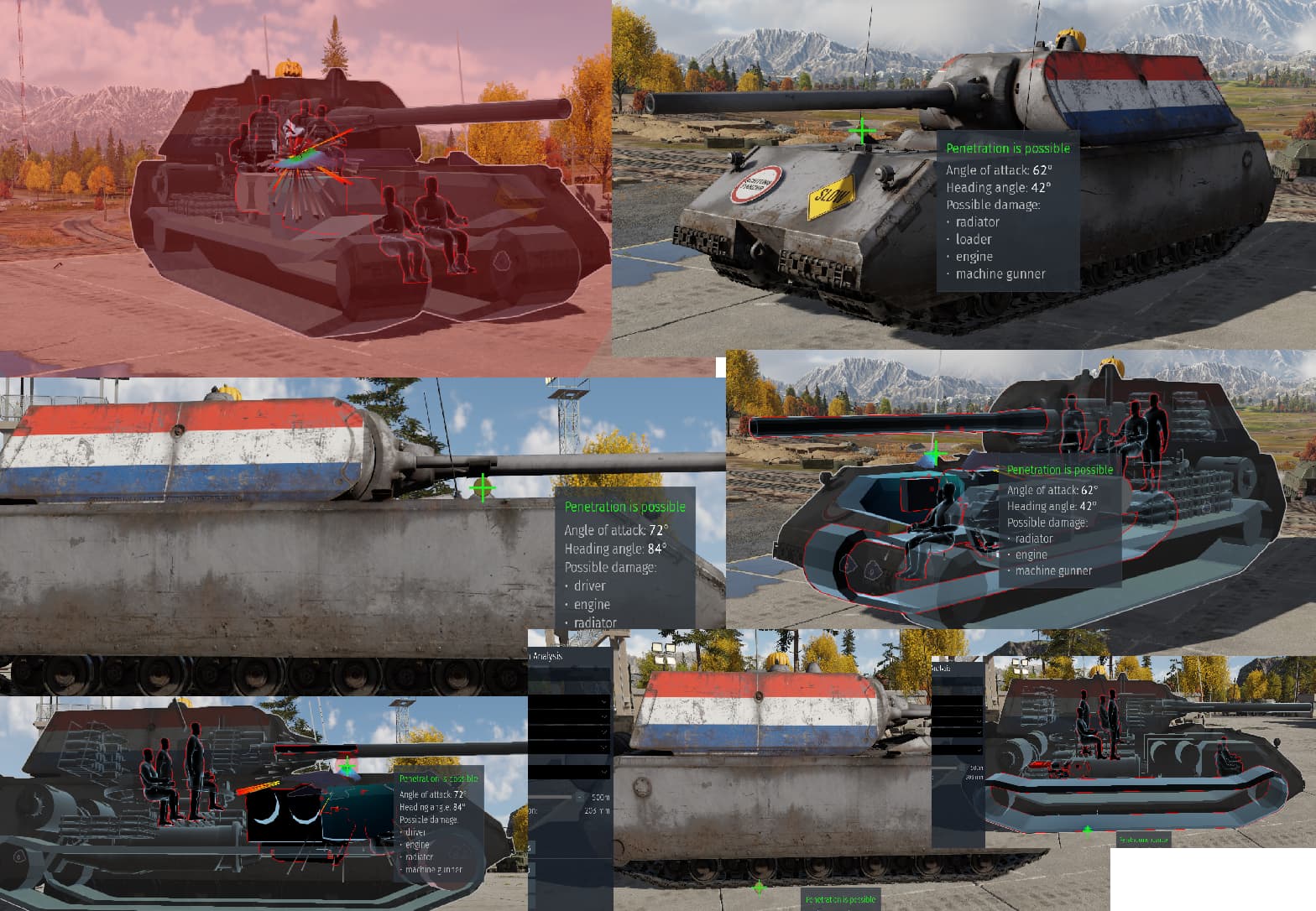
Yet they refuse to rework this mechanic