Would you like to see this An-32B in-game?
- Yes
- No
0
voters
An-32B Bomber

During the campaign against the Islamic State, the Iraqi Air Force fielded an Antonov An-32B tactical transport carrying conventional bombs.
The An-32 was developed from the An-26, and the An-26 had been designed during the Soviet period with a secondary bombing capability. Four external bomb carriers could be fitted to the fuselage, while an optical sight was provided for bomb delivery. The bombing installation had been tested as early as 1972. In effect, Iraq was exploiting a largely forgotten feature of the aircraft family at a time when it badly needed additional strike capacity.
The Iraqi An-32B bomber have been fielded in two distinct weapons configurations. One aircraft used four external BDZ-34 bomb carriers mounted beneath the fuselage, while a second was fitted with a removable roller-conveyor system in the cargo hold that allowed bombs to be discharged through the rear loading opening. Both arrangements were intended to carry up to four weapons, but the available evidence suggests that they were installed on different aircraft, rather than combined on a single airframe.
I have found no evidence that Iraqi An-32Bs ever carried eight bombs on a single sortie. For that reason, this suggestion is for the aircraft that has external armament, using the four fuselage-mounted bomb racks. Ultimately, however, the final implementation would be up to Gaijin.

This is a highly unusual aircraft and could make for a genuinely interesting event vehicle in War Thunder. Its biggest issue, however, would be its likely Battle Rating. It could place it alongside much older, Second World War-era aircraft. That historical mismatch may prove controversial with some parts of the community.
An-32 History with Iraq
Spoiler
The An-32 emerged in the 1970s as a more powerful development of the An-26, intended especially for operation in hot climates and at high-altitude airfields. Its two AI-20D Series 5 turboprops provided considerably more power than the An-26’s engines, while much of the fuselage, cargo system and general arrangement remained closely related to the earlier aircraft. Antonov formally designated the improved An-32B in 1987.
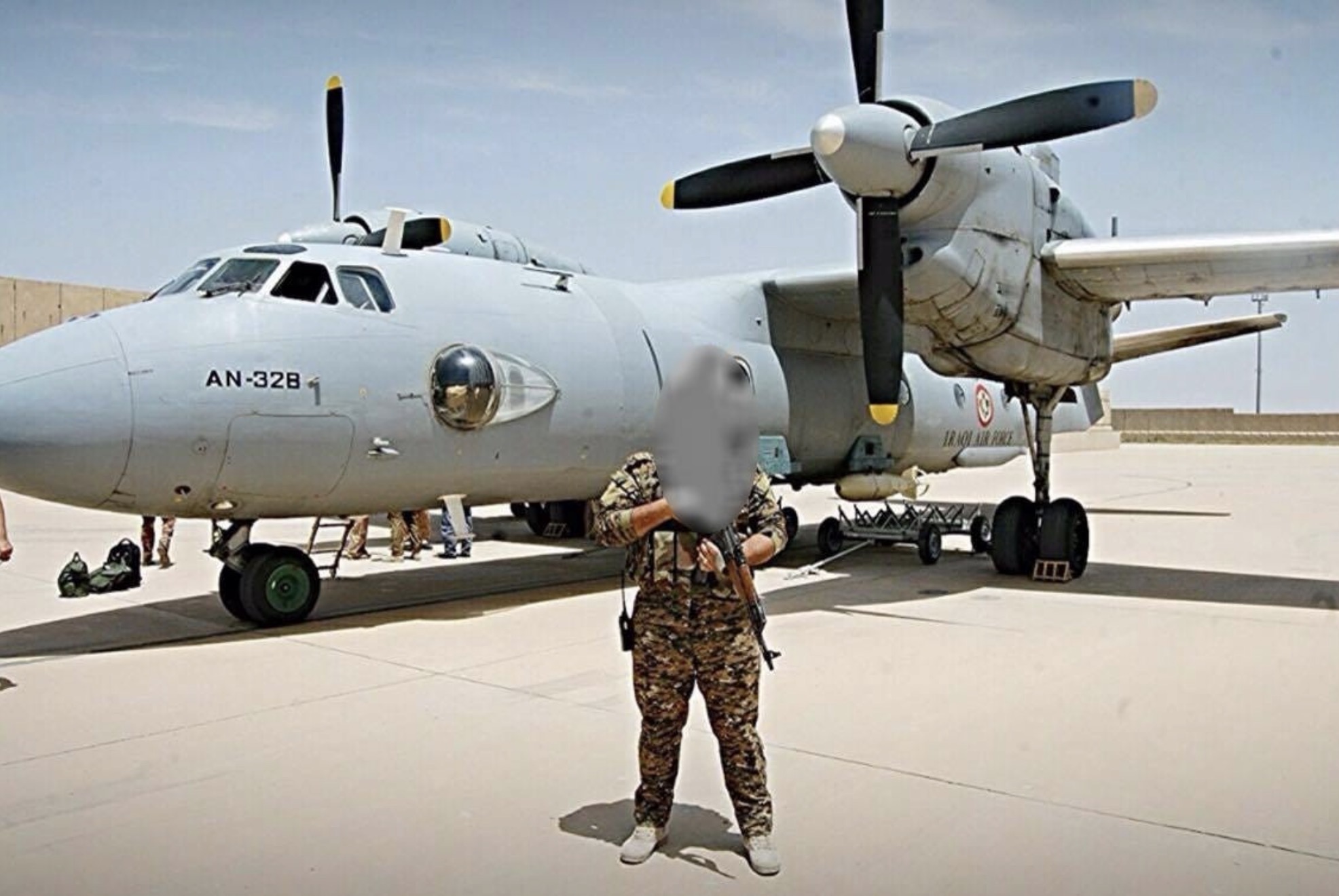
Iraq bought six An-32Bs from Ukraine under the wider program to rebuild its armed forces after 2003. The contract covered six aircraft together with technical documentation, spares, ground-support equipment and warranty support, at a total contractual value of about $96.9 million. Six aircraft were ultimately supplied to the Iraqi customer. Deliveries began in late 2011 and were completed in 2012. They were initially straightforward transports. By 2013 they were being operated by the Iraqi Air Force’s transport arm.
The fall of Mosul and the rapid expansion of Islamic State-controlled territory created an urgent requirement for aircraft capable of attacking ground targets. Iraq’s newly ordered F-16s were not yet available for combat inside the country, while the air force’s existing strike force was limited. Under those circumstances, even a slow transport capable of carrying several conventional bombs had value. Two of the six An-32Bs were prepared for bombing, with Ukrainian technical assistance.
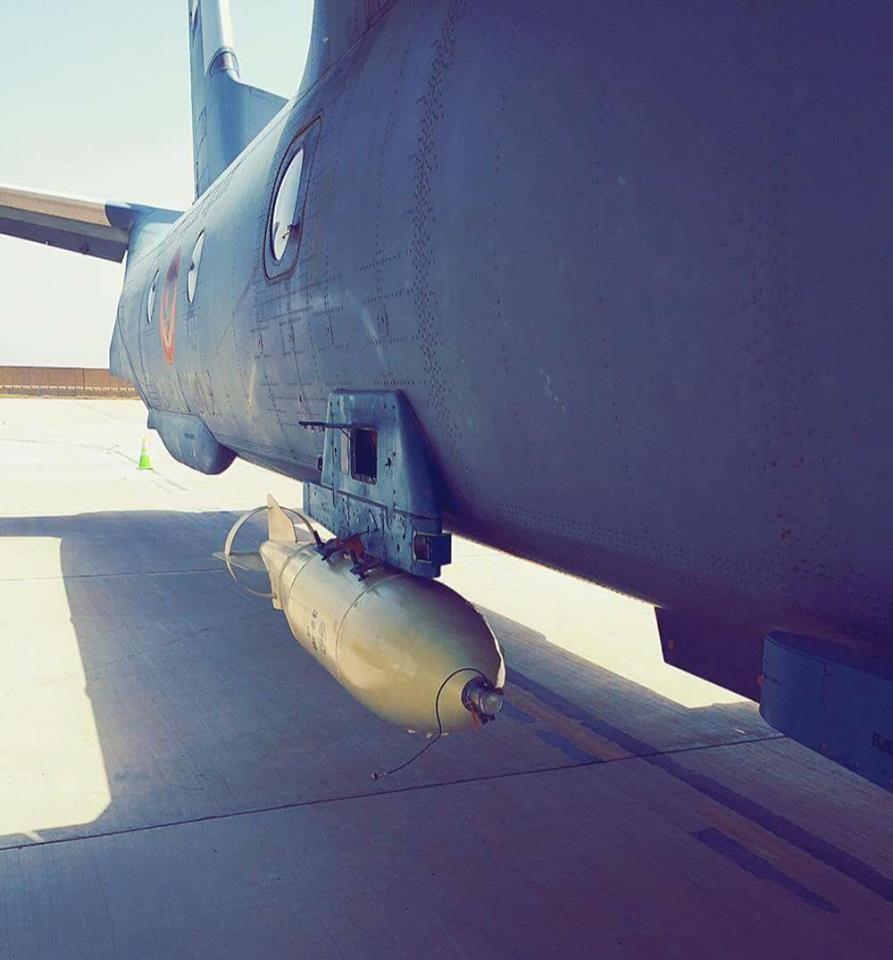
The Iraqi material credits the An-32 fleet with 990 strike sorties between June 2014 and December 2017. Against an opponent with a strong radar-directed air-defence network, using an An-32 in this manner would have been extremely dangerous. It was a large, relatively slow aircraft flying a predictable bombing profile. Against Islamic State, however, the air-defence threat was much more limited. That gave Iraq room to employ aircraft and weapons that would have been impractical in a conventional high-threat environment.
The Bomber In-Depth
Spoiler
The External Bomb Installation
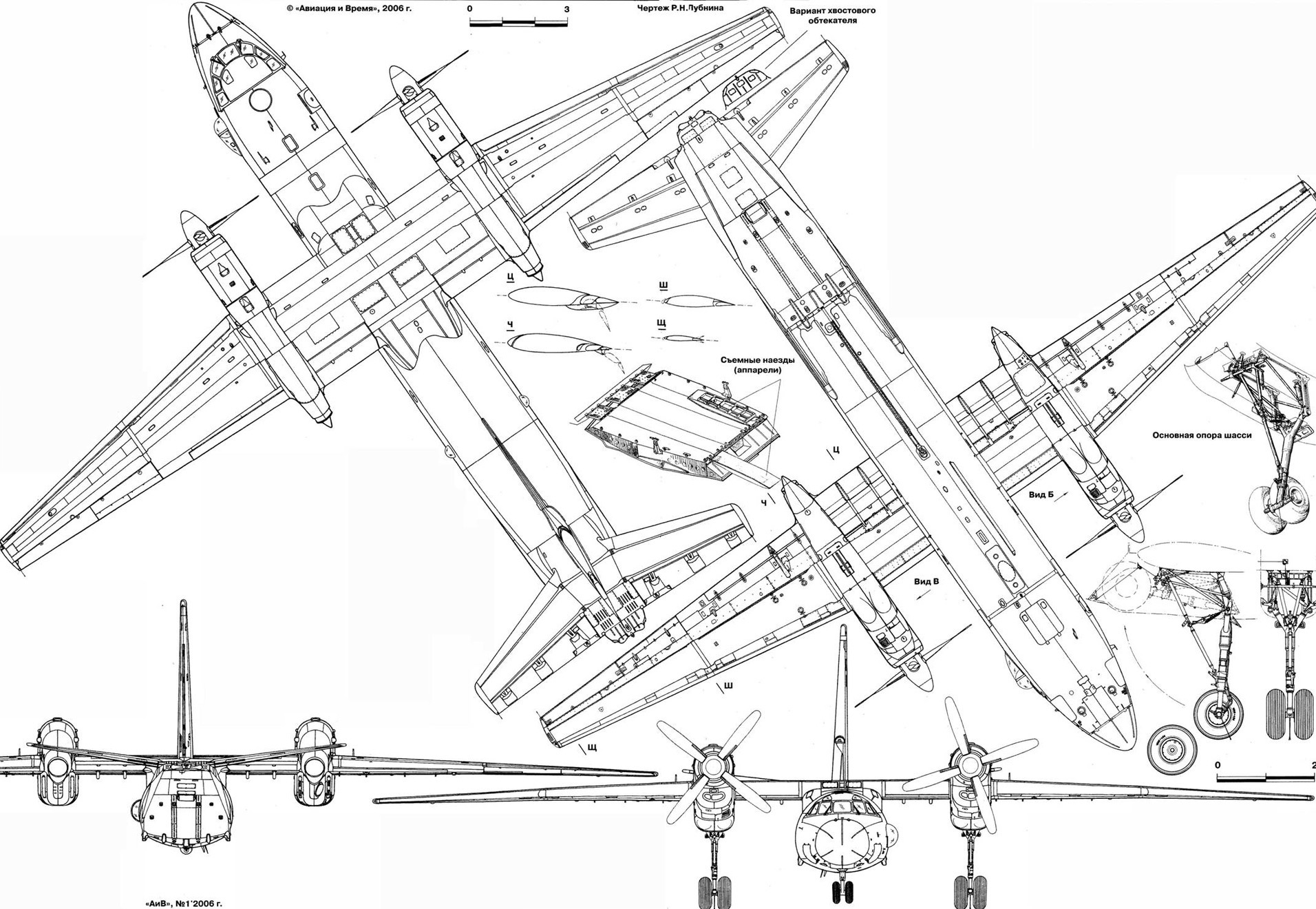
The first arrangement was the more conventional of the two. Four BDZ-34 beam-type bomb carriers were fitted beneath the central fuselage, with two positions on each side. The BDZ-34 arrangement belonged to the Antonov transport family’s original military equipment.
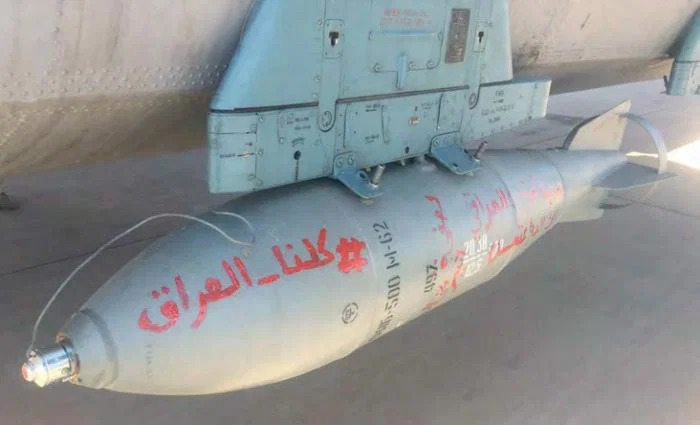
On the An-26, the four carriers were mounted on pylons attached to reinforced areas of the fuselage. The mounting areas are around fuselage frames 15–16 and 21–24. Tests conducted from Antonov’s Gostomel flight-test base in 1972 included flights with four FAB-500 bombs as well as lighter OFAB-100 weapons. Those trials found that the external load reduced speed and rate of climb but did not seriously alter the aircraft’s stability or handling.
The weapon associated with the Iraqi aircraft was a 500-pound, or roughly 227-kilogram, unguided bomb of Chinese origin. Four of these produced an external bomb load of only about 900 kilograms. Nevertheless, Soviet FAB-500-series bombs were another usable weapon.
The NKPB-7 bombsight
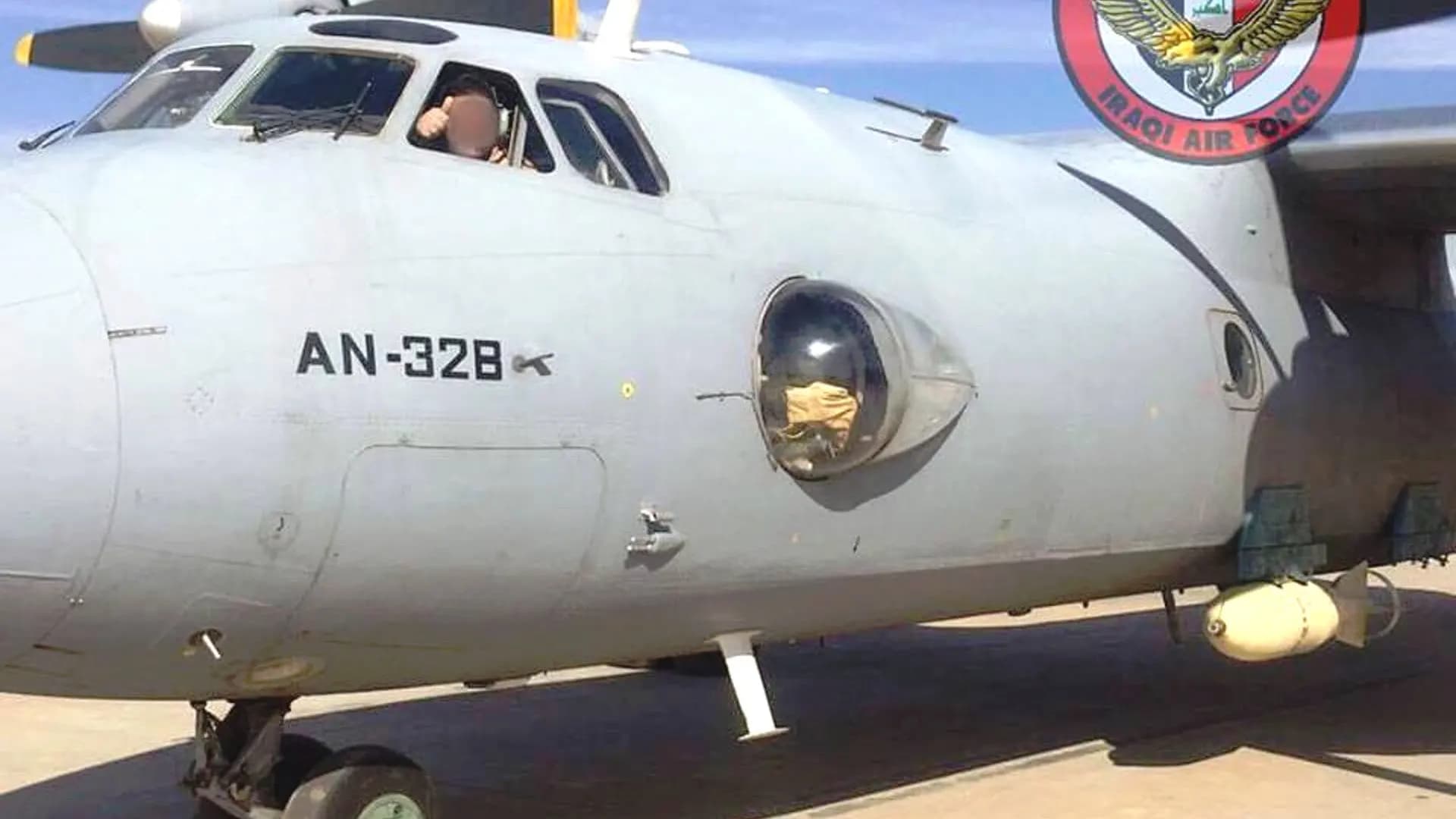
Bomb carriage was only half the problem. A transport aircraft also needed some means of deciding when to release the weapon. The aircraft family used the NKPB-7 optical sight, a simple Soviet-era device intended both for aerial delivery tasks and for bombing. The NKPB-7 was used from the navigator’s observation position on the left side of the forward fuselage.
It was not a modern continuously computed weapons sight. There was no targeting pod, laser designation system or GPS-aided weapon interface. The navigator or bombardier observed the target through the sight and the crew flew the aircraft onto the required bombing course, taking account of parameters such as altitude, speed and the ballistic characteristics of the weapon. At the calculated release point, the bombs were dropped using the aircraft’s electrical release equipment. The result was essentially conventional visual bombing carried out from a large turboprop aircraft. Accuracy inevitably depended heavily on crew training, weather, altitude and the quality of the bombing solution.
The cargo-compartment bomber
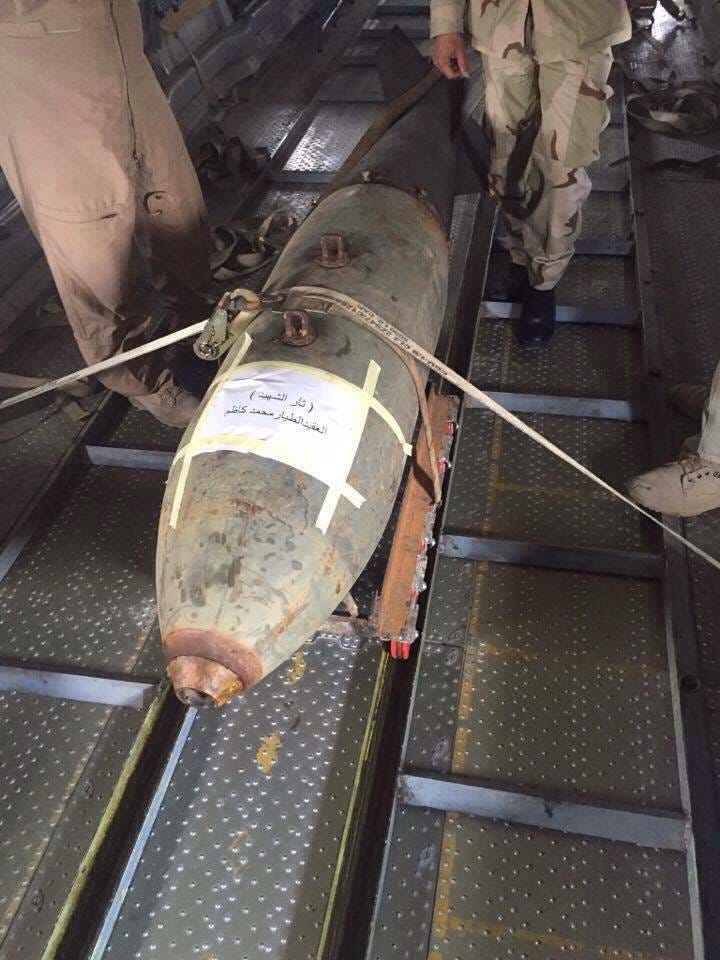
At least one aircraft was fitted with a removable conveyor arrangement inside the cargo hold so that the bombs could be carried internally and dispatched through the rear cargo opening. The Iraqi internal conveyor is documented as carrying four Chinese-made 500-lb bombs, each weighing only about 227–250 kg. The weapons were secured inside the hold on the removable conveyor. During the attack run they could be moved aft and released from the aircraft through the opened rear loading area.
Specifications
Spoiler
| Item | Specification |
|---|---|
| Manufacturer | Antonov Design Bureau; production at the Kyiv Aviation Production Association |
| Variant | An-32B |
| Type | Twin-turboprop tactical/utility transport |
| Configuration | High-wing monoplane with rear loading ramp and retractable tricycle landing gear |
| Crew | Normally 3: pilot, co-pilot and navigator; provision for a fourth crew member/flight engineer |
| Length | 23.68 m |
| Wingspan | 29.20 m |
| Height | 8.75 m |
| Wing area | 74.98 m² |
| Empty/equipped weight | Approximately 16.8–17.4 tonnes depending on equipment fit |
| Maximum take-off weight | 27,000 kg for the standard An-32B |
| Maximum normal payload | Approximately 6,700 kg |
| Fuel capacity by weight | Approximately 5,500 kg |
| Powerplant | 2 × Ivchenko/Progress AI-20D Series 5 turboprops |
| Power | Approximately 3,812 kW / 5,100 equivalent hp per engine |
| Propellers | Four-bladed, constant-speed, reversible-pitch propellers |
| Auxiliary power | Independent APU installation for ground operation and engine starting |
| Cruising speed | Approximately 440–460 km/h; Antonov quotes 460 km/h |
| Maximum speed | Roughly 500–530 km/h depending on weight, altitude and reference standard |
| Operational ceiling | Approximately 8,000 m |
| Range | Highly payload-dependent; Antonov gives about 800 km |
| Hot-and-high capability | Designed to operate from airfields at elevations up to approximately 4,500 m and in very hot climates |
| Runway capability | Capable of operating from austere and unpaved airfields |
| Cargo compartment length | Approximately 12.48 m |
| Cargo compartment width | Approximately 2.78 m |
| Cargo compartment height | Approximately 1.84 m |
| Cargo loading system | Rear cargo hatch and ramp, floor guide rails and removable roller conveyors |
| Cargo-handling equipment | On-board winch/hoist system capable of handling loads of approximately 3,000 kg |
| Maximum personnel load | Up to 50 troops/passengers |
| Paratroop configuration | 42 paratroopers plus jumpmaster |
| Medical evacuation configuration | Up to 24 stretcher casualties with medical personnel |
| Palletised load | Up to 12 small freight pallets in appropriate configuration |
| Cabin | Pressurised and air-conditioned |
| Airdrop capability | Cargo, pallets and vehicles could be delivered by parachute; removable roller equipment and floor guides assisted extraction |
Iraqi bombing installation
| Item | Iraqi configuration |
|---|---|
| Iraqi fleet | Six newly supplied An-32Bs |
| Aircraft reported as adapted for bombing | At least two aircraft |
| Nature of modification | Exploitation of existing An-26/An-32 bombing provisions |
| External bomb system | Four BDZ-34-series beam-type bomb carriers |
| Bomb-rack location | Two carriers on either side of the lower fuselage, beneath the wing/centre-section area |
| Original rack capacity | An-26-family installation was compatible with bombs weighing up to approximately 500 kg |
| Bomb type | Conventional unguided free-fall bombs |
| Bomb-aiming system | NKPB-7 optical bombsight |
| Weapon guidance | None |
| Delivery method | Visual/optical level or shallow-profile bombing using calculated ballistic release |
| External weapon release | Electrically controlled release from the BDZ-34 carriers |
| Internal bombing system | At least one aircraft fitted with a removable conveyor/roller arrangement in the cargo compartment |
| Internal bomb load | Four approximately 500-lb-class bombs reported |
| Internal release method | Bombs moved aft along the cargo-handling system and released through the rear cargo opening |