YAMATO DAMAGE CONTROL, COMPARTMENTALIZATION AND FIRE SURVIVABILITY
I am honestly disappointed with the current situation of the Yamato in the game. Historically, it should have been among the ships with the strongest damage-control and survivability characteristics available in the game.
This does not mean that the Yamato should be “invincible.” Rather, its design placed exceptional importance on compartmentalization, flooding control, damage containment, and firefighting systems.
Below is the documentation and evidence that I believe should be considered when evaluating its current damage model.
Some of the links may require access or a request for the book mentioned, but I believe that with a more in-depth search for the author, you may be able to find it available on other websites.
I gathered some opinions and information and asked ChatGPT to organize everything into a cleaner post format, with folders/sections that can simply be opened. I believe it may have made some edits to certain paragraphs without me realizing it, so I’ll leave it to naval experts to check the information and the links and point out anything that may have been changed or misrepresented.
I’d also like to remind everyone that, even though English is a universal form of communication, I still haven’t completely mastered the language. I can understand it fairly well, but I sometimes struggle with sentence structure and writing, so I use ChatGPT mainly to make minimal corrections and make what I’m trying to say more readable.
Thank you for your patience, and I hope you have a good morning, afternoon, or evening, wherever you are while reading this post.
Enjoy the reading !
📁 1. ORIGINAL JAPANESE DESIGN DOCUMENTATION
One of the most important sources is 「戦艦大和設計と建造」 (Design and Construction of the Battleship Yamato), associated with naval engineer Kitarō Matsumoto, who was involved in the Yamato’s design.
The National Diet Library of Japan has a record of the publication:
🔗 National Diet Library — 戦艦大和設計と建造
The publication contains technical material and drawings related to the Yamato’s construction, including material concerning its internal structure and compartmentalization.
📁 2. YAMATO'S INTERNAL COMPARTMENTALIZATION
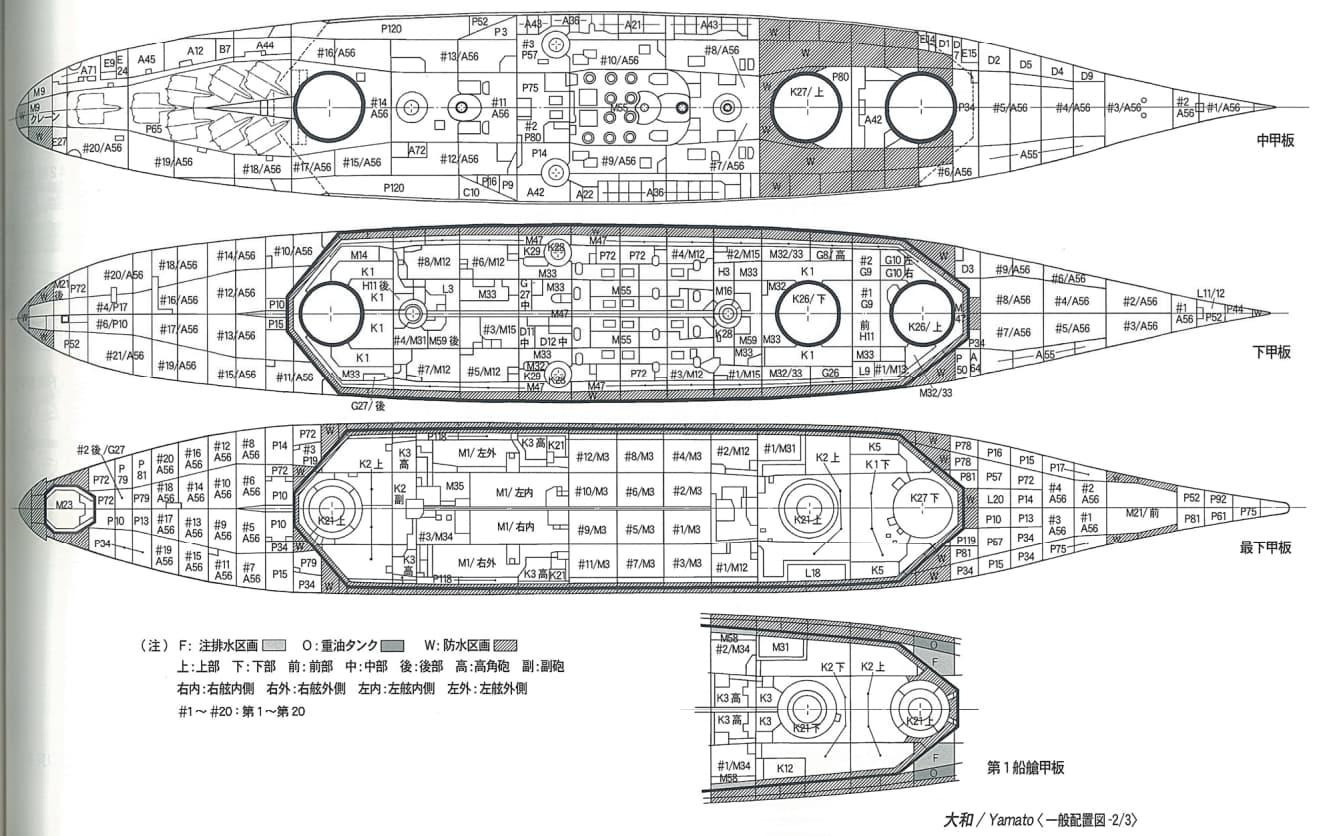
The Yamato had approximately 1,147 watertight compartments, with approximately 1,065 located below the armored deck.
This is extremely important because a warship’s survivability does not depend solely on armor thickness. Internal compartmentalization determines how far flooding, fire, explosions, and other damage can propagate through the ship.
Japanese documentation also includes drawings specifically concerning:
「軍艦大和前部・中央部・後部注排水区画図」
These are diagrams concerning the flooding, drainage, and compartmentalization arrangements of the forward, central, and aft sections of the Yamato.
🔗 Japanese archive record containing the technical drawings
This demonstrates that the Yamato’s internal subdivision was highly detailed and was an important part of its damage-control design.

📁 3. FIREFIGHTING SYSTEMS
The Yamato did not rely solely on its compartmentalization.
Japanese sources concerning the ship’s construction describe dedicated firefighting equipment, including foam-based fire protection systems, as well as structures intended to prevent and contain the spread of fire.
One particularly important point is that the Yamato had a foam fire-protection system installed as part of its original construction.
🔗 Japanese source discussing Yamato’s construction and firefighting systems
Therefore, the Yamato should not be considered simply as a ship with “many bulkheads.” Its design also incorporated systems specifically intended to fight and contain fires.
📁 4. CO₂ AND OTHER FIRE-CONTROL SYSTEMS
There are also Japanese references to carbon dioxide (CO₂) systems associated with firefighting aboard the Yamato.
Such systems were particularly useful in enclosed spaces, where a fire could be suppressed by reducing the available oxygen.
🔗 Japanese reference concerning the Yamato’s CO₂ system
I would consider this source less authoritative than the original technical documentation, but it is useful evidence for identifying equipment that can potentially be verified through primary documentation.
📁 5. FLOODING AND DAMAGE CONTROL
The Yamato’s extensive internal subdivision was also directly related to flooding control.
The internal compartments allowed flooding to be restricted to damaged areas, helping preserve the ship’s buoyancy and stability after severe damage.
This is important because damage control is not simply about extinguishing fires.
It includes:
• Isolation of damaged compartments
• Flooding control
• Drainage
• Stability management
• Isolation of damaged systems
• Firefighting
• Protection of vital areas
Therefore, evaluating the Yamato’s survivability only through HP, repair mechanics, or whether a fire module has been repaired does not necessarily represent the actual damage-control philosophy used in the ship’s design.
📁 6. INTERNAL-MODEL ISSUES IN WAR THUNDER
This becomes particularly relevant when looking at the Yamato in War Thunder.
There are discussions on the official War Thunder forum concerning problems with the Yamato’s internal partitions.
One of the issues specifically discussed is:
“Modeling of internal partitions in the hull.”
🔗 Official War Thunder discussion — How Survive with Yamato?
This is important because internal bulkheads and partitions can prevent a projectile, fragment, or explosion from directly affecting multiple vital areas of the ship.
📁 7. REAL YAMATO VS. THE IN-GAME INTERNAL MODEL
War Thunder obviously needs to simplify a ship as complex as the Yamato in order to create a functional game model.
However, there is an important distinction between necessary simplification and incorrect representation of structural elements that directly affect survivability.
The community has raised concerns regarding the representation of internal structures such as:
• Fragmentation bulkheads
• Watertight bulkheads
• Holding bulkheads
• Internal protection behind the main belt
• Subdivision of vital areas
🔗 Community discussion concerning the Yamato’s internal model
This should be considered community evidence rather than official Japanese documentation, but it is still useful because players have been comparing the in-game internal model with historical plans and structural information.
📁 8. WHAT DOES THIS MEAN FOR FIRE SURVIVABILITY?
This is the most important point.
I am not claiming that the Yamato should automatically extinguish every fire within a few seconds.
That would be difficult to prove from the available documentation.
The stronger and more historically defensible argument is this:
The Yamato combined extensive compartmentalization, dedicated firefighting systems, internal barriers, and sophisticated damage-control arrangements. Therefore, the containment and propagation of fires should take these characteristics into account.
A fire starting in one compartment should not necessarily behave as if the entire interior of the ship were one open space.
The combination of:
watertight compartments + internal bulkheads + firefighting systems + isolation of damaged areas
should contribute meaningfully to the ship’s survivability.
📁 9. WHAT IS ACTUALLY DOCUMENTED?
🟢 Strongly documented
• The Yamato had a very large number of watertight compartments.
• Its internal subdivision was extensive.
• Japanese drawings exist showing its flooding/drainage and compartment arrangements.
• Damage control was an important part of the ship’s design.
• Dedicated firefighting systems existed.
• Foam-based fire protection was incorporated into the Yamato’s design.
🟡 Reasonably supported, but requiring stronger primary documentation
• Exact details of the CO₂ firefighting system.
• Exact numbers and locations of specific firefighting equipment.
• Specific response times of the firefighting systems.
🔴 Claims that should NOT be made without further evidence
• That every major fire could be extinguished within a few minutes.
• That the Yamato was practically immune to fire.
• That every piece of the real Yamato’s compartmentalization is necessarily missing from the War Thunder model.
📁 10. CONCLUSION
I am not asking for the Yamato to simply receive a “buff.”
I am asking for its damage-control and internal survivability model to be reviewed against the historical documentation available.
The Yamato does not need to be invincible.
However, if War Thunder aims to represent historical warships, its survivability should take into account the engineering that was actually incorporated into the ship.
We have Japanese documentation concerning:
→ Compartmentalization
→ Flooding and drainage systems
→ Damage control
→ Firefighting systems
→ Internal barriers
→ Hull structure
We also have discussions on the official War Thunder forum concerning problems with the Yamato’s internal partitions.
For these reasons, I believe the Yamato deserves a technical review of its internal model and damage-control mechanics.
I am not asking for a “buff.”
I am asking for the in-game model to better represent the ship that was actually built.