I’m having moments where I’m going mach 1.2—not got all the upgrades yet—and I’ll shoot a missile down at a guy. It’s one thing if it’s multipath, it’s another if the missile I see go stupid chasing chaff. I get that the seeker head will jump inbetween the two, the target, and the chaff. But I have a steady TWS with an unobstructed lock. In fact there are times where the same happens when I have a hard lock and some how the missile will choose the chaff instead of actually listening to my damn radar. I’ve noticed this happen when a dude is running away from me popping chaff. I have a steady lock and the missile just ignores what my TWS says and will chase a chaff that’s far behind him.
I get it if it’s a PESA radar. Duh, but in the AESA era. Why aren’t missiles just… Listening to TWS if it detects chaff. It’ll lock the chaff too.
I think this issue would be fixed if two way data link was modeled in game, but as it stands the AIM-120D has the same seeker and guidance methods as the other AMRAAMs in game.
Once the Missile pitbulls at 16km, in my experience, datalink from TWS does very little if anything at all.
in-game, once the missile goes active it largely ignores what you are doing and is dependent upon its own seeker. There are times where the DL will re-engage, and so maintaining the lock till impact can be useful. but most of the time, once it has gone active, you can go cold.
You can tell whether the missile is listening to your radar or not by the pressence of a small dash above the target on the radar screen which looks like this:
I genuinely dont know if they should change this behaviour, it would be more realistic but make fox-3s way more dangerous and the game isnt ready for that. The maps are too small, there are major issues with how chaff is modeled in general, lack of systems such as ECM, etc etc. In the future, absolutely, but for now, I think they should focus on fixing everything else, this include actioning reports for missiles, such as the AMRAAM’s kinematic performance, smokey exhaust and some seeker buffs.
My best advice for getting AMRAAM to work well is this:
Fire fast, if you can, get up to Mach 1.4 kind of range, they like a fast launch
Fire high, 25k ft seems to work quite well for me.
Dont make the missile work too hard, fire towards the intercept point that should be displayed on top tier aircraft
Try and fire within the LSZ, doing so greatly improves the chances of your missile hitting. (note, it can be buggy at the moment)
Support the shot all the way as best you can, but dont choose it over dying or getting into a bad spot
Look for vulnerable targets, those at contrail height will struggle to defend and aircraft like F-15s and Su-30s are very vulnerable to top down attacks if they are flying low due to a lack of spherical RWR.
Then it’s not worthwhile. You’re having a missile whose main use case is long-range. And gaijin’s idea is to make it where you completely nullify it by just spamming chaff.
Meanwhile you have MICA missiles and R-77-1s that turn on a dime.
When I fight Eurofighters. I almost never go down from the AIM-120 but the 9M or I get shot down when I’m forced to close in because nothing but 1 circle exists in this game.
If you’re not going to do it right to the best of your ability. Don’t add it at all.
Not only from a gameplay perspective but also from a historical perspective as I’ve seen people’s perceptions of a vehicle’s performance get affected by this game.
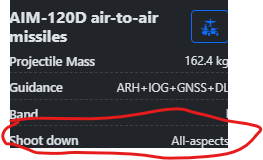
Ds are significantly better at energy retention, which means that even if they have less practical overload and pull the Gs subtly slower overall, they’re able to pull at least 15-25Gs beyond 20kms. That alone implies they’re effectively better for most of kinematic circumstances than C-5s. I nearly tore my scalp trying to make C-5s work when I got them in my EFs because once they go below M2, they barely turn at all compared to AIM-120A|B/Ds.
C-5s are borderline pathetic to the point they’re not the fastest (120D), neither have the furthest range (120D) or pull the hardest Gs of the AIM-120 series (120A/B).
I dont know where people get this kind of insanely wrong information
if you want just look at the weapon spreadsheet that shows that they have identical PID terms, and are kinetically identical other than the 120D weighing just under 1kg more
120C actually has fractionally faster times to target due to the reduced mass
it doesnt do that, and even if it did that would only hurt the 120D because it has a randomized positional error instead of a constant drift
the 120C IOG is actualy more accurate until its drifted for a few seconds, and in what scenario is your 120 that was fired at long range flying on IOG for more than a few seconds
IOG+GNSS help Ds to have less drift, keeping more energy in the process, simple as.
AIM-120Ds are strictly better missiles than AIM-120C-5s at every BVR scenario you can think of. At WVR or below 8kms, resort to AIM-120A/B.
yeah, thank you for confirming that you are just hallucinating
no
like really just no
exactly when does GNSS come up in the most common and effective BVR where you retain DL?
you know given that the missile finds the target when its ~20km out its not excatly flying on IOG long enough to notice the drift, which means that the 120C is superior due to the reduced weight and slightly better energy retention in manuvers (caused by the reduced weight)
and I dont think you understand how IOG drift impacts a missile because it is not how you seem to imply