You can go supersonic if you lower your IAS by going a bit higher
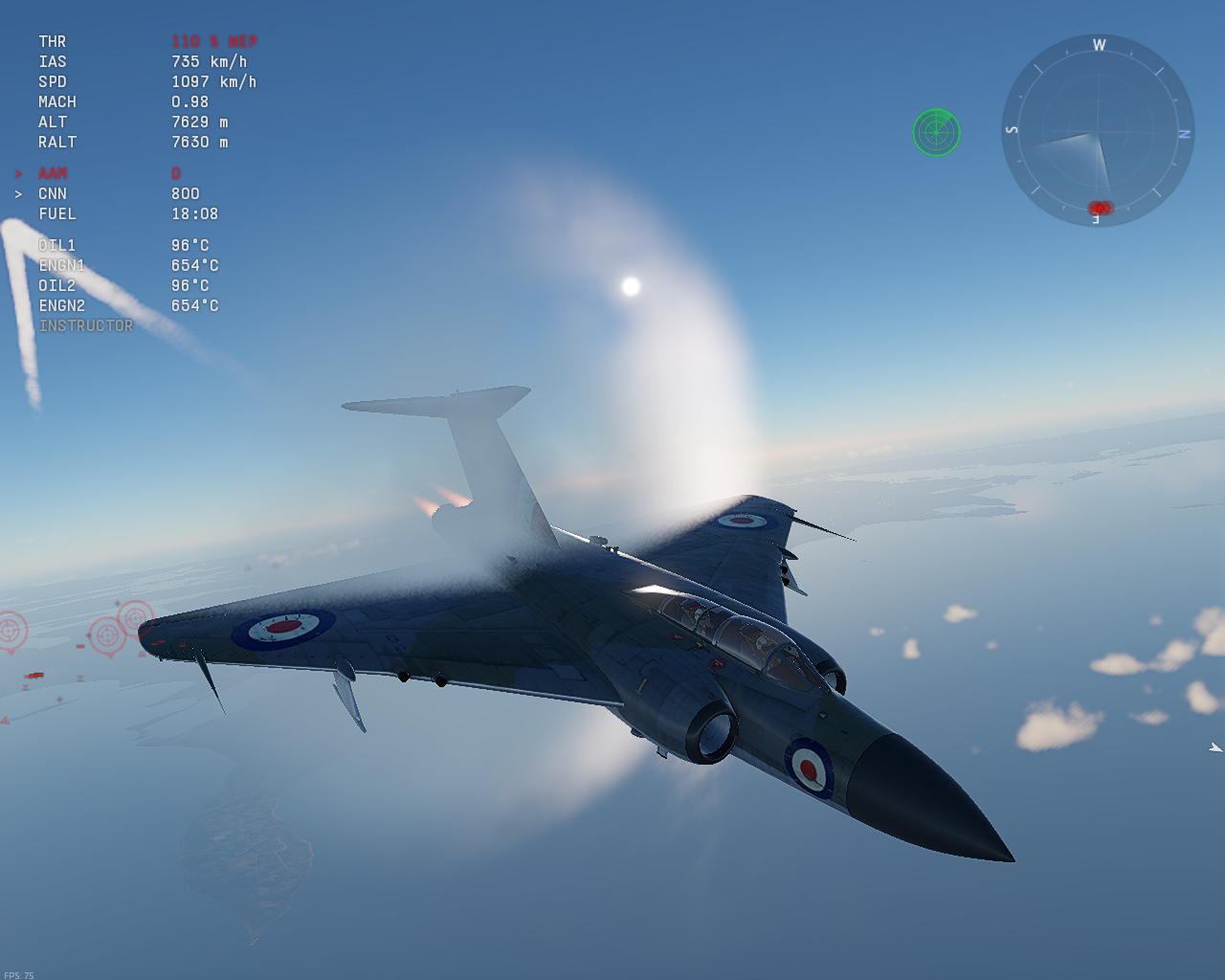
When they did it over London, at what alt did they fly?
You can go supersonic if you lower your IAS by going a bit higher
1954 IIRC The pilot was distracted with something and accidently went supersonic
From the little research Iv done it was often heard booming and could go supersonic in dives
Makes sense as its flying just under in normal flight, so dives would be certain death without dropping speed before
Taken from wiki The Gloster Javelin was capable of flying at speeds just under the speed of sound, with a maximum speed of around Mach 0.95 at altitude. It was transonic, meaning it could fly at supersonic speeds in a dive, but it was not a true supersonic aircraft in level flight. ]
it doesn’t matter. This is just a discussion. Collecting data is also a way to help me increase my knowledge. The game also sets a very high altitude temperature, which reminds me of when playing 229 in cold regions or on snowy maps, feeling that the engine is very weak. Of course, in that game, everyone’s plane was like this. Height affects temperature, and temperature leads to a decrease in the speed of entering the sound. The thin air in high-altitude areas reduces resistance, which also meets the conditions for a sonic boom. Although we don’t know the specific numbers on each map. However, at a height of -40℃, a sonic boom of ≥1105 km/h is within a reasonable range.
What altitude did you try this at? Javelin has a M1.07 limit, so it can go supersonic but ONLY at medium-high altitudes, otherwise the indicated airspeed limit is reached first.
Not sure, when i used the jav it was one of the first jets i played so doubt i was high lol
Would it really rip wings IRL if it was too low though? The Jav IRL was dangerous, killed test pilots, 2 or 3? maybe im wrong and some managed to bail, its been a minute since i watch the vid. And used to flat spin which you couldnt recover IIRC
The “rip speeds” we have are the “do not exceed” speeds from manual, with +30kph or so as a margin. So not necessarily, as some planes went far past their manual speeds and stayed fine.
But no real way to know, and beyond that speed you would be taking a huge risk as to whether your plane stayed in one piece.
Your first mistake was playing Germans and expecting “balance”
Second mistake expecting Gaijin to care
Third mistake is not making thread " give us premium gold ammunition forHo229 at $1.99 per bullet"
The mach limit is 1.1 actually. But yeah, just climb to 10,000m, accelerate to top speed and start diving and you will be supersonic in no time.
Your thrust actually increases on cold maps since the air is colder and denser.
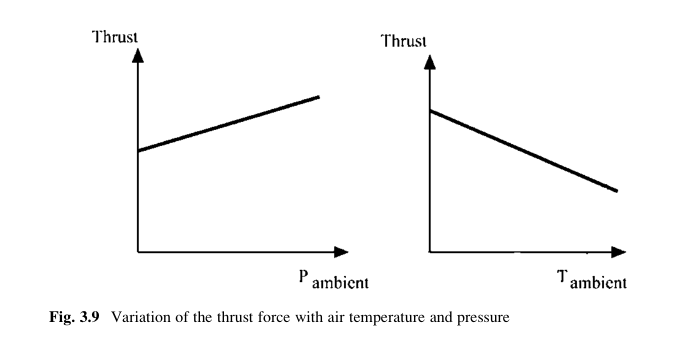
I don’t think war thunder models temperature change at altitude though.
The rip speed calculation is actually flight manual do not exceed x 1.05 i believe. You can do the math for Javelin, Maximum speed in the manual at sea level is 535 kts which is about 990.82kph x 1.05 = 1040,3 which more or less matches the 1041 ripspeed we eventually got for it.
Decrease in air density more than counter-acts decrease in temperature, since htedensity already “includes” the temperature.
I realize this, but like you can’t cool your radiators down to -40°C if you go high enough and turn your engine off is all i mean.
hahahaha
When I play with other fighter jets, I find that they generate a lot of heat at low altitudes, but the temperature drops significantly when they climb to high altitudes. For example, the Su-11, continuous low-altitude flight will cause the engine to overheat. Another point is that after continuous combat, the temperature of the ho229 engine will also rise to the critical value. However, when I climb to a high altitude at the same speed, its temperature will also drop. Does this indicate that the game is not so detailed, but there is indeed a setting for high-altitude temperatures?
Besides, shouldn’t the thrust of fighter jets’ engines decrease at high altitudes? For instance, due to the decrease in air density and insufficient oxygen content.
Moreover, in the game, the practice of high-altitude acceleration obviously requires a much longer time.
I don’t know if what I said is right?
The temperature of the engines decreases because thrust output decreases. It’s a function of air density, not temperature. I have tested this, i tried going to 15km and turning my engine off and waited to see if it would go below the default map temperature and it never did.
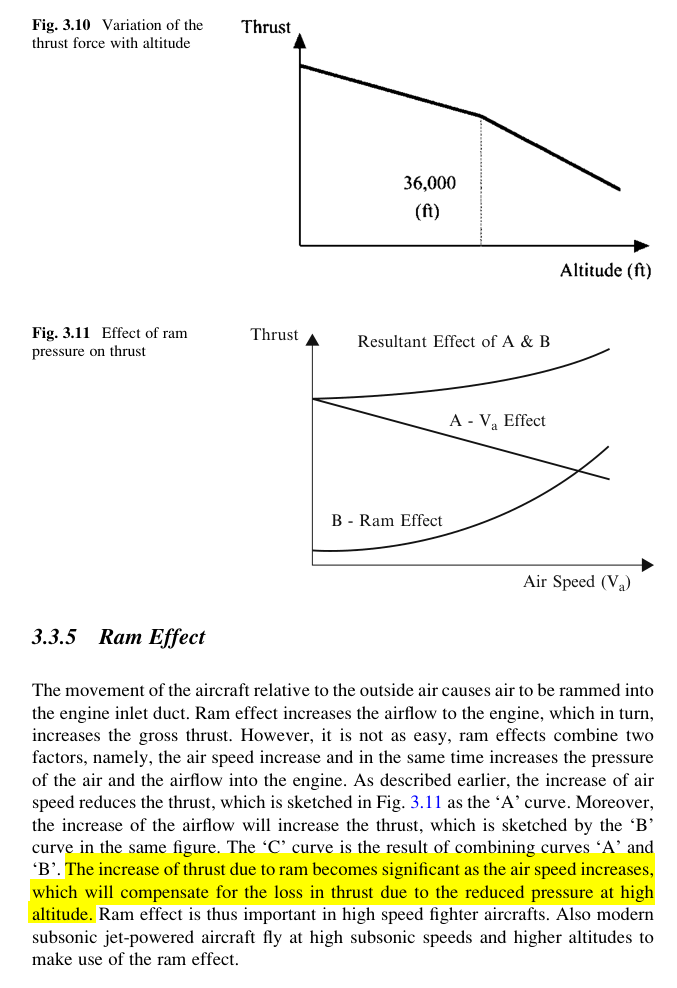
And yes thrust generally decreases at altitude unless you are in a top tier afterburning jet maintaining near peak IAS speed, then you will generate the same thrust regardless of altitude because the ram effect offsets the decreased air pressure.
Do you know how we called Japanese fighter jets in the past? In that era when only the F86 was the top jet.
We refer to Japan as the major shareholder of gaijin because Japanese fighter jets enjoy preferential treatment for air takeoff, and the power of the R2Y1 is self-evident. So why not talk about the air takeoff of the F84G? Because the R2Y1 was too agile in the past, both the modified 234C and me163 (R2Y1、ki-200)were much stronger than the original German fighter jets.
I still clearly remember that at that time, the ho229 had almost no control. If it was hit, it would catch fire. Even if the speed was above 500 and the decelerator was opened, it would be torn apart. Thus, gaijin’s first fighter jet with a decelerator that could be torn apart was born.
At that time, almost everyone was playing with the ho229, so some problems were quickly fixed. After all, German fighter jets had once been glorious in the WT. hahaha
It seems that this is indeed the case. Just now, I observed for a long time using port 8111, gliding down from 8500M to 6000m. It took me about ten minutes. The engine temperature did not drop any further. The su11 remained at 15℃ without any change. You’re right
229 would just need an actual usable rollrate.
It is atrocious, I keep easily pulling into an enemy 6 only to miss because my plane was a 2 degrees tilted to my left, and because I don’t have rudder, all my rounds passed by 1 meter from the enemy.
13 seconds for a full barrel w instructor
9 with full controls, but your nose falls down (i’ve only pressed my roll key)
You have to create situations where the roll rate does not matter.
You can also tilt your ho so you can use some of the pitch as your rudder, for example, when chasing someone that is not turning.
Even in 2026, when I search for genuine feedback from other players about the Ho-229, I still come across someone who once chatted with me—still stuck on his pitiful performance record with the Ho-229, bragging about it despite knowing nothing at all. So I feel compelled to supplement some original information about the Ho-229 to help more players who enjoy this aircraft. I’ll provide a more detailed explanation regarding the speed comparison between the Spitfire Mk 24 and the Ho-229, as well as the climb performance of the Ho-229. Honestly, I don’t want to wake up someone pretending to be ignorant。
Since I don’t want to engage in any conversation with him, and his understanding of ho229 is limited to a certain stage where he’s stuck, I’ll include this person’s reply image so everyone knows which part I’m responding to. This will make it easier for people to see exactly what he said and what I replied.
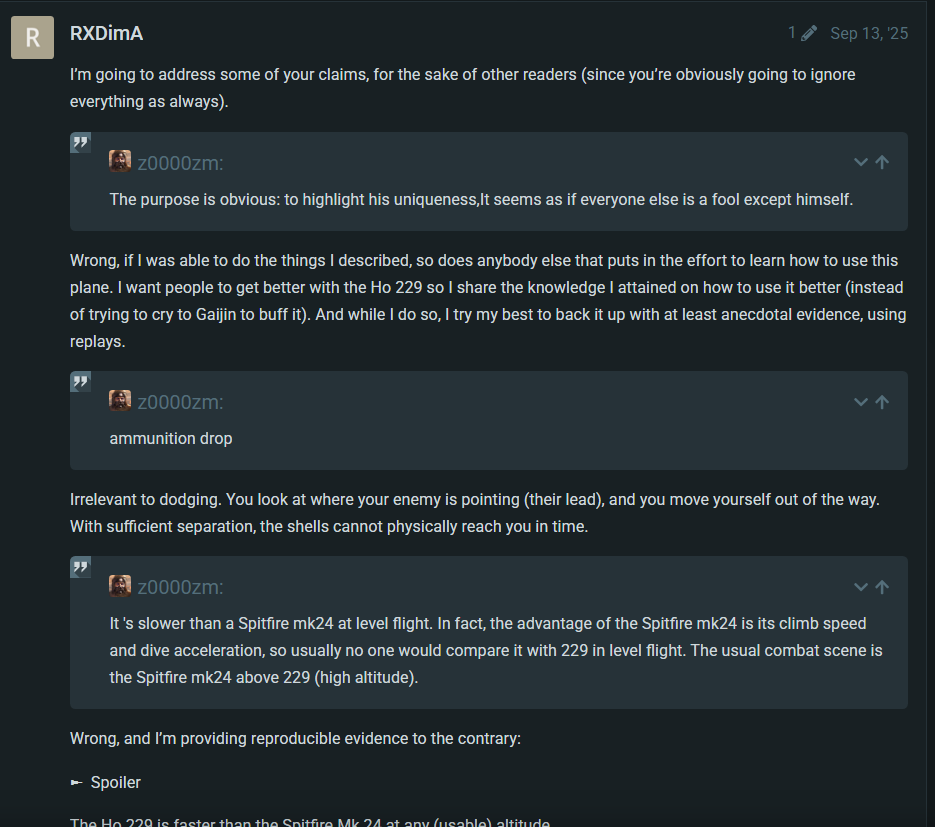
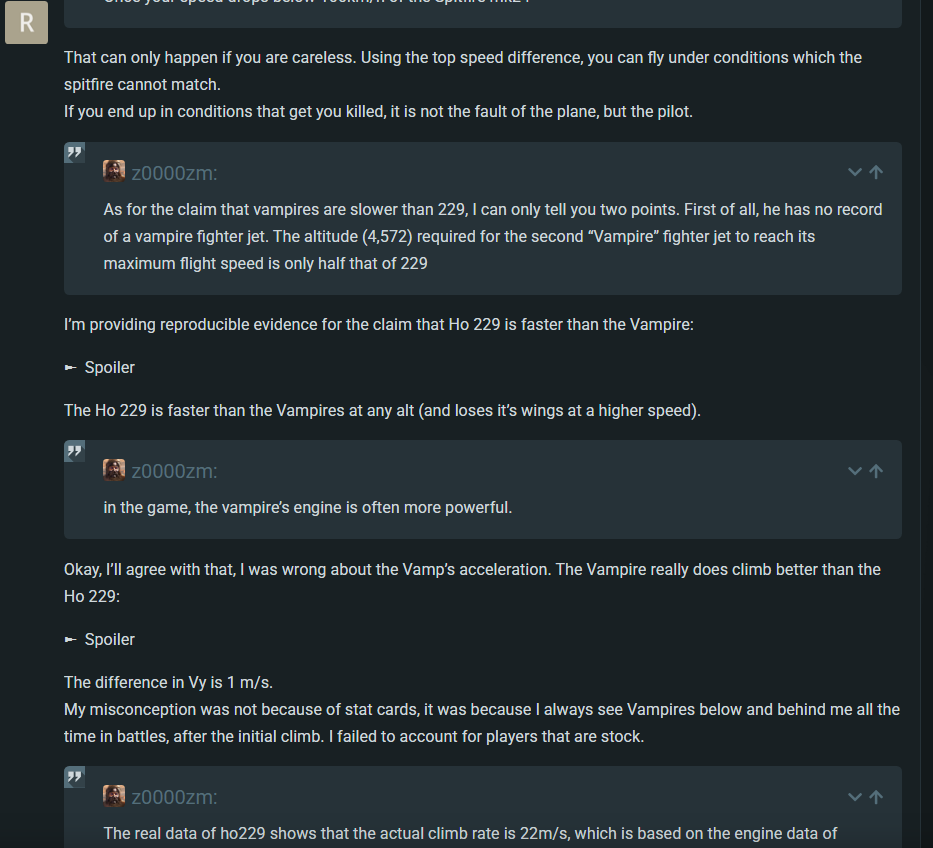
Now I will give my response:
Let me first explain why he misunderstood or even distorted what I said—because he has too little combat experience, too few battles, and insufficient data in both theory and practice. As a result, his response to the points I raised naturally became distorted. Data reflects people’s understanding of reality, yet he dismisses my data and insists he is right. There’s a term that perfectly explains his behavior: anecdotal fallacy (curious readers can look it up).
First of all, players who often play the Spitfire 24 fighter know its climbing ability. If played enough, most of the time the Spitfire 24 fighter will be at high altitude, above our heads. When attacking, it quickly converts altitude into speed advantage, which is why I mentioned that the speed (acceleration) of the Spitfire is faster than that of the HO229. Ho229 also requires slow accumulation of speed during diving, unless a large angle diving is adopted to widen the distance.
Let’s take a look at how he replied to my question. It’s ridiculous to compare the horizontal flight of the Spitfire 24 fighter jet with the HO229 fighter jet. What did I say? He doesn’t understand anything at all, that’s why I said he doesn’t understand what I’m talking about.
In addition, at an altitude of 8000 meters, compared to the Spitfire 24 fighter jet, when the HO229 fighter jet climbs to this altitude, a Spitfire 24 fighter jet with undamaged performance would normally be at least at a higher altitude than the HO229. Another comparison of the speed of Spitfire and HO229 fighter jets at an altitude of 8000 meters at the same altitude. The person who replied to me had no idea that the engine thrust of Jumo004D attenuates at high altitudes, and it is very severe. At the same time, there is no doubt that the Spitfire 24 fighter jet is at a higher altitude, and anyone can test it. (But please go to the game for actual combat)
The same issue applies to testing with Swedish jet fighters below. I can’t help but wonder why he always denies other people’s data and the advantages of fighter jets to discuss the HO229? Later, I figured out why he was doing this, in order to make his own theory stand firm and make those who didn’t understand think he was right. But as long as you are frequently in game rooms with weights of 7.0-8.0, you will find that the two being tested are usually at higher altitudes than ho229, and the thin air at high altitudes can allow opponents to achieve higher speeds than sea level, even if the speed is lost, as long as they are in a diving state, they are enough to catch up with ho229.
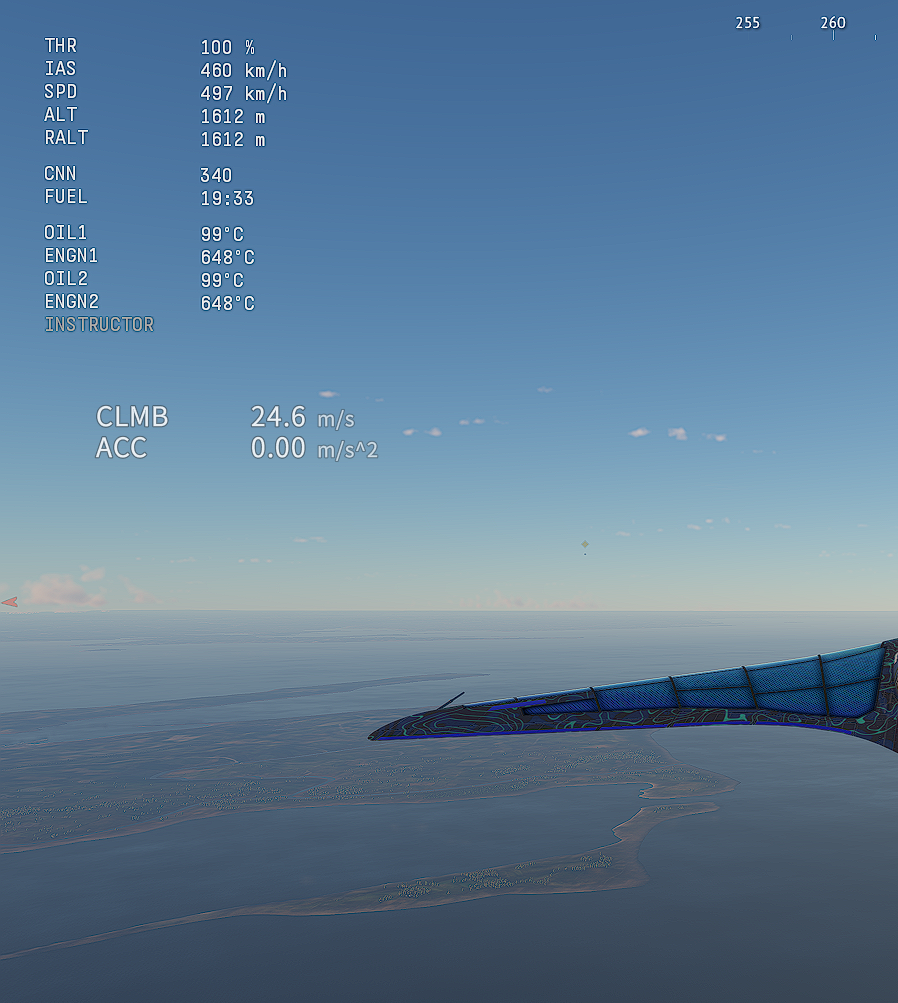
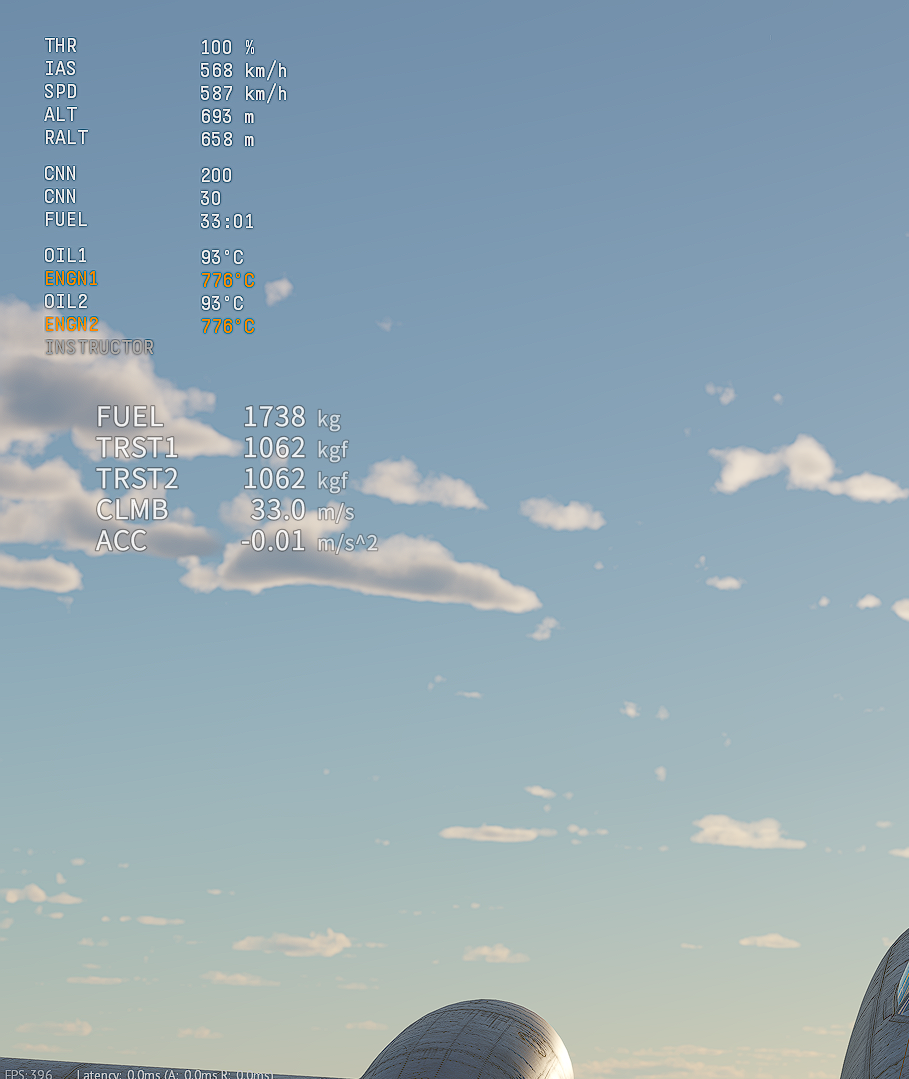
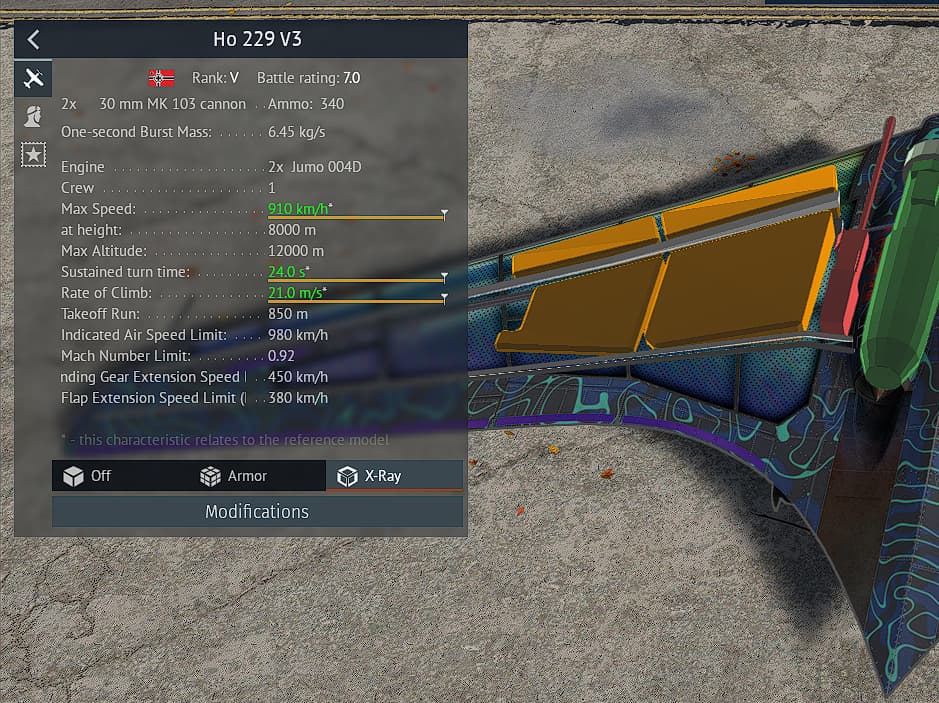
Another comparison chart of two fighter jets climbing at a low altitude of 400 meters shows that the same issue is not the difference of 1 meter per second, but rather the fact that the engine of the HO229 cannot achieve a climb rate of 24.7m/s near an altitude of 1800 meters. At this time, it is necessary to increase the climb angle to ensure the climb speed, which will result in faster speed loss. If you want to reduce speed loss, you need to lower the climb angle.
I will provide historical information that can be found online. First, we need to clarify a logical point: historically, the Ho 229 used the Jumo 004B engine, which had slightly less thrust than the Jumo 004D in the game, with the Jumo 004D producing 1,050 kgf. Now, let’s look at the climb rate of the Ho 229 (Jumo 004B) in real historical tests, and compare it with the so-called enhanced Ho 229 (Jumo 004D) in the game to understand whether its climb rate is realistic.
I will provide data for the Ho 229 from both the game and historical records.
The following are data from Wikipedia as well as in-game data:
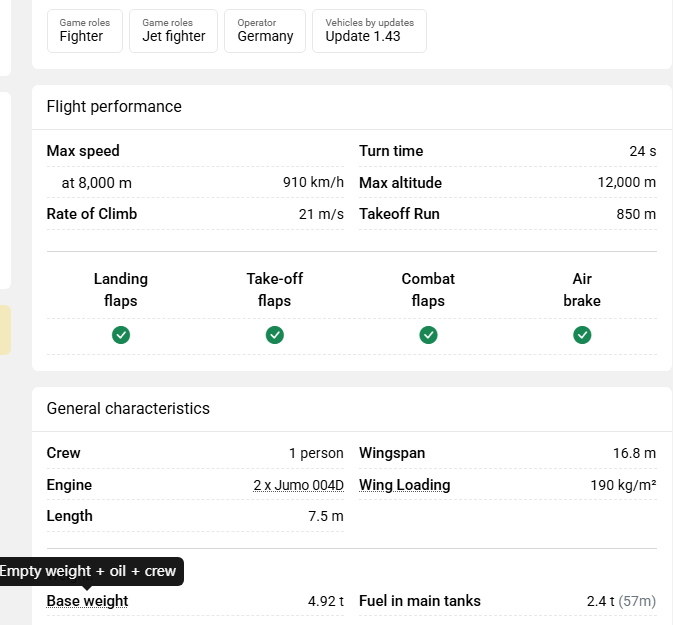
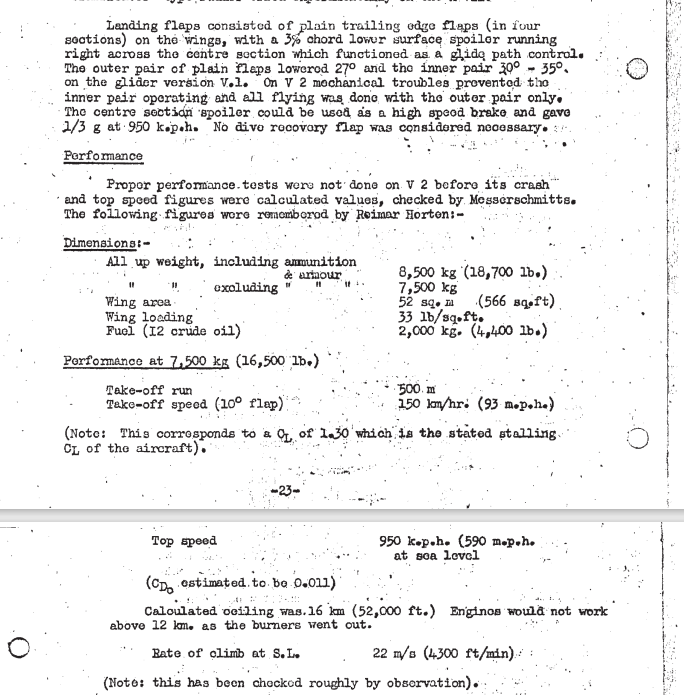
Real historical records:
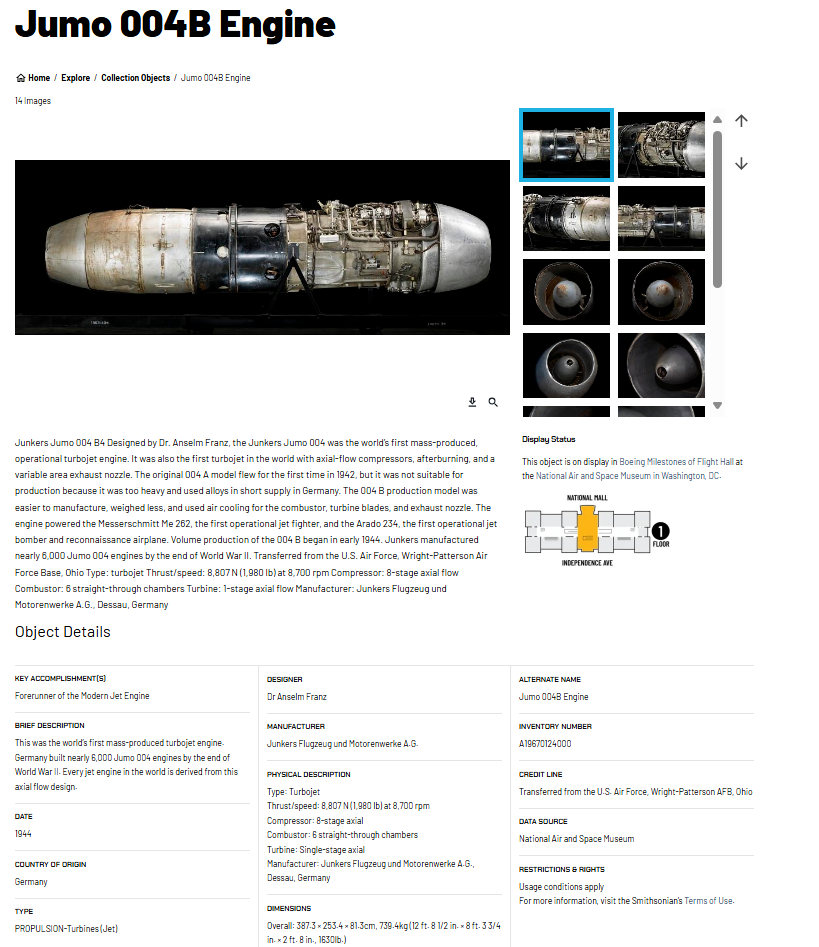
Okay, now here’s the question: What do we actually see from the data? What is the climb rate of the Ho229 in the game? What about its weight? Its thrust?
In real historical reports, the Ho229, when using the Jumo 004B engine, was heavier than in the game but could reach a climb rate of 22 m/s. Can the game achieve that?
From the wiki I mentioned above, you can see the data is the same as in the game. So, what’s the total weight when the game version is fully fueled? Base weight: 4.92 t, Fuel in main tanks: 2.4 t (57 m) = 7.32 t total.
Here’s the issue: Historically, the Ho229 was heavier and had less engine thrust than the game version, yet somehow its climb rate was better than in the game?
So I really don’t want to argue with people who only have a cursory understanding that Ho229’s engine was supposedly ‘enhanced,’ they just look at the panel stats. But the person I replied to—everyone saw it—even doesn’t understand the panel stats and doesn’t get how to compare fighters. So I’ve laid it all out here; my logic is clear, and anyone can see it. If someone could answer this question, that would be great.
Also, don’t tell me to submit a bug report or anything like that. Submitting something simple like this, all the info you can find online clearly shows Ho229’s climb rate. They want historical data, fine, I found it and submitted it—it sank like a stone into the sea.
It’s a simple logical problem: you shouldn’t be getting worse performance than the actual historical figures.
So I really don’t want any more back-and-forth with this person who only half-understands things. He’s just a quick-play gamer who likes to show off once he gets a few kills; don’t expect to have a deep discussion with someone like that. And when I see him misleading people condescendingly under other Ho229 articles, it annoys me even more. Imagine if I got arrogant and showy over a few achievements like he does—I’d be busy bragging instead of explaining all this here.
Oh, and according to his idea, all the players I’ve killed are like coughing babies, and I just hide in the high altitude until everyone else dies and then swoop down to clean up the mess to win?
He doesn’t even understand the most basic relationship between win rate, kill count, and number of engagements.
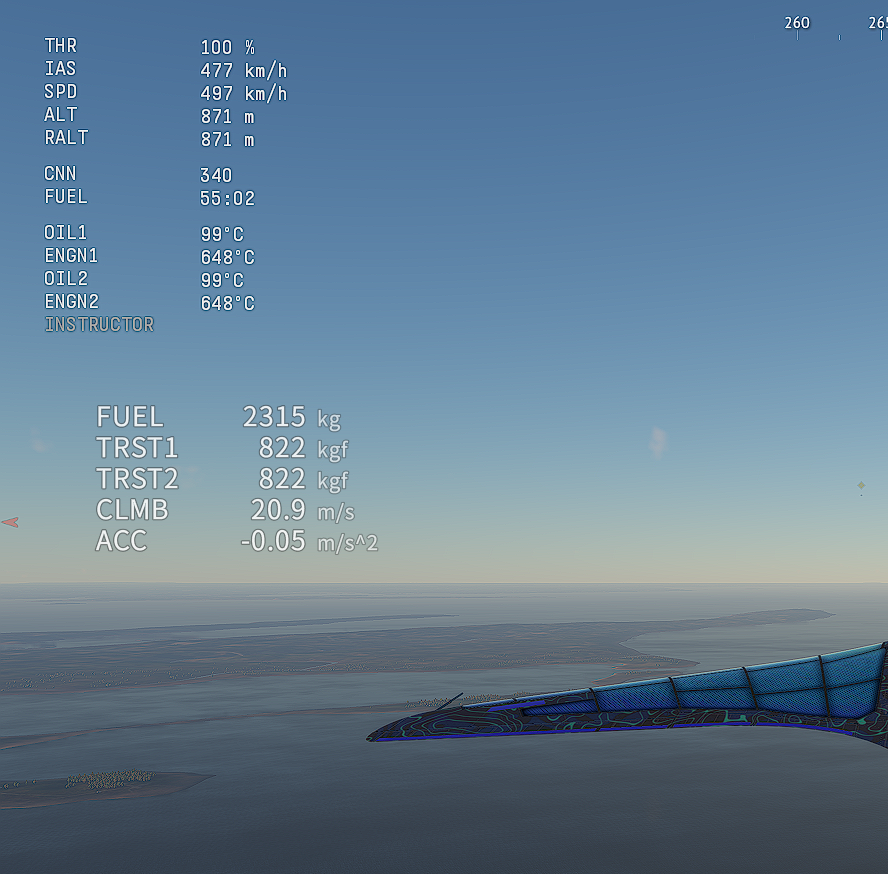
Compared to the Su-11, who’s climb rate is closer when fully fueled?
Flying wings are known for their climb rate, so this performance is standard, right?
Are there other 7.0 fighter jets in the game that actually perform worse than the Ho 229? I’ve played enough to feel it deeply, but the Ho 229 generally performs worse than other players’ planes in the community. To put it simply, it’s harder to handle, and this situation is artificial, deliberate.
Another important reason I don’t easily compare fighters from other countries: nobody likes others messing with what they love, so I don’t want to cry for Gaijin to nerf the planes other players like, even though they really do crush the Ho 229 and create an imbalance. So I try to avoid making the Ho 229 too niche or too far behind other fighters. It’s just a game; there’s no need to ruin someone else’s experience.
Because originally the Ho 229 had too strong CAS capabilities, and because of many player complaints, it lost its armor-piercing ammo belt (all the HVAP-T, though I used to love it in air battles, I hardly use it for CAS), so I don’t want to be a crab (Crab Bucket Syndrome). Players should be united, objective, friendly, rational.
But all of this assumes that our differences in the game aren’t too big, right? So how big is the gap now between the ho229 and before? And how big is the gap compared to current same-tier fighters? Even so, I haven’t cried to nerf other jets to create “balance”; I’m just reasonably asking it to regain its proper performance. Even if that means putting it back into the old 7.3 lineup, that’s reasonable, isn’t it?