Dear Community and Developers,
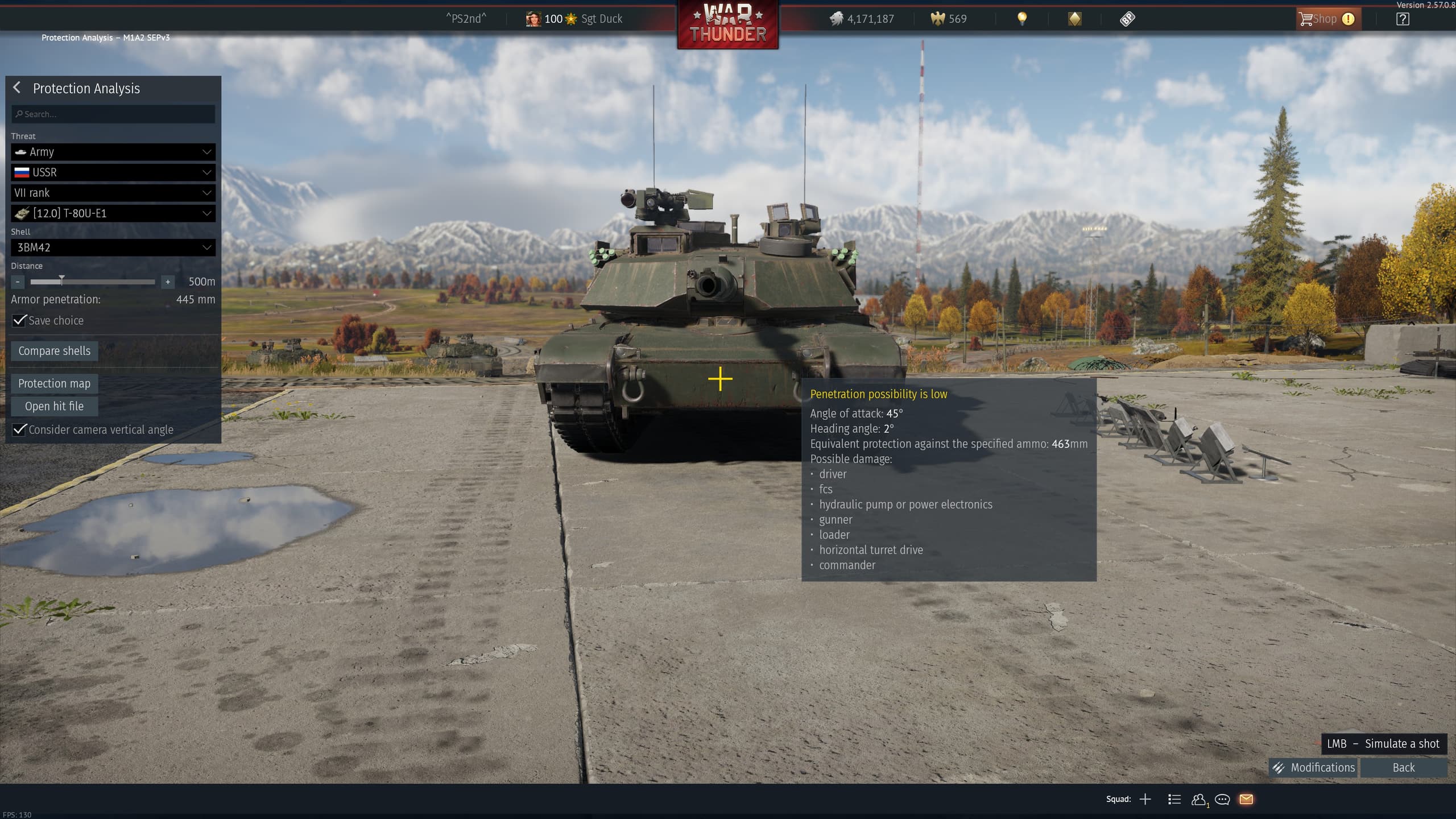
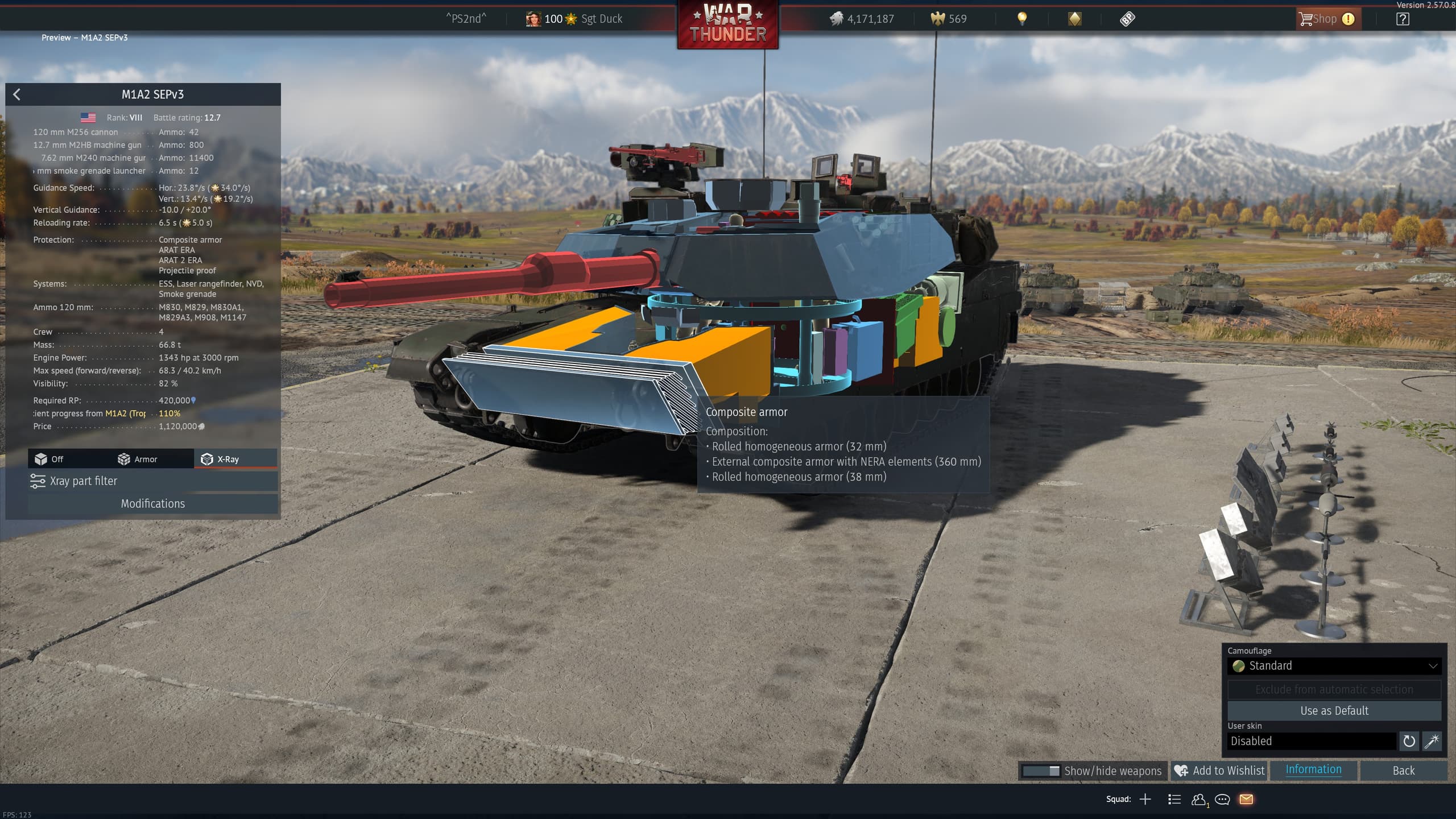
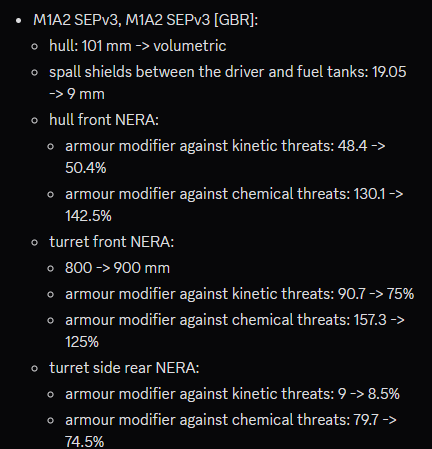
The recent developers’ blog post regarding the hull armor of the M1A2 SEPv3 has raised serious concerns. Unfortunately, the argumentation provided by the development team relies on an outdated historical narrative, conflating 20-year-old restrictions with the technical reality of a modern, completely redesigned serial production vehicle.
Below is a detailed, step-by-step analysis based strictly on unclassified, official US Government reports, the Federal Register, and Congressional budget justifications.
Part 1. The “2006 NRC License” Misconception
The Devs’ Claim: The developers heavily rely on a US Nuclear Regulatory Commission (NRC) license from 2006, which limited depleted uranium (DU) in the hull to just 5 specific M1 tanks used for training schools. Based on this, they conclude that hull DU armor was never mass-produced for the Abrams fleet.
The Refutation: This is a classic case of an outdated dataset being applied to a modern vehicle. The 2006 NRC license applies strictly to the variants of that era (M1A1 and early M1A2 SEPv1/v2). Nobody claims that 1990s or mid-2000s Abrams tanks had mass-produced DU in their hulls. However, the developers are erroneously applying these 20-year-old limitations to the M1A2 SEPv3, which entered serial production in the late 2010s and features a completely different protection suite.
- Official Source: US NRC Official Document Record (nrc.gov)
Part 2. Legal and Technical Definition of “Heavy Armor”
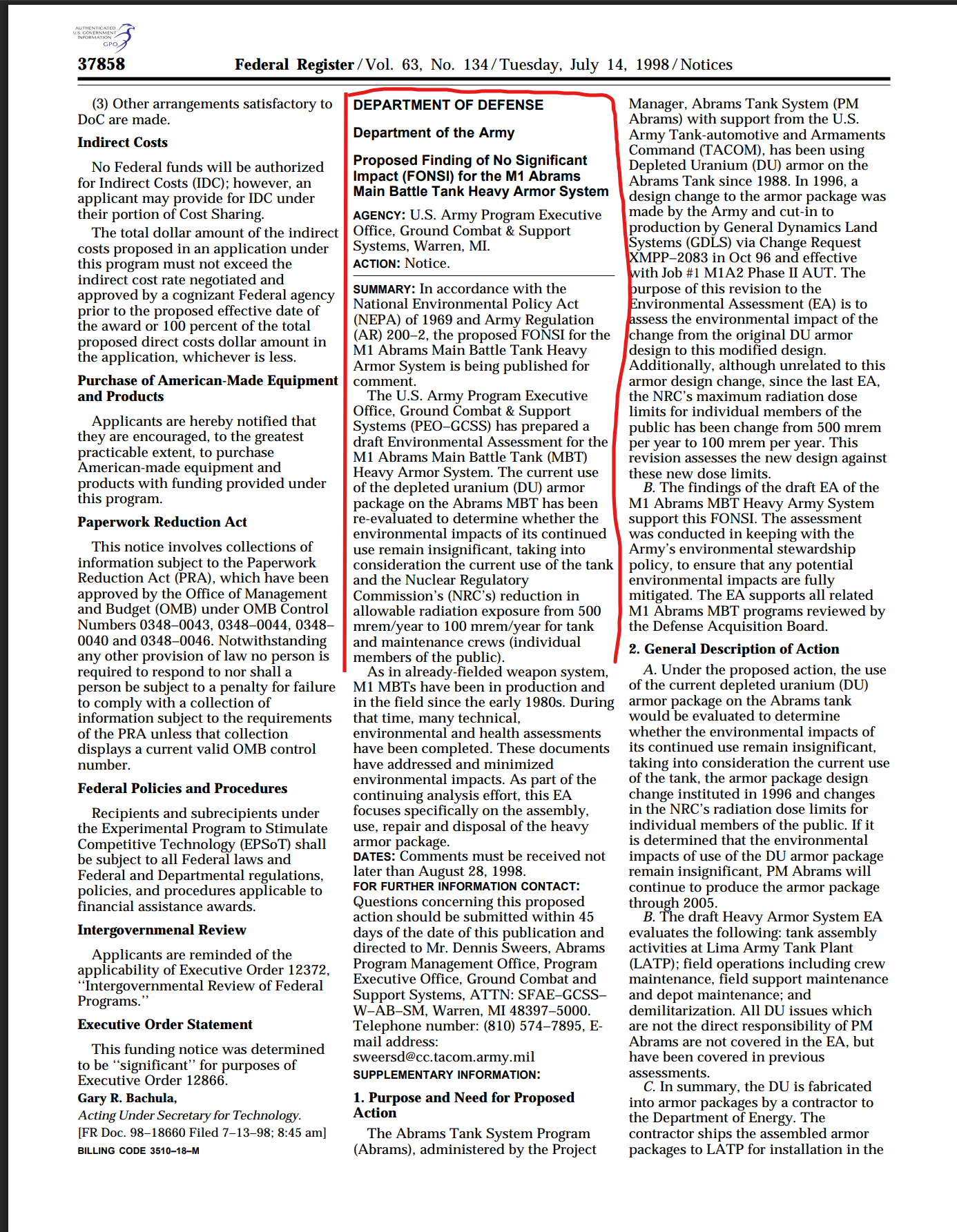
To prevent any semantic evasion—such as claiming that “Heavy Armor” in US documents merely refers to thicker conventional steel—we must look at the US Federal Register (Vol. 63, No. 134, July 14, 1998).
This official government document explicitly binds the military term “Heavy Armor System” to a specific material:
“…the environmental assessment for the M1 Abrams Main Battle Tank Heavy Armor System. The current use of the depleted uranium (DU) armor package on the Abrams MBT has been re-evaluated…”
Figure 1: Official US Government definition legally equating the term “Heavy Armor System” directly to depleted uranium (DU) armor packages on the Abrams MBT.
Part 3. The Definitive Proof: M1A2 SEPv3 Mass Hull Armor Upgrades
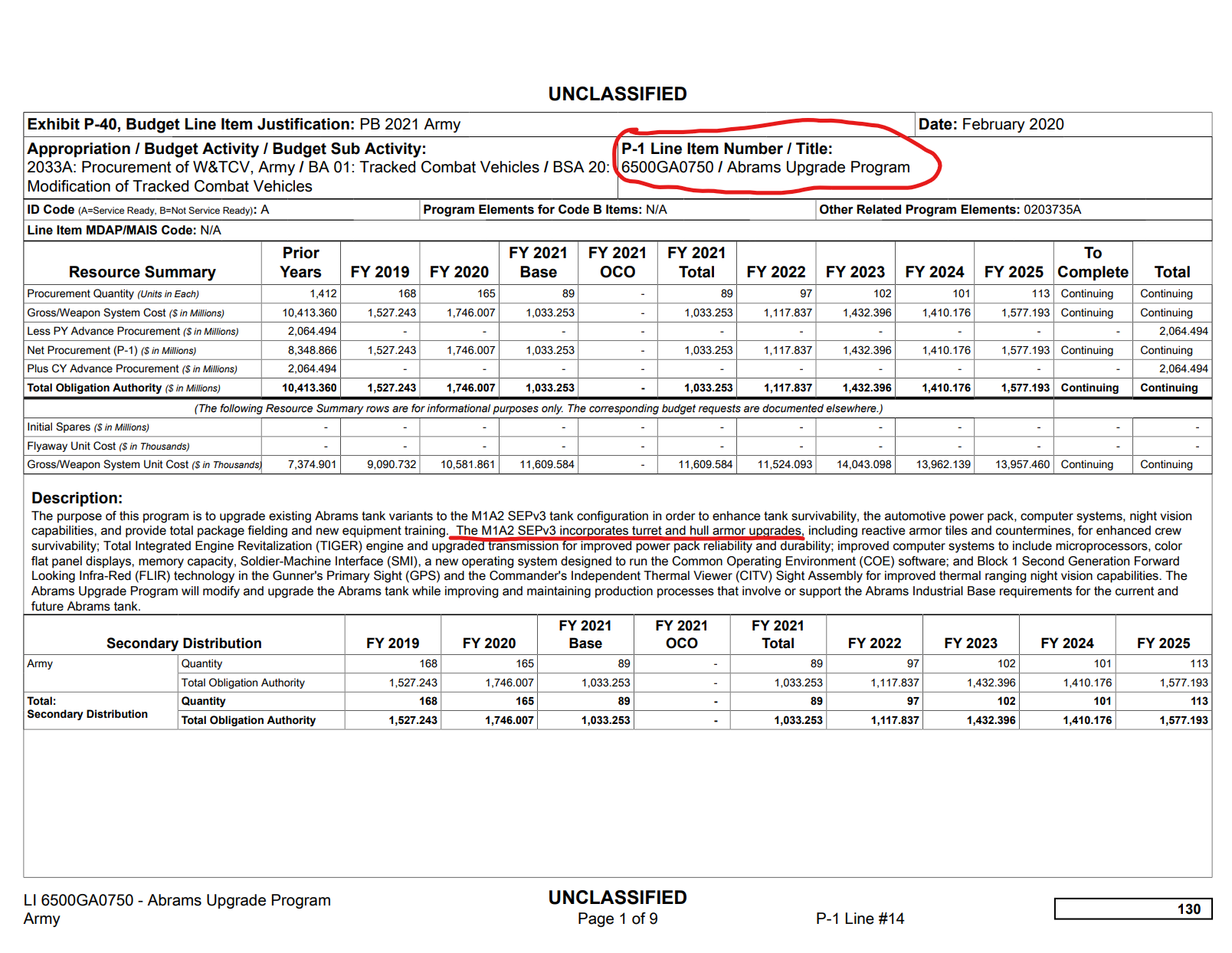
The definitive proof that completely refutes the developers’ stance comes from the official Department of Defense Fiscal Year (FY) 2021 Budget Estimates, published in February 2020.
On page 158, under Exhibit P-40 (Budget Line Item Justification) for the “ABRAMS UPGRADE PROGRAM”, the US Army states the following in the official “Description” section:
“The M1A2 SEPv3 (v3) incorporates turret and hull armor upgrades to counteract advanced crew survivability…”
The Pentagon explicitly reports to Congress that the funding allocated for the SEPv3 variant is designated for serial armor upgrades applied to both the turret AND the hull. This is implemented via the Next Generation Armor Package (NGAP). To achieve the required protection levels against modern threats within the physically constrained 650mm frontal profile of the Abrams hull, the integration of heavy, next-generation dense matrix inserts is a physical necessity.
- Official Source: https://www.asafm.army.mil/Portals/72/Documents/BudgetMaterial/2021/Base%20Budget/Procurement/WTCV_FY_2021_PB_Procurement_of_Weapons_and_Tracked_Combat_Vehicles.pdf
Figure 2: Official US Army FY2021 Budget Justification Book confirming that the serial M1A2 SEPv3 modernization program actively installs upgraded heavy armor into both the turret and the HULL.
Conclusion
The developers’ narrative that “hull DU armor was restricted to only 5 tanks in 2006” is completely outdated and irrelevant to the serial production standard of the M1A2 SEPv3.
Official US military procurement records prove that during the deep overhaul and modernization process to the SEPv3 standard at the Joint Systems Manufacturing Center (JSMC) in Lima, Ohio, the hulls are fully stripped, and the passive armor arrays in the frontal hull structure are replaced with modern heavy armor packages (NGAP) to guarantee advanced crew survivability.
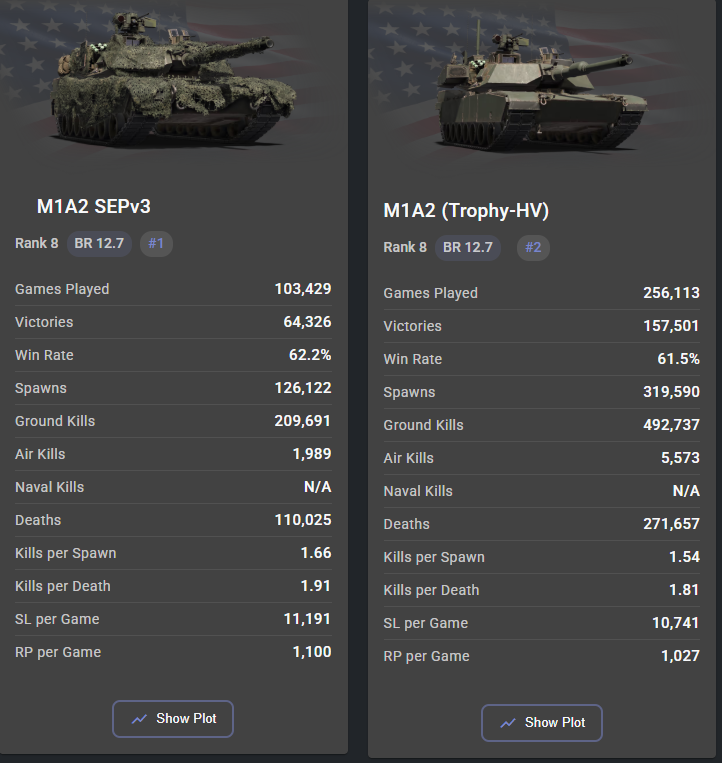
We formally request the development team to adjust the frontal hull protection (LFD/UFD) of the M1A2 SEPv3 in-game to accurately reflect the official technical and financial documentation of the US Army.