Also, here you. the MG triggers the HEAT round. And expected you see shrapnel from the explosion.

the Bonus round shown uses small submunitions to form its penetrators. Where there are 2 per 155mm howitzer shell.

I dont think its a stretch to say that is roughly equivalent to a normal heat round in terms of explosive mass
yes, and it would form a penetrator, and to form that penetrator it would leave a roughly spheroid explosion like the 155mm BONUS round i presented a video off.
What are you trying to say??
That the T80 PKT’s muzzle triggers the round, while the rest of the MG doesn’t which makes everything alright, although the muzzle makes about 1/20th, or less, of the total volume of the installation?
Tank’s round has 2.5kg, while 155’s has >5kg, so it’s quite the stretch, actually.
that the MG is there and you can see exactly what counts as the machine gun in the damage model.

there are 2 sub munitions in the grey cylinder.
That is not a stretch to say 1 of those is roughly equivalent in explosive mass to a 120mm or 125mm heat round.
Like the physics behind it is the same regardless of the size.
So, what’s your point?
That having a hit box that is 1/20th of total volume is ok, or what?
In practice, the hitbox is nonexistent…or (I have a feeling you’re a bean counter) De Jure it exist, but De Facto it doesn’t.
Well, of course it is. The only way to have no blast around, at all, is to have it detonate in a container.
The debate here is about how much and does it have power to penetrate the turret top.
For the purpose of the game in a “top attack” scenario. As much as its TNT equivalent would do in terms of an HE round.
this is more or less the case in the game (its nolonger the case above some arbitrary TNT equivalent for HEAT rounds but idk the exact number)
only that the initial claims were bull. idk why you are trying to attach more meaning than that to it.
Well, no.
Here’s a shaped detonation…

…and here’s an unshaped detionation…

Given the same amount of explosive, it’s impossible that shaped and unshaped have the same effect in all directions. No idea, what part you don’t get here, but here you go.
Not at all, because I can get hit into the mast on Leopard2 at a kilometer range, while you have to get to a knife range to the Sovet tank to hit its PKT’s barell. How’s that the same and how does, for all intents and purposes, the T90 has a hitbox on it’s top mounted PKT?
yes there is a penetrator. the explosion is still roughly spheroid. Thats how Shaped charged munitions work. Idk what you are grasping for.
its the same in that there is a MG there for you to hit.
Yes, we get that you have no idea what you are writing about. Diamond et al are patiently trying to explain why you are mistaken, but you are clinging like a drowning rat to your belief that it must be Gaijin’s fault that you lost an engagement.
I know, I’m gonna regret it, but do you even understand the topic?
Irony…
Ok, so you don’t. No shame in admitting, but stop spamming with gibberish. Thx.
Think more, type less.
Ok o think i can try to clear things up.
So i think it is clear to anyone that you cannot direct all of the energy of the explosives into the penetrator. That would assume shaped charges have an efficiency of 100%, which would be bonkers.
Sadly if you try to search for their energy efficiency, you will mostly get results about their efficiency in penetrating armor.
That gives a number, if the explosive energy is about 470kJ, then in the initial stages the penetrator has about 60kJ. That leaves 410kJ unaccounted for.
Since it is an explosive charge going of and only 60kJ are transferred into the penetrator, it is fair to assime that the remaining 410kJ are set free like in a regular explosion since the energy cannot simply dissapear.
So assuming that the rest of the explosion behaves like it would on a regular HE round is reasonable. And it would expand spherical (with the exception of the directed part of the explosion) relative to the shellls velocity.
And yes that part of the detonation should be able to create overpressure.
So the assumption that the entire explosive mass gets directed into the penetrator is simply wrong.
Btw: this should have been obvious because of the construction of a shaped charge. Only 50% of the explosive energy wo uld even go into the direction of the cone that creates the penetrator. So the efficiency would never be able to exceed 50%. It wouldn’t be exactly spherical since the redirected blast is part of the blast that would go into a certain direction if it wasn’t a shaped charge, but enough of the residual blast would be still directed at the tank.
You cannot just ignore the explosive energy that isn’t going into the penetrator, it doesn’t dissapear, it will do damage.
Now, we’re talking.
So how much “residual” actually is?
What we do know for sure is that TOW designers, eg. put a head looking directly down into the top of the turret to ensure the kill when the missile is overflying the turret.
We also know that such a warhead in TOW has a 6kg, that detonates its primary (and thus by far the strongest) blast wave directly down into the turret’s roof.
In comparison, we have 2.5kg HEAT whose tertiary blast wave hits the roof of the tank.
The differences are enormous in effect. I mean, it’s just plain stupid to assume that the 120, or 125mm HEAT round has enough power to punch through the turret’s roof with its tertiary blast wave…or does someone have some actual data to factually disapprove what I said?
idk how to say this, but there really is only “1” blast wave. Thats from the explosion.
the penetrating bit is a projectile made out of copper (or aluminium on some warheads). Thats why there is a copper liner.
Any “loss” in overpressure effects would be some degrees off the penetrator as in basically any other direction was pushing against the copper liner.
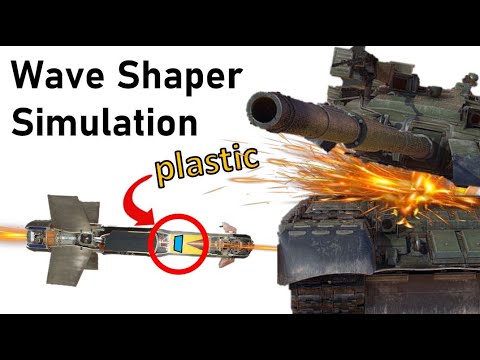
I think this image in shows it well where there would be “loss” in overpressure, and thats in the blue “horns” around where the penetrator forms. As seen, above and below there isnt really any loss. Neither is there any behind.

(Green, light blue and red is indicating higher speed than blue, red triangle idk why its there, and its a 60mm heat warhead with inert wave shapener)
This is with a innert wave shapener in the middle of the explosive. But as one can see, it forms a spheroid. And for the purpose of “top attack” overpressure it would be basically equivalent to its TNT filling.
i already told you that. Of a 470kJ Explosive it is 410kJ…
so roughly 8/9th is residual.
You could read the entire post. It’s in there
Too lazy to read
I mean i even posted a source.
With a shell with 2.5kg explosive mass 2.2kg will not be directed into the penetrator.
And since the blast that gets redirected is the blast which energy is directed toward the cone (i alread said that btw), the blast perpendicular to the penetrator is unaffected.
Since we are talking about the blast perpendicular to the direction of the penetrator, we have to treat it like a 2.5kg explosion. So the same explosive mass as some IEDs. And the roof armor isn’t thick.
Afaik this is the velocity relative to the shell itself.
But yeah. The energy perpendicular to the cone shouldn’t be affected at all. It has no interaction with the cone.
That would be, no.

What we do know, though is that a Carl Gustaf 1.7kg HEAT round’s tertiary blast (or radial blast, if you prefer) does penetrate 7mm of top armor on a BMP-1.
GJ rates Leopard2’s roof at 21mm vs CE.
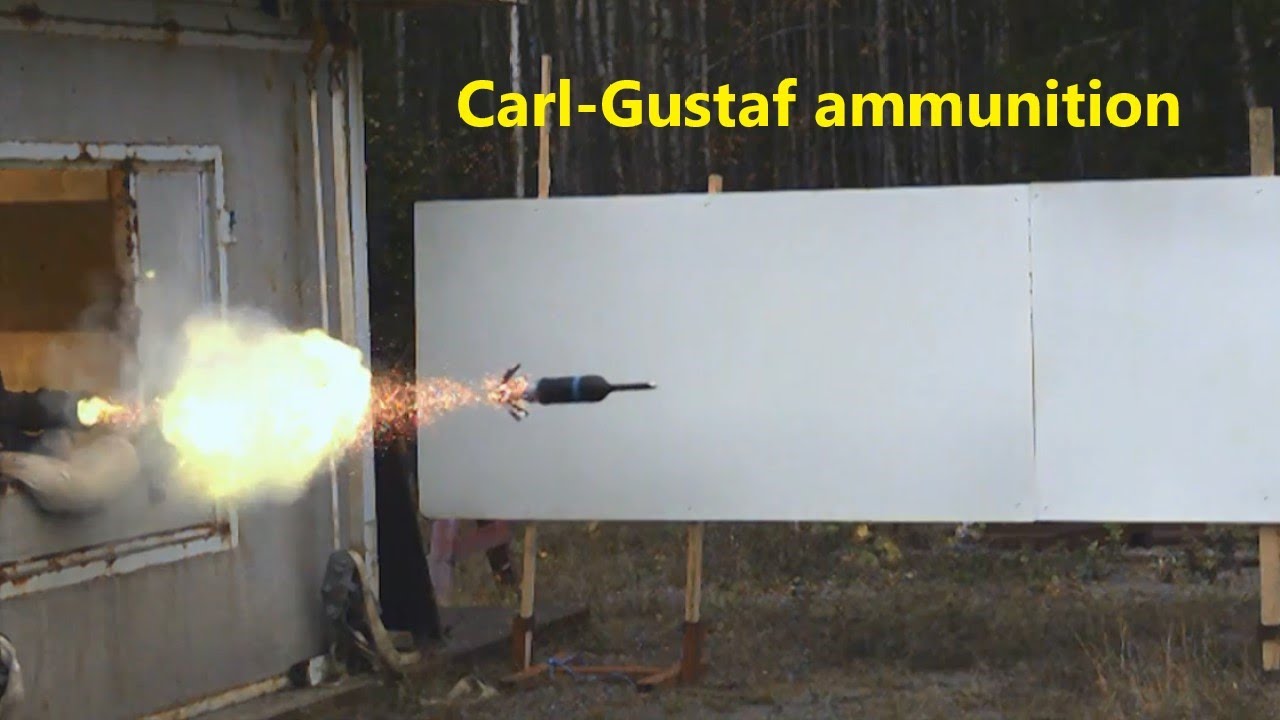
We also know (or at least come as close as a simulation is capable of) that a 125mm 3.2kg HE round, which has way stronger radial blast (technically it’s all axial blast since it’s an isotropic explosion), than a 125mm HEAT round, doesn’t really penetrate the Leopard1’s roof all that convincingly.
So, maybe the proof will emerge later, but for now I’m calling a BS on a 3BK18M killing Leopard2 via commander’s mast hit.
without any source on what is shown here this is useless.