Does anyone have any information on how many weapons the different Hawk variants can carry? When I tried searching for information, all I could find was how much weight it can carry on its hardpoints, but I couldn’t find any details such as “the Hawk carries X amount of bombs or missiles”.
If there is a scheme of the armament for the different Hawk variants such as the T1, 100, 200, etc. I would like to see them
You can read the suggestions here on the forums, they are well researched
5 Likes
I’ve seen all these threads, but from them I could only understand the number of weapon suspension points on different Hawk modifications and how much weight of suspended weapons they can carry, but I didn’t find any specifics on the quantity, for example, how many bombs does the T1 carry?
The only thing is, after I created this topic I found this scheme, but I’m not sure how true it is

with more modern ones everything is clear, because each pylon in the game will most likely accept agm65/aim9/gunpod
8 typically, with a notional 9th if the gun pod isn’t carried


Also 8 SNEB rocket pods

I don’t have photos of T.1/Mk.50/60 series with a bomb fitted on the centreline hard-point, but a central ERU pylon was displayed on the ground behind XX156 at Farnborough in 1976


A more streamlined ERU was used to carry Sea Eagle during trials in 1983
Image

which seems to be the same one carrying bombs on ZH200 (the Hawk 200 preproduction aircraft with no wingtip rails)
Image

and production Hawk 120s

AIM-9s could be carried on either the inboard and outboard hard-points depending on how they were wired so typically only 2 were carried.
RAF T.1As usually only had the inboard pylons but some examples were modified with outboard pylons for trials (XX156, XX258, XX280, and XX205 all had 4 wing pylons at some point)
Carrying 4 AIM-9s on the outboard with a dual-rail launcher was more likely than wiring all 4 pylons for sidewinder, since it left the inboard free for fuel tanks.
Some of UAE’s Mk.63s were fitted with additional wingtip rails like their Mk.103s - they’ve since been transferred to Jordan
5 Likes
Thank you very much for these photos!
By the way, does T1 have any countermeasures?
I don’t believe so, you’d normally know by looking at the tail for the CM’s but i haven’t seen any hawks aside from the 100 and 200 with CM’s
1 Like
Then we can only hope that it will not get a high BR when it is added.
Personally, I hope that T1 will be an analogue of alphajet/iar93 with BR 9.0-9.3 in GRB
I don’t think any variants that had them before the Hawk 100/200-series
The dispensers for those fit in the box above the engine exhaust and brake chute, below the rudder, so it’s quite distinctive if a Hawk is fitted for them or not
Ed:- Phoenix RX0 already explained above
1 Like
See its the Finnish Hawk MK.51A have 9M’s and new cockpits with IFF, its likely they will not be added to the game to avoid balancing issues.
As some people have stated gaijin could just add CM’s to the vehicles in a case similar to the F-5C or the F15A. I doubt gaijin would do this for the Finnish Hawks but whos to say. Regardless they could just add MK.66 or the standard MK.51 since all of them have been tested with R60 or can be added without.
Even with the Hawks like the MK.66 being planned for service until the 2030’s theres been no plans to add CM’s to them since they have mainly been used for training exclusively.

MK.66 Hawks also have a unique HUD and cockpit for the upgraded avionics.
I feel that if gaijin was to add trainer esq vehicles to warthunder they would add something like the Folland Gnat before the Hawks. Though id like to see both, and also a Yak 130 if we got a trainer jet focused update.
3 Likes
You sure about this mate? Both the Release to Service and Flight Manual have two pylons listed. I’m aware Mk.60’s had strengthened wings to accommodate the two additional pylons.
Lot of the serials listed are demo fits for airshow static display, however
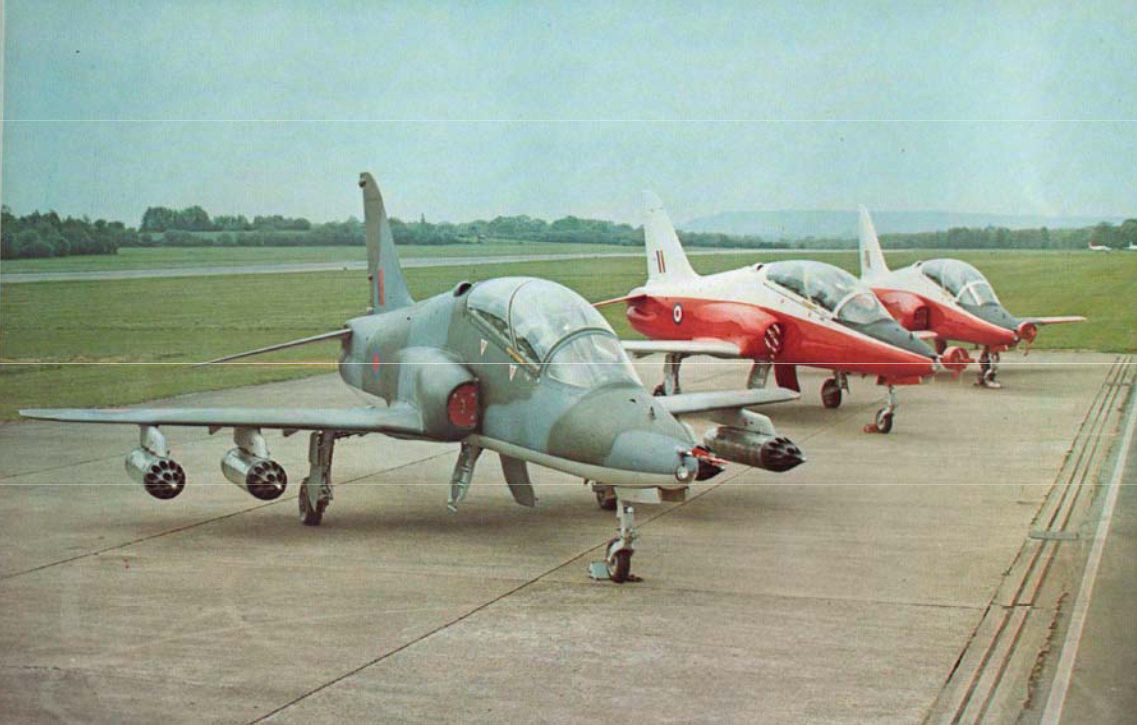
First RAF example would be XX156 with 4 SNEB pods back in 1975 - this was the second RAF pre-production Hawk and the plane used for RAF weapon trials and other Hawk development at RAE Bedford. As such it was the first Hawk painted in the grey-green tactical camo scheme, but with a light-grey underside that wasn’t included on the eventual service camouflage scheme for Tactical Weapons Unit Hawks. 1976 Hawk brochure has photos of this configuration in flight during hot weather trials in Malta.
There’s also photos of it in flight with CATM-9s and 100gal tanks but I don’t know the date for that one. I would guess some time after 1979, as I understand that was when the “Mixed Fighter Force” was conceived for Hawk in the RAF, culminating in firing trials with AIM-9s by 1983 and service by 1986.
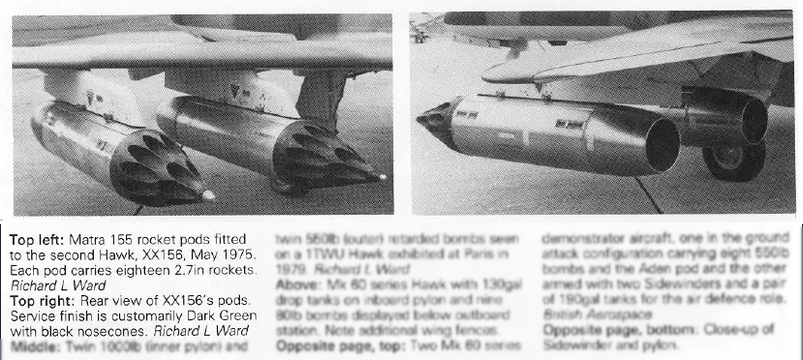
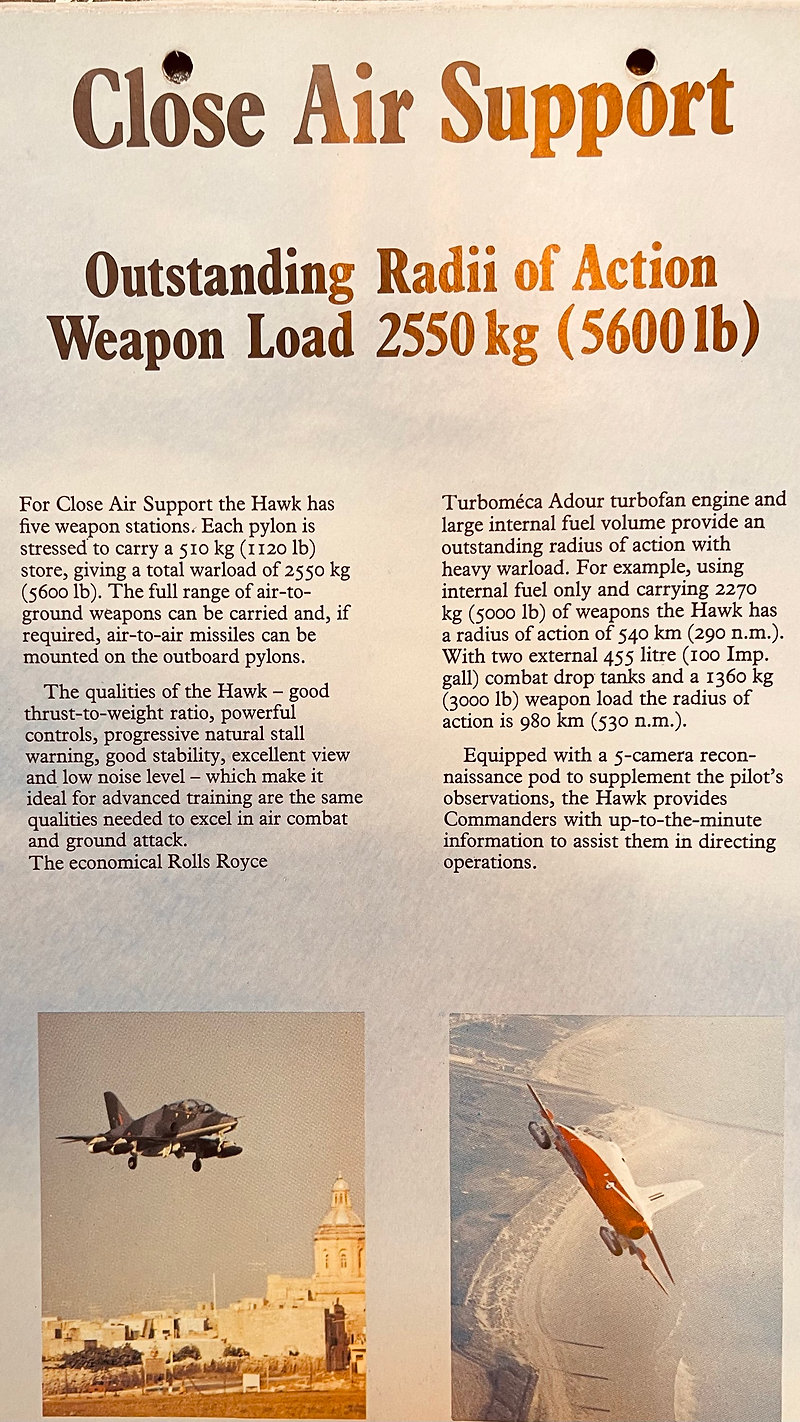
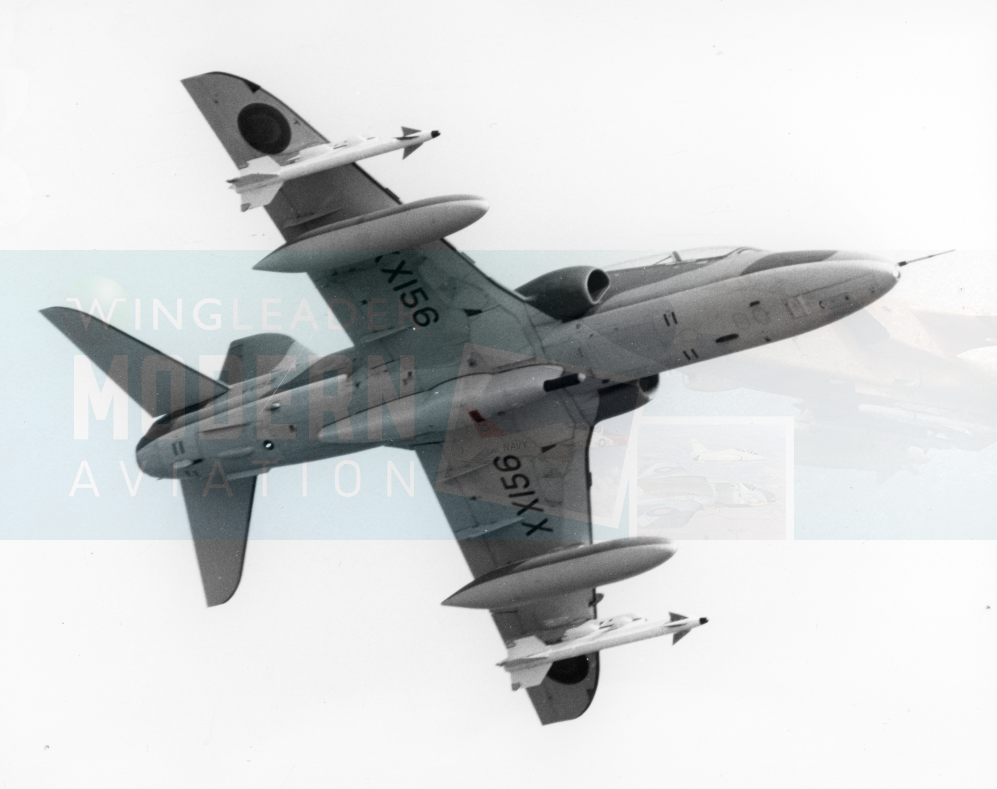
Other T.1 serials with the outboards for airshow static display etc. are using the latent mounting for the outboards that have been there since the first T.1s. DE&S brochure flogging the RAF’s old Hawk T.1s says they still have 5 hardpoints for weapon carriage, even though the RAF only used 3 of them (for the 2 pylons and gunpod) in service as a trainer.
Photos of BAE’s 1983 Sea Eagle flight trials with XX258 show the additional pylons fitted on the outboard hardpoints, carrying CATM-9s, with (likely empty) 190gal drops tanks on the usual inboard pylon, plus the Sea Eagle on a bomb carrier in the centreline hardpoint.
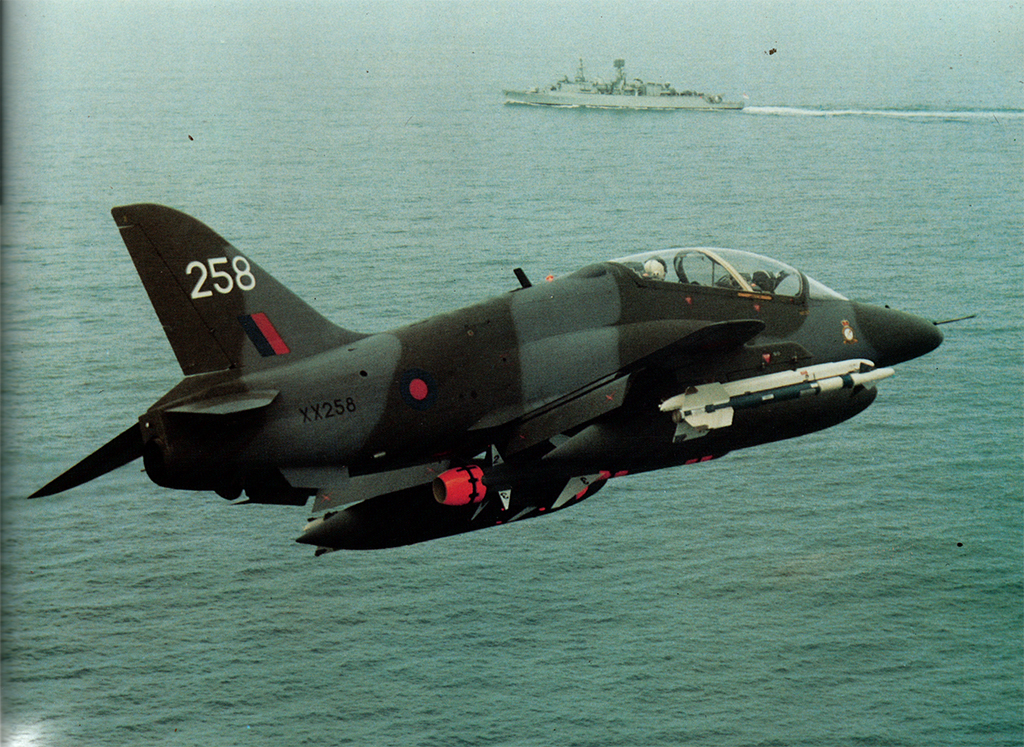
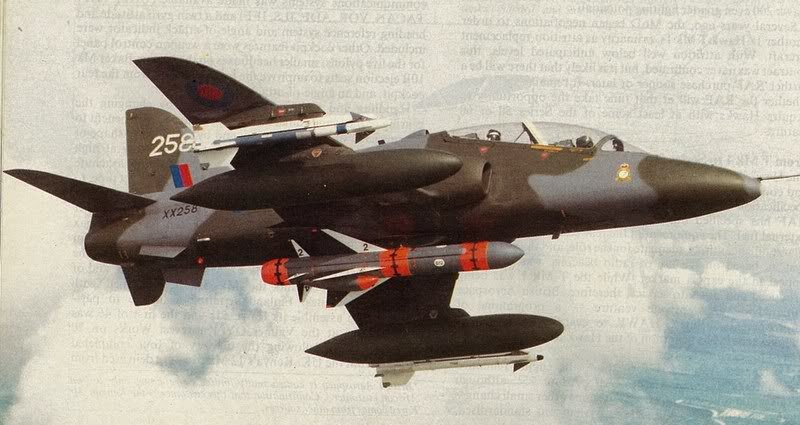
Like I said at the time though, only the 2 inboard wing pylons were fitted in service by the RAF on Hawk, and the extra ones were for attack role trials, not a requirement for the in the service weapon training role. So would likely mean some modification to get them to function - at a minimum, rewiring for outboard sidewinders - as even the T.1As weren’t wired for the inboard ones until ~1986.
The trials with XX156 would have informed the decision not to put the additional pylons on in regular service as a weapons trainer. AFAIK it was limited to 2+centreline due to performance and lack of requirement, and export Hawk Mk.50 offered a higher-rated powerplant specifically to better support weapons on the 5 pylons (4+centreline) to perform the ground attack role.
The strengthening for Mk.60 is not for additional pylons over Mk.50, but for additional capacity on those pylons.
2 Likes
Did you just get some new manuals by any chance?
Following this, Harry Fraser-Mitchell from BAE wrote a paper on Hawk’s development history for the RAE’s Journal of Aeronautical History that covers how Hawker Siddely were factoring the additional pylons in to the jet’s design and manufacturing, vs the RAF’s own requirements, and the MoD contract included approval for more pylons than the RAF was going to use.
From the beginning it was always recognised that an RAF order alone would not cover the
costs of the project to HSA. It was clear that alternative versions would have to be developed
from the initial version, and these must be offered for sale to other Air Forces. In particular
Scandinavia, with the exception of Sweden who had their own vigorous industry, was a possible
source of orders, and also the Middle East, together with the emerging nations of Africa. The
Far East was also a possibility, with Malaysia and Indonesia as front runners.
It was further recognised that many of these countries wanted a dual-purpose role for the
aircraft, a trainer without stores which could quickly be converted to a light strike role, carrying
external stores on multiple pylons. Thus the schemes were designed to have a four- or five-
pylon capacity, and the structure had to cater for these in terms of maximum weight and
equipment. The MoD Specification for the Hawk explicitly mentioned this, but warned that
any impact on the T.Mk.1 should be minimal.
For the RAF aircraft, only inner wing pylons are provided, capable of mounting weapon trainer
stores up to 1,500 lb weight, but export versions of the aircraft carry up to five wing and
centreline pylons, the inner ones being capable of carrying external fuel tanks with capacities
of 100, 130 and 190 imperial gallons each. The maximum weight of external stores in this case
could be up to 6,800 lb (which has been demonstrated).
As such, Hawker Siddeley designed the plane to have 5 pylons from the get go, and the RAF approved 4 hardpoint wing structure and a centreline hardpoint on Hawk to allow expansion over its two-pylon trainer role. But those delivered to the RAF were provided with only 2 because that’s all the RAF had a requirement for. Structurally they can, and have demonstrated fitting 5 on Hawk T.1 the same as Mk.50 and later Mk.60. And DE&S do list the ex-RAF T.1s as having 5 hardpoints to support 5 pylons if required.
Ministry of Defence’s actual motto has always been “fitted for, but not with”
Bonus colour photo of XX156 with 4 SNEB pylons, alongside two of the RAF’s other pre-production airframes XX157, XX158
3 Likes
Id be careful with that doc, the only thing hes drawing on his own experience is Part 1;
With only a total of just over an hour for the whole presentation, it was impossible for any of the speakers to go into any detail, and the Author felt that it was desirable for the whole story to be written up as a paper, in three parts as presented by the speakers above. He has attempted to do this himself, but relying heavily on data provided by the other speakers and other sources for Parts 2 and 3. It is to be hoped that a future issue might encompass further information from the other contributors to “The Hawk Story
So the sum total of his citable contribution in that paper is literally this so fig1 to 1.7;
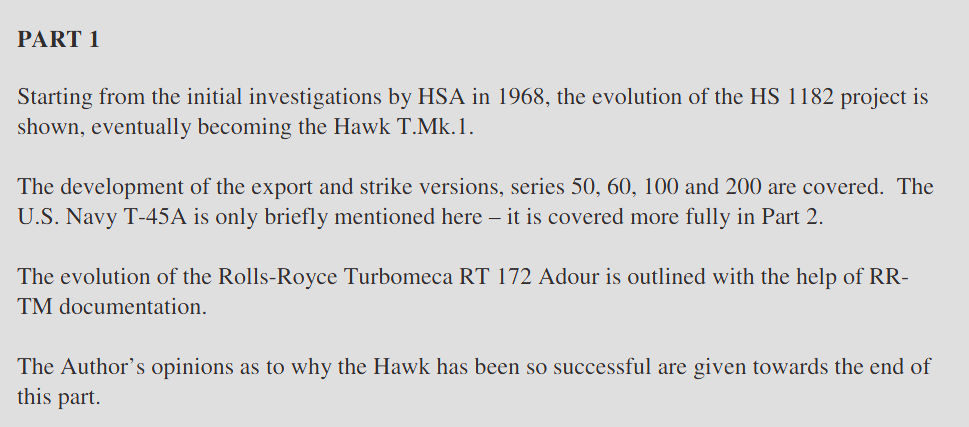
Parts 2 and 3 are “other speakers and other sources” all of which are uncited.
For example Janes information is mixed into the doc;


Does draw much of the stuff about additional pylons by design, from a direct quote from the MoD’s contract with HS for delivery of Hawk for the RAF in Ministry of defence (Procurement Executive) Specification 281 Development and Production
should be capable of conversion to a close support role using one centreline pylon and two outer wing pylons, including the carriage of jettisonable external fuel tanks, heavy weapons and twin store
carriers.
But would be better with the full context of the contract which shows that is in addition to the two inboard pylons for the RAF’s weapon trainer role requirement outlined by ASR 397.
1 Like
Should in an archive or Museum, I could try my contacts at BAE Systems as well.
Air Staff Requirement doc wouldn’t be all that useful in this case. It’s more of less the RFI that companies responded to, not the production spec. It’ll only ask for 2 pylons
The other document, Specification 281 D&P is the one that outlines the design spec for Hawk that the MoD contracted HSA to build
The Hawk T.1As shown in the devstream though have the 3rd (centreline) stores pylon, which the RAF didn’t use either. Gun pod uses the hardpoint, but pylons weren’t installed apart from occasions like the above Sea Eagle trials.
Not sure why devs are treating the 2 outer wing hardpoints different if they acknowledge the centreline one could fit a pylon that wasn’t used by the RAF.
Could the T.1A get Sea Eagles?
That would be rather interesting for 8.0 ASB