History
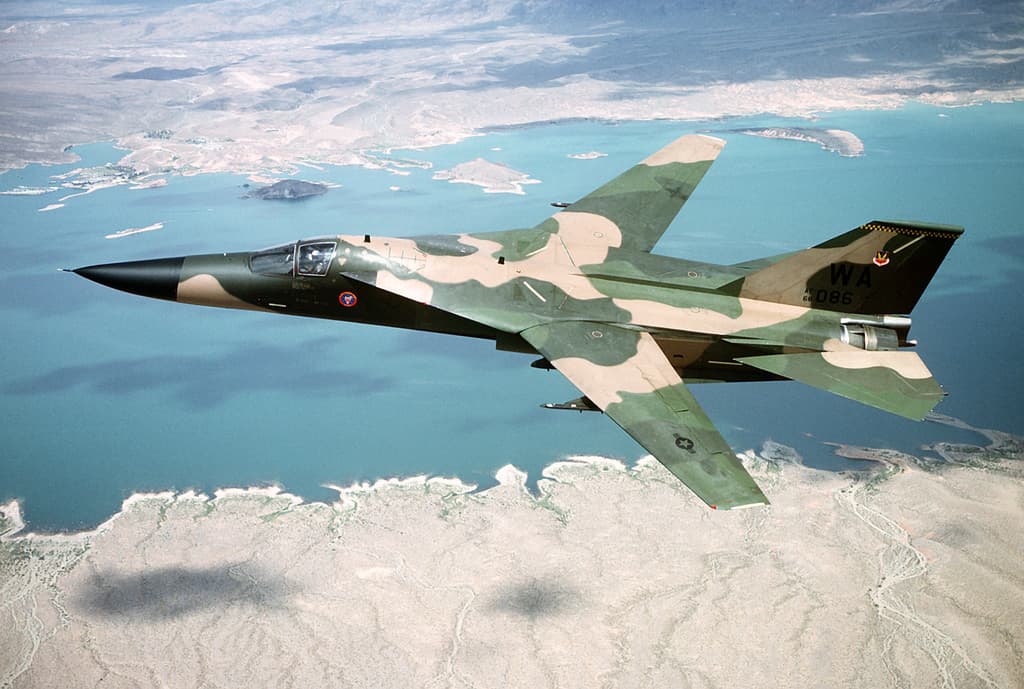
The F-111D was the third production variant of the Aardvark developed for the United States Air Force. It was intended to be a significantly more advanced version of the F-111A, incorporating digital avionics and a pair of uprated Pratt & Whitney TF30-P-9 engines. The new digital avionics suite was designated the Mk II Avionics Package.
The Mk II package replaced the F-111A’s AN/APQ-113 attack radar with the more advanced AN/APQ-130, which featured look-down capability and an illuminator utilizing a Ku-band continuous-wave guidance beam to support radar-guided air-to-air missiles such as the planned AIM-7G Sparrow. The radar also offered improved air-to-ground performance, including Moving Target Indication (MTI) capability.
The F-111D also incorporated the Triple Plow II air intakes to address the chronic compressor stall issues encountered on earlier variants. These redesigned intakes were mounted four inches farther away from the fuselage. The original Radar Homing and Warning System (RHAWS) of the F-111A was replaced by the newer AN/APS-109C system, while the Countermeasures Receiver was upgraded to the AN/ALR-41.
The Mk II avionics suite represented a first-generation digital design and provided greater accuracy, reliability, and flexibility through software-based configuration. The cockpit was extensively redesigned to accommodate the AYN-3 Horizontal Situation Display and the AN/AVA-9 Integrated Display Set, intended primarily for the detection and tracking of airborne threats rather than offensive air-to-air combat. As a result, both crew members received their own head-up displays. The pilot was provided with a rectangular CRT display, while the WSO received an enlarged terrain-following radar scope, all linked to other sensors via a new IBM AN/AYK-6 digital computer complex. Either crew member could fly the aircraft and operate its weapons systems.
The F-111D also incorporated the Triple Plow II air intakes to address the chronic compressor stall issues encountered on earlier variants. These redesigned intakes were mounted four inches farther away from the fuselage. The original Radar Homing and Warning System (RHAWS) of the F-111A was replaced by the newer AN/APS-109C system, while the Countermeasures Receiver was upgraded to the AN/ALR-41.
On May 10, 1967, the USAF ordered 315 F-111Ds. However, development of the Mk II avionics package proved costly and problematic, resulting in a significant reduction to just 96 F-111Ds. The first F-111D, serial number 68-0085, rolled out and completed its maiden flight on May 15, 1970, although it did not yet possess a complete Mk II avionics suite.
By late 1969, the Mk II system remained unfinished, and by the mid-1970s, issues with the Norden Integrated Display Set had still not been fully resolved. These persistent developmental problems significantly delayed deliveries of the F-111D to the USAF. To address the resulting capability gap, the Air Force procured the F-111E as an interim solution. The F-111E retained the earlier TF30-P-3 engines and the F-111A’s analogue avionics suite, allowing production aircraft to enter service between 1969 and 1971 without waiting for the troubled Mk II system.
Once the major issues had been corrected, the first fully equipped F-111D, serial number 68-0090, was delivered to the 27th Tactical Fighter Wing (TFW) at Cannon Air Force Base, New Mexico, on November 1, 1971. This aircraft was the sixth F-111D produced and the first equipped with the complete Mk II avionics package. The 27th TFW achieved Initial Operational Capability (IOC) in September 1972.
A total of 96 F-111Ds were delivered between June 30, 1970, and February 20, 1973. These aircraft equipped the 522nd, 523rd, and 524th Tactical Fighter Squadrons of the 27th TFW.
Despite entering the service, the F-111D continued to suffer from operational difficulties centered around its complex avionics systems. The fleet was also plagued by spare-part shortages, further reducing aircraft usage. After years of troubleshooting and corrective actions, the 27th TFW finally achieved full operational readiness in January 1974.
The 27th TFW remained the only wing to operate the F-111D. The difficulties encountered during the development and operation of the Mk II avionics suite convinced the USAF to pursue a simpler and more reliable successor. This resulted in the procurement of the F-111F, the final production variant of the Aardvark family. Approved in 1969, the F-111F incorporated the less expensive and more reliable Mk IIB avionics package along with the more powerful TF30-P-100 engines.
The F-111F proved to be the most refined conventional strike variant of the Aardvark family and generally offered superior reliability and performance compared to earlier models. Deliveries of 106 F-111Fs began in 1970 and continued through 1976.
Efforts were later made to modernize the F-111D by integrating LANTIRN targeting pods and compatibility with television-guided precision weapons. However, these upgrade proposals failed to secure funding. As a result, the F-111D became one of the first Aardvark variants to be withdrawn from service, with retirement beginning in 1991.