I can do that within 10-15min
Sounds good, I will add you as a friend and we can coordinate in game chat
I have the game open but I’m finishing some work rn
Okay I have recorded some tests, I will release a cut down versions of the tests soon.
It turns out it is easily possible to flare IRCCM missiles even below 2km with 100% thrust, sometimes with one flare.
1 Like
It turns out gatewidth missiles aren’t much better than a non IRCCM AIM-9L right now. Thanks for help once again.
3 Likes
We did some testing and these are the results:
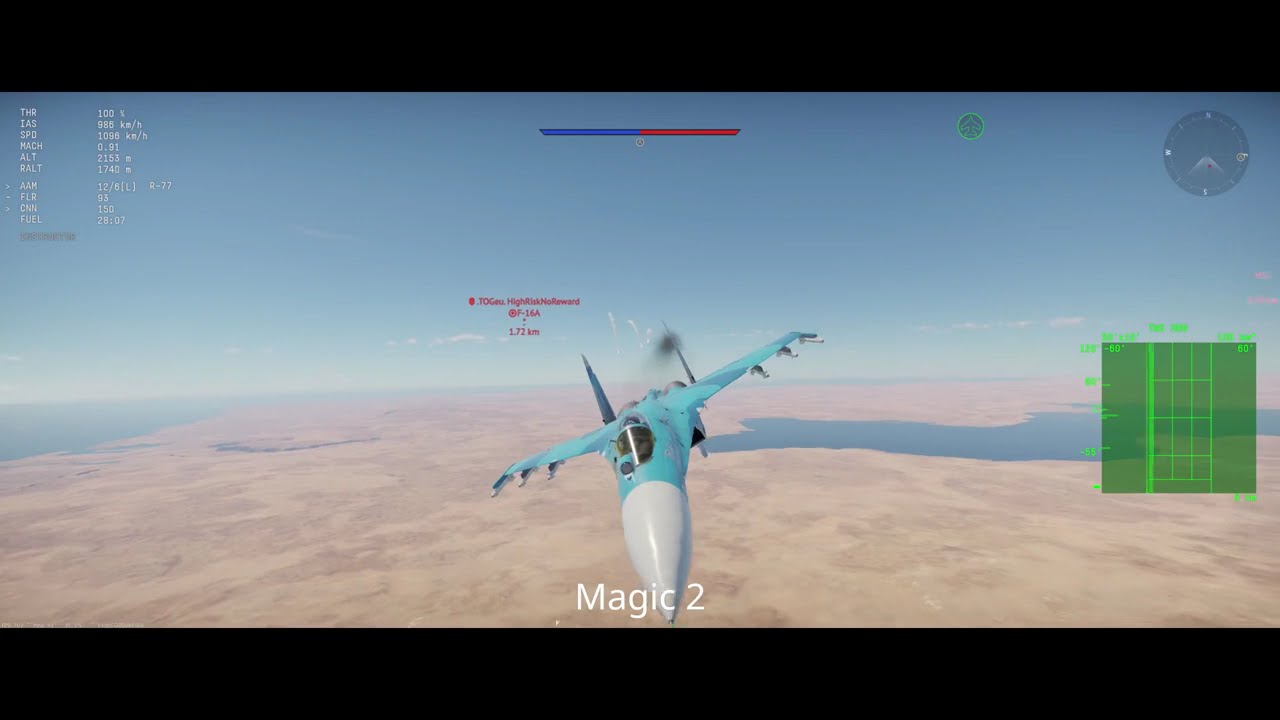
The IRCCM does seem to work at least, but to questionable effect. The most notable example was PL-8B which was quite easy to one-flare from within 2km. The Magic 2 felt as flare resistant as the Aim-9L up until ~700m. Even shooting slightly side-aspect made the seekers very vulnerable.
The evasion techniques and testing methodology was ad-hoc, but I still think it clearly demonstrates that these missiles are way more susceptible to flares than expected.
6 Likes
They all have similar flare resistance because the seeker after fov reduction works similarly between all except the R-27T/ET.
But clearly, there is something very wrong with gatewidth IRCCM, the IRCCM itself is working because you can see the FOV shrinking in the sensor UI in the replays, but they get easily flared regardless.
1 Like
I made a new bug report with @InverseBits video. There are a few old bug reports related to the issue that were either ignored or straight-up dismissed. Hopefully this video is enough to grab the devs attention. @Gunjob can you take a look at this issue so it isn’t ignored again?
Gatewidth IRCCM is broken (video proof) // Gaijin.net // Issues
6 Likes
LMAO the bug report was closed with “not enough info” what a joke.
I give up.
Hey, sorry another mod closed it. From reviewing your test footage it does appear to bite flares. But with this stuff we need replay files etc so we can review in sensor view.
Reason being is its very difficult to ascertain if the flare was in FOV without being able to see the FOV of the seeker which is much easier to see in sensor view. Gate width IRCCM doesn’t have a flare rejection capacity more over the reduced FOV makes it less likely a flare will enter the FOV of the missile, however if a flare does enter the FOV the missile is unlikely to reacquire the original target.
So simply; if we can’t see the FOV of the seeker we can’t make a judgement on if the flare was in FOV or not.
2 Likes
Its pretty evident that being able to consistently flare them at 1km away in rear aspect should not happen like it is shown in the video. Why can’t the devs themselves take 5 minutes to test it?
Feels like they expect the community to make a PowerPoint presentation of the issue and also provide the exact cause and code fix.
This is their job, not ours. I am not being paid, they are.
1 Like
They arent lol
The tech mods test it before they send it to devs and they are volunteers
Gunjob isnt either mate.
Of course, these are my local replay files:
replays.zip (4.3 MB)
We first started testing the R-73 and magic 2 in one replay. The second replay is mainly PL-8B testing, with some R-73 testing too.
The total length of replays is probably not more than 30m and features all of the shots in the video. Thank you for looking into it.
3 Likes
Me when I misread
Thanks, I’ll review them this evening :).
2 Likes
I meant the devs, not the moderators, the fact that they rely on the community and moderators to find and help to fix a lot of game issues is ridiculous.
Even if gaijin put a LOT more money into research, they arent beating a discord server worth of autistic guys who find that info as a hobby.
If so, why is this issue not largely talked about? It’s been months since gatewidth missiles have been behaving like non IRCCM missiles. It’s a very apparent issue that affects many nations.
I was wondering why 9M is feels more reliable than Magic II / pl5e / r73 recently. this post explains it well.