We do have several documents and design requirements to go off of though
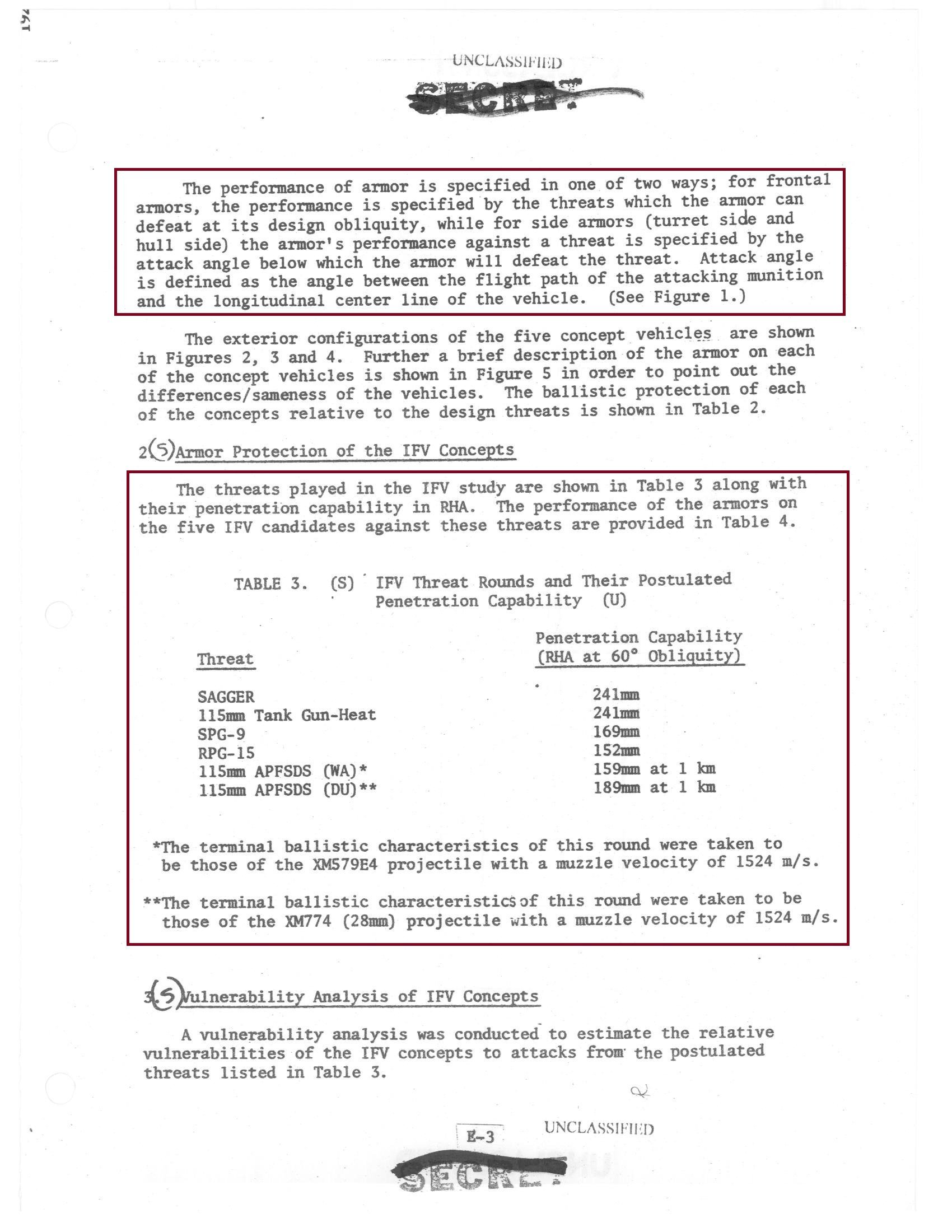
The initial (X)M-1 design requirements have long been declassified(¹), they are as follows:
- ‘‘Protection of the crew compartment against XM774 (simulating Soviet APFSDS) at 800-1200m’’
- ‘‘Protection of the crew compartment against 127 mm HEAT at 50° frontal arc’’
This armor package is BRL-1 and puts the RHAe vs KE at ≈350mm, and ≈636-700 mm vs CE @ 50° arc.
The IPM1 and subsequent M1A1 use the same armor as eachother(²) which is BRL-2, the turret featured increased volume. The threat simulant was XM833 APFSDS, that puts the RHAe vs KE at ≈400 mm @ 60° frontal arc.
Heavy armor had been in development for quite a while, so by october 1988 the M1A1 HA was fielded with HAP-1, this offered substantially improved protection. It’s threat simulant was M829E1, this gives us the 600 mm RHAe vs KE @ 60° frontal arc figure which is further backed up by the ARMOR Magazine(⁶) estimates as well as the U.S. document provided to Sweden for the tank trails(⁵).
HAP-2 was produced in an effort to increase multi-hit durability, this armor was fielded on the M1A1 HC and M1A2(²).
There were developments around improving the M1A2’s overall armor(³), but these would not be fielded due to weight, budget and production schedule constraints(⁴). The fall of the Soviet Union likely also played a part in the reduced urgency for upgrading armor.
The hull armour does not seem to have been upgraded during this time period, this is reinforced by the fact that the armor diagram presented to Sweden(⁵) of a U.S. M1A2 shows the hull to still be equivalent to the original (X)M-1 design requirements, it’s further backed up by statements found in source(⁴).
Another reason for why the hull armor very likely wasn’t upgraded is because U.S. studies concluded that only around 5% of all hits a tank sustains occurr to the lower front plate, with 35% to the upper glacis and 65% for the turret(⁸). This is also why the turret armor saw considerable upgrade efforts.
The M1A2 Abrams was also not focussed around protection increases(⁹), instead the focus was around digitalization, improving target acquisition, etc.
Now we come to the SEP, for this we have extensive, and I do mean extensive Budget allocation sheets (can be found here Army Financial Management & Comptroller > Budget Materials) which detail exactly what changes have been made for the SEP, the only concrete protection enhancement made was to the turret composite side armor(⁷), this was increased by 250% against shaped charge munitions.
And lastly, for some reason people who play video games seem to believe that the survivability onion only has a single layer which says: ‘‘Don’t be penetrated’’ and nothing else. Obviously, armor isn’t the only way in which a vehicle defends itself.
(1) Source
Spoiler


(2) Source
Spoiler


(3) Source

(4) Source

Spoiler

(5) Source
Spoiler

(6) Source
Spoiler

(7) Source

(8) Source

(9) Source

(10) Source
Spoiler

I know this is a long post, just thought I’d be elaborate and use it as a reference in the future :P


