Yes. Why wouldn’t it be?
Now answer the question.
Yes. Why wouldn’t it be?
Now answer the question.
Show me that particular chart
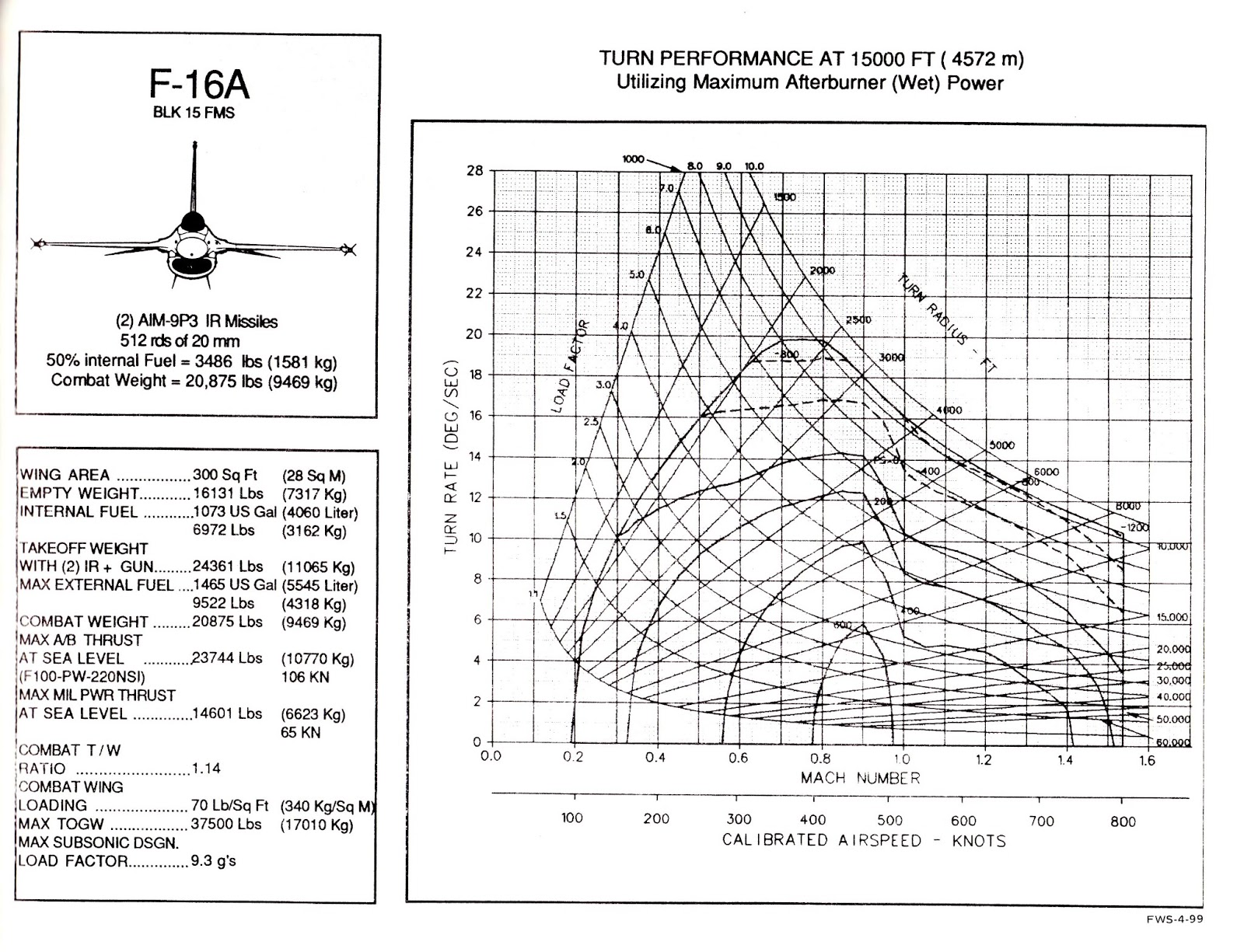
If it’s what I think it’s for 50% internal fuel and 2 AIM-9
Coolio so thank you.
With less fuel in it and half the drag it can only match the ITR of the F-18 and at low speeds it’s only slightly better in sustained turns.
What I said before still stands:
Less ITR below 7 G
Less sustained turn at lower Mach numbers
Where is the fuel figure in the F-18 EM diagram? Do you think the F-18 EM diagram corresponds to similar fuel load; i.e 85% shown in your preferred F-16 EM diagram?
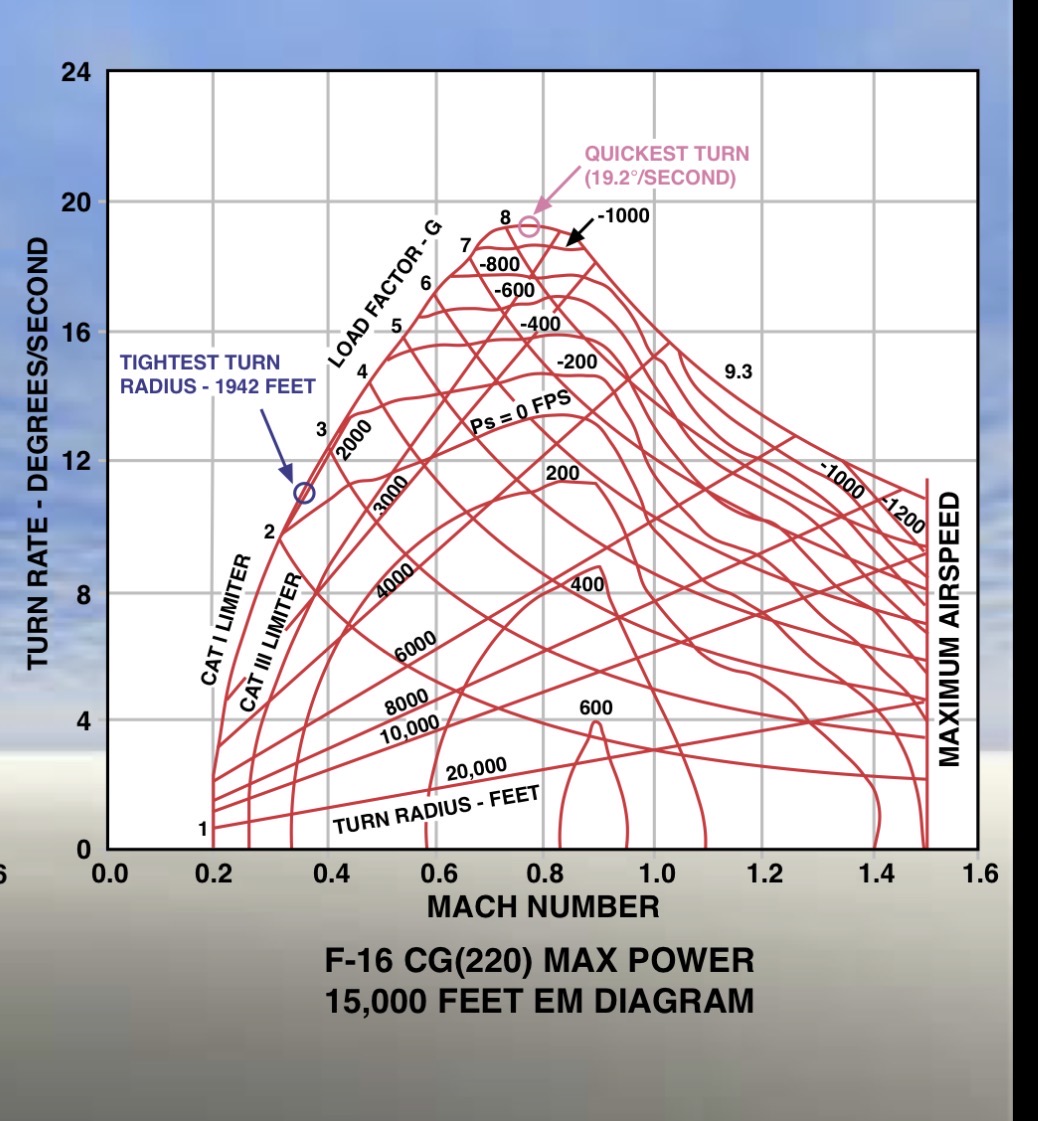
60% like you said as it matches the 12.3 d/s found in the other source.
With 2 amraam and 2 winders
Add 2 amraam and the associated pylons to the viper and you’ll be close to 22,000 lbs.
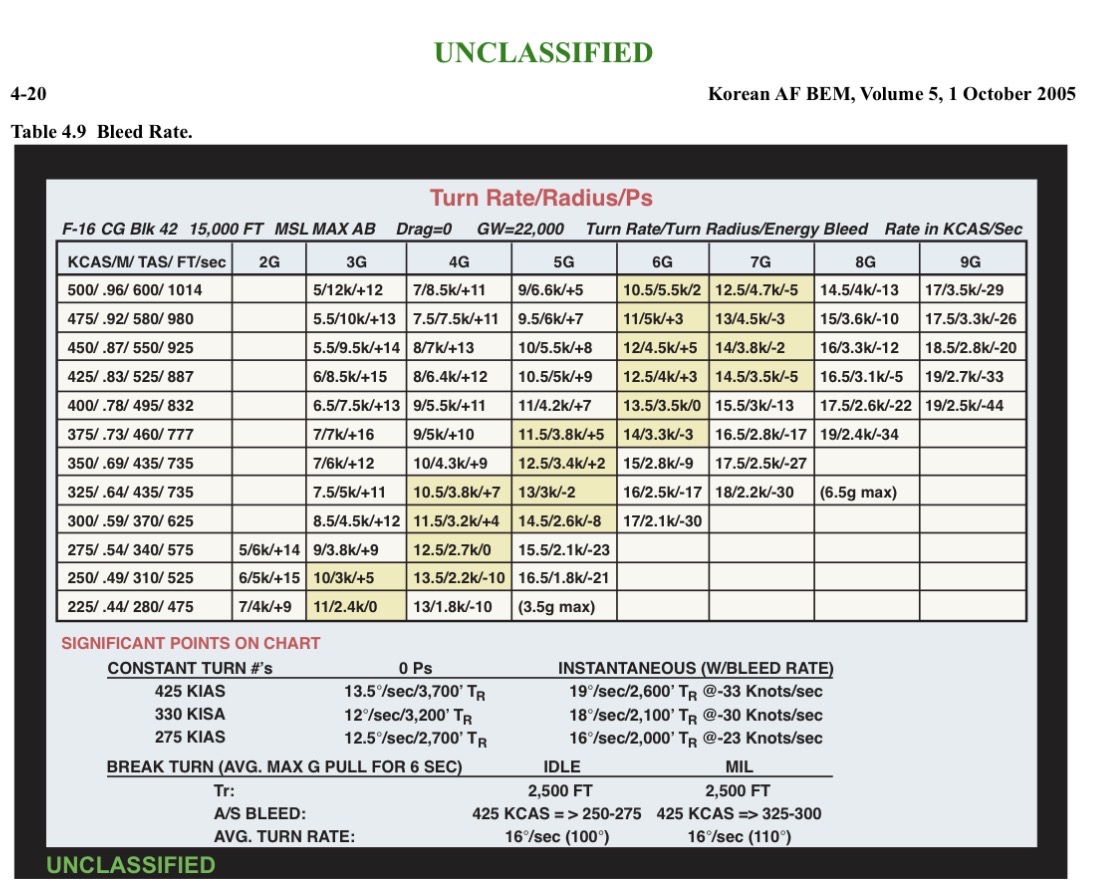
This is for a C viper with a weight of 22,000 lbs and a drag index of 0 (no missiles) it’s at a disadvantage in all parameters except acceleration at lower speeds. Like I stated.
It does not match the GAO report. The Eidetic EM diagram shows a higher turn rate than the GAO document by about 1.5 degrees per second.
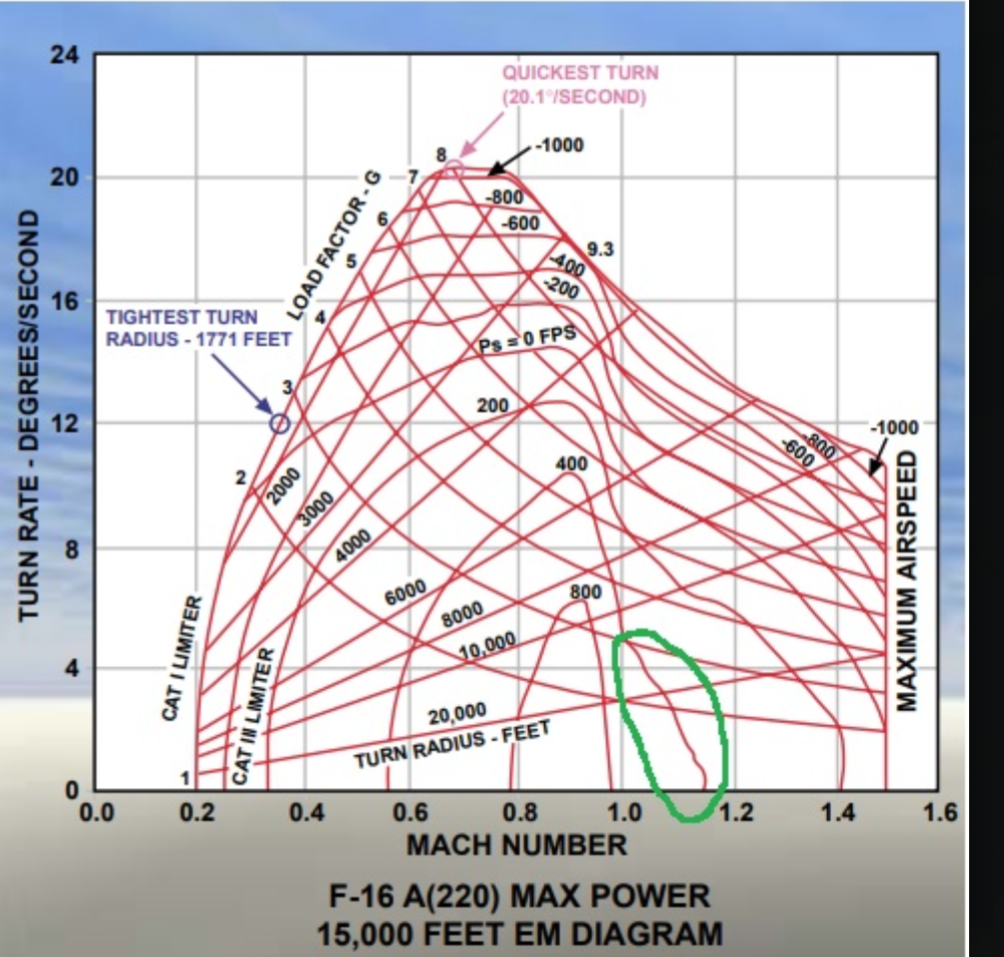
This chart is for an F-16C airframe with the PW-220 engine. It is the heavier F-16C airframe equipped with the earlier engine.
It is telling that you are committing the chart in the same document that shows the values for the F-16A as well.
That shows the same chart you did, 50% fuel lower weight.
They are aerodynamically basically the same and would have the same ITR at the same given weight.
You are selecting a chart that 1 - has the F-16 at a lower than comparable weight, 2 - lower than comparable drag index.
The F-16A airframe is lighter than the F-16C airframe. Does this not compute?
Does this not compute….
They are the same
If the F-16A weighs 22,000 lbs and the F-16C weighs 22,000 lbs they will have the same ITR.
Airframe weight only affects how much can be carried before X weight is reached as one starts out with a higher weight.
The F-16C is not going to weigh the same as the F-16A because one airframe is heavier than the other. Are you not able to understand this?
You clearly aren’t capable of understanding. So I’m not going to bother with you.
Anyways have a great day and continue to spread misinformation, it’s funny to read.
Note how same Korean document shows higher ITR number for F-16A compared to F-16C. I wonder why this is?
That chart is the chart you shared earlier at 20,800 lbs
50% fuel and 2 winders.
Again add the weight of suspension for the 2 other missiles the weight will be greater.
As such the ITR goes down. And with the extra drag the STR goes down.
It’s actually not.
This chart is slightly different than the FWS chart. They are the same for practical purposes. Also iirc the Korean document doesn’t specify a weight or a missile count.
The reason they are different is because the F-16A Blk.15 airframe is lighter than the F-16C.
Also you never addressed where you are getting the idea that F/A-18 chart that you posted shows that it is equipped with 4 missiles and more fuel? The EM chart shows better turn performance than the GAO report which means it’s for a lower weight.
Yes this is the bleed rate table that is referenced in my post. Keep in mind these numbers are for a Block 42 F-16C so you have the weight of the F-16C airframe but without the benefit of PW-229 engine or GE-129 engine.
So you are using the worst possible F-16 in terms of EM values.
Also completely ignoring the F/A-18 question again.
What question.
And again Airframe is irrelevant when we are talking about 1 specific weight
What are you basing your assumption on that the F/A-18 in the EM diagram that you posted corresponds to performance figures of greater than 50% internal fuel?
This is a simple question that you ought to be able to answer.
We are not talking about 1 specific weight. You seem to be misunderstanding the Korean BEM manual.
An F-16C at 50% fuel will weigh more than an F-16A at 50% fuel. This is due to the airframe of the F-16C being heavier.