You’re betting on your opponent missing. If he doesn’t, tough luck for you.
This is ultra simplistic and doesn’t reflect reality. Not only does a two-circle have to be initiated by both parties(and a good F-18 pilot won’t do that, instead opting for the one-circle cause why would he play into your strength/his weakness). Which one comes out on top is highly dependent on the skill of both pilots. You can find experienced F-16 pilots gunning down dumb LTs in F-22
Hell, the merge alone can determine how easy or hard a fight will be for a plane. The F-18 will struggle in a Butterfly set but put up much more of a fight in a Beam set.
I’ll say it again: if there’s a Hornet vs. Hornet duel, the one who doesn’t lose speed but stays in two circles fight will win. This works very well on older aircraft (example F-5 vs F-5) whose missiles cannot be turned properly. A fight from one circle with a loss of speed is usually a defensive fight, in which the aircraft simply cannot out-turn the opponent in any other way (example M2000C vs F-16).
And ignorance of these basics is the cause of your poor statistics in simulator mode on 3rd generation aircraft.
Haven’t touched these in years, I learned a lot since then.
And even back then, that led me to a K/D of 2 in the Kurnass, 2.5 in the F-14, 6 in the F-4J so what are you even talking about lmao. Not only that but why bring 3rd gen planes into 4th gen discussion?
No, it’s entirely dependent on what plane fights what. Read what I said. A good F-18 pilot is NOT going to entertain a two-circle fight with a F-16. He’s going one circle and will use his AoA authority to cut into your turn and bag you there.
If the F-16 goes with a sustained turn there as you’re implying, it’s possibly already bagged and done at the one circle. Back to what I said, it’s entirely up to pilot skills. If the Hornet guy can get the Viper pilot slow, then Hornet guy will most likely come out on top. Otherway around, Viper comes out with the win.
I suggest you watch this video from the timestamp provided. They address exactly this subject after a growler guy said his F-18 couldn’t dogfight anything.
I don’t need to watch this video; I know everything perfectly well without you. I even showed you what would happen if identical planes fought. And you’re still arguing. You’re a theorist arguing with a practitioner. That’s the difference between us.
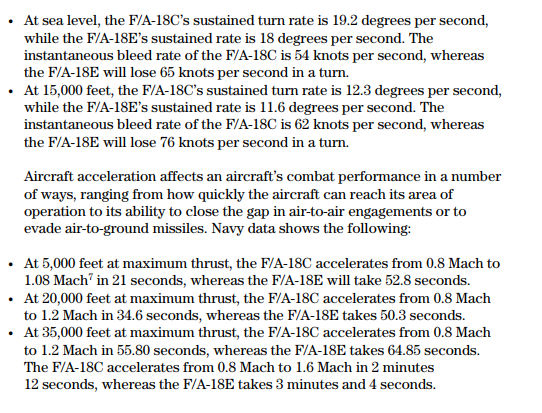
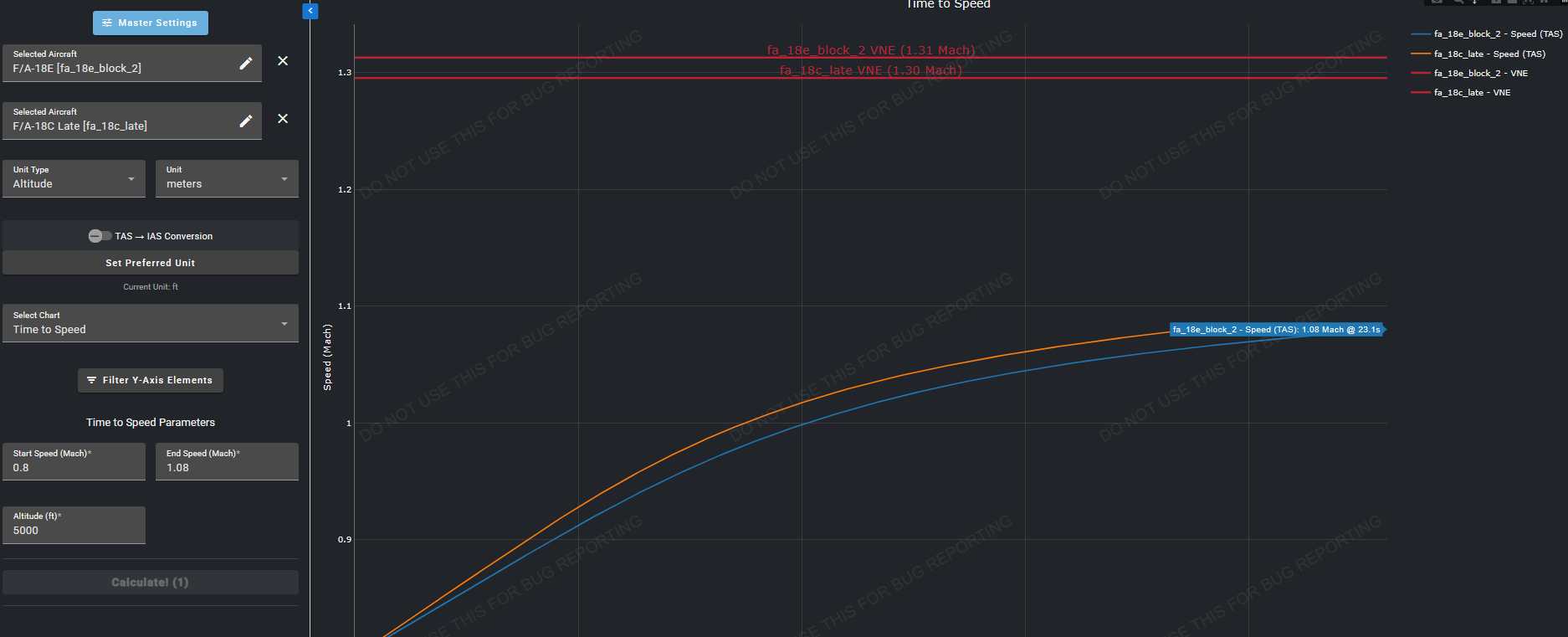
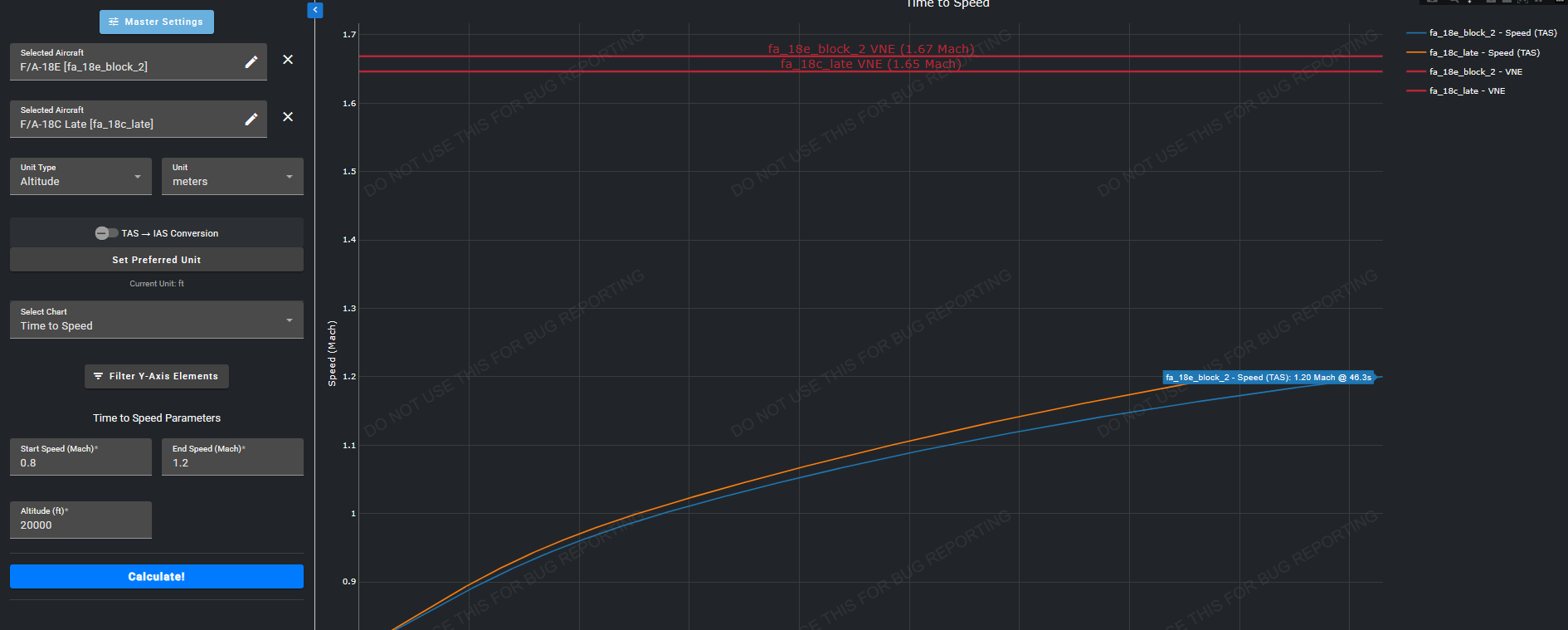
F-16 will consistently put rate F-18 when compared at similar fuel states. The numbers in linked chart you are showing are better than 60% fuel numbers in GAO report.
The difference between 50% and 85% fuel fraction F-16A model is on order of about 2 degrees per second at 15,000ft across pretty much the entire speed range.
This is an extremely reductionist assumption that doesn’t actually prove true in real life or even in the game. This fundamentally misunderstands the dynamics of a dogfight and ignores angular advantages that can be gained against someone who is attempting pure rate fight only game plane.
Maybe because it can’t actually sustain a turn ingame and it still overperforming. Gaijin must think bigger wing = better maneuverability or something because the Superbug is verifiably worse in the dogfight in almost all regimes except stalling.
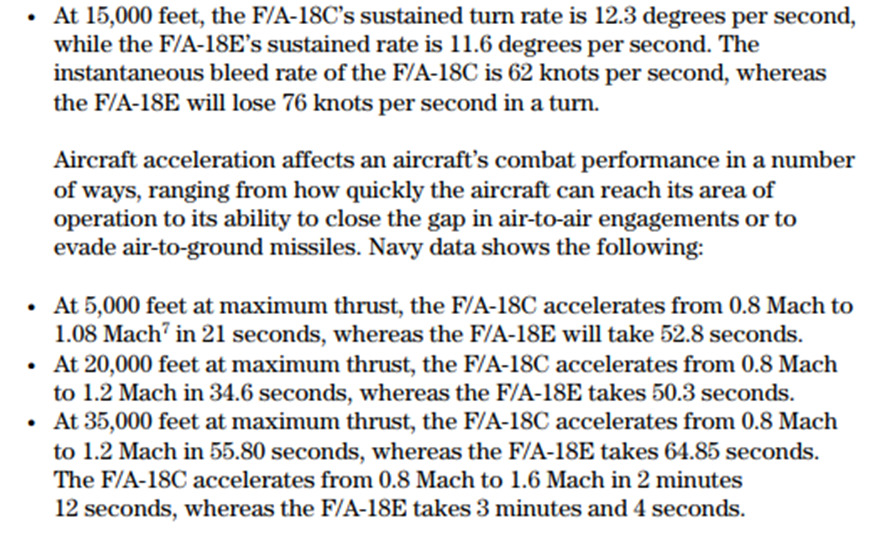
The specific numbers are for F-18 with the upgraded engines, 60% fuel, 2 Aim-9, and 2 Aim-120. The diagram in the NASA study is likely for 50% + 2 Sidewinder.
In apples to apples comparison the F-16 will have higher sustained turn rates and lower bleed rates at most speeds beyond Mach .5.
The diagram you are using the claim that the F-16 is bad is based on being loaded to 22,000lbs which is quite heavy.
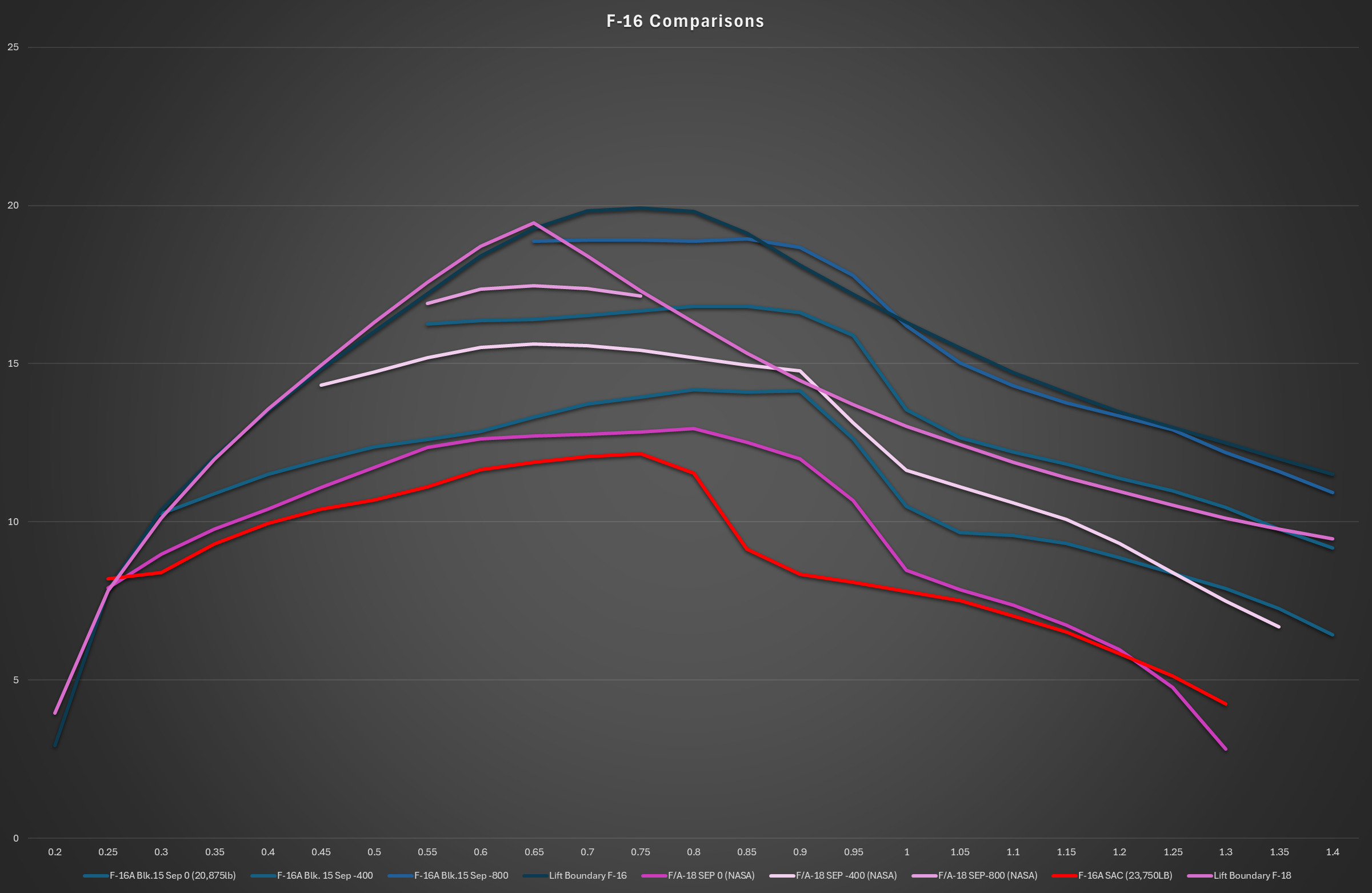
Just to reiterate this point I made an overlay of the F-16A Blk.15 EM diagram from the Fighter Weapons Symposium, the 1984 EM diagram (at 23,768lb), and the NASA F/A-18 EM Diagram that is not at a specified weight.
The 1984 EM diagram corresponds to a loaded weight 85% internal fuel in F-16A Blk 15. It also corresponds to the PW-220 engine pre-FADEC/DEEC. There are allegedly slight differences in available thrust between pre-FADEC and post-FADEC engines.
The Fighter Weapons Symposium diagram corresponds to an F-16 with 50% internal fuel and 2 sidewinders. This gives a weight of 20,875lb in this configuration.
The NASA/Eidetic EM diagram for the F/A-18 does not specify a weight or configuration. However we can make a logical guess based on the values present in the EM diagram when compared to known values in the 1996 GAO report in regards to the F/A-18.
These comparisons are for an aircraft with 2 Aim-9, 2 AMRAAM, and 60% internal fuel. This gives us a value of 12.3 degrees per second for the F/A-18C in this configuration. The NASA EM diagram shows a sustained turn rate of 13 degrees per second so it is logical to conclude that the NASA EM diagram would correspond to a lower weight figure than the 12.3 degrees per second configuration in the GAO report.
It is logical to conclude that the NASA EM diagram would correspond roughly to 50% internal fuel and 2 sidewinders.
This is what happens when you roughly overlay the EM diagrams with each other. There is no speed range where the NASA F/A-18 EM diagram shows significant turn performance advantages over the F-16A Blk.15 in terms of energy maneuverability. The only way that the F/A-18 displays EM advantages over the F-16 is if the F-16 is loaded to a higher weight.
The sustained turn rate of the F-16 is higher than the F/A-18 at 15,000 feet by about
The bleed rates (negative SEP values) are lower for the F-16 than the F/A-18. The bleed rate values are more pronounced at high speeds and less pronounced at low speeds.
The F-18 has more control at lower speeds. It’s lift limit allows it to sustain around 4 degrees per second at Mach .2 vs 3 degrees per second for the F-16 at the same speed.
This comparison can also be confirmed by comparing the bleed rate figures in the GAO report (54 kts / sec) and figures in a declassified South Korean document for the F-16 that claims a bleed rate of around 30 kts / sec.
Very easy to see the F-16 overperforming in lift here.
It’s should not match the F-18 in ITR.
But obviously it should have more SEP at higher speeds. While being worse at lower speeds and having a disadvantage in ITR across the board below the 7G limit of the F-18.