Ah, I see you’re talking about Bri*ish squadron vehicles!
2 Likes
We don’t talk about the br*tish in the 🇺🇸🗽🦅🇺🇸 🇺🇸 🦅 🦅‼️‼️ AMERICAN MADE F-16 🇺🇸🗽🦅🇺🇸 🇺🇸 🦅 🦅‼️‼️thread.
2 Likes
Sorry, edited accordingly
2 Likes
Thanks, you almost gave me PTSD flashbacks, I was about to go throw a bunch of tea in a river.
1 Like
“PTSD flashbacks”? That just sounds like a good time!
Historically I always thought transmission was at the base of the vert stab (blue) and receivers at the top (red)
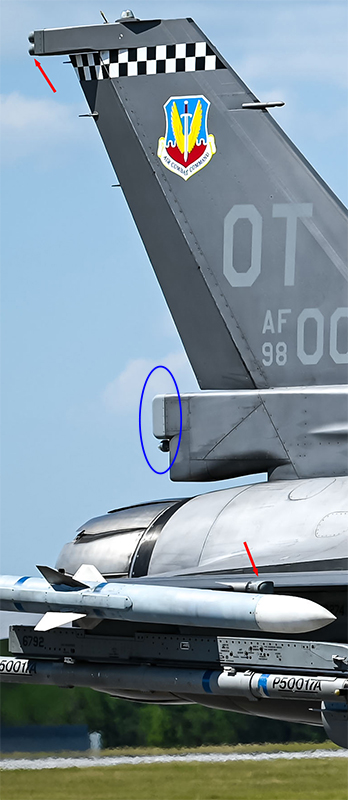
Fits with what Northrop seemed to say about the transmitters for IVEWS in the image posted by @Abyss_Revenant
Turkish ALR-178 SPEWS-II is going for that layout with the transmitter (verici) antenna at the base and maintaining receivers at the top
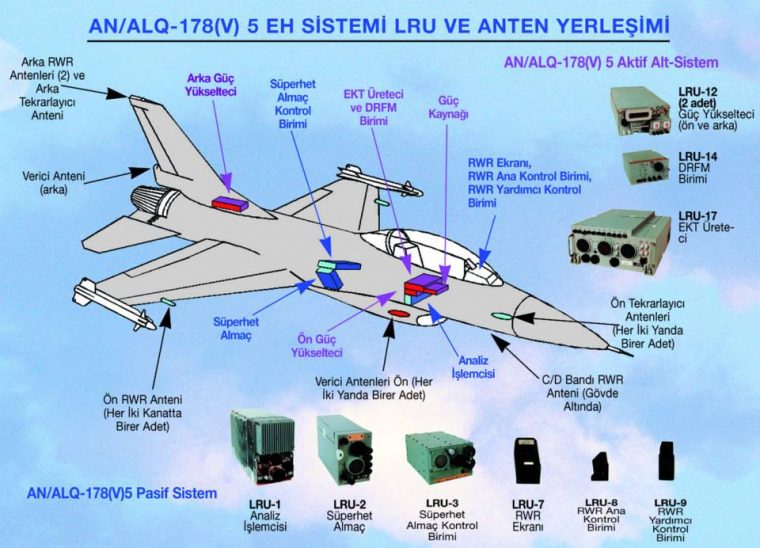
plus transmitters on the sides of the intakes where those new fairings are on the IVEWS test airframes.
ALQ-211(v)4 AIDEWS fit on export Advanced Block 50/52 uses these locations for the transmitters also (aft and frontal), which seems to have carried over to Viper Shield for Block 70 judging by the new planes exported so far.
But obviously IVEWS layout can differ significantly depending on what Northrop found works best in their test flights. It’s an all-new installation so there’s not necessarily the need to maintain legacy form/fit for specific antennas. We can already see there’s a whole host of new panels, ducts and fairings not seen before on USAF F-16s.
1 Like
I thought the US canceled the EW suite for the PoBIT and just incorporated the ALR-69A(V)
EW was originally a sub-program of the DRWR procurement that lead to ALR-69A. But it got cut out of that, and IVEWS development has proceeded as a separate USAF program of record that is supposed to start rolling out in the next year or two. AFAIK it’s not been cancelled yet, and an EW upgrade was actually considered to be quite important now.
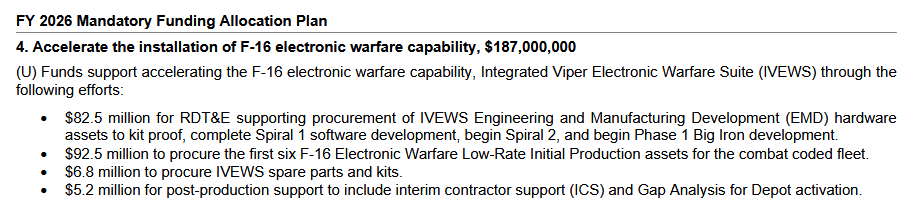
IVEWS was in the FY 2026 Mandatory Funding Allocation Plan
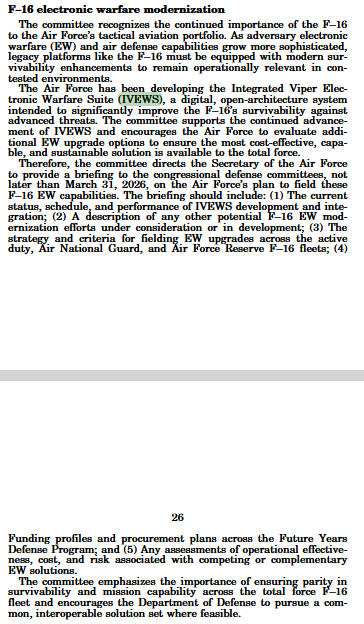
Status was that congress asked the USAF to present options for alternative EW systems ahead of the FY27 budget, while emphasising the need for an EW upgrade in some form.
But since then, the Iran conflict has obviously moved the agenda for congress and the DoD
Will have to see what’s in the FY27 budget when the Pentagon publishes its detailed request a week from now, to see if it’s still on the cards, and what form the EW upgrade might now take.
2 Likes
so for our ingame RWR screen, it would work like a spherical RWR since it doesnt even show altitude?
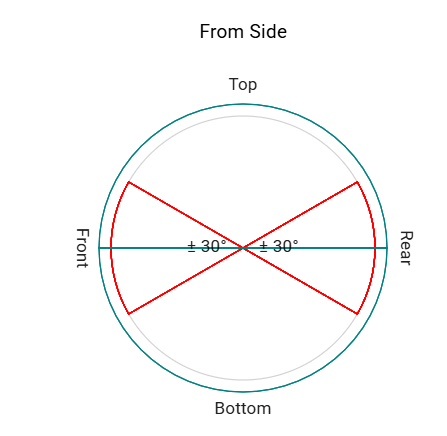
it would work like the spo-15.
Where within ±30 degrees, it gives precise directions.
When above those limits, it just gives pulse/launch/track warnings with no directions, but you still at least get warnings

2 Likes
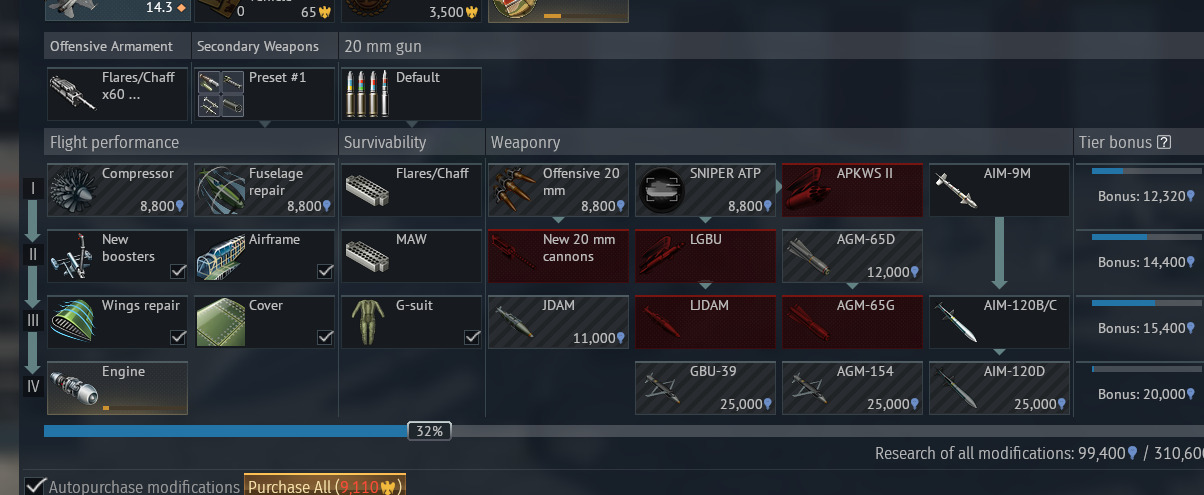
i see, thats still useful. hopefully IVEWS turns out to have better coverage
it would be able to tell me if its an ARH missile and not a hard lock right?
2 Likes
yea
So if an arh missile is locking you, it will give the launch warning tone.
If a plane is locking you, you will just get the track tone.
1 Like

Altitude for RWR contacts is only shown in the data tree or through the HAD page. Some modern vipers don’t require the HTS to get the most out of the ARAD functions though, but as said previously some targeting pods can’t seed data from the HAD page.
1 Like
It will still grant you bearing and signal strength, it just doesn’t populate data that’s needed for most SEAD functions.
As said though, the accuracy of its directionality is greatly reduced.
3 Likes
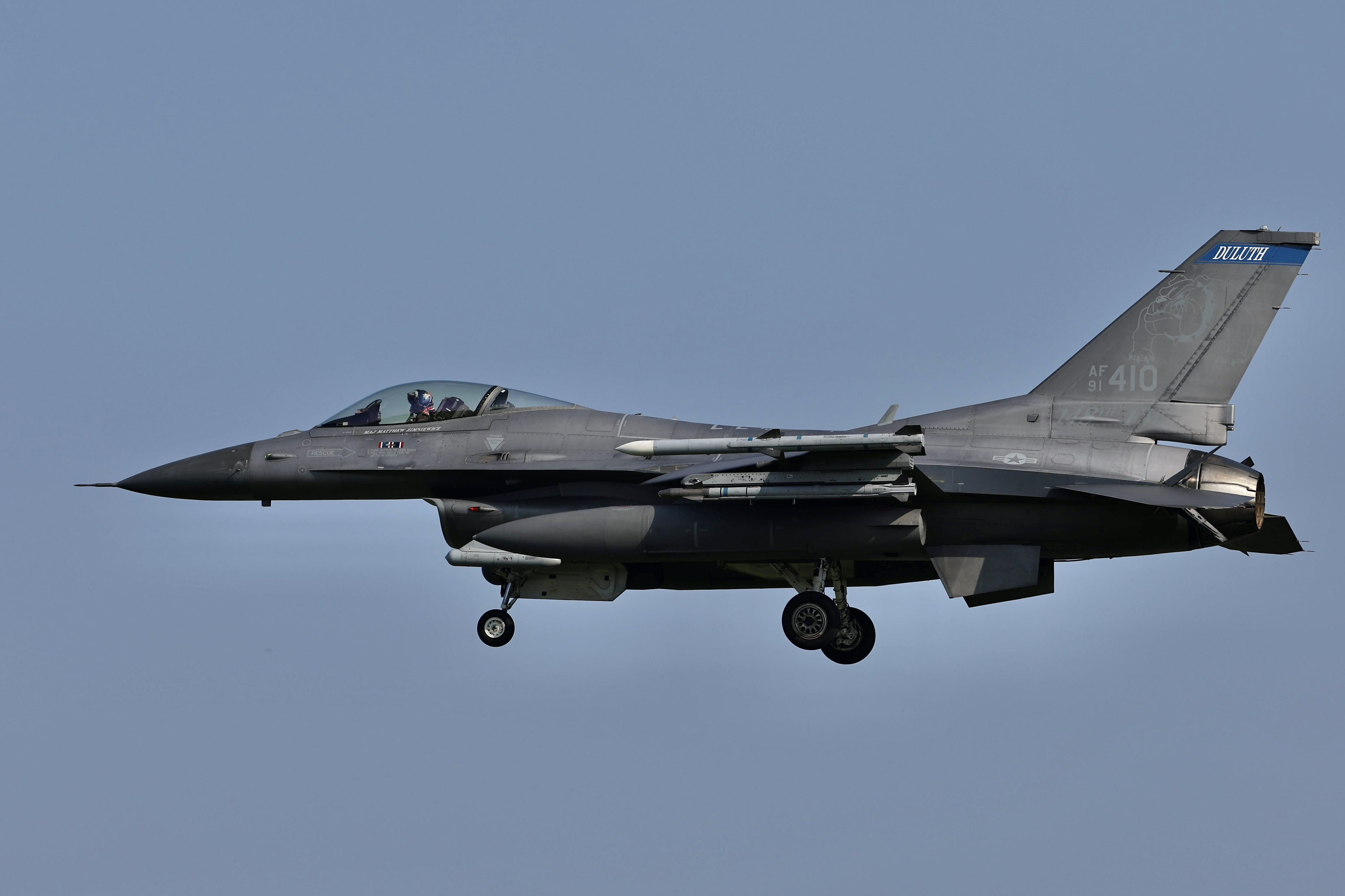
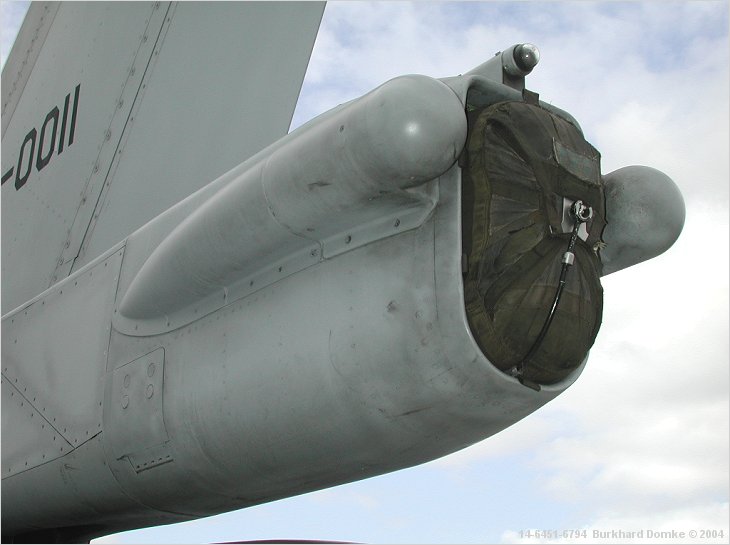
On an ordinary viper there is also the antenna at the aft end of vertical stabilizer fairing.
Afaik most US vipers don’t get ASPJ, so whats that
probably for? Data Link?
Thanks
AFAIK it initially contained RWR antennas for the original RHAWS installation (the old, non-digital ALR-69), along with the two tear-drop shaped “bug eye” fairings on the side of the nose.
The original RHAWS had 2 receiver antennas at the top position and 2 antennas at the bottom position, plus the two on the sides of the nose. That setup was used on F-16A, and IIRC F-16Cs up to the middle of Block 30 production because the F-16C’s intended ALR-74 RWR was delayed. F-16Cs weren’t really supposed to keep on using ALR-69 the way they have done.
The base of the tail on F-16C was designed to accommodate an internal ASPJ and the ALR-74 antennas were to be in the top of the fin. Albeit in the end podded systems were kept for the USAF instead, and ALR-74 lost out to ALR-56M.
F-16C Block 30 and above had an air scoop and vent on the the base of the tail that were intended for the internal ASPJ. The scoop has been removed on some F-16 Block 50s more recently, where they have been refitted with a Beyond Line-of-Sight SATCOM system. However, the IVEWS test airframes still have a scoop on the leading edge of the base of the tail (possibly enlarged), plus a replacement vent on the side (squared rather than slanted).
AFAIK it’s redundant as an RWR location on ALR-56M installations which has (IIRC) 5 antennas in the top installation alone. As are the “bug eyes” that were largely replaced with the addition of “beer can” antennas on the wings. But subsequent F-16 Block retain all the fairings for redundancy purposes allowing the RWR to be changed according to customer requirements, or to support installation of additional antennas.
The digital ALR-69A installation seems to use the original RHAWS layout, or additional antennas, since manufacturers were being contracted to produce new “bug eye” fairings.
https://sam.gov/opp/e292e70326282ccecedf6dd4c8a584a1/view
3 Likes
Correct me I get you wrong, F-16s with ALR-56M don’t have receivers in ‘bug eyes’, instead beer cans take the duty of frontal RWR coverage.Also antennas in vertical stabilizer fairing are not in use.
The ALR-69A DRWR uses both ‘bug eyes’ and beer cans, plus antennas in fairing.
I’ve been told the “bug eyes” were empty on planes with ALR-56, yes. And that carries with what BAE put in their old brochure image
The above contract just suggests the bug eyes are used for new digital ALR-69A, where planes with non-digital ALR-69 have received Antenna Optimization modifications. I don’t know what the AO modifications were, so don’t have info on the current layout of antennas on aircraft with ALR-69, or ALR-69A to say whether both the beer cans and bug eyes are used simultaneously or not.
I only know that beer cans were first fitted in the middle of Block 30 production around the time the delayed ALR-74 RWR originally intended for F-16C, wasn’t working out and decision was made to pursue ALR-56M. The beer cans were retrofitted on older airframes including Block 25s. So either those are present on planes with either legacy RWR system as a full replacement for the bug eye antennas, or they are supplemental antennas on F-16s with pre-digital ALR-39.
1 Like