Not Auto GCAS, but system for emergency recovery from dangerous situationsduring tests.
1 Like
From DCS community…
Quite interesting topic for F-14B(U) HUDs.
3 Likes
Is it me or are those aim54 going faster than they do in game
1 Like
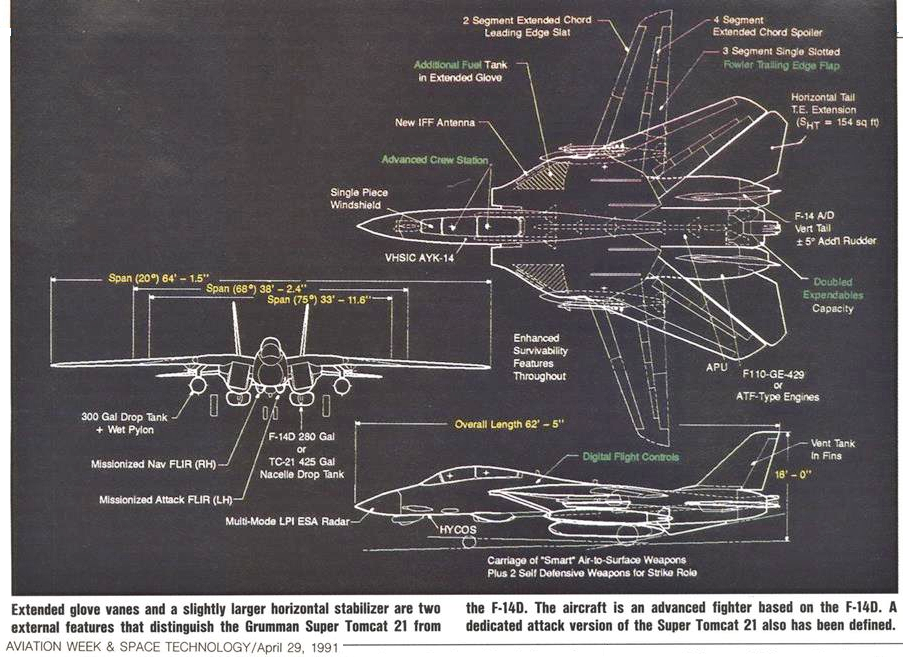
Very interesting article regarding F-14D/ST-21 performance. Copy and pasted because the original link requires Registration.
Spoiler
Versatile and Flexible F-14 Offered as Best Choice When Pitted Against F/a-18
STANLEY W. KANDEBO April 29 1991
Versatile and Flexible F-14 Offered As Best Choice When Pitted Against F/A-18
STANLEY W. KANDEBO
NEW YORK
Defense Dept. decisions to terminate the Grumman F-14 program and procure an advanced version of the McDonnell Douglas F/A-18 base have polarized the debate on the near-term future of carrier-based fighter/attack aircraft into one pitting proponents of light-weight, limited-capability aircraft against those favoring heavier, more-capable aircraft.
Without continued procurement of the F-14D, the aircraft’s production line will close in the near future, and any additional derivatives of the F-14 will become moot (AW&ST Mar. 11, p. 52). But Grumman and some U. S. Navy officials believe that if budget decisions permit only the F-14 or F/A-18 to be selected for continued procurement, the F-14 should win. They argue that the F-14 and its derivatives are the more versatile of the two aircraft families and therefore would be the best choice to provide the Navy with maximum flexibility in future aircraft procurement. They also believe production price is not a big factor in differentiating between the two aircraft when capabilities are considered. While McDonnell Douglas officials point out that F/A18E/F reliability, maintainability and overall life cycle costs are expecieu IO ue lower mail muse Ol me JT-IH-, the Navy recently estimated the production NEWS upgrades, would be $30-40 milhon. In comparison, Grumman estimates that on a similar production basis, the Super Tomcat 21, a much more capable version of the F-14, would cost about 25% more than the F-18E/F. “The Defense Dept, plans to spend about $4 billion in research and development to upgrade the F/A-18 into a configuration that will have fewer sensors, a far less powerful radar and overall less capability than the current F-14D. The F-18E/F will not be able to fly the fleet air defense mission as currently defined, it will be incapable of flying the escort mission that was required to defend a strike performed by A-12 attack aircraft, and it will be incapable of performing missions defined for the A-12 itself,” a Grumman official said. McDonnell Douglas officials, however, describe the F/A-18E/F effort as an airframe program that will improve the growth capability of the F/A-18 so the aircraft can continue to evolve, with new sensors and new avionics, for another two decades. “The F/A-18 is not an aircraft that is specifically designed for fleet air defense or as a medium-attack aircraft. It can’t be an AX and given the naval advanced tactical fighter requirements, it can’t be a NATF either. It is a compromise. It offers tremendous capability at a relatively low cost,” McDonnell Douglas officials said. They also said there are some carriers operating fighter and attack complements composed solely of F/A-18s, and that the Marine Corps has found the multimission aircraft suitable for a number of roles. The current fleet air defense mission calls for an aircraft to take off, cruise to station at best speed and altitude, loiter for 90 min., accelerate from loiter to Mach 1.35 to engage in combat, spend as much as 1 min. in afterburner at Mach 1.35 during combat, then break off, return to the carrier at best speed and altitude and land with enough reserve fuel for 20 min. of sealevel loiter plus 5% of initial fuel. Armed with two Phoenix missiles, two AMRAAMs and two AIM-9s, the F-14D would have a combat radius of 220 naut. mi: The F/A-18C/D and F/A-18E/F with similar weapons would not be able to perform this mission, unless the combat Mach number were lowered and the aircraft were allowed to drop its external fuel tanks, Grumman studies show. The high drag penalty of the tanks at supersonic speeds inhibits the F/A-18 from sustaining supersonic flight with the tanks attached. By contrast, the F-14 can and frequently does fly supersonically with external tanks attached. For the same mission with a similar weapons loadout, with the combat Mach number lowered to 1.2 and with the aircraft allowed
to drop its external tanks, the F/A-18C/D and E/F would have combat radii of about 120 and 260 naut. mi., respectively. Under the same conditions, the F-14D and Super Tomcat 21 would have combat radii of about 350 and 430 naut. mi., respectively. “The importance of supersonic flight in these roles cannot be underestimated,” a Grumman official said. “Supersonics are integral to the mission because the high speed allows you to engage targets, shoot and breakaway to engage additional targets across the battle area. Supersonic dash speed also is important in bringing down bombers at distances from a carrier that exceed the range capabilities of the bomber’s cruise missiles.” Studies comparing aircraft performance in a strike mission developed for an advanced medium-attack aircraft parallel the fleet air defense results. In this mission, where eight Mk. 83 bombs and two AIM-9 missiles are carried, the aircraft takes off from a carrier, cruises at best altitude and speed, descends to sea level and performs a low-altitude penetration of enemy airspace by flying 100 naut. mi.—50 at 420 kt. and then 50 at 480 kt.— to reach the target. Once there, the aircraft drops its payload and performs as many high AoA maneuvers at maximum g as possible before leaving the target.The aircraft that is the reverse of the outbound flight. The aircraft lands on the carrier with enough fuel for a 20-min. sea-level loiter and 5% of the initial fuel load. Under these conditions, in which several of the F/A-18 wing stations normally used for external fuel tanks are used instead for carrying bombs, the F/A-18C/D and E/F have mission radii of 190 and 265 naut. mi., respectively. The F-14D and Attack Super Tomcat 21, however, have mission radii of 400 naut. mi. and more than 500 naut. mi., respectively. The F/A-18E/F, however, will be able to match the F-14D at some specific points in its flight envelope. Navy studies have indicated that in some mission profiles, an F/A-18E armed with four Mk. 83 bombs, two AIM-9s and external tanks would have a mission radius of about 475 naut. mi. With the same payload, the F-14D would have a mission radius of about 460 naut. mi. But unlike the F/A-18E, the F-14D would be able to fly the same mission with virtually the same combat radius with double the Mk. 83 bomb payload, Grumman officials said (AW&ST Mar. 25, p. 25). McDonnell Douglas officials do not dispute these performance studies, but they do reiterate that the F/A-18 is not intended to be an F-14 or an AX. They also say the fleet air defense mission may be changing, arguing that with the reduced Soviet threat, the war scenario in which wave after wave of Soviet bombers attempt to attack the U. S. fleet may be outdated. And even if that scenario returns, as is likely given the addition of large supersonic bombers to the Soviet naval aviation inventory, there still will be time to develop an F-14 follow-on, the McDonnell Douglas officials argue. In addition to performance, shortfalls in F/A-18E/F sensor capabilities as compared to those of the F-14 also have been noted by critics of the program. The almost $4 billion R&D price for the F/A-18E/F does not include monies for an improved radar, an infrared search and track unit or long-distance television camera imaging system. The latter two items are in the F-14D, however. “Compared to the radar in the F/A-18, the radar in the F14D has six times the average peak power and twice the antenna area. The F-14D radar also is 2 dB. better on gain and has a 20% narrower beam width for better resolution. Overall, the F14D radar has twice the detection range and 14 times the search volume of the F/A-18s,” the Grumman official said. But McDonnell Douglas officials point out that if waves of attacking bombers are the threat, the aircraft group will have a substantial cross section, so the current radar and stand-off capability of the F/A-18 could cope with this threat. □
3 Likes
everyone knows the F14 was the better plane we all knew that its just politics that stopped it and back alley bribes F18 was probably the biggest mistake every made
4 Likes
That’s nice I wonder if theirs one for them to also use CM since in crew skill it has awareness
It does
6 Likes
I thought soo I had the missile stay under me for a cool min or even go behind me and over me
it wasn’t just that, Grumman was getting low on money due to multiple other failed programs mixed in with the amount of maintenance needed per flight hour being high as well as cost due to the wing box being out of titanium and the process of welding that in a vacuum, although the tomcats were promising, overall the F/A-18As were a cheaper option at the time even if the tomcat had more range and more speed, with a proposed F-14E super tomcat being looked at, it was dropped
1 Like
it was better in everyway but price pretty much
Amazing! Definitely can see most of us would use the female voice for the WSO/RIO (if we get the choice of choosing)
1 Like
you mean Prez from the hit game project wingman?

5 Likes
also this isnt the first time
F11-F super tiger
The German Air Force, Japan Air Self Defense Force, and Royal Canadian Air Force also showed interest.[citation needed] With an eye to the possibility of an order from West Germany in particular, Grumman offered to build a variant with the 10,500 lbf (47 kN) Rolls-Royce Avon instead of the J79.[6] However, following selection processes allegedly marred by the Lockheed bribery scandals,[7] all of these potential customers chose the Lockheed F-104 Starfighter.
Prez is so goated
1 Like
Spoke generally, but YES.
HELL YEAH I’D WANT HER AS MY WSO/RIO
Peak game
I don’t know about anyone else is having the same trouble but i couldn’t get the f14B to Mach 2.35 most I got it to was 1400 mph and Mach 2.10 even at 30000-50000 ft it took forever just to get it at 2.10 with nothing on the aircraft was I do something wrong?
Is something like AIM-7R (AIM-7P with miniaturized AIM-9M seeker for terminal guidance) within the realm of reason for the F-14D? I feel that without AIM-120, the D it isn’t distinct enough from the B to be worth unlocking for anyone but enthusiasts.
2 Likes
Nope. Its an artificial nerf put on the F-14s. Even the F-14 can’t get over 2.25.
1 Like
Was it ever fired?