About what ?
Also that was not DS that made the report
The salt is strong in this one
About what ?
Also that was not DS that made the report
The salt is strong in this one
Half a 9L’s turn radius is still quite good, but it is the first production TVC IRAAM, and its 10-20y older than western TVC missiles. Assuming the missiles are travelling at the same speed (for simplicity), half the turn radius is double the G-load.
When simplicity tells you that a missile does 100g because of fruits
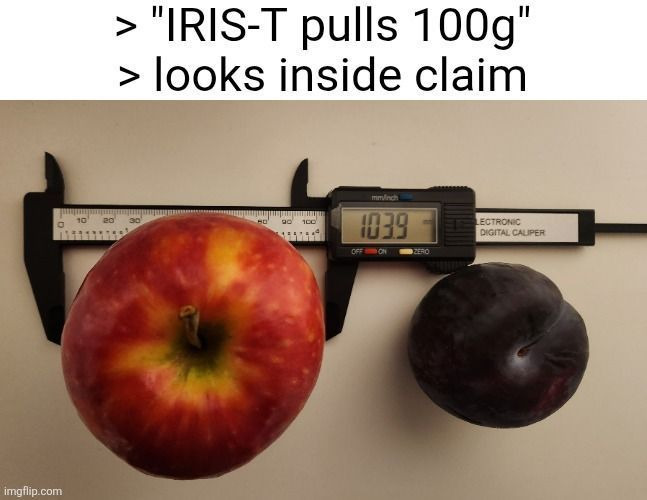
Let’s be honest, 50g is probably underperforming, but 100g, can’t be serious
Giving me flashbacks to my childhood where I got blamed for something I didn’t do. I never made a report to nerf the G-load of IRIS-T.
The problem with this theory is that it doesn’t account for the guidance delays. There’s reasons to believe the R-73 could have overperforming guidance delay while the IRIS-T could have underperforming guidance delay. Part of why the MICA is so strong in high off-bore shots is because of its very low guidance delay of just .15 seconds which is the lowest out of all fox-3 missiles iirc.
I messed around with the unmodified rbs98 on the JAS39E and there is def some funky guidance shenanigans going on. IRL is there a difference in programming between the standard air launched and SL variants? Perhaps a guidance delay on the SL accounts for time taken to leave the launcher vs immediately going HOB in the air as seen in test fires.
on the IRL performance chart its closer to 2/3s the 9L radius
there 100% would be some difference in programing IRL
If it does in fact use H-infinity as claimed, I dont think it need it.
The advantage of an H-infinity controller is that, too my understanding, it basically “builds” a new controller for every shot, taking into account all variables defined as important by the designer of the controller, and optimizing for the desired outcome, so the missile being air launched or ground launched is likely irrelevant, as the guidance controller will optimize for the launch conditions and target conditions on its own.
When are they going to be mad enough to do an air launch of the SLM?
IRIS-T SLM/SLX or CAMM-ER/MR mounted to aircraft would be really interesting
(im really surprised they’ve never fitted CAMM or CAMM-ER to an EFT, even just in trials)
Basically halfway there to MICA-NG lmao.
As if the UK can afford that level of frivolous spending at the moment…
The expensive bit would be developing the weapons, they already exist and are in service.
CAMM would just be a matter of swapping an ASRAAM seeker to the CAMM seeker. I doubt would be all that difficult or expensive.
CAMM-ER would be a more extensive modification as they would need to figure out a way to mount it on a pylon, but I doubt would be all that hard, then just remove the booster/turn over pack.
the CAMM-ERs arent that much larger and dont have a wierd shape to them like the MRs do.
Instant MRAAM, for the fraction of the cost of developing something new, and most of the supply line already exists as well.
2x ASRAAM, 2x CAMM-ER (Or even ASRAAM-ERs, keep the IIR seeker, but have the extended range of the CAMM-ER) and 4x Meteors would be an interesting weapons fit for an EFT
did not know camm/asraam had folding fins
Just CAMM so it fits inside the tubes
18 seconds at 0.25 play back speed and you can see them deploy
tailless design improves stealth in lower frequencies as well.
they are only accurate because they have massive antennas, a fighter sized array will still be fairly inaccurate.
against jets without IR reduction maybe, even against F-35 or F-22 it will probably not put up those numbers
The interesting part as to why the “H-infinity” controller was even nessecary in first place: The maneuverability is so high that “traditional” ways of controlling (proportional/integral navigation) weren’t possible as the hysteresis would just make them unable to keep up.
On that note: spiraling out of control after launch shouldn’t be an issue firstly because of the different control schema, secondly because of the giant strakes to stabilize the missile even at extremely high AoAs and thirdly because a modern digital autopilot shouldn’t let it spiral out of control in the first place even if it has to fly a wider curve than demanded by the target.
Here’s another mission with 8x IRIS-Ts, made to test the missile against Rafales in different ranges, angles and high off boresight situations.
Bug report created regarding issues with radar POIs blocking manually created POIs via the map.
Really annoying in NE, having to disable the radar to be able to place a POI on the map
https://community.gaijin.net/issues/p/warthunder/i/uQXcgRUFl9TP
It wasn’t just the nuclear and carrier capability that caused problems for FEFA as it was then known. It seemed that France wanted a fundamentally different aircraft to the rest of the nations (stuff like France wanted 75 kN engines and were happy with a max speed of Mach 1.6, while everyone else wanted 90 kN engines and at least Mach 2). British negotiators from when the original requirements were being defined noted that everyone seem to be on broadly the same page, apart from the French. In one of their reports they remarked that if the French weren’t involved, the negotiations would have been over in less than half the time. Apparently the French negotiators also informed everyone on the first day that they did not have the authority to make any concessions on any of France’s requirements; which everyone was a bit surprised by, considering that the whole point of the meeting was for everyone to make some concessions and agree on a common set of requirements (apparently the next day the French came back, seemingly having found the authority they needed to make some concessions).
