Yes, as for the size its either power on target or priority not sure.
Would kinda make sense that a Incoming Missile would get a Higher Priority, but same can be said for Power :(
Something that would be really nice to implement in third person RWR interface is an altitude indication for missiles. On aircraft capable of determining whether an incoming missile is above or below them, the MSL symbol could have a small arrow inside the circle, right next to “MSL”, an upward arrow if the missile is above you and a downward arrow if it’s below you. This would be super useful considering how many missiles the system can detect coming at you during a normal match, and it seems like something they could definitely implement
1 Like
Still asking myself why some video games have a much better readable 3D radar screen :D
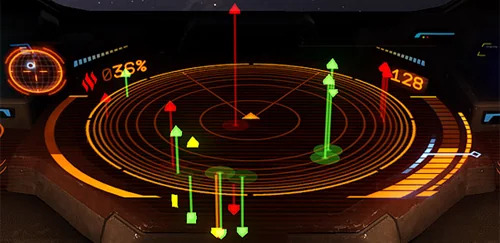
I mean you could even improve that by having everything below you have a dashed line, while everything above keeps its solid line.
3 Likes
Id assume power.
There are better ways to denote order of priority like a number, but relative strength is easier to denote visually.
The RWR panel needs sooooooo many overhauls and this would be one of them.
Id also include target filters, colourisation of different types of contacts, scalable ranging
1 Like
You’ve hit the nail on the head, there’s only those two options.
The UK has been winging it in terms of anti ship munitions since the retirement of sea eagle on tornado.
There is literally no strategy, the subs can’t put to sea, we no longer have tactical nukes, we no longer have ASHMs.
Literally the only plausible strategy is to spam brimstones at vessels until they run out of munitions and then finish them off with paveways….
1 Like
It is already in the game, but it is limited to aircraft whose onboard RWR can actually distinguish between above and below.
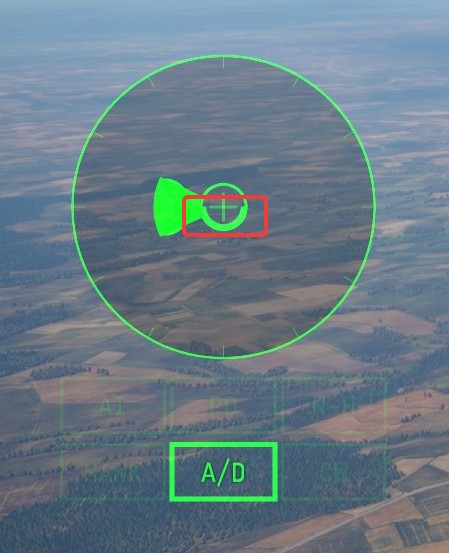
I think the thing with the EFT is that, theoretically speaking, RWR and MAWS contacts should still be shown in the HMD display (and the HMD and HUD display will actually tell you where to steer to avoid/defeat the missile, while the onboard voice system will also be talking you through it to boot), so having it displayed on the MFD’s was likely seen as unecessary clutter, but in-game, the HMD only shows radar and friendly TDL contacts, omitting the RWR and MAWS ones, so you end up in a siyuation where the defensive situational awareness is significantly worse until gaijin decides they feel like implementing core survivability systems the aircraft incorporates irl.
Coin toss as to if they’ll ever model those things though. There are bug reports in, as well as for things like HMD display of ESM located SAM targets, buy seeing as that stuff is almost exclusively a sim feature, and gaijin doesnt care about sim, the chances we ever see them implemented are slim to none imo
1 Like
The older Soviet SPO-15LM already provided relative elevation information, allowing the pilot to know whether the priority threat was above or below the aircraft. The newer L-150 family, including the MiG-35’s L-150M-02, should obviously be capable of at least the same kind of vertical threat determination considering how much more advanced these systems are. WT itself already reflects this in the sensor code, where the L-150M-02 has *angleFinder: true* on both receivers, so the game already treats it as capable of measuring threat angle rather than just azimuth.
The Eurofighter is another clear example. EuroDASS officially states that the Praetorian DASS ESM antennas provide full spherical spatial coverage, so the system is not limited to a flat 360 degree azimuth picture and can detect threats in the vertical plane as well. WT also models the Praetorian with *angleFinder: true* on both receivers, with 180 degree elevation coverage.
Considering how advanced systems like the L-150M-02 and Praetorian DASS are, it would be very surprising if they could not at least indicate whether a threat is above or below the aircraft. The same should apply to many other modern RWRs with elevation or angle finding capability. The exact cockpit symbology may vary from one aircraft to another, but the underlying vertical threat information is clearly something these systems are capable of providing
2 Likes
F-35 has Stormbreakers so we have some options…But air launched isn’t great.
NSM is pretty impressive from what I have seen though
It’s possible UK buys some LRASM for VLS and F-35’s, would at least give the Navy some real anti ship firepower
Also a purchase of NSM like luque mentioned
I was referring to current capabilities, not those that are planned, for example stormbreakers aren’t even integrated fully yet, and the UK doesn’t have them. But to speculate on future capabilities.
Stormbreakers from F-35’s are probably even less viable than Brimstone’s from Typhoon or Sea Venoms from a Wildcat, purely because they’re unpowered, and probably have a slightly larger RCS than the Brimstone due to the wings? And the Sea Venom is sea skimming with terminal avoidance, so much more useful.
NSM is lightweight, and capable which is always what you need. It is external only carriage on F-35B which is kinda tragic given it was always a core F-35 family member, a bit of a poorexcuse for a ‘capability’, and by the time we’ve got it Typhoon will be doing the same thing but with Stratus, which we know is just better, as an individual missile and as a combination.
The LRASM isn’t going to happen in British VLS cells, Stratus does the same thing but better in a similar timeline. For F-35’s NSM makes the most of an absolutely terrible deal, which frankly is that you do not build a fleet carrier sized helicopter carrier.
VTOL is an unfortunate reality which means the QE’s will never be serious fleet carriers despite us paying a premium to have them be the size of fleet carriers.
F-35B also can’t fly from QE’s with NSM and Stormbreakers, so you’d have a fat chance of getting through modern anti-ship defences with 2 JSM. Whereas a mixed loadout from a Typhoon or one Stratus LO and one RS would be pretty potent.
F-35B for the UK was a mistake, as were the QEC’s if they were going to be anything but: fleet carriers, or small Ark Royal equivalents.
according to what, they are both very comparable missiles.
LRASM is already tested on mk41 VLS, its actively in service and in production for air versions which would be more capable at destroying ships than NSM
Public info says: Stratus LO has longer range (LRASM estimated to be 500km class, Stratus LO is confirmed as 1000km class), its also newer, with an equal budget and emphasis on VLO so we can assume at worst an equal RCS, they’re both high subsonic weapons.
That’s also not considering the impact of RS and LO being complementary missiles, with one engaging more of a vessels ABM system, which you might not be aware but something like a Burke (until the Flight III of which there is 1) can only combat seaskimmers like STRATUS LO, OR Ballistic missiles, not both. And the Burkes are somewhat of the peak of air defence after the Type 45 in terms of sensors (Type 45 specifically was designed to do both searches simultaneously hence the ball mast and the separate ABM radar). So we needn’t worry about our adversaries.
You’d actually be hard-pressed to find anything LRASM does better than Stratus LO other than being ready in American use. Bringing me to my next point:
You haven’t considered the UK angle relevance to this. Firstly the UK does not and will not field MK.41 in anything until late 2028 at best. Secondly it isn’t integrated fully onto F-35B, and won’t be until block IV, which if I recall correctly, won’t be ready until minimum of 2032.
So why would we buy an inferior American missile, to use on a British ship, when in the same timeline we could buy a British missile, that’s better.
1 Like
LRASM is based on the AGM-158B, which is a 500nmi+ class missile. from what little info i can find on stratus lo size, it is a bit over 5 meters long, which is closer to the JASSM-XR airframe with 1000-1200 mile estimated range. hardly inferior in range.
calling Stratus RS a ballistic missile type threat is a huge stretch, SM-6, SM-2, and RIM-162 as well as comparable missiles could deal with it.
Flight IIA’s are getting SPY-6v4
its possible they accelerate integration to include any TR-3 jets before 2031-2 when block 4 is operational. you are also assuming stratus development goes perfectly well
Given it can display the RWR threat in the HMD, I think it’s a fairly safe assumption it can tell relative angle fairly accurately
2 Likes
LRASM uses the JASSM-ER airframe, it also trades a massive amount of fuel capacity to house its heavy, multi-mode passive RF sensor suite and targeting computers. This reduces every single estimate i’ve seen of LRASM’s effective range to exactly the ~500 km (300 miles) I cited you’re arguing they’ve reduced the paper range of LRASM to a quarter of its actual range?
Furthermore, comparing Stratus LO to JASSM-XR (AGM-158D) is a severe physical mismatch. JASSM-XR is a 10,000-lb class behemoth designed primarily for bomber carriage, whereas Stratus LO is a tactical weapon designed to fit inside standard Mk 41 VLS cells while achieving a ~1,000 km range through a clean-sheet 2020s aerodynamic design.
Actually, its an understatement, and you also haven’t even considered the way naval radar architecture works across a dual-role setup. Particularly (but not exclusively) with reference to the Burkes.
Ballistic missiles follow a consistent mathematical parabola with some featuring terminal re-entry evasive maneuvers. This means its actually easier to intercept a standard ballistic missile than it is to intercept a hypersonic evasive cruise missile, that then transitions into a sea-skimmer with top attack.
That requires use of both the ABM modes and the sea-skimming modes, which have a cool-down transition time between them.
Hence why the Type 45 literally uses two radars for this task.
While an SM-6 or ESSM is the correct tool for the job, the ship’s combat system has drastically less time to detect, track, and achieve a firing solution against a maneuvering Mach 3+ target at sea level compared to a high-altitude ballistic track, and will then lose time as it transitions into a sea-skimming threat.
First point, that’s going to take a long time. Second point, in the next sentence I highlighted the Burke being one of the best air defence assets out there, so compared to our adversaries, really China on their peak ships are the only ones actively fielding vessels consistently capable vs a Stratus LO and RS hybrid attack in the form of the Type 055 and Type 052.
I also doubt the UK every committing any action against China, and will probably let them do their own thing.
As you likely know TR-3 (Technology Refresh 3) is strictly a hardware upgrade, it provides the core processor, memory, and displays. You cannot accelerate a weapon onto TR-3 without the Block 4 software coding that actually instructs the aircraft on how to interface with the weapon.
Regarding the F-35B variant as it physically cannot carry large anti-ship missiles internally. Mounting them on external pylons ruins the aircraft’s radar cross-section, entirely defeating the purpose of using a 5th-generation platform.
However if that were the only platform capable of carrying an ASHM, then as I already conceded, they’d be useful, if just simply underwhelming.
echo chamber, lockheeds over 200 nmi range is more than likely for a sea skimming approach which will cut down range considerably.
stratus LO would suffer from this as well, the 1000km estimates (which are the most hopeful, high end ones), would be for standard maximum range land attack flight profile compared to an antiship one.
10,000lb missile that is 5.2m long? maybe 3300lb launch weight on the high end for the antiship version, based on normal AGM-158C weight and size.
AN/SPY-1 Radar | Missile Threat resolved in 2016 for SPY-1. stratus rs is also not going to touch anywhere near ballistic missile altitudes, it would be more like dealing with a high altitude jet than BMD. you also forget that for now, RS is air launched (not even being bought by UK for now) and it is only stratus LO that is directly planned for the UK and ships.
maneuvering and mach 3+ at sea level, lol.
that is actually not true, it does get new software which is one of the biggest reason for the TR-3 delays.
i assumed that since this was initially about anti ship missiles for UK, on typhoon/ships, that platform RCS was not that big of a concern.
Am i the only one who would like an Plane based Tyrfing?