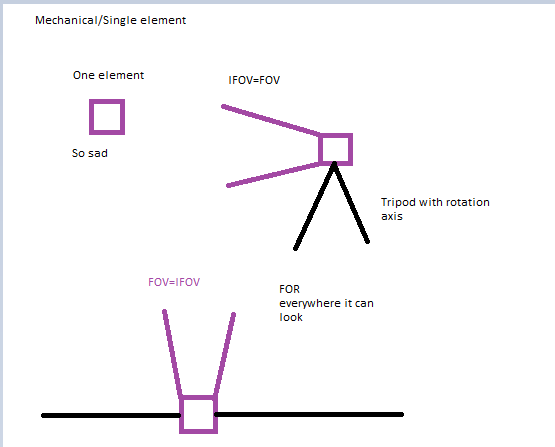
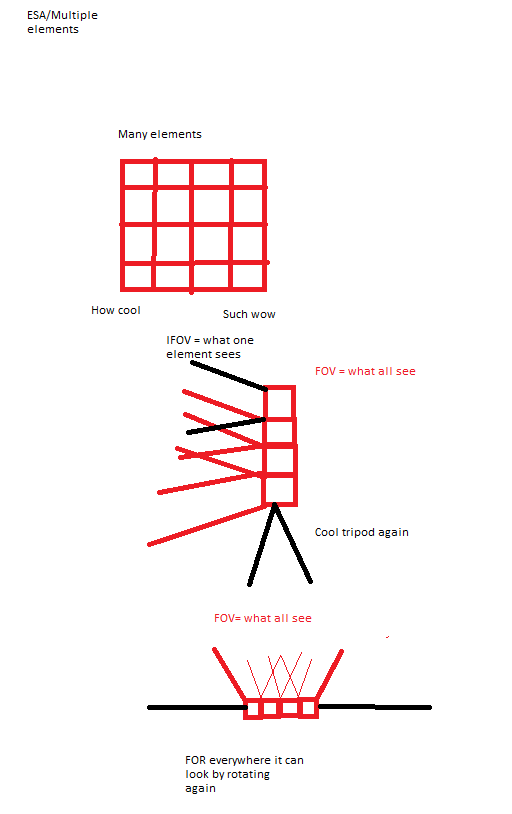
So, if we go by this definition:
We can think of mechanical radar like a single element detector camera, where due to its limitation FOV is equal to IFOV. The whole area where we can move the sensor with mechanical systems is FOR.
Now ESA is like a multi element array, where there are multiple IFOV making a compound FOV, that can be moved mechanically into FOR.
Mechanical
One beam = one detector
FOV = IFOV, due to the fact there is only one detector, or one beam.
Moved around only mechanically to a hive while FOR.
ESA
Multiple detectors/beam emmiters = multiple beams
IFOV = what one detector/radiator sees
FOV = Compound of all available detectors / radiators
FOR = the area coumpund FOV (made out of multiple smaller IFOV) can see by moving it mechanically.
I literally quoted the video you shared, and endorsed, word for word (hence the quote marks)… So you’re now saying the video you sent, and relied on for your last several posts, was wrong?
The video you endorsed as accurate said that IFoV is the FoV of a single pixel in the detector of a thermal camera. Guess what: Sniper XR is a thermal camera, so as per your own video its IFoV is the FoV of a single pixel in it’s detector. Just admit it: you got something wrong.
So exactly as I said then. For a standard radar FoV = IFoV and the gimbal limits = FoR:
Yes, funnily enough I already agreed with that point too. In fact it was my starting position right at the start of this whole stupid debate. For a typical fixed plate AESA radar:
FoV = The area the antenna can scan electronically
FoR = The total area the radar can see - as the antenna is bolted in a fixed position the radar can only see an area the size of what the antenna can scan electronically, so FoR of radar = FoV of antenna
However ECRS is not a fixed plate AESA, the antenna can be repsotioned, so:
FoV = The area the antenna can scan electronically
FoR = The total area the radar can see - as the antenna can be physically repositioned the radar can see an area larger than just what the antenna plate can scan electronically by itself. Therefore the FoR of the radar is larger than the FoV of the antenna.
No. Brainfart on my part, so now I’m conflating things that can’t be conflated.
Too many tangents. Now to the point.
Did you?
…surely doesn’t look like.
And then there’s this…
Where you directly conflated IFOV and FOV in ESA.
Yeah, that’s the thing I linked from the Patent office, while you were claiming that FOV is half power beamwidth…and it is, but by the definition from MSAs, where the only beam movement was mechanical.
What you call FOV, is called eFOV, now.
However, this entire discussion boils down to you stubbornly refusing to accept FOV as eFOV+mFOV in this particular case, in spite of multiple sources corroborating it.
no it dosent for this context, eFOV and mFOV you seem to be trying to decompose Field of View into “electronic” and “mechanical” components this might make sense for a hybrid system, but that’s not whatis being discussed and even if it were, FoV still means the instantaneous coverage, not a sum of sub-components
for MSA:
FoV: The beamwidth at any instant
FoR: The full mechanical sweep arc
for ESA
FoV: The electronically scanned volume
FoR: Same as FoV (since there is no mechanical repositioning)
EFOV (Electronic Field of View): the range of angles the radar can steer its beam electronically without moving the antenna. For SBX, this is only +12.5 degrees
OV (Full Field of View): a phased array with +60 degrees electronic scan
LFOV (Limited Field of View): phased array with reduced electronic scan, like the SBX
Mechanical rotation: the SBX antenna sits on a gimbal/turntable that physically rotates +178 degrees to compensate for its tiny EFOV
quote from page 6 “To compensate for this very limited EFOV, the SBX radar’s antenna is mounted on a gimbal on a turntable that allows the antenna to be rotated (±178°) and elevated (0-90°).”
the document NEVER uses “eFOV” and “mFOV” as sub components of FoV the document treats EFOV as a standalone technical term for electronic scan range, and mechanical rotation as just… mechanical rotation there’s no “mFOV”
the document’s EFOV is essentially the same thing flame was describing as FoV for an ESA radar the volume the beam can cover electronically without repositioning the antenna, the document just adds the “E” to emphasize that it’s the electronic scan range specifically
basically you made info up and kept doubling down instead of admitting that you were in the wrong even tho the same document literally proves what flame has been telling you
The N035 uses a PESA antenna mounted on a two-stage electro-hydraulic drive, offering a mechanical field of view (azimuth ±60°) and electronic field of view (beam scanning ±60°) for a total advertised field of view of approximately ±120° .
yes flame has. Im not sure how you still arent getting it.
“eFoV” + “mFoV” = FoR
To use the Blogs example.
IBRIS has 60° FoV from the radar itself, and would be +/- 60° if it was a fixed array.
But the radar is gimballed and can be moved +/- 60°.
So 60 + 60 = 120. So the entire Field of Regard (FoR) for the radar when combining the eFoV (or what is normally referred to just as FoV) with the mFoV (or what is just usually called the gimball angle) for that perticular radar would be 120°
So:
FoV (Field of View): The area the sensor can see without being moved
FoR (Field of Regard): The area the sensor can see when it is moved
eFoV (Electronic Field of View): Same as FoV
mFoV (Mechanical Field of View): The amount the sesnor can be moved (also refferred to as the gimball range)
iFoV (Instanteous Field of View): Not overally relevant for radars, but within the context of other sensors like a FLIR, its the amount that each pixel or sub-unit can see, without factoring in the lens or the entire sensor.
the only one here that dosent seem to get the difference between FoV and FoR at this point is you
this was origanally just about FoV and FoR and you brought in IFoV, EFoV and MFoV that are all completly irrelevant for the ERCS Mk1 this was origanlly about
The FoV is +/- 60°. This is the amount the radar can actually use if it were fixed.
The FoR is +/- 100° This the amount the radar can actually use when it is moved.
The mFoV is +/40°. This is the amount the radar can be moved.
The eFoV might be higher than +/- 60° because its not a hard edge, but a drop off in performance past 60°, but whether the computer just disregards those imputs entirely, effectively creating a hard edge or they do appear on the radar scope but are notably degraded in quality and the pilot is just aware of that limitation is unknown.
In-game however it is a hard edge on every single aircraft. Therefore the FoV is +/-60° and the FoR is +/- 100°