AESA or M-Scan?
How about both, mate.
The difference is only the refresh rate and boresight limit.
AESAs and M-Scans function fundamentally differently and an AESA will keep the target updated very quickly regardless of TWS mode.
So the only real advantage gained by narrowing the AESA radar is keeping the radar scope picture clearer meaning you can see what is going on better if there is a lot of a targets near each other.
M-Scans are actually affected by track rate and switching to a narrower mode will improve the rate updates are provided to the target, but for the best DL you want to hard lock the target as it gives you the same kind of DL an AESA does in TWS.
It also has the advantage of keeping the contact on the radar screen better, as with the slower modes, the contact may stop being tracked altogether, so a narrow mode ensures the radar is updating the contact often.
With the M-Scan my default is the second narrowest (i can’t recall the exact angles at the moment and I’m on mobile so can’t check), but often use hard lock and will narrow the mode if I feel it’s needed
but for the AESA I’m usually using the 90x30 mode and rarely switch to hard lock unless I’m using HMD or ACM to target someone
1 Like
This beg the question whether we shoot them at close range:
- Does DL works?
- Does this also apply when notching, either we don’t make them break DL otherwise their Fox3s will connect through our notch/chaffs.
- Its seem to me that we can even notch/change alt at low speed but sometimes they can still track us at high speed. → DL might be the culprit.
In some situations like lookdown and when the target has been lost by the built in-seeker it will switch back to DL iirc.
So it will help. But worse case scenario it does nothing but allow you to rapidly send a second missile if needed
But of course, never choose DL over defending, because you can’t send a second missile if you are dead
no it dosent because TWS ESA refreshes the target every 0.5 seconds anyways (could be slightly less or slightly more dont remember)
that only goes for the AESA EFs tho
on the normal EFs a narrow scan pattern can help
yes it does, as long as the target has not been lost by your radar and if the missile loses track
but the missile uses its own radar and not DL once it locks onto the target
M-scan also refresh faster with narrow boresight.
that is what i said
you dont need the narrow scan on the AESA EF
Spoiler
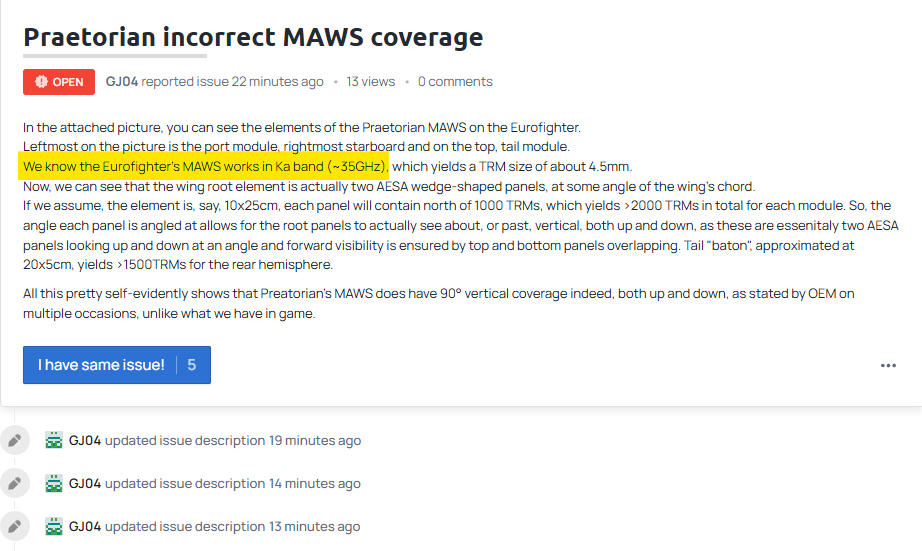
We know the Eurofighter’s MAWS works in Ka band (~35GHz),
How do you “know” that?
as stated by OEM on multiple occasions, unlike what we have in game.
You seeing something I’m not, I’ve not yet seen a claim the MAWS is spherical, RWR and LWR sure but we have proof for that.
While it was not directly stated anywhere (I think), there were some radar parts (forgot which one) made by one of the companies (my memory is bad today) that overlapped very well with EF MAWS creation/introduction, that were not used anywhere else, and we’re designed to work in K band.
Oh, that’s easy…
The high resolution pulsed Doppler
radar and processing techniques
ensure high probability of detecting
the smallest missile targets whilst
maintaining a very low false alarm rate.
“High resolution radar” is a nomenclature for Ka band and and up, which makes “alleged” frequencies highly probable, ie. good enough for this exercise, so whether it’s 35 or 26GHz is next to irrelevant, as the range and resolution in game are arbitrary anyway.
Now for the hard one…
How many Gs can Rafale pull at M1.4/40.000ft and even harder, what’s Rafale’s empty weight?
There’s a video in this or other EF’s threads which clearly states the MAWS coverage is 360, but GJ decided to apply it in horizontal only, for some unknown reason. Luckily managed to find the pic that explains what’s going on and how it actually works.
I’m sorry to say that report isn’t going anywhere. Even if we ignore the lack of any attached sources you have a few big problems which kind of invalidate the premise of your report:
- The MAWS is almost certainly not AESA
- The MAWS very likely does not operate at 35 GHz
- Even if we ignore the two points above: fitting 2,000 TRMs into a package that small would be incredibly difficult today, let along 30 years ago when the MAWS was designed.
- It is never stated anywhere official that the MAWS gives spherical coverage.
2 Likes
- Then it’s PESA, irrelevant. Element size depends on freq. not signal generation method.
- Then what is “high resolution radar” in your opinion?
- Russians managed to cram 1700 Xband elements into Zaslon back in the 70s.
Not sure what is the problem.
But all this is irrelevant, since it’s obvious there’s one (A/P)ESA panel pointing up and the other down, which makes it see into vertical and probably past vertical. At 45° where the game cuts the MAWS, the wing root module most likely has the largest possible gain. I mean, cmon…
Iirc. That is just DASS Coverage which includes LWR, RWR and MAWS, not just specifically MAWS.
As for the coverage, I think 60° would probably be accurate but I don’t think 90° is. But proving even 60° to Gaijin is going to be hard.
Though would be good to get the PIRATE MAWS added
1 Like
Btw quick random question does ESM count as RWR if it can ID radars eg? this sounds retarded ngl
Anyway what i wanted to post
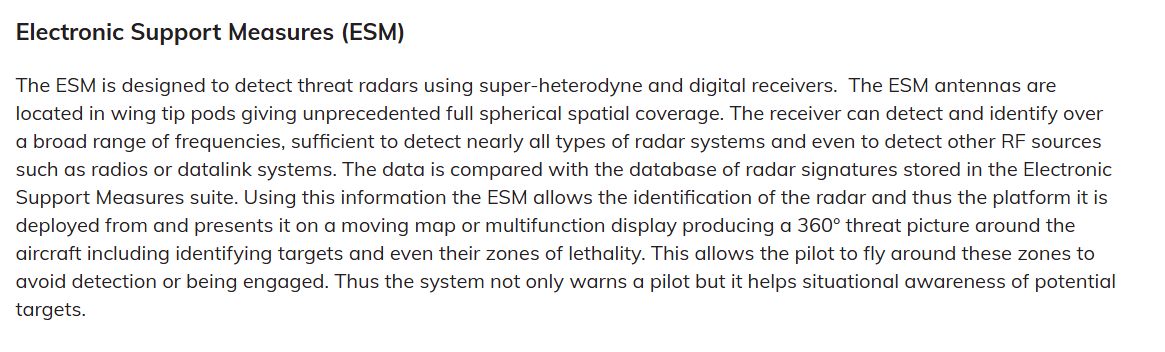
what they describe as ESM isnt that just basically an RWR
With DASS it’s all really heavily integrated, but I don’t actually know how you would describe the difference between ESM and RWR, to be honest