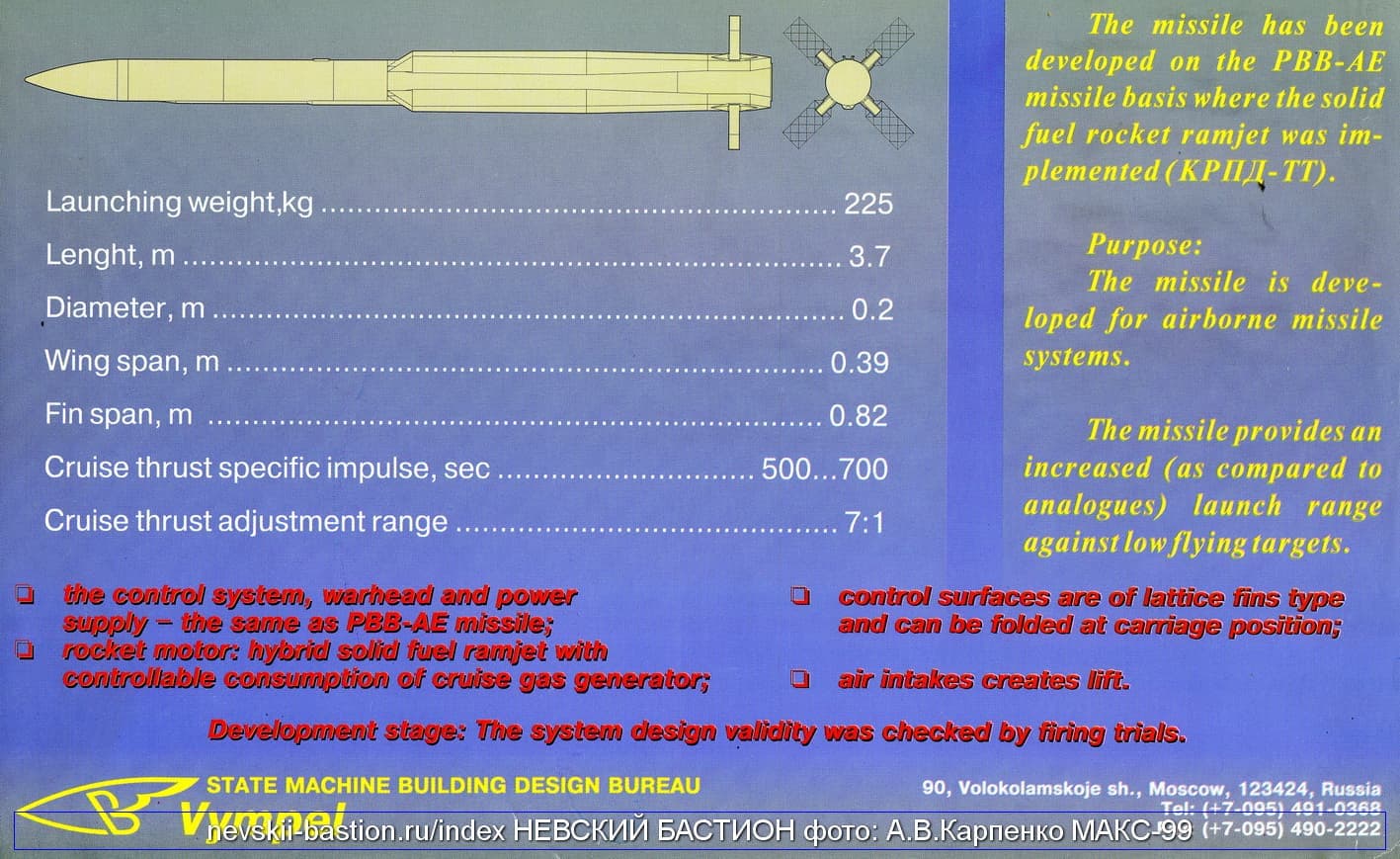
An ISP of 10 000 just isn’t realistic for a chemical powered engine.
And gas ejection is indeed that formula :
Ve=ISP*9.1 (on earth), so they do are ejected at insane speed.
That’s literally the second law of newton. How do you get a hundreds of kilograms heavy rocket to go Mach 5 with only a fraction of the weight in ejection gaz ? By having said ejection gaz going at a much higher speed
ISP =/= dV, this is saying a dV for the motor section of 6000-10,000 is possible
If we say the ISP is… lets say 2000.
then for a 50kg motor with 20kg of stored solid propellent. We get nearly exactly 10,000m/s…
More realistically, lets say 1400ISP.
a 60kg motor and 25kg of propellent.
Gets you a deltaV of 7400m/s
I don’t think you understand the implication of an ISP pf 6000, let alone 10 000. This would completely revolutionize the aerospace kndustry.
Typical ISP for the most efficient air breathing engines (such as turbofans) varies between 3000 (low altitude) and 7000, 7500 at high altitude at a maximum. And that’s using the most efficient tech for air breathing engines currently.
Also, here is NASA giving the Ve formula I used above
For reference, the formula still stands for non bypass engines (ie, ramjet). With an ISP of 1000, the ejection gaz speed would not be Mach 30 but Mach 300…
Also, even with an ISP of 10000, the Mach of the ejecting gaz is not really Mach 30, since their composition is highly different from air. It probably more along the line of below Mach 10 (before slowing down and mixing with the air)
one more image related to the meteor from the same source. it focuses on the software talked in the pdf and is meant to train personnel, but covers a lot of different topics for a2a missiles so i guess it’s worth sharing NATO S&T AVT-321 Technical Course
Specific impulse is ISP. From my knowledge, Specific impulse has always been defined either as ISP, or as Ve in a looser definition, never as DeltaV.
For reference, the images talks about multiple systems - meteor, HSAD, T3, making it even more unlikely to be referring to DeltaV
Note these powerpoints and brochures arent usually made by an engineer…
The values and units both make sense for it to be referring to deltaV, which is a metric of impulse.
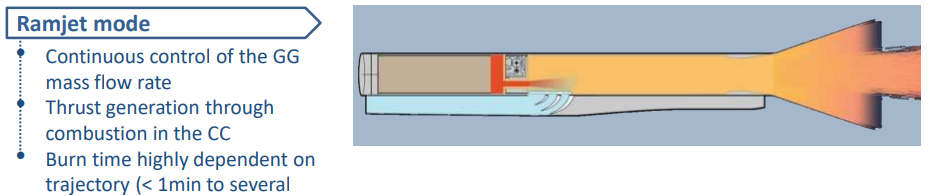
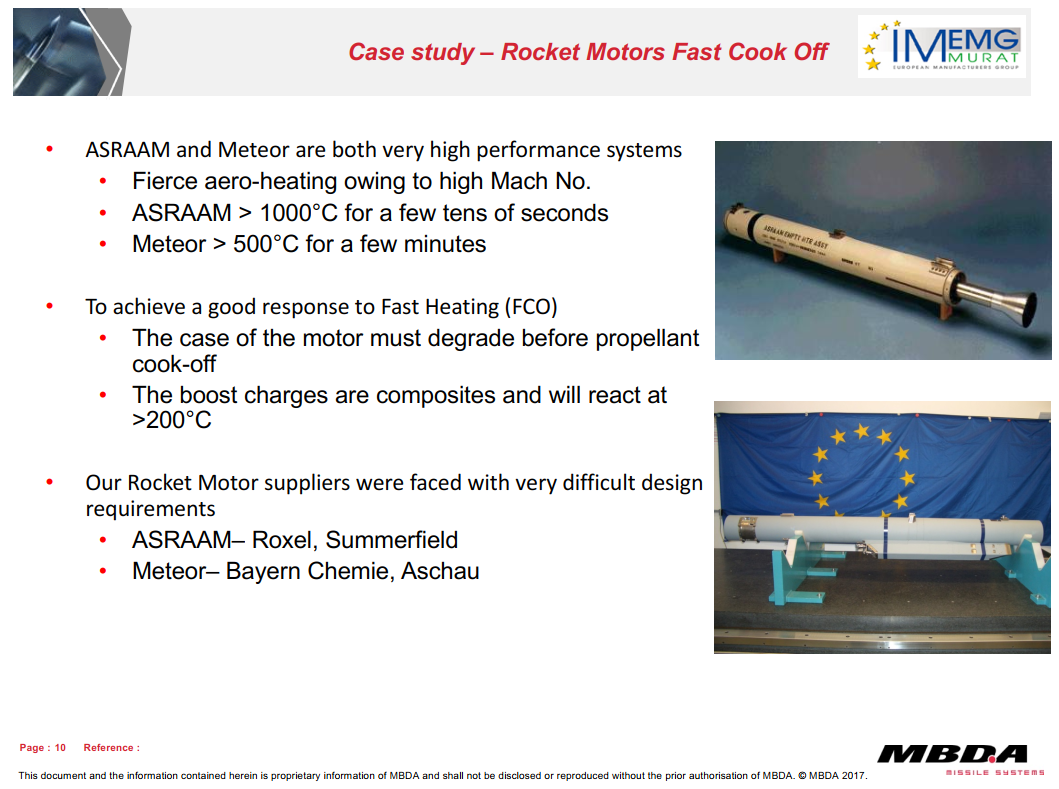
something else that indicates the meteor can burn for a few minutes is that the motor casing is made to resist the equivalent of ~mach 3.5 - 3.7 (500°C+) heat for “a few minutes”
A DeltaV of 10000m/s would not make sense either. Thats intercontinental ballistic missiles values of DeltaV. Although the missile is fully atmospheric and not ballistic, this value is just way too high for a missile with a range within 500km. There’s not that much drag that it would have 10000m/s of DeltaV to achieve its range
I disagree, i am expecting ramjet to have quite a lot of drag, given its needed for the ducts/intakes to function, it also does not have variable inlet ramps.
That is deltaV specific to the motor, not the missile, with the entire missiles weight included… it will be much lower…
If we include a 40kg booster, a 190kg missile would have 2500m/s deltaV provided by the ramjet. Giving roughly 3000m/s total for the combined booster and ramjet.