I expect the 2000m/s dV is specific to the motor section. Is that how you got the ISP? For a 210 ISP that would be about a 67kg total motor to achieve that 2000-2100m/s dV
with the new propulsion system for missiles, you can add a lot more than only 2 burns, but for a ramjet like missile with throttle control you need to manually adjust the burns and everything, its annoying to get it right but i tried to make one based on a paper (pages 33-40) i had found, it doesn’t have a name and it’s clearly not the a3m or meteor because of the type of fuel used in the sustainer, but it still had a lot of good info
this was 40km range rear aspect shot at 10km altitude with the derby ER thrown in the video to have something to compare with (derby er currently outperforms anything air launched except the fakour, with the pulses configurated better for a2a), the prototype thing can’t do 100km in 90s either
1 Like
legend
it’s specific to the booster section
what dV did the ramjet section provide?
total was 1612m/s, booster was 496m/s, ramjet was 1115m/s. the stats are like this
initial mass was 190kg
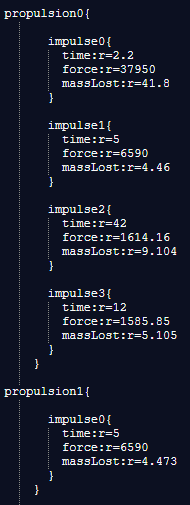
i expect the ramjet is closer to 1500+
same, keep in mind this missile i tried to make has worse performance than the meteor as they discuss on the paper how much of an improvement using a boron loaded fuel (the type of fuel the meteor uses) for the sustainer would give
Spoiler
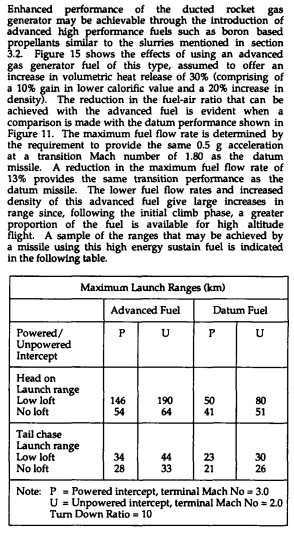
boron based fuel gains
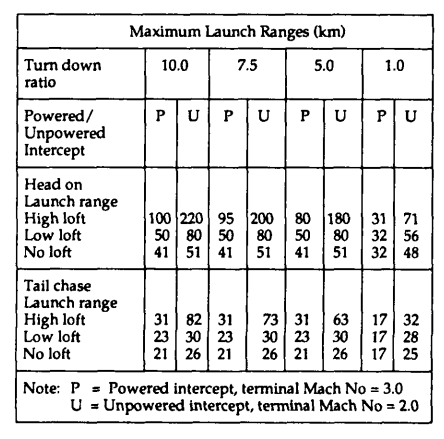
range table that is interesting to look at, launch conditions are mach 0.9 at 6000m, the meteor has at least 12:1 tdr, so even if it had the same type of fuel for the sustainer it would still travel a further distance than that because of the lower floor for minimum throttle
note a 0.5g acceleration for meteor would be about 1kN, which would allow for a seriously long burn time if the ISP is >1400m/s
And you are assuming that the flame extinguishing is the end of the boost. It could be even shorter as there’s usually a short burn out phase after the main boost, as the residues burn out.
The aim of this motor appears to be absolutely minimum impact on the ignition of the ramjet, so i would expect very little residuals/tailoff
this other video has a couple of firings with 2 angles, idk if it has been shared before
A quick google search seems to be indicating to me that ISP of ramjets vary from 1200 to even up to 1900 depending on the fuel - and the altitude, so 1600 might not be a dumb assumption
Edit : this is from a research paper on potential performances of different engines in Martian atmosphere. The J1 value for earth should be between 5 and 10 from my understanding
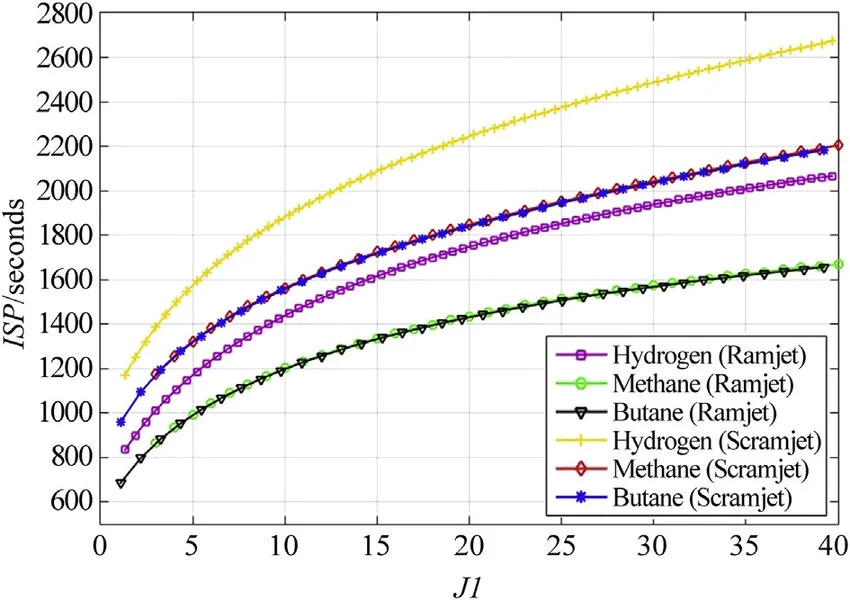
indeed.
are those ramjets solid fueled like the meteor? that can change the isp a lot
Ah no? They seem to be liquid fuel, so yeah it might make a difference, good catch
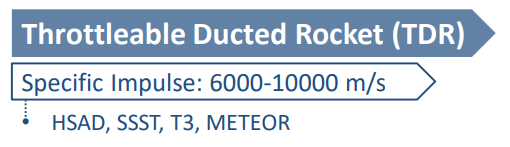
this is what i found related to isp from a nato training presentation
This is not ISP, but probably ejection gas ve.
ISP = ve/g, g being the gravitational constant, so basically
ISP = 10000/9.81~1000s
my bad, should be around 610 ISP up to around 1020 isp
No its not, because the gases are not ejected at mach 30…
Thats the specific impulse of the motor.
Where specific impulse is ISP * g * ln(initial mass/final mass)
where final mass is initial mass - fuel mass - giving:
dV = ISP * g * ln(initial mass/(inital mass - fuel mass)