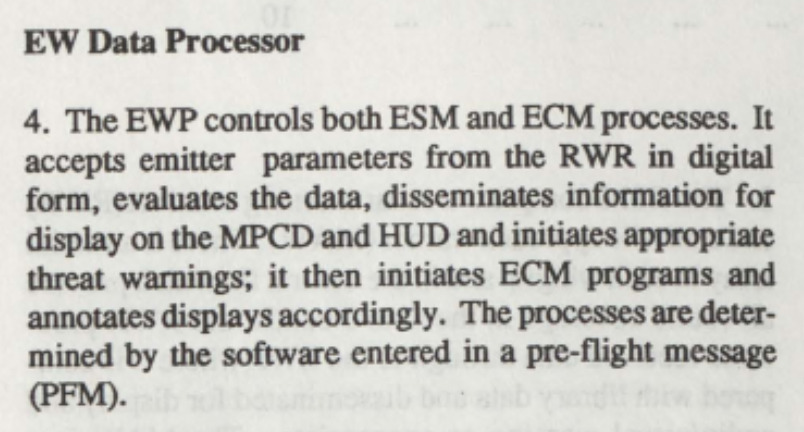
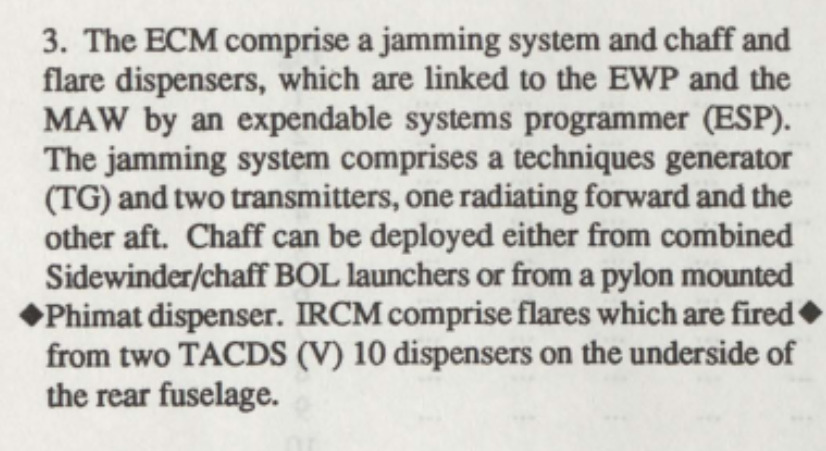
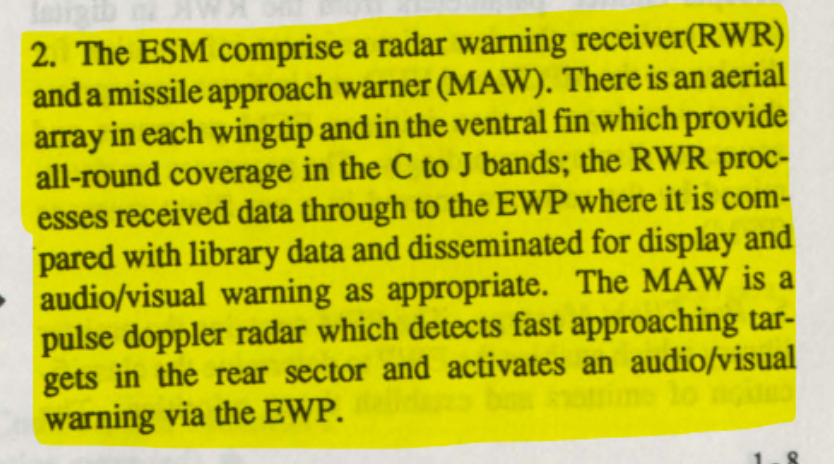
Though with full DASS, the kill chain on dealing with an incoming SARH threat would involve at first detection on the ESM;
SARH detected by ESM
ECM begins attempting to jam the threat
DASS “Manoeuvre command” directs pilot into notch
Towed Decoy is deployed
Chaff dispensing starts
You would be relying on the MAW as a final resort for terminal manoeuvres this is where something like the longer ranged UV/IR system on Rafale offers a clear advantage as the MAW can begin tracking the threat much earlier. But the rest of the toolkit should be exhausted before we’re only down to the MAW.
I wonder if Amids could measure the cross section and go off from there, and assume missiles higher than a certain size or below certain size must be a radar or IR missile.
It’s likely to be simply poor wording in my opinion, both PVS2000 and AMIDS are linked into “DAS” systems on Harrier II and Eurofighter Typhoon respectively.
Yeah well, the IRIS-T SLM (IR) missile has around the same size as a NASAMS (RF) missile. So that will also be problematic ^^
You would need to generate a very high resolution (I)SAR image of the missile with <1 cm resolution at >10 km to be able to differentiate between missile types and have enough time for countermeasures.
As I understand the brochure, PVS2000 could be integrated into the ECM system as seen on harrier, but could be offered as a standalone system on other platforms if it was necessary, so the question is how it would operate if it was installed as a standalone system on a vehicle and not integrated with the ECM system.
Likely in a more basic dispense everything against all threats modes. I cannot think of a installation of PVS2000 or AMIDS that wouldn’t involve some kind of DAS suite comprising at minimum an RWR, I suppose it could be retro fit to old analog only RWR equipped aircraft. But such an aircraft seemingly never existed.
The idea was to fit it on things that probably weren’t originally combat aviation, which would explain the standalone capability. I don’t know if that ever happened.
Sky Guardian in its installation with AN/ALQ-101-10 on Jaguar was independent. But not all SG fits are the same, SG-2000 on AH Mk.1 incorporates a full DAS as does SG-200D on AH Mk.2.
But no, FA.2 doesn’t have any active jamming capabilites, either by pod or alternate modes of the radar.
It’s also likely that the angular precision of the different systems is enough to detect multiple sources independently even in close proximity. I don’t have the values for the EFT, but I know that all detection systems for the rafale are said to be sub 1º precision.
I’d assume that the MAW has a better discrimination than the RWR due to the high band it operates on the EFT as well, and the RWR probably is similar to the rafale in capabilities.
I don’t even know we are speaking of standalone anymore. Now every plane has a DAS system that treats different threats in a standalone system (such as what @Gunjob shared above); before even feeding such information to the rest of the aircraft systems (for example, before another pass of sensor fusion for offensive capabilities). It just doesn’t make very much sense to speak of MAW and RWR has different systems, just like it doesn’t really make sense to differentiate the emitter and receiver of modern ESA radars.
As for in game implementation, combining MAW and RWR would be a very basic sensor fusion mechanic to implement, and to be honest I’m surprised this isn’t basical’y the first thing they introduced when they started adding simple sensor fusion stuff