Currently, in War Thunder, Explosive Reactive Armor (ERA) generally functions with a uniform protection value. If a shell hits the ERA brick, the game calculates the protection provided based on the specific type of ERA (e.g., Kontakt-1, Kontakt-5, Relikt) and applies that value to the penetration calculation.
However, based on technical literature regarding the hydrodynamics of shaped charges and explosive interaction, ERA protection is not uniform across the surface of the container.
I have reviewed a technical paper titled “Dependence of the protective ability of a dynamic protection container on the point of impact of a cumulative jet” (derived from Soviet armored vehicle journals, Vestnik Bronetankovoy Tekhniki, circa late 1980s). The data clearly demonstrates that the effectiveness of ERA drops drastically as the impact point moves from the center of the cassette to the edges.
The Source Data
The paper details an experiment involving a standard ERA container with two explosive elements, tested against a 93mm anti-tank grenade warhead at an impact angle of 60°.
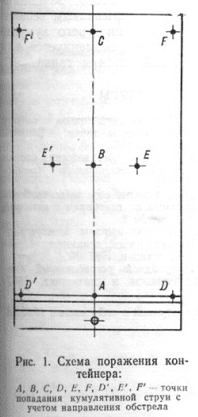
The study measured the Protective Contribution (Q) of the ERA at different impact coordinates (see Table 1 data below).
Point B (Center): This is the optimal impact zone. The plates interact with the jet for the maximum duration (L_{max}).
Points A, C, F (Periphery/Edges): These are 10-15mm from the edge. The protection drops significantly because the “feeding” of the plate into the jet path is cut short by the edge of the plate, or the jet only interacts with one element instead of two.
Comparative Data (from the paper):
Hit Location
Impact Point Description
Equivalent Protection (Q)
Drop in Efficiency vs Center
Point B
Center
~462 mm
Baseline (Max)
Point A
Side Edge
~258 mm
-44%
Point D
Lower/Side area
~207 mm
-55%
Point F
Top Edge
~123 mm
-73%
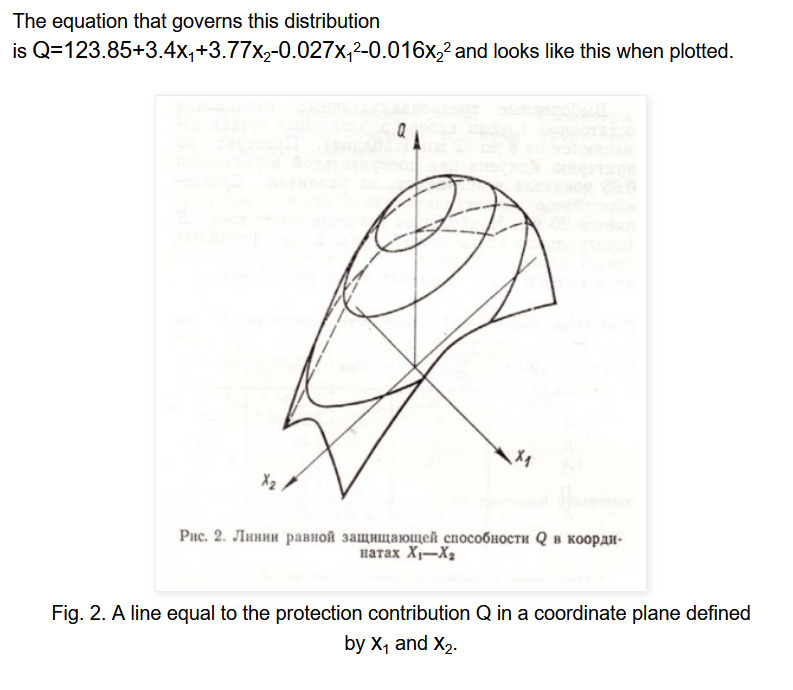
The “Elliptical Paraboloid” of Protection
The paper states that the protection distribution follows the shape of an elliptical paraboloid. It is not a flat plane of protection.
The study concludes with a very important statistic for game balance:
>400mm protection is provided by only 25% of the container’s surface area (the very center).
>350mm protection is provided by roughly 50% of the surface area.
>300mm protection is provided by 75% of the surface area.
Conclusion & Suggestion
Currently, hitting the very edge of an ERA block in-game often yields the same “black hole” absorption result as hitting the center. This is unrealistic.
I suggest implementing a volumetric or gradient modifier for ERA blocks:
Center Mass Hits: Should provide the stated maximum protection values found in the stat card.
Currently, War Thunder models these tanks inconsistently:
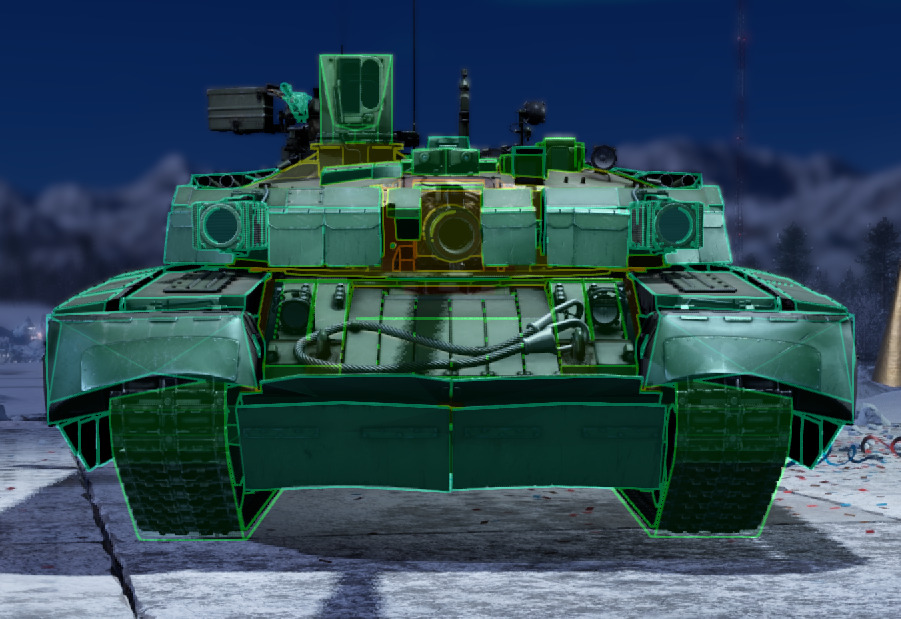
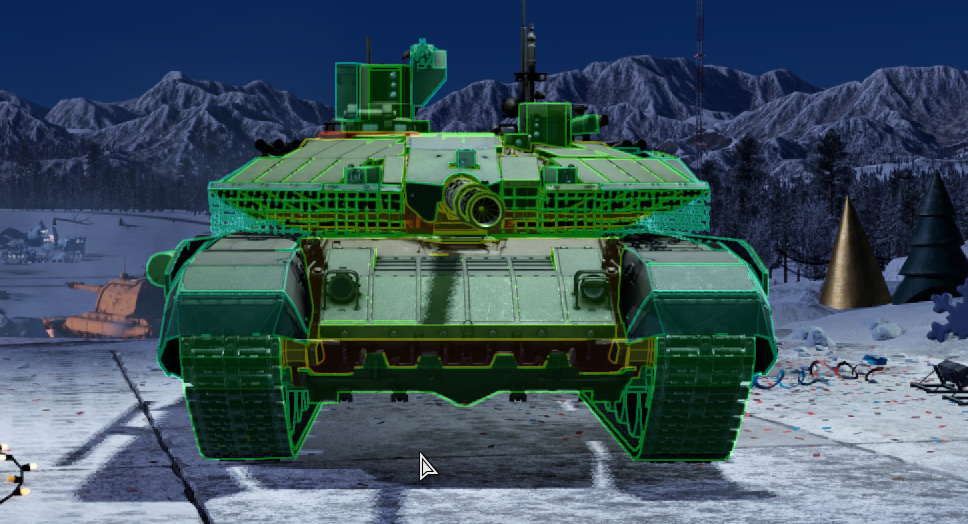
T-84 (Oplot/Duplet): The game accurately models the physical gaps between modules. If a shell hits the gap, it bypasses the ERA. The tank is penalized for its visual geometry.
T-80BVM / T-90M (Relikt): These tanks have “soft case” or tightly packed ERA. The game currently treats these arrays as a uniform barrier. Because the bags visually touch, the game engine acts as if there is 100% protection across the entire frontal arc.
Why this is unfair: According to the paper, the T-80BVM and T-90M should possess “ballistic gaps” identical to the T-84. Even if the Relikt bags on a T-80BVM are touching, the explosive elements inside still have edges.
If a shell hits the “seam” between two Relikt bags on a T-80BVM:
It is hitting the Point F or Point A (edge zones) described in the paper.
The protection should drop by ~60-70% in that specific spot.
Therefore, the T-80BVM should have “weak zones” on the edge of every single brick, effectively making its protection profile very similar to the T-84.
3. Conclusion & Suggestion
The current model grants an artificial advantage to Russian top-tier MBTs by ignoring the edge degradation of their ERA, while strictly punishing the T-84 for its physical layout.
I propose the following changes:
Implement a protection gradient: ERA blocks should not have a single flat protection value. They should have a “Center” value and a distinct “Edge” value.
Normalize “Gap” Mechanics: If the T-84 is vulnerable due to spacing, the T-80BVM and T-90M must also be vulnerable at the seams of their ERA bags. The “Edge Effect” proves that visual coverage = ballistic coverage.
This change would bring realistic consistency to ERA mechanics and level the playing field between the T-84 and its contemporaries.
For this and countless positive changes (this may see as negative as it’s nerfing but I see as positive as it’s making the game more realistic) we as community are looking forward for a more realistic explosive reactive armor overhaul, which counts the performance against the previously reported shots in specific spots that may reduce the asset protection performance and something I’ve noticed that it’s the high sensitivity of indirect explosion and not to mention another dozen of missing features that either make this one specific feature to not work properly as their real life counterpart.
I would like to share my support on this and even more, I suggest a proper suggestion post as I don’t think this falls under proper bug report. However, nothing is flowers and sunshine, War Thunder is not a deeply realistic game as people wants it to be and the game markets itself to outside public, it’s either by its own engine limitations or developer’s decision if it’s worthy for the game’s health or not, a highly realistic War Thunder could generate a very negative impact or a very positive impact, which I highly doubt on the latter as seen with proposed changes like APHE rework proposal that was rejected by the community that could’ve resulted in a more realistic War Thunder.
@God_46
Here’s a research paper on how the angle affects APDFS.
The paper used 500mm length projectiles which is shorter than M829 (not an A1/A2 version) so the data visualizations wouldn’t 1:1 match an ingame round. You’d need to do some math to get the values using different rounds.
Would probably have to be made as a suggestion but I think this would be nice to have, would buff duplet ERA which I believe is inteded to minimise this effect