History
Intelligence gathered from the Spanish Civil War highlighted the need for modern attack aircraft capable of flying farther and faster while carrying a 1,200-pound bomb load. In response, the United States Army Air Corps (USAAC) issued a new specification for such an aircraft in 1937, with a submission deadline set for July 1938.
Douglas began with its Model 7A mockup and refined it into a more advanced design known as the Model 7B. This prototype was powered by two 1,100 hp Pratt & Whitney R-1830-S3C3-G Twin Wasp engines and featured multiple machine guns and a maximum bomb load of up to 2,000 pounds. Alongside designs submitted by Martin, Stearman, and North American, Douglas offered the 7B for evaluation. The aircraft made its first flight on October 26, 1938. Around this time, representatives from the French Purchasing Commission inspected the Model 7B and were impressed, placing an order for 270 aircraft tailored to French specifications. These aircraft were designated DB-7s, with the first flight occurring in August 1939. Deliveries began in earnest by October.
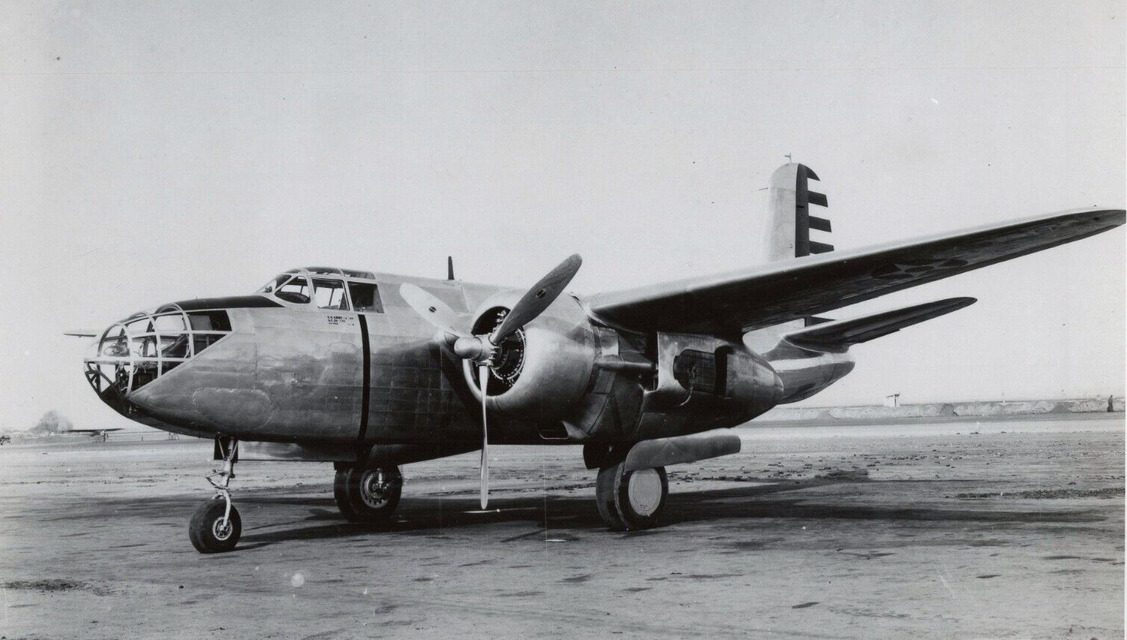
Despite isolationist policies that delayed domestic orders, the USAAC eventually selected the Douglas design on May 20, 1939, as it best met the original 1938 specification. The Army placed an initial order for 63 A-20s and 14 A-20As. The A-20 and A-20A were similar, but differed in their powerplants. The A-20 was equipped with R-2600-7 engines fitted with turbo-superchargers for high-altitude operations, while the A-20A used R-2600-3 engines with two-speed mechanical superchargers, optimized for low- and medium-altitude missions. The large turbo-superchargers on the A-20 were mounted below the wings, along the outer flanks of each engine nacelle, and were expected to give the aircraft performance sufficient to evade interception.
However, only one A-20 with turbosuperchargers was fully completed. The installation proved bulky and complex, delaying its first flight until November 11, 1940, two months after the A-20A had already flown. The aircraft also suffered from cooling issues, and turbocharger production by General Electric was already stretched thin. Combined, these problems made the A-20’s configuration impractical for large-scale production. As mission requirements shifted, high-altitude performance was no longer deemed essential for the attack role.
As a result, in the spring of 1941, the decision was made to convert all remaining A-20s to the A-20A configuration, omitting the turbo-superchargers entirely. Interestingly, three A-20s retained their turbo-superchargers and were subsequently converted for photo reconnaissance duties under the designation F-3, a logical repurposing, as reconnaissance missions typically occurred at higher altitudes.