The DU inserts are much easier to calculate as the weight increase would be easy to determine and DU vs RHA equivalent already exists. I just wish on the ones that “have” DU in game would show that in the x-ray module of the armor instead of being identical with a RHA increase in effective thickness.
IIRC someone on an older forum post went through the effort of calculating all changes made to the base SEP v1 over the M1A2 and weight calculations for each. They came up with weight that could not be attributed to any other upgrades other than armor. As a suggestion to Gaijin, if the weight of the current NERA arrays is known, then make an educated guess of changes in those arrays to match the weight increase, and subsequently an effective thickness increase.
problem is getting them to do it, they would do educated guess to anything but abrams hull armor
seriously they really think US technology in developing hull armor is stuck in the 80s
if an educate guess is to be made, just do the most basic one
M1 have 450mm, give it 10% increase so 495(which would resist 3bm42) for M1A1 then for HC, it gain better turret, but it might as well get some some improvement in hull, i remember a figure of something 200kg so thats 1 marine with full level 4 plate, which resist 7.62 at range so like 20mm → HC gets 515mm
and for A2 gain 10% increase again, which now resist 3bm46, but that wouldnt be balance so maybe a 5%, okay so we are at 545mm which resist 3bm46 at range but not up close
and for every SEP until V2 do the 200kg marine method
boom thats done
2 Likes
You are hanging your entire argument on a note about 5 tanks at Army Schools, but you are completely ignoring the conflict that creates with the CBO report from the exact same year.
The 2006 CBO report lists the M1A1 AIM as having Heavy Armor added to the hull. The AIM program was not 5 prototypes. It was a fleet-wide refurbishment of hundreds of tanks. If only 5 tanks in the entire US Army had DU hulls in 2006, then the Congressional Budget Office lied to Congress about what they were paying for in the AIM program.
You also claimed that the Heavy Armor changed versions and might not be DU anymore. The 2016 license amendment destroys that theory. They amended the license to allow possession of unlimited hulls. If the new version of Heavy Armor in the hull was non radioactive, they would not need to amend a Nuclear Regulatory Commission license to possess it. You do not license non-DU armor with the NRC.
To answer your question of where they got such a license:
They got it in Amendment 10, which you acknowledged. The fact that they hold a nuclear license for hulls proves the hulls contain nuclear material. If the hull armor was just steel or ceramic, that license would be legally invalid.
1 Like
Your theory doesn’t out weigh his though, since his primary argument is that HA armour package does not necessarily contain hull DU.
Well there was a specific licence handed out to the US army for hull DU experiments, and from that licence it was a very limited number of hulls, not sure exactly 5 but limited. Then it would mean that US did not put DU into any other vehicles, at least not widely or else they wouldn’t need that licence.
He sort of never said HA contained DU in hull in the first place.
AS u said, why would they have amended it only in 2016 if as u claimed over a decade ago the tanks that first had DU hulls have been in service, that would mean the US army is violating a couple laws relating to use of contaminating substances.
You are confusing a specific Nuclear Regulatory Commission license for Army Schools and Depots with the existence of the armor itself.
To answer your question on why the license was amended to unlimited in 2016: That coincides with the end of major combat operations in the Middle East and the return of the heavy brigades to US soil for depot maintenance. The tanks were coming home.
But your argument completely ignores the CBO Report.
In 2006, the Congressional Budget Office audited the M1A1 AIM program and stated explicitly: Heavy Armor added to hull and turret.
If the hull armor was non-DU (steel/composite), why did they call it Heavy Armor?
The 1998 Federal Register defines Heavy Armor as the DU Package.
If your theory is true, then in 2006 the Army lied to Congress about what they were installing, and the CBO lied in their audit. I trust a Congressional Budget Audit regarding what was physically paid for and installed over your interpretation of a license timeline.
A bureaucratic delay in updating a possession license does not magically turn a DU armor package into steel. The CBO confirms the armor was there in 2006. The Federal Register confirms that armor is DU. The paperwork caught up later.
1 Like
Again, the CBO nowhere states that there is DU in the hull, that is YOUR addition to that document based on conjecture.
Your entire argument builds on the wrongly assumed base idea that the “Heavy Armor Package” = “DU in hull” when that is not the only way that can be interpreted and not the sole logical conclusion that can be drawn. It is absolutely one of the ways it can be read, but not the only way and that is where you are faltering.
The exact opposite, i’m claiming it started with only DU in the turret and later changed to include DU in the hulls for way later variants.
This is wrongly applied logic, just because you are allowed to have something does not automatically mean that you do in fact have it. It proves nothing. My cousin has a drivers license, she doesn’t own a car.
No, again, faulty logic. I can get a licence for anything and then choose to not get that thing later. Just because i get a licence for something doesn’t force me to then get that thing.
2 Likes
Your driver’s license analogy shows a fundamental misunderstanding of how Nuclear Regulatory Commission licenses work.
A driver’s license is a qualification. An NRC Material License is a possession and storage authorization. A better analogy is a permit to store toxic waste. You do not apply for a federal permit to store toxic waste, hire safety inspectors, and submit annual audit reports for a waste dump that you don’t have and don’t plan to use for 10 years.
The Army has to pay for Radiation Safety Officers, leak tests, and compliance audits for every line item on that license. They are not spending budget and administrative hours maintaining a license for hulls if those hulls don’t exist.
You also keep ignoring the definition.
-
The 1998 Federal Register explicitly defines Heavy Armor as the DU Package.
-
The 2006 CBO Report states Heavy Armor was added to the hull.
That is not conjecture. That is substitution.
If A equals B, and B is in the hull, then A is in the hull.
You claim DU hulls came way later with the SEPv3.
The CBO report is from 2006.
If the hulls didn’t get DU until 2017, then the Congressional Budget Office lied to Congress in 2006 about what they were paying for.
You are asking me to believe that the government defined a term, used that term in a budget audit, and maintained a nuclear license for it, but actually none of it was true and it was just a steel box the whole time. That is not logical.
4 Likes
It is fairly indisputable based on the 2006 license that only 5 tanks had DU in the hull as of 2006. This means that your source stating:
Some late-production M1A1HA and M1A2 Abrams tanks built after 1998 have DU reinforcement as part of the armor plating in the front of the hull
Is likely referring to those 5 tanks.
Let’s look at what happened after 2006. Up until it expired in 2006 the NRC license for the Abrams armour had two line items for Depleted Uranium. One for “as needed” and one for “5 tank hulls”.
Spoiler
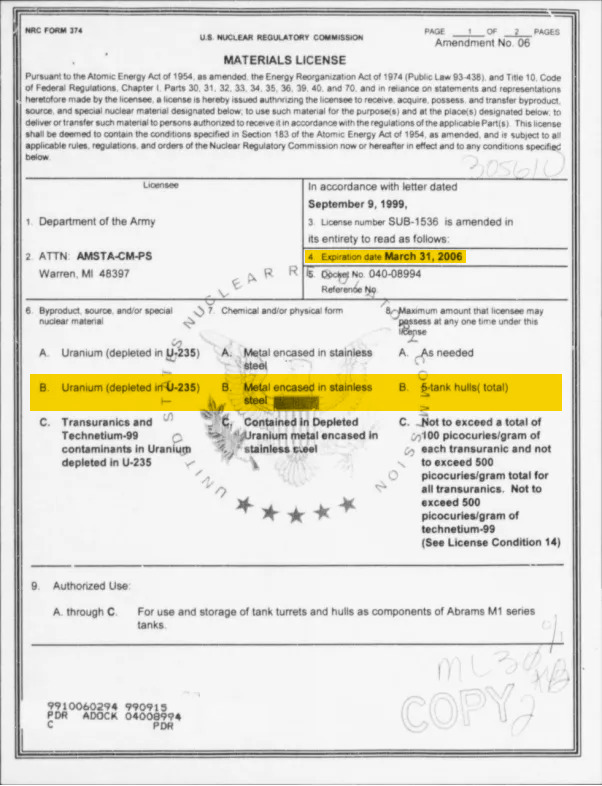
The license was then renewed in 2006 (amendment 9) and the second line item for Depleted Uranium containing the 5 hull limit was removed:
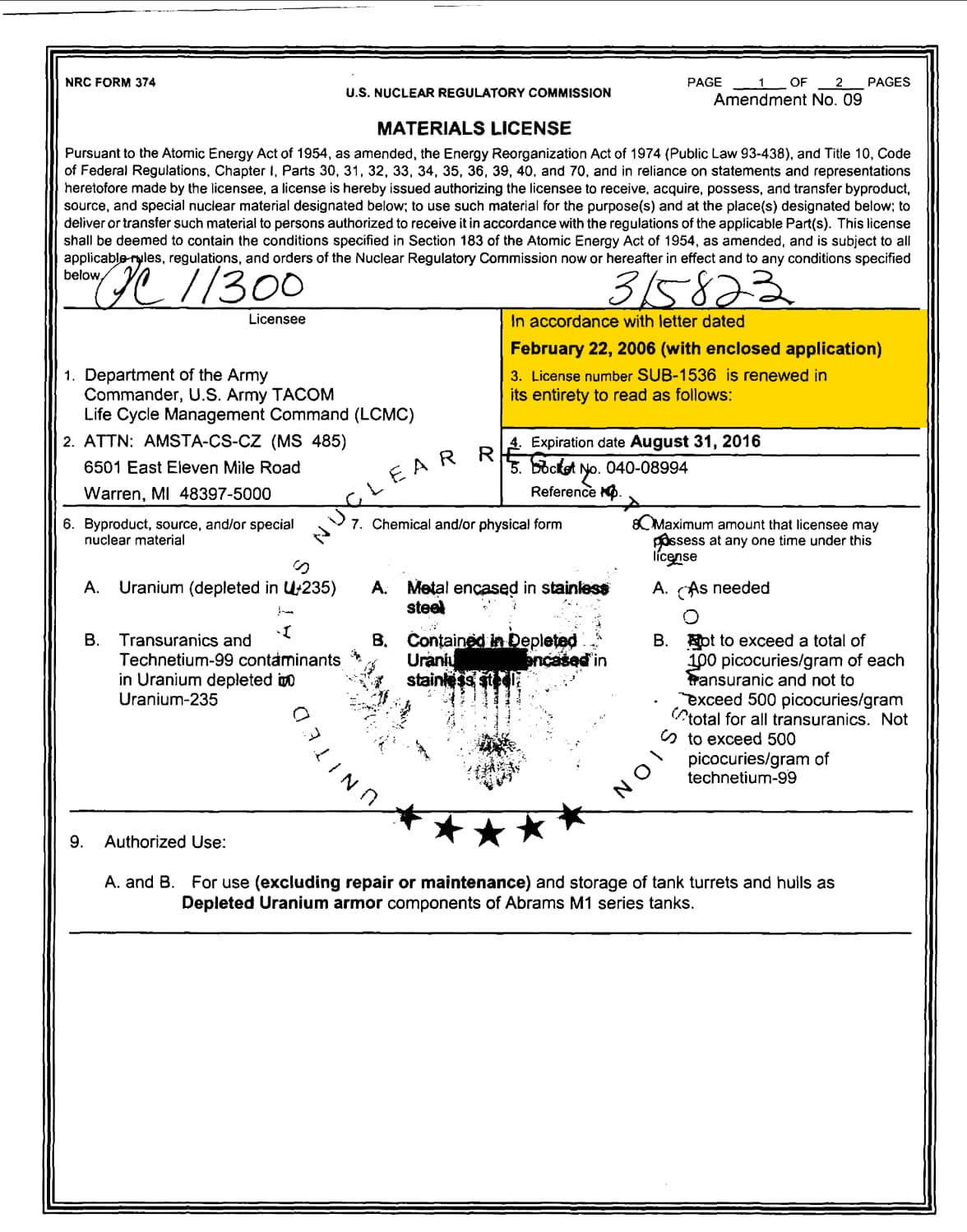
So case closed, the Army clearly requested the 5 hull limit be removed so they could use DU in as many hulls as they want, right? Well not quite…
Notice how the license says this?
In accordance with letter dated February 22, 2006 (with enclosed application)
License number SUB-1536 is renewed in its entirety to read as follows
Well how about we go and read that letter in which the Army requested the license be renewed. Here it is:
Spoiler
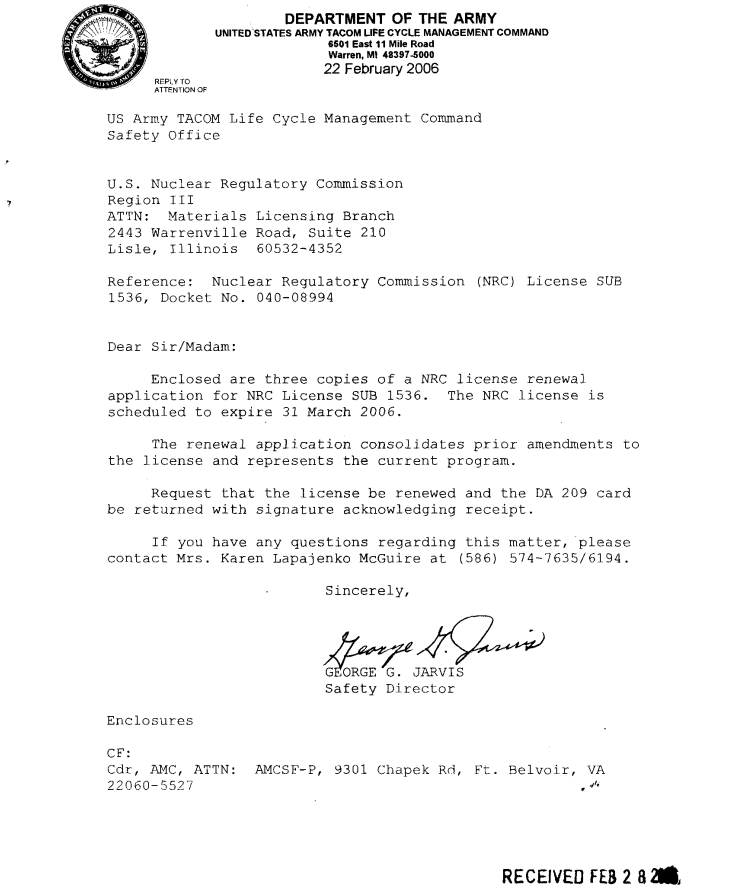
We can see that the letter includes the application form the Army filled out to renew the license. And that the form states that they must provide, among other things, on a separate sheet of paper:
a. Element and mass number b. chemical and/or physical form and c. maximum amount which will be possessed at any one time.
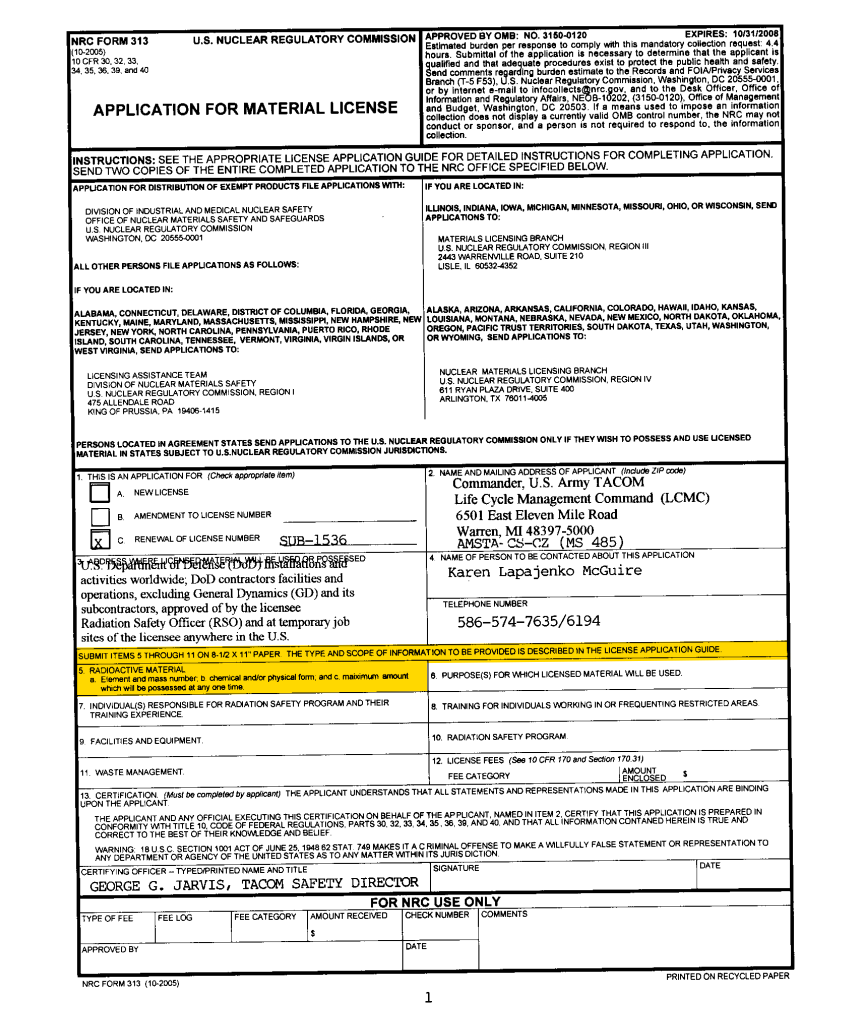
So let’s look at the additional sheet of paper the Army submitted. And well would you look at that they requested the license be renewed with the 5 hull limit still in place. They also included a diagram which again states there are only 5 DU hulls.
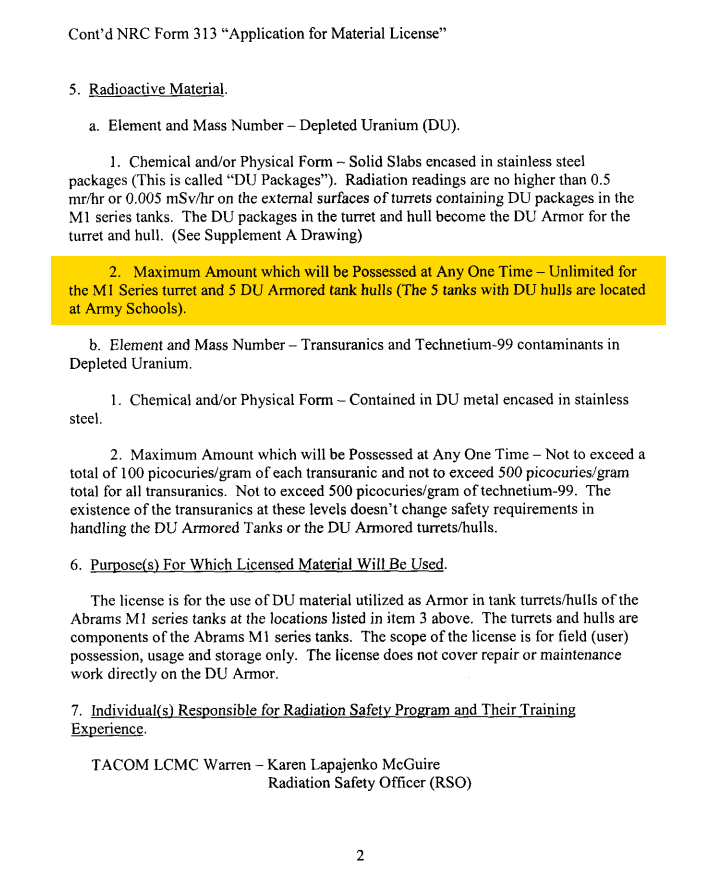
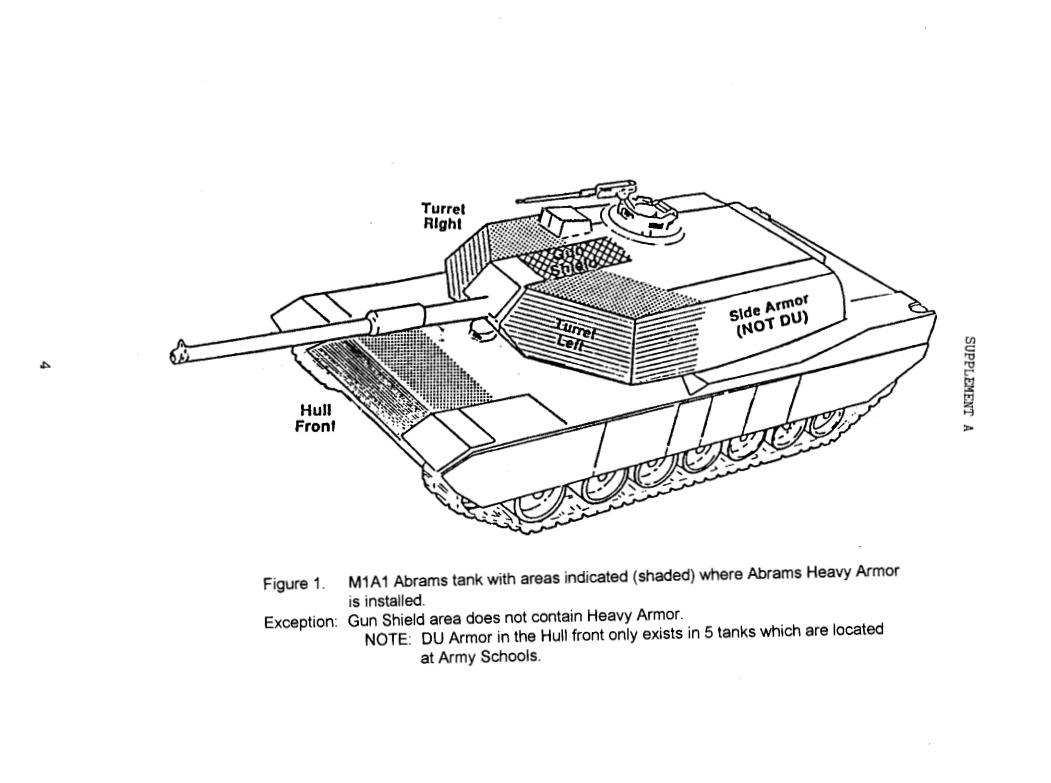
So in summary: before the license was renewed in 2006 it placed an explicit limit on the number of DU tank hulls. It was renewed in 2006 and the 5 hull limit was removed, however when the Army submitted the request for the 2006 renewal they kept the 5 hull wording on their application form. Therefore we can conclude two things:
- As of 2006 the Army only had 5 tanks with DU hull armour and had no intention of increasing that number, otherwise they wouldn’t have explicitly kept the 5 hull limit in their renewal application
- The removal of the 5 hull limit was likely a decision taken by the NRC themselves, not at the request of the Army (as once again the Army kept the 5 hull limit in their renewal application).
Why would the NRC remove the 5 hull limit without being asked to do so? I can’t say for sure, but if I were to speculate I’d say that the first line item on the license states that the Army can possess DU “as needed” with no stipulation that said DU must be in the turret. So the NRC may have decided the second line-item was irrelevant.
What is clear however is that as of 2006 the Army had no intention of possessing more than 5 tanks with DU hulls as that is what they put on their renewal application.
That same document claims the Bradly has 500 mm of KE protection, I think we can therefore conclude that it is in no way a credible source.
Spoiler
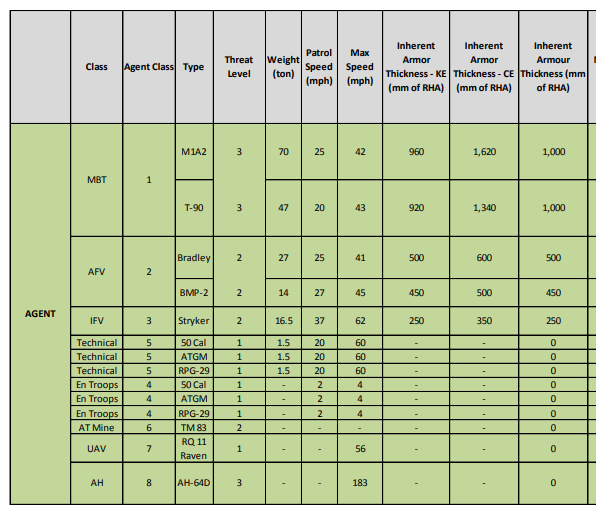
4 Likes
They have to have those things happen for the 5 hulls they had any way, there would be no extra cost.
Also, you absolutely can do exactly that. Is it a waste of money? Yes. Does that stop it from happening? No.
Does not explicitly state DU in hull.
I will repeat this:
Does not explicitly state DU in hull.
No, it’s conjecture because you do not have any source AT ALL that explicitly states that thee HAP = DU in hull. That is YOUR addition and YOUR interpretation. It is not the only way to read those sources.
Your failing already at A equals B, that is what you have failed to show.
The CBO does not state DU in hull.
They didn’t. You did.
1 Like
Was the 500mm figure for the Bradley including BRAT and other additions? And did it state what angle of impact they got that figure from?
I already agreed with the other user that the thesis paper has bad data regarding the Bradley and BMP protection values. I am not relying on that source anymore, so we can drop that point.
However, regarding the license, you actually just proved my argument.
You found that the Army asked to keep the 5 hull limit in their application, but the NRC removed that specific line item in the final Amendment 9. You speculated that the NRC likely removed it because the first line item, As Needed, made the second line item irrelevant.
I agree. That is exactly how regulations work. If the NRC removed the specific hull limit because As Needed already covers it, then legally, the Army is authorized to possess DU hulls As Needed. The specific limit of 5 was legally dissolved by the regulatory body in 2006.
You are also missing the operational context of 2006. This license covers domestic possession at TACOM and Army Schools. In 2006, the M1A1 AIM and M1A2 SEP fleets were heavily deployed in Iraq. They were not sitting at TACOM facilities in Warren, MI. The 5 tanks at the schools were likely the only DU hulls physically located at that specific licensed facility at that time.
The CBO Report from August 2006 confirms that the M1A1 AIM program included Heavy Armor added to the hull. The Federal Register confirms Heavy Armor is DU. And the NRC License was broadened to As Needed in that same year. The fact that the Army’s application paperwork lagged behind the CBO’s physical reality doesn’t disprove the armor. It just means the NRC cleaned up the license to cover the discrepancy.
2 Likes
They are not using any real values in that paper
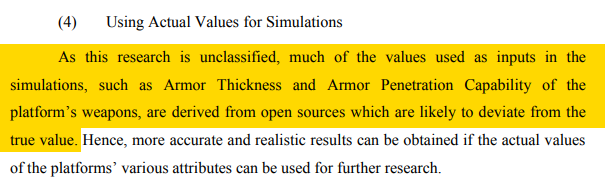
I want to know what they were on to find sources that stated those numbers
You said I defined the term and not the government. That is false. Look at the text in the Federal Register.
Proposed Finding of No Significant Impact (FONSI) for the M1 Abrams Main Battle Tank Heavy Armor System
Section 3, Paragraph A explicitly says:
…in all instances, the maximum potential exposure to radiation from the Heavy Armor System will fall well under the 100 mrem/year NRC limit.
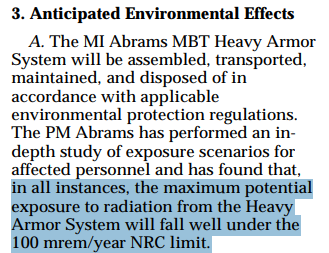
The government states right there that the Heavy Armor System emits radiation. Steel and ceramic do not emit radiation. Only the Depleted Uranium package emits radiation.
This proves that Heavy Armor System is the official name for the radioactive DU package.
So when the CBO Report from 2006 states Heavy armor added to hull and turret, it is stating that the radioactive armor system was added to the hull.
You cannot argue that the hull armor is just the non-radioactive part of the package when the Army explicitly defines the Heavy Armor System as the source of the radiation exposure.
1 Like
This can be 100% be explained by DU in turret only. There is no need for there to be DU in the hull for this to be true.
Correct. But the package doesn’t need to have DU in all it’s parts for it to be called the DU package, DU in only the turret would still logically cover all those bases.
No, it does not.
Lets do a thought exercise. Pretend for a moment that the Heavy Armor Package is a package that increases armor of several parts (including the hull) of the tank but the only parts of that package that have DU in them are the ones added to the turret. All of your arguments and all of your bases will still be covered and can still hold logical truth if the package is designed in that way. Try to actually read your sources and think of the Heavy Armor Package in this way and you will see that they still work to read that way without any sort of leaps in logic anywhere.
Because the turret parts with the DU are included in the package. If i have a box of nails and only one of those nails is radioactive you still get exposure from being near the box even if the rest of the nails aren’t radioactive.
You are making the assumption that all parts of the package contain the same things when that is not stated anywhere and is not needed for all your sources to still hold true.
Yes they are authorised to have as much DU as they want, but the fact that they stated DU is only in 5 hulls and kept that on their application form shows they didn’t have more than 5, or have interest in doing so.
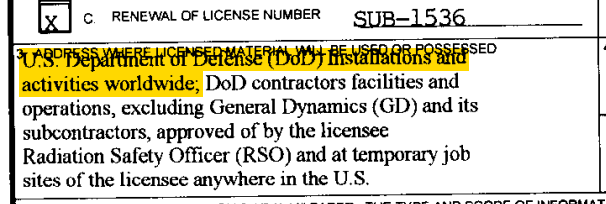
The license is worldwide, not for any one site, or even for just for US sites. I.e. there are only 5 tanks worldwide that have DU armour (all of which happen to be in Army schools) and the Army doesn’t plan on getting any more of them.
Or maybe, just maybe, the CBO got their table wrong? The CBO are not the army, and it’s not like they have access to proper information on the Abrams, they cite a report published before the M1A1 AIM existed and a random guys website for crying out loud: M1 Abrams Main Battle Tank
You can’t treat them as a more reliable source than what the army out in their application.
I think everyone is missing the bigger picture here. If there isn’t enough evidence to prove that specifically DU was used, then what changed that counted as armor improvements/upgrades? It’s completely absurd to assume that the US didn’t improve the lower hull array until the SEP v3.
1 Like
Your thought exercise fails because of the Nuclear Regulatory Commission license.
You are arguing that the Heavy Armor Package is a mixed box, where the turret is the radioactive nail and the hull is the non-radioactive nail.
If that were true, the NRC license would only list the Turret. The NRC does not license non-radioactive items just because they are in the same box as radioactive ones. They regulate specific components.
Take a look at NRC License SUB-1536 again.
Item 9 (Authorized Use) explicitly authorizes the possession of “Depleted Uranium” for use in “tank turrets and hulls.”
It does not say “For use in tanks.” It specifically singles out the Hull as a destination for the Depleted Uranium.
If the hull was just the non-radioactive part of the package, as you claim, then listing it as an Authorized Use for Depleted Uranium would be false. The license proves that the Hull is not just a part of the package; it is a container for the radioactive material itself.
So your logic that the package can be split doesn’t hold up. The documents confirm the radioactive material is in both specific locations.
1 Like

4 Likes