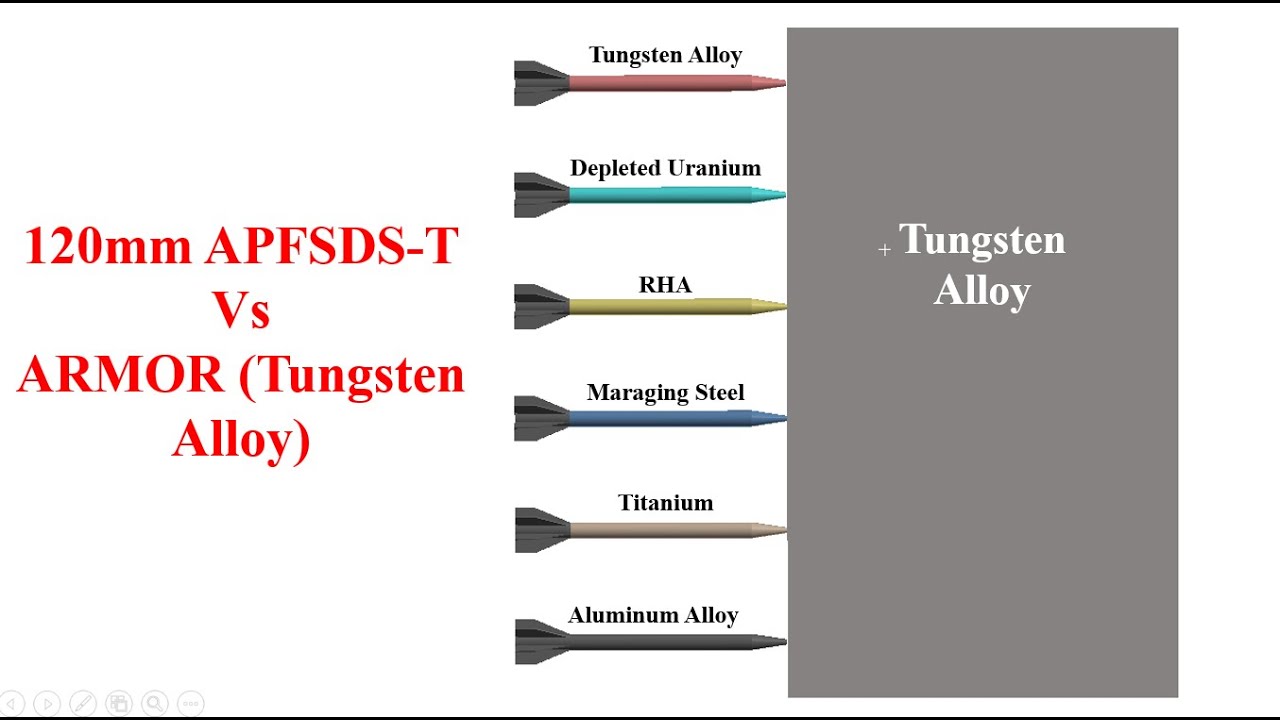
Mushrooming has nothing to do with flexural ability of a KE rod, that is solely relying on thigs like plasticity, areal moment of inertia, young modulus, and flexural rigidity.
KE-W A1, and KE-W A4…
And US defence industry is heavily relying on its European counterparts as well, Tungsten alloys, is one aspect where the US is simply years behind.
A4 could mean any round, the reason its KE-W means "Kenetic → (W) or Tungsten on the periodic table.
Its called trade, that’s how it works… But yes in relation to who supplies the most technology and support across the board that medal goes to the US. From computers to transmissions all of NATO relies on US supply.
Mushrooming lowers post pen spall and lowers the integrity of the round leading to more chance of shattering or even non pen. https://www.youtube.com/watch?v=ycPeO8xGXAw - this it at a flat angle but it does show how DU pens more thx to it keeping its integrity.
Tbh most of your sources aré unreliable and not oficial and have even been roasted before in the forums because they aré straight out lying of exagerating some stuff, at hypervelocity impacts, the penetration mechanism shifts to hydrodynamic flow, so material strength matters less and density dominates, and modern WHA has advanced to higher density domains at around 18.5 to a whooping 19 kg cm³ just aproximates, and not only this but some countries like japan have even added adiabatic shearing to their WHA apfsds trough advanced metallurgy wich gives them the hypervelocity impact advantage over DU while keeping the inherent natural extra penetration from DU
I understand where you come from, but the sources are also incredibly old. At the time, the US was really lagging behind the WHA alloy department, and even then, this was based off a tungsten-nickel-iron alloy, which was incredibly basic even at the time (1980s). Comparing that to today’s alloys like the grain-refined WHA with controlled cobalt/nickel ratios, you are comparing 40-year-old research with today’s modern technology. Now, addressing another issue, DU does lose its adiabatic shearing once it starts going faster and faster, and it’s noticeable since the 1600 m/s. The same tests you showed always test both at 1200-1500 m/s, exactly on the speed where DU dominates and becomes the most effective.
“Catastrophic shattering” also describes 1970s tungsten, not modern W-Ni-Co alloys engineered specifically to prevent that.
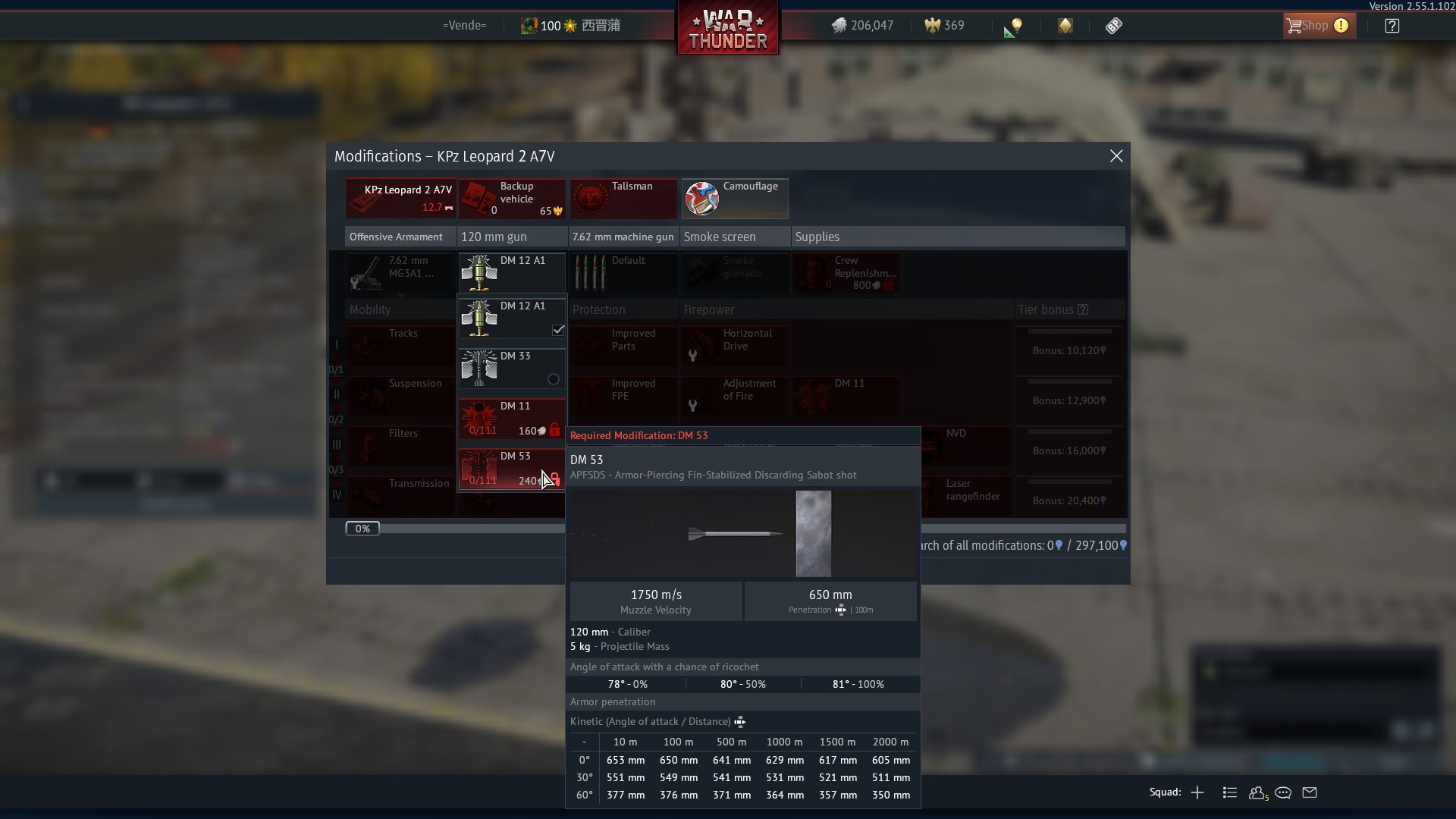
DM53/DM63 , and this is a real thing, and it’s mostly related to the same issue that modern APFSDS now use much more complex and capable WHA alloys.
You’re citing 1980s papers on generic WHA alloys tested at velocities where DU self-sharpening works best. Modern WHA APFSDS is fired 300-500 m/s faster, entering a regime where DU’s thermal softening increases and WHA’s stable high-strain behavior pays off. Modern WHA rounds like DM53/63 operate at velocities and with alloy formulations that close most of the historical DU advantage gap. The performance difference is narrow enough that nations choose WHA based on non-penetration factors which proves DU isn’t 'flat out better in every way
this is not 100% true, the wider hole and radial stress waves can fracture more material on the far side of the plate, wich in theory produces more spall, now this in theory can also be applied to the DU rod aswell, adiabatic shearing dosent produce more spall and pyrophoric capabilities only heats up the material that is being sent inside the tank, it dosent really produce more spall nor its magical NOR it acts up like thermite melting trough everything, its in very wrong wording just an incendiary round
again you are using a generic rod with no real identity as a modern apfsds, if we are comparing raw material capacity ofc DU its gonna be better in every way, if we are comparing modern alloy with DU its gonna be more likely to match DU performance, specially stuff like higher denisty WHA with adiabatic shearing
Does he need to make sure he gets every piece of data used to explain DU superiority? You guys are asking for
Information only the governments have again still inconclusive. None of you guys know what actually goes into an APFSDS round. It’s all based on close enough guess work using a calculator.
-Abrams is accurately based of some Swedish trials people provided sources to not some random statements
-WT treats DU rounds with the same metrics as WHA. Because that calculator can’t calculate correctly the sharpening penetration aspect of DU. So in WT DU=WHA for simplicity
-Even though Gajin state’s primary sources are the way to go you can’t stop the “I once heard” or “trust me I’m an APFSDS expert”
Bro could get a source from the president himself and would still be daft, well, that’s what makes you a burgerbro I guess.
And for your information (not like you know what that means), the calculator does reflect self-sharpening, that’s why M829A2 has 700mm’ish of perforation/60 at 2km’s, just like in real life ))))
there is enough proof already imma search it and post it once i find it
he needs to make sure he finds a reliable piece of data that its modern enough to counter check the info and not just claim stuff based on generalized apfsds with no real capabilities compared to modern apfsds
DU is treated as DU, including adiabatic shearing, in fact type 10 apfsds also has adiabatic shearing counted ingame, i’ve already done calculations based off ingame stats using the magical lanz odermatt formula
its sources about the tungsten density used by rheinmetall not LO , LO its widely known as the most accurate form of calculation used for the penetrators because its simple accurate and goes straight for what it needs to go, its even used for simulation videos