No source provided and a source from the united nations is not enough.
1 Like
What part of superior are you struggling with?
DU Rounds > Tungsten rounds.
Black and white: Tungesten (the main ALTERNATIVE round)
again go clown somewhere else.
I’m going to go play my US M1A2T AIM Sep V2 Swedish tank now good luck out there
The formula we use in War Thunder disagrees with what you’re saying. DU rounds also bend more than WHA and, as Jecka said, are more prone to snapping. W.L. and W.O. give similar numbers in their papers, which are indirectly used in War Thunder’s APFSDS penetration calculation. They also made another graph showing that optimal velocity and energy efficiency are areas where DU suffers.
So no, DU is not “vastly superior to Tungsten rounds in each and every way”.


Bruh i was still typing and my source got sniped…
If you still don’t believe us, here using Gaijin’s own numbers for DM53, when using a DU alloy with equal density to Gaijin’s WHA DM53 density it goes from 652.8mm → 620.9mm
*fixed typo
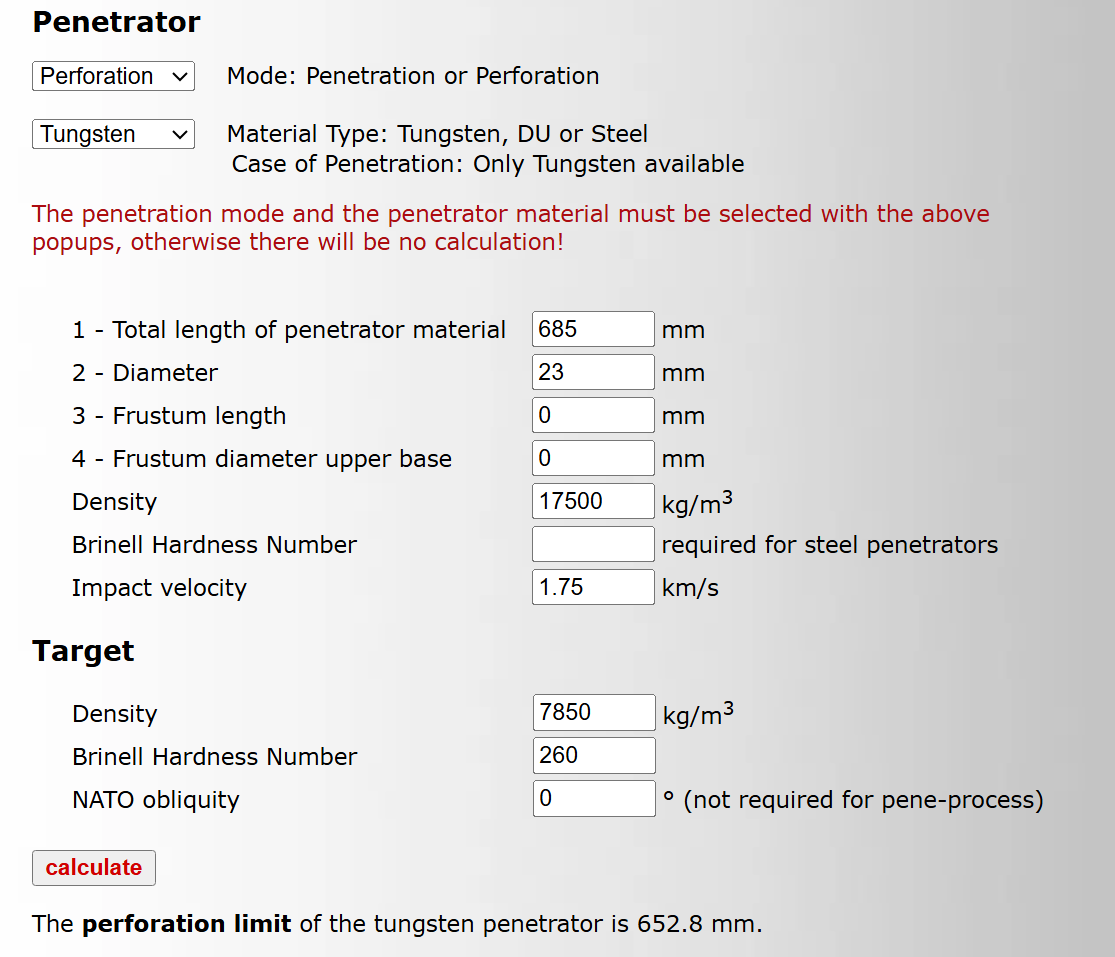
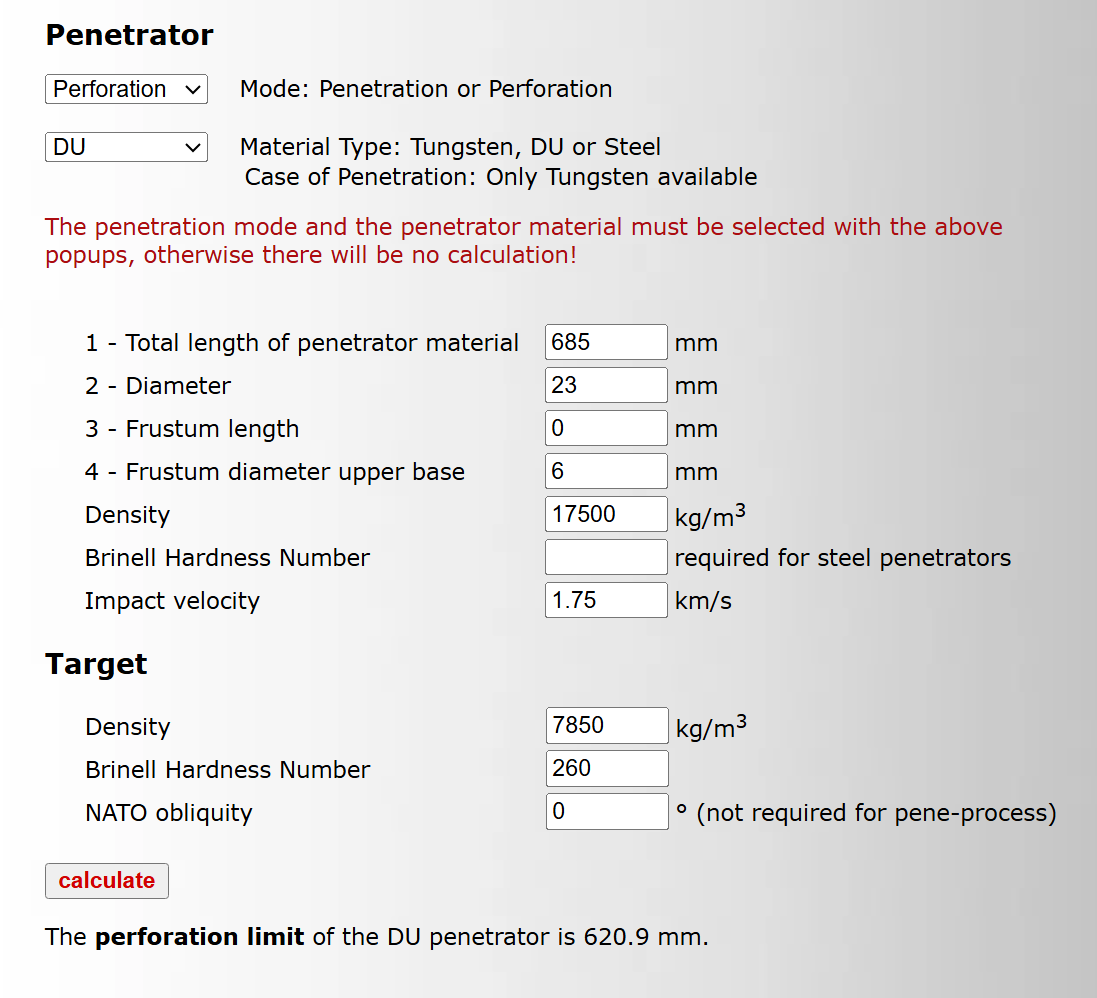
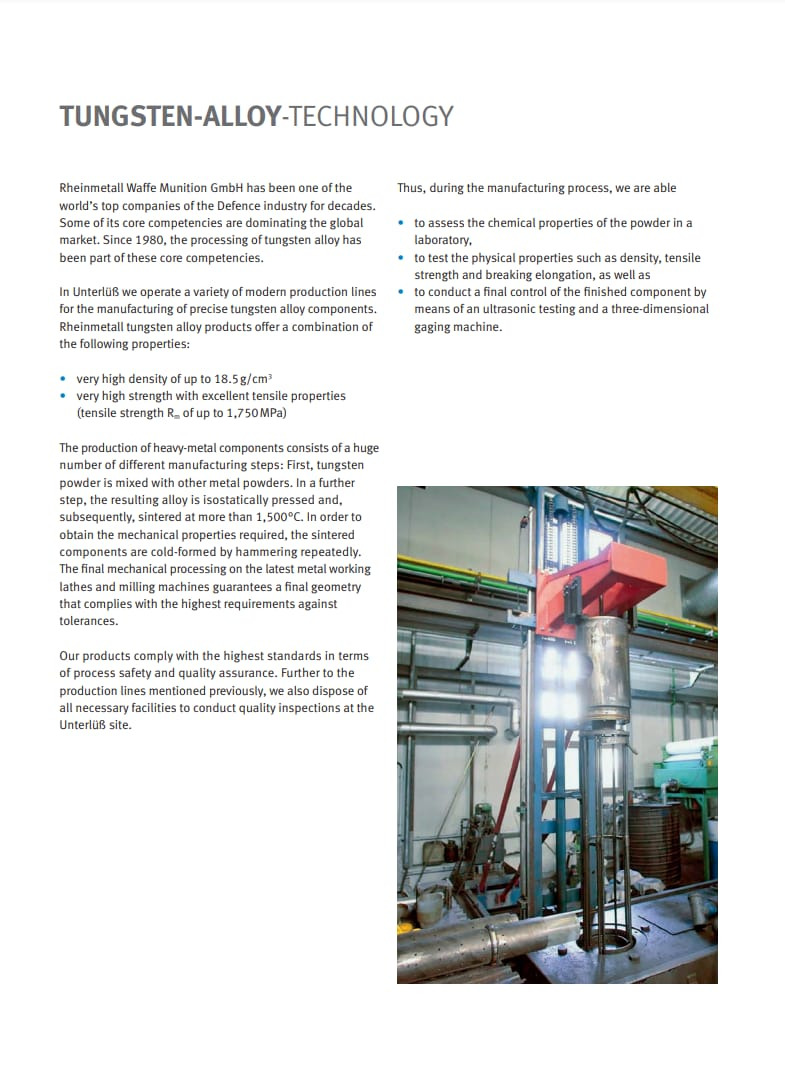
his is true even if we increase to higher WHA densities like 18500 kg/m^3, which RH WM claims to reach while maintaining higher tensile strength values than DU alloys.
3 Likes
-
All this forum has shown is Gajin doesn’t know anything and neither do game masters all of a sudden when it’s inconvenient. So any “WT reference saying this or that” is useless.
-
I agree
What I should of said is “DU is vastly superior to tungsten.” Just because one aspect might be better still doesn’t change the fact it’s superior to tungsten.
- If a direct source from the United Nations stating DU is superior to Tungsten provided with a direct link and not just screenshot I don’t know what will.
Overall, DU is superior to Tungsten and Tungsten is a good alternative. It’s like trying to pawn off oatmilk as real milk. It might have benefits here and there but real milk will always be king.
And they have the authority to say this because? The LO equation is built from decades of expertise in APFSDS development. It’s a series of very detailed papers and studies that go into much more depth than anything the UN has produced. The UN has zero authority on this topic. They have nothing to point to, as they don’t work with these materials, develop the rounds in question, or run any terminal ballistics research. They have no institutional expertise on whether DU outperforms WHA mechanically.
The vast majority of your UN source does not even talk about the mechanical properties of DU, nor compare them to WHA, nor their effect on armour. The paper is primarily about health hazards, radiation exposure, contamination, and legal issues. That has nothing to do with penetrator dynamics. The only substantive mention of DU’s penetration “superiority” in the paper paraphrases the US/UK governments own justifications for using it:
“Both states claim that the use of DU ammunition is militarily necessary on account of its superior ability to penetrate hard armour compared with tungsten (the main alternative).”
Not a very fair nor good comparision now is it?
Which is why DU has worse performance givien identical situations? Gaijin has already artifically reduced the density of all WHA to a max of 17500 kg/m^3 where DU gets 18600 km/m^3 yet a shorter DM53 has superior pen to M829A2. Once again, the constant energy graph directly shows what we are saying.
This graph uses cylinders with an aspect ratio of 30 for its penetrators, with constant impact energy (10 MJ) WHA out performs DU over ~1650 m/s. Which is exactly where most WHA penetrators reside velocity wise.
Graph

DU is worse in many areas. Trying to frame the difference as “oatmilk vs real milk” is an extremely weak claim given the information available. The consequences of a lower elastic limit and lower Young’s modulus are far more impactful than just “wow, lower number.” They directly drive the design of APFSDS. In DU’s case, they force the use of much stiffer and heavier sabots, which in the paper’s own words “compensates the slightly better impact behavior of DU in RHA.” So even in the regime where DU is ballistically superior to WHA, it’s only slightly better, and even that slight edge gets cancelled out by the sabot penalty. The authors also directly link the failure of US APFSDS development to achieve a better sabot-to-penetrator mass ratio to the use of DU and its need for stronger sabots.
2 Likes
DM53 vs M829A2, first at ~4.5km distance (1750m/s when fired), the second is at about ~2.5km (1670m/s when fired)
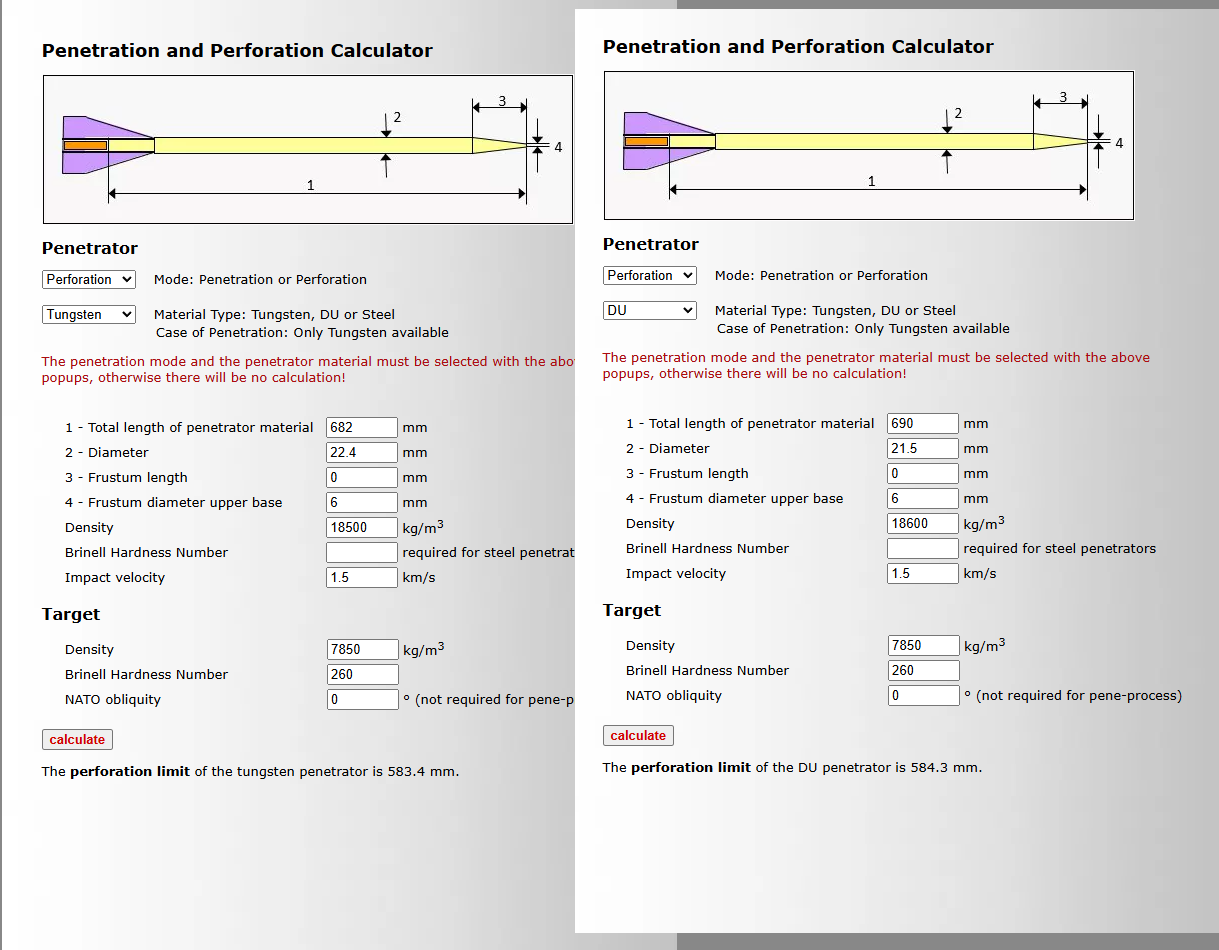
Again, because you don’t understand how to read:
It is more nuanced than just “muh thing better”, most DU “performs better” as it is tested against semi-infinite RHA blocks until the projectile completely erodes, meaning a denser DU will perform better than a less dense WHA even if their material properties are actually identical, solely because it carries more energy, but when a more or less equally dense WHA projectile is pitied against DU, they even out, or, WHA even performs better.
United Nations stating DU is superior to Tungsten provided with a direct link and not just screenshot I don’t know what will.
And their authority on the subject is null. They’re only repeating the popular argument for DU i.e slightly better performance versus RHA.
This is M829A2 versus DM53 at 1670m/s (A2 is left, DM53 is right):
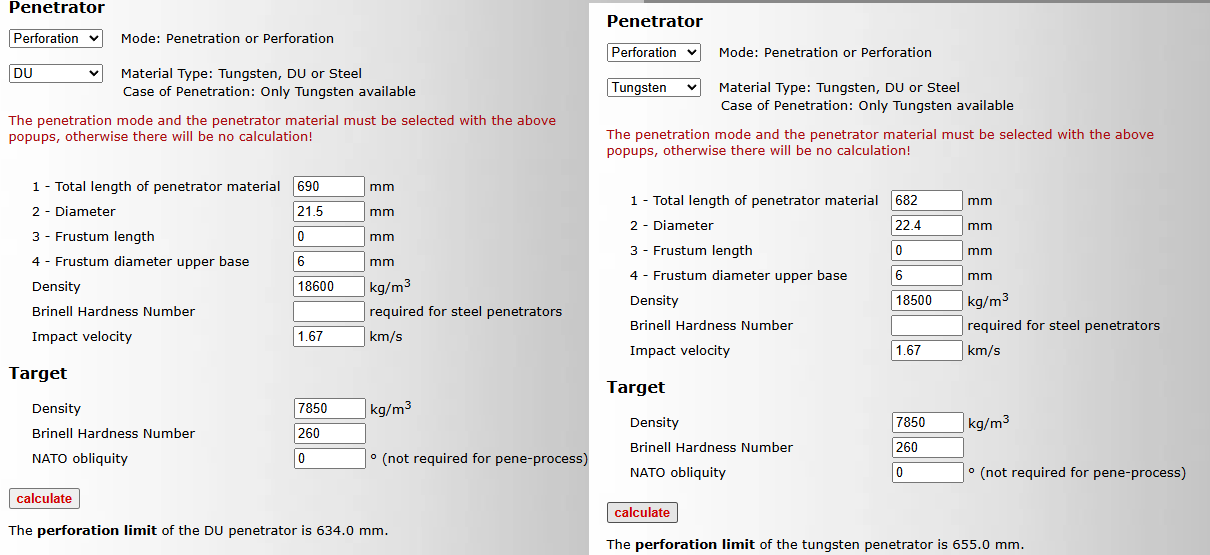
DM53 performs better, even though it’s shorter, and is made from Tungsten.
3 Likes
Noted, UN is not a credible source. Only LO, my apologies sir.
Noted, Gajin is not a credible source. My apologies again I always forget LO is the one and true source.

I’ll make sure to use this third party god tier calculations over anything the government can provide me in the future.
The document is in 95% about health and safety, it’s not a primary source for DU vs WHA debate, no matter how much you pretend it to be because it fits your narrative.
Also, Odermatt is an expert in the field and he actually published his methodology on the very same website, you’d know that if you could do more than type “is DU better than Tungsten” into google search.
Your source has no mention of DU’s material properties. The penetration superiority claim is exclusively a statement from US and UK officials, and those statements themselves cite no technical sources. This is a game of telephone, not an official document that proves DU’s superior penetration capability.
The papers are linked on the website. If you don’t want to (or can’t) find the clearly marked peer-reviewed papers (something your UN document also lacks), that’s no longer my issue. You can either read the facts and accept them, or continue to peddle misinformation from a document that has no authority on the topic.
Once again, the UN paper is about the ecological, health, and legal ramifications of DU weapons, not their capability or superiority. The authors are openly paraphrasing UK and US claims with no proof those claims are correct. The UK and US are also not exactly known for making the best WHA penetrators.
1 Like
My apologies I forget Germany is the superior nation in all tech I mean they won WW1 and WW2 after all. I was being too simple minded believing government entities across the world, giving proper information to the United Nations about the capabilities and strengths of DU rounds compared to tungsten and why nations prefer them over tungsten is a massive blunder on my end. I’ve come to realize some guy created a website and knows all ammunition classified and unclassified. Woe is me please forgive me I was wrong.
I’m going to go get ready for my day. Take it easy man

I think I might stick to the one that shows actual test data
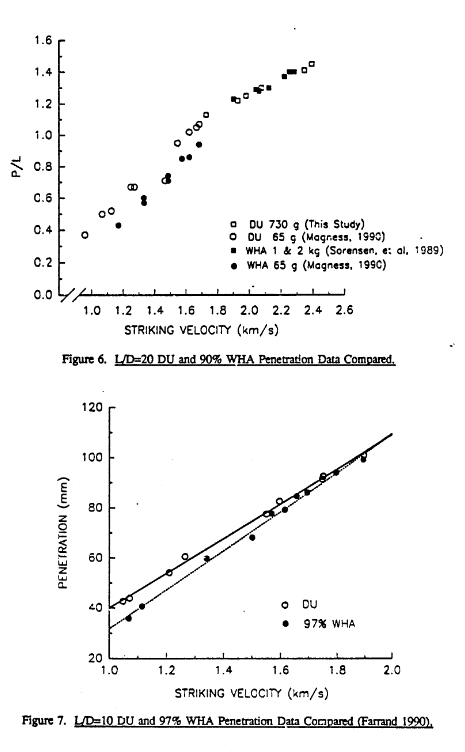
and would you look at that
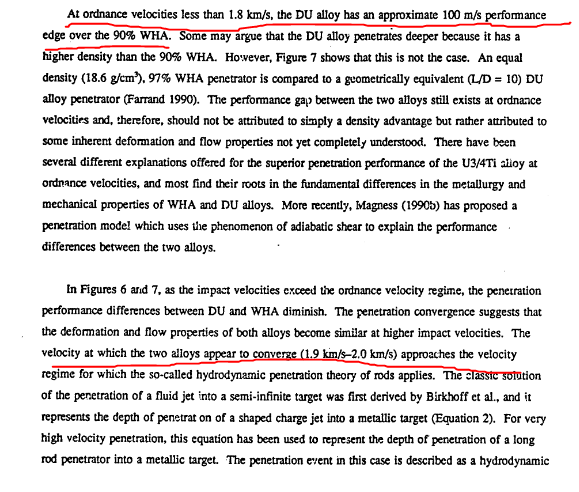
it shows the convergence velocity as higher than the muzzle velocity of most of these rounds, in which case DU is the better option
It’s from the government you have to use LO man.
To note: this paper’s tests were carried out before 1991, i.e before WHA alloys matured, monoblock WHA was still very new by then, and had “infancy problems” (and as said before, US doesn’t make good WHA alloys even today, based on research papers i’ve seen, needless to say, that’s why KE-W series are all basically using copy’n’paste of RHM’s 2nd tier alloys).
In either case, at least someone with a brain here, a fresh breath of air after sandm*an
3 Likes
Swiss Ordnance Enterprise Corp, Allmendstrasse 86, 3602 Thun, Switzerland 2
Swiss Defence Procurement Agency, Feuerwerkerstrasse 39, 3602 Thun, Switzerland 3
French-German Research Institute of Saint-Louis (ISL), P.O.Box 34, F-68301 SAINTLOUIS-CEDEX (France)
They literally started the paper with a pictrure labled “FIGURE 1. Tungsten rod penetration in a 400 mm thick RHA plate of 260 HB hardness, obliquity 53° NATO (1994 test in Thun)”
This is directly their test data, from working in these companies for decades but sure.
This literally agrees with what we say? The test data you showed uses lower mass & lower ME test data, this is exactly what LO shows, this does not talk about high LD & high mass APFSDS like the DM53s, M829A2s etc of the world. Also the papers are much older and do not account for the development since, LOs paper is from 2001, not 1991. Since then much better WHA have been developed and fielded (Ie DM53).
2 Likes
I tried to warn him it needs to be LO.
I always forget no nations besides Germany develops and improves their ammunition. United Nations doesn’t know what they’re talk about man. Can you believe these guys don’t know LO? Psssf
is it impossible for DU alloys to have also improved?
Are you daft? LO’s data is more accurate and comprehensive, this just adds to what we already said. You are in the wrong here, the data agrees with our claims, not the other way around. If you are so in denial about the facts laid out before you, nothing I or anyone can say to you will change your opinion, at which point I recommend you get off the forums.
With “this” being the outdated 1991 test data.
UN still has no authority… and I can clearly see you’re daft enough that for you, this discussion lost meaning posts ago, now it’s just your way of feeding your ego. In that case, nobody can really do anything for you being in so much denial, honestly I’m thinking it’s your nature to be like this.