Documentation of M1A2 / M1A1 HC Hull Armor Composition (1996–2016)

I’de like to add to this with this document at page 95
https://www.cbo.gov/sites/default/files/cbofiles/ftpdocs/74xx/doc7461/08-02-army.pdf

the fact it makes the distinction between HA and DU by referencing all 3 and 2 generation iterations when talking about the AIM and M1A2/M1A2 SEP I think should be more than enough to prove HA does not mean DU and shouldnt be used interchangeably

1 Like

What’s the difference? It’s gonna make the tanks go up in BR if they get a buff.

They could also just undo the reload buff, see what happens first.

Isn’t that enough of a reason for the Abrams to get it? If it’s “technically compatible” then won’t that be enough?

If not, how come non V4.5,6 Ah-64E gets the JAGM and how come all Ah-64Es get the DIRCM?

Is the standard different for tanks? If it is, why does the Taiwanese M1A2T have the KEW-A2 round since it hasn’t been exported to that nation?


Is there a dev blog talking about the standards using when making changes to a vehicle? I’m a bit confused if there is any since, it seems to be applied when convenient. I would much rather have the devs say “it’s for balance” rather than “historically accurate” since they seem to flip flop constantly.

8 Likes

I would support this given that there will is solid proof, which as of the ones submitted are not quite up to standards. I will also want further evaluation of other armour module updates, including but not limited to the T-series autoloaders, spall liners of various tanks, the armour profile of tanks like Merkava Leclerc and leopards, along with various balancing mechanisms that ensures all these additions are fair in actual gameplay without having any nation seal clubbing the rest.

I think this only applies to munitions and loadouts though i’m not sure, best ask the Community Managers for a correct answer. The CV90’s for example have been denied the IR tracking because they don’t have that one specific module installed even though they can relatively easily install it.

I wouldn’t know. In general it’s better to ask things like this to the Community Managers. I do know that munitions are sort of a balance factor to give or not (with the requirement that the vehicle can use the munition) and is less restricted by historical loadouts.

I think this is the best post for this: ( [Development] Reports concerning the protection of post-war combat vehicles - News - War Thunder )

And while this post is old it does give some insight into how they look at reports and chose to implement some of the things: ( CM Covert Disclosures No.3: Updates from Smin )

Other than that i don’t think there are any comprehensive posts in that way but rather individual answers from the Community Managers.

1 Like

Interesting post. But there’s some glaring issues with your use of the sources.

The Wyoming Mining Association is a secondary source. Note that when mentioning other applications of DU, it provides citations or images, while the comment for Abrams armor is unsourced. This means that for the authors it’s intended to be “common knowledge,” however since this whole debate is about whether the pre sepv3 abrams had DU hulls, it is useless as proof.

The CBO source lays out its sources for the information pretty easily. A previous 1993 report, and this site M1 Abrams Main Battle Tank

Those don’t give any comments about where the DU is. These sources also use the term “special armor” to refer to DU.


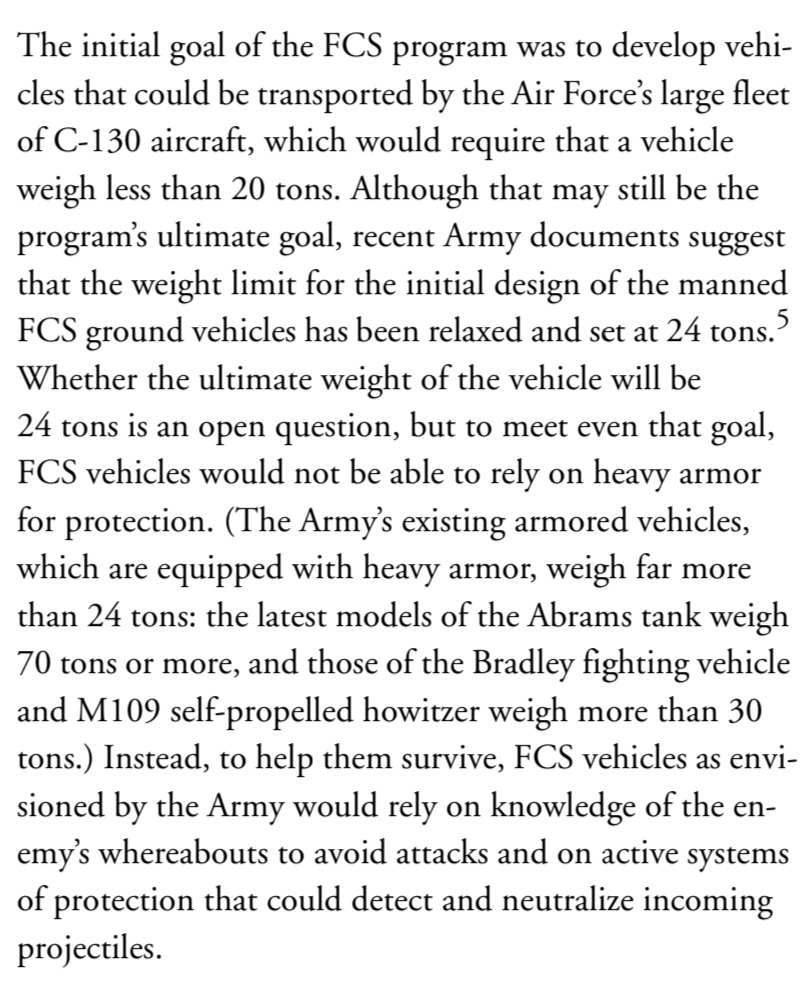
It’s also clear “heavy armor” means literally heavy armor. The source that you use to say “heavy armor” = DU consistently calls it the “Heavy Armor System,” with capitalization, while here “heavy armor” is used earlier in reference to how heavy previous combat vehicles are in comparison with the FCS’ 24 tons
Screenshot_20260113_060332_Chrome

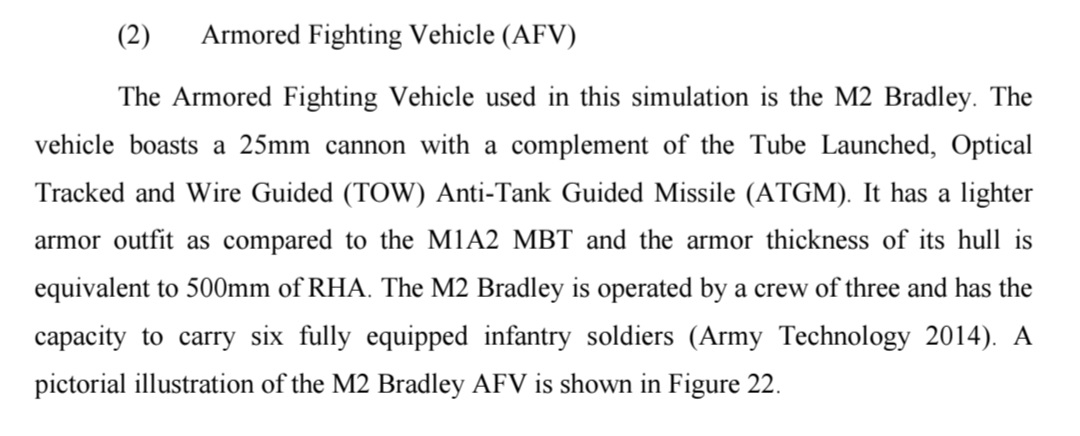
The Naval Postgraduate School source is just someone’s Master’s thesis. The purpose of the thesis is to analyze add on armours and APS protection, and it’s clear the specs provided are just generalizations, not facts (the provided value is also uncited). Especially as immediately after the Abrams, for the Bradley he states:

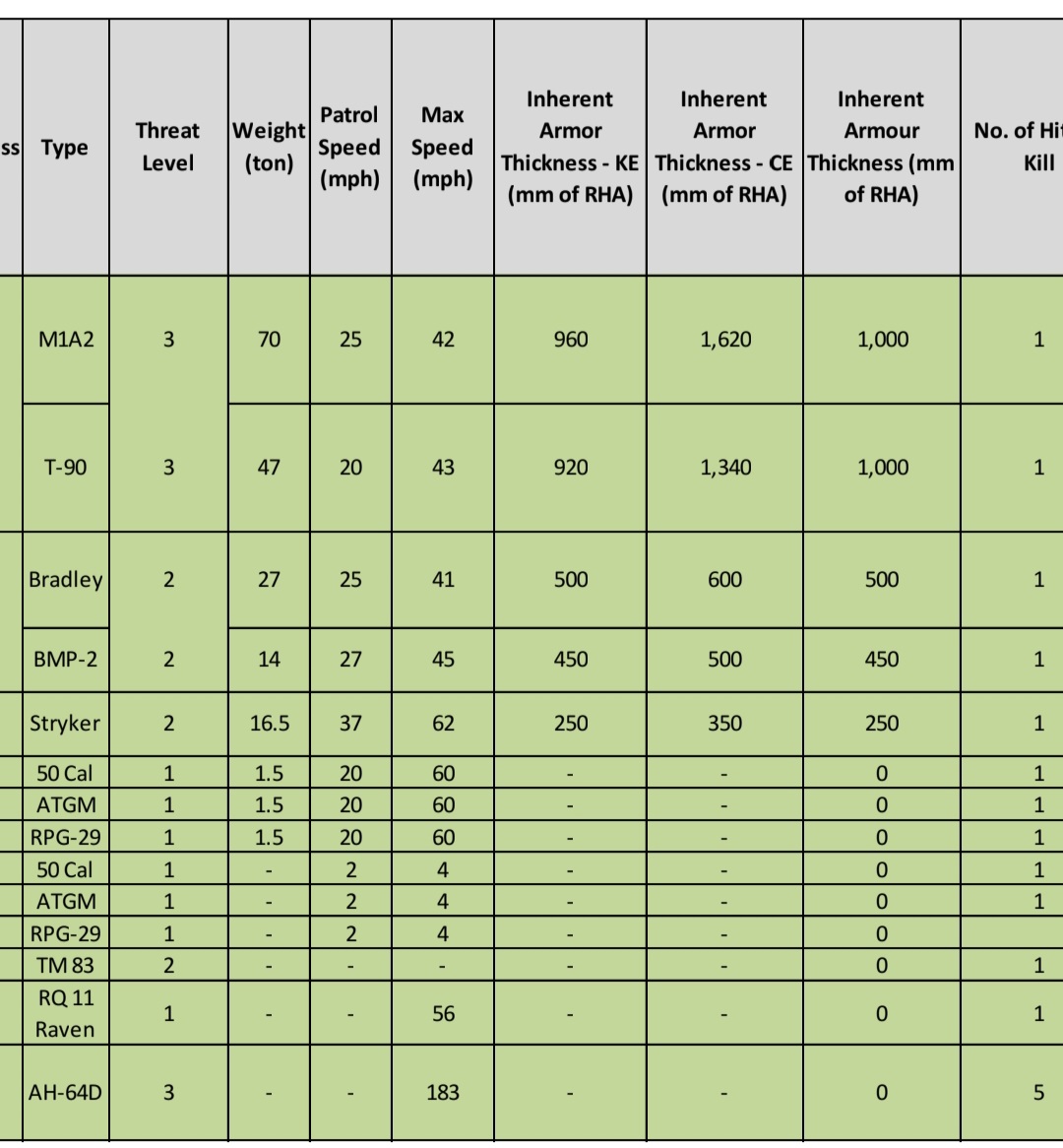
To prove this point, he also provides a table of his simulations, with armour values for some Soviet vehicles.


Now hey, let’s say the Bradley does have 500mm RHA equivalent. The BMP-2 sure as hell doesn’t have 450mm RHA equivalent armour.

The 2016 set of licenses is fairly pointless, as Gaijin’s quibble is with the M1A2 to SEPv2. By then the newest variant was the SEPv3, which we know is confirmed to have DU hulls.

1 Like

I agree with you regarding the Naval Postgraduate School thesis. If their data suggests a BMP-2 has 450mm of protection, that is clearly an error in their simulation model, and I am happy to discard that specific source to maintain quality standards.

However, I have to push back hard on your interpretation of the CBO Report , the Federal Register , and the timeline regarding the SEPv3.

“Heavy Armor” is a Proper Noun, not a generic adjective.
You argued that “heavy armor” in the CBO report is just a generic description of weight. You cannot cherry-pick the usage of the word “heavy” from a paragraph about air transport weight limits to disprove a technical designation in a specification table.

The Federal Register (Vol 63, No 134, July 14, 1998), a primary federal legal document, explicitly defines the term.
Title: "Proposed Finding of No Significant Impact (FONSI) for the M1 Abrams Main Battle Tank Heavy Armor System "
“This EA focuses specifically on the assembly, use, repair and disposal of the heavy armor package… The current use of the depleted uranium (DU) armor package on the Abrams MBT has been re-evaluated.”

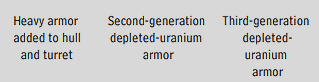
In 1998, the Army legally defined “Heavy Armor System” and “DU armor package” as interchangeable terms. Therefore, when the 2006 CBO Report (Table A-1) lists “Heavy armor added to hull and turret” for the M1A1 AIM, it is using the official Army nomenclature for the DU package established 8 years prior.

If “heavy armor” were just a generic description of weight as you claim, the IPM1 (which gained weight over the M1) would be listed with “Heavy armor” too. It isn’t. It is listed as “Improved composite.” The CBO uses specific technical designations in that row, not adjectives.

The SEPv3 Timeline is Impossible.
You stated: “By then [2016] the newest variant was the SEPv3, which we know is confirmed to have DU hulls.”

This timeline is factually incorrect.
The M1A2 SEPv3 did not enter Full Rate Production until late 2020 .
The NRC License Amendment in question is from 2016 .
The CBO Report citing “Heavy Armor” in the hull is from 2006 .
The Federal Register confirms the “Heavy Armor” cut-in happened in 1996 .

You are suggesting that a CBO audit from 2006 and a production cut-in from 1996 are referring to a tank (SEPv3) that wouldn’t exist for another decade. The NRC license covers the operational fleet (M1A1 SA and M1A2 SEPv2) that was circulating through depots at that time.

The Federal Register explicitly states: “In 1996 , a design change to the armor package was made by the Army and cut-in to production… effective with Job #1 M1A2 Phase II .”

That “Job #1” refers to the M1A2s built 25 years ago, not the SEPv3. The “Heavy Armor System” (DU) in the hull has been the factory standard since 1996. Linking the Devblog about the “5 school tanks” relies on an outdated 2006 license limitation that was superseded by the later amendments authorizing broader possession.

3 Likes

The issue here is that the way it’s worded doesn’t mean that DU is present in all parts of the “Heavy Armor System” / “DU armor package” .

Analogy:
If you have two pieces of paper and one has a red dot in the top left corner, you ask someone to get the paper for you and they ask which one, you can anser “the red dot one” without it meaning a paper covered in red dots because just one red dot is enough to distinguish it from other pappers with no red dots at all.

In the same way the “DU armor package” is enough to distinguish it from other non DU armors even without all of the parts of that package containing DU.

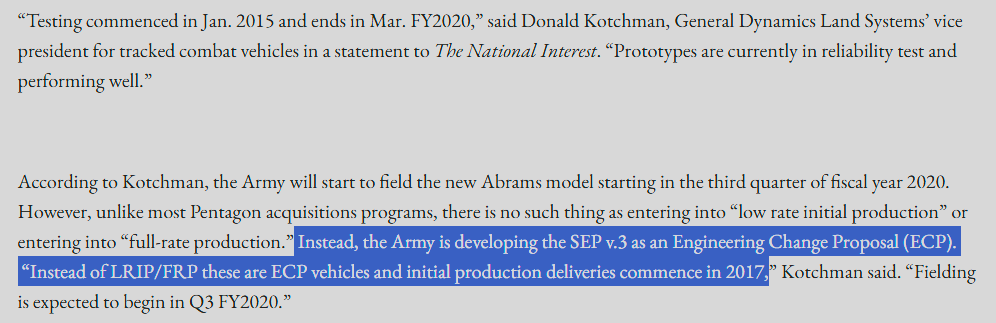
Full rate doesn’t mean that they weren’t produced before that (not the best source, i know).

image

( https://nationalinterest.org/blog/buzz/inside-the-us-armys-lethal-new-m1a2-sep-v3-abrams-main-16445 )

as well as:

image

( Picture Of Newest M1 Abrams Tank Variant With Previously Unseen Turret Armor Emerges )

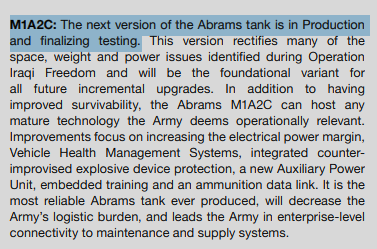
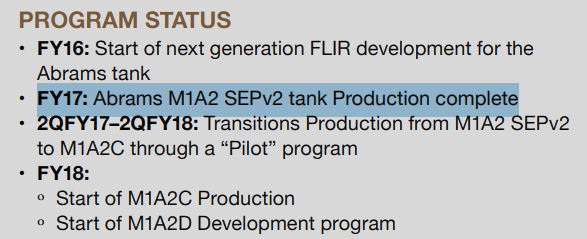
And this military magazine from 2018 (SEPv3 was previously known as the “C”) stating production is already ongoing and that the SEPv2 completed production in 2017:

image

image

( https://api.army.mil/e2/c/downloads/533115.pdf )

The amended 2016 NRC license wouldn’t have been nearly in time enough to cover the SEPv2 but in my opinion is rather a preparation for the SEPv3 that likely started production around 2017.

Not proven, there is nothing that point to the “Heavy Armor System” to mean DU in the hull. That is a conclusion that you have personally made based on conjecture.

Not really, as those could just as well mean DU in the turret and still be correct and valid while referring to the SA and SEPv2.

1 Like

Using ChatGPT to argue something that has been disproven time and time again (based on the available sources) is peak America main

2 Likes

Formatting a post to make it readable isn’t using AI, it is just putting in effort. But if you want to ignore the actual .gov links because you think I sound too formal, that is your loss.

You claim this has been disproven time and time again, but you haven’t posted a single source. Where exactly was it disproven?

The Federal Register from 1998 explicitly defines Heavy Armor as the DU package. The CBO report from 2006 explicitly says Heavy Armor was added to the hull. Those are primary government documents.

Unless you have a source that overrides those specific legal definitions, nothing has been disproven. You are just repeating what other people say on the forum without actually reading the files.

3 Likes

Does not automatically mean DU in all parts.

Correct, but that does not automatically mean that that part of the Heavy Armor Package contains DU.

honestly i dont get why people keep insisting 100% DU in the hull, there could be possible armor improvement in ke/ce protection without the use of DU. Eg. better armor array, density, thickness, materials
its better to find other data regarding hull armor improvement instead of finding old info on “DU hull” and the use of “DU”
i would advocate for better abrams hull but DU isnt the solution

1 Like

You admitted the CBO confirms Heavy Armor is in the hull, but you are arguing that specific part of the package might be non-DU. That interpretation breaks federal law.

The Nuclear Regulatory Commission only has jurisdiction over radioactive materials. They do not license steel, ceramic, or NERA. If the hull armor was just the inert part of the Heavy Armor System, it would not appear on a nuclear material possession license.

Yet, Item 9 of NRC License SUB-1536 explicitly authorizes the Army to possess Tank Turrets and Hulls as Depleted Uranium armor components.

You are suggesting the Army got a nuclear license for a non-radioactive hull just for fun. That is not how the government works. If the hull is on the license, the hull contains the DU. Combining that with the Federal Register definition from 1998 and the CBO location from 2006, the conclusion is obvious. The hull has the radioactive material.

3 Likes

I think the biggest thing here is there was armor improvement, just maybe not with DU. The improvements stem from (what I can gather) remade layouts of NERA and possibly changing the thickness of NERA materials. The captured M1A1 SAs in Ukraine might lend some insight on how those arrays were changed (if at all) but that’s if such images exist. I think the problem that gets overlooked with the DU argument is yes, these arrays were improved, just how much and with what materials. Most people just think DU was the only upgrade made to armor, but even the SEPs changed RHA to Titanium alloys, why not in other areas?

materials are armor arrays improvement are in every gen abrams, call me no evidence but that one trillion budget doesnt always goes into politician pockets

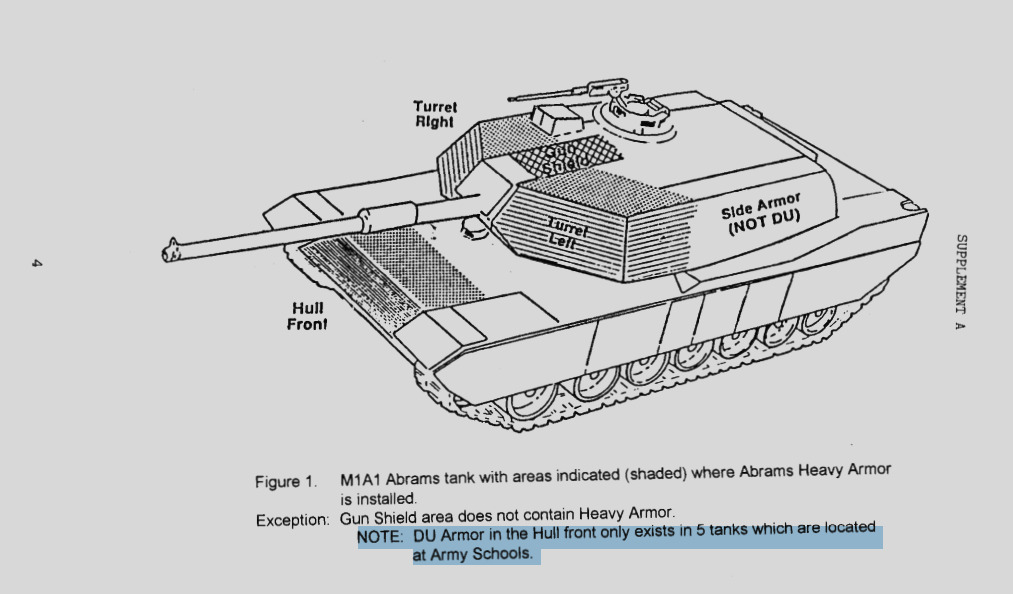
Only after 2016 did that licence apply to a possibility of all tanks, before that they specify 5 prototypes that do have DU in the hull.

( https://www.nrc.gov/docs/ML0605/ML060590665.pdf )

So they have a licence for those 5 and only after 2016 are they allowed to have it in more of the tanks. At that point the Heavy armor has had several version of it. It’s not one singular package that is identical through all versions of the tanks, it gets changes and new tech a few times at least as specified by the CBO.

image

( https://www.cbo.gov/sites/default/files/109th-congress-2005-2006/reports/08-02-army.pdf )

So if the army had no NRC license for more than 5 hulls before 2016 and none of the other hulls before 2016 had DU in them then i fail to se the breakage of law that you are referring to.

Where did they get such a licence?

It’s evident they do change, but I believe Gaijin will only accept more concrete sources of what exactly got changed, meaning those arrays are likely still and will remain classified.

even if we found “REAL ARMOR IMPROVEMENT DOCUMENTS” they would demand the actual down to the digits number
this never gonna happen
they cant just do an educate guess

The DU inserts are much easier to calculate as the weight increase would be easy to determine and DU vs RHA equivalent already exists. I just wish on the ones that “have” DU in game would show that in the x-ray module of the armor instead of being identical with a RHA increase in effective thickness.