The graph provided actually shows the M1A1 AIM expanding in the fleet from 2000 onwards. It was not being phased out; it was the primary modernization path for the thousands of existing M1A1 hulls that the Army could not afford to replace with brand-new M1A2s. The AIM program was specifically meant to keep the bulk of the fleet relevant for decades.
Regarding the cost of DU, the Department of Energy already pays to store and secure hundreds of thousands of tons of this material as a waste byproduct. Using it for armor is not a massive new expense; it is a way to utilize a raw metal that the US government already has in massive stockpiles. Developing and manufacturing the high-end ceramics needed for a non-DU export array is actually more expensive than using the DU surplus.
Speculating on why the Army might want to cut costs does not change what the Congressional Budget Office actually reported. The CBO audited the program and recorded that Heavy Armor was added to the hull. These are financial and inventory records based on real contracts. Claiming the Army skipped the upgrade to save money on a metal they have in surplus, while the documents state the work was done, is just a guess that contradicts the official record.
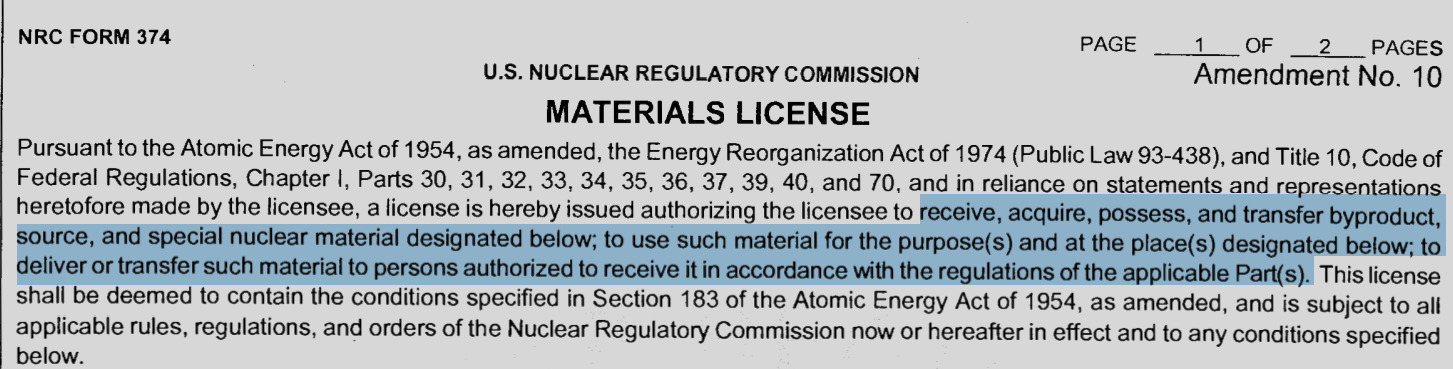
Item 9 in this 2016 NRC license is the exact authorization for installation. It permits the Use and storage of hulls as depleted uranium armor components. In NRC regulatory terms, Use refers to the operational employment of the material for its licensed purpose. A hull cannot be used as a DU armor component if the DU has not been installed.
The 5 tank limit you keep citing is not true. It does not exist on this license or the 2006 amendment that preceded it. The maximum amount is officially listed in Item 8 as As needed. The NRC would not authorize the unlimited use of hulls as radioactive components if they were just empty steel boxes.
The contractor handling license you posted covers factory tasks at Lima. This Army license covers the physical inventory of the fleet. Item 9 legally identifies the hull as a component that contains the uranium. That is the literal definition of installation for an armor package. The paperwork confirms the material is in the hulls and the limit on the number of those hulls has been gone for two decades.
Item 9 of license SUB-1536 is that authorization. It explicitly permits the Use and storage of hulls as depleted uranium armor components. In federal licensing, the term Use is the specific legal authorization for the material to be operational in its final assembled form. You cannot use a hull as a DU armor component if the material hasn’t been installed.
The contractor license you found for General Dynamics describes their specific shop floor handling tasks. The Army possession license defines the physical configuration of the fleet once the government takes delivery. By authorizing the Use of hulls as DU components in Item 9, the NRC is authorizing their integration into the vehicle.
The 5 tank limit was legally deleted from this license in 2006. Item 8 now authorizes possession As needed. There is no reason for a federal agency to remove a specific numeric limit and switch to unlimited authorization if the production was stopped at 5 tanks. The NRC removed the limit to cover the mass production fleet confirmed by the CBO audit. The documents show the limit is gone, the use is authorized for hulls, and the material is being utilized in the fleet. If you are waiting for a license that uses the word installation instead of the legal term Use, you are ignoring how federal possession and use statutes are actually written.
expanding? when the A2 portion is about 3x bigger than the AIM portion of the graph but notice how all productions basically dwindled around 2000-2003, I cannot get up to date figures but reality is, they clearly were reducing costs hence production across the A1/AIM/A2/A2SEP reduced significantly post 2000.
Who pays the DoE? government does. who issues budget changes? government does, just because the DoE pay the cost doesnt mean the cost is coming from elsewhere, do you think the DoE just produce there own money… no it comes from subsidies and government budget changes with each administration that comes along and wants to either increase or decrease it.
You also realise DU isnt purely used for armour or weapons right? just because they have a huge stockpile doesnt mean its all available for armour or weapons, a lot of it is also used to dilute enriched uranium from weapon programs and is also used in civil nuclear reactors because they dont use pure high enriched uranium, they use a mixed oxide or MOX fuel which to make that they need DU
The production graph dwindles after 2000 because the US stopped building brand-new hulls, not because they were cutting corners on the upgrades. Every AIM and SEP is a remanufactured tank. The AIM program was the only way to keep the thousands of M1A1s relevant during the Iraq war because they couldn’t afford to replace every single one with a brand-new M1A2.
Speculating about DU being used for MOX fuel or civil reactors is a reach. The MOX program in the US was a total failure and got cancelled years ago. The Department of Energy is currently sitting on over 700,000 metric tons of depleted uranium. It isn’t a rare or expensive material that needs to be siphoned; it is a waste byproduct they have to pay to store anyway. Using it for armor is literally the most cost-effective way to get high-density protection compared to buying expensive specialized ceramics for an export array.
The CBO audit from 2006 isn’t a theoretical plan. It is a record of what the government actually paid for and installed during that rebuild process. If the CBO says Heavy Armor was added to the hull, then the government signed the contracts and the work was done. Guessing about production headroom or handling costs 20 years later doesn’t change the official financial record of the fleet’s configuration.
Right and do you honestly think they would spend the money needed to convert all of these to DU hulls/turrets when they clearly needed to cut costs, hell if the main use for these was during Iraq they sure as hell knew adding DU to these would be redundant because they wouldn’t be facing anything of major concern in terms of firepower.
Do you see the picture now in why adding DU to what is basically a refresh fleet makes no sense.
No its not a reach, this was lifted in 2005 and the Nuclear Energy Association confirm that with public documents.
What you also dont see to grasp is the stockpile of DU the US have isnt all in the form needed to produce armour, the majority of there stockpile is in the form of DU Hexaflouride (DUHF) which costs money to deconvert, as of 2024 the Nuclear Energy Association claim the US have roughly 765000 tonnes of Hexaflouride stockpiled and this has to be converted if you want to use in other areas like armour and ammo
No it isn’t. It does not mention installation. it doesn’t even mention that they are allowed to possess the packages outside of the turrets and the 5 hulls. Only as part of them.
Correct, so who installs them?
correct.
No, they have not given authorization for handling the packages outside of the turrets and the 5 hulls. They have not authorized transport and storage of the packages. only as part of turrets and the 5 hulls.
No, point 13 and 17.
for security reasons.
No, absolutely not. Not even a little. You are completely impossible.
Condition 17 actually disproves your point. Read the very first sentence: Except as specifically provided otherwise in this license.
That is a legal override clause. It means that if a specific box in the license header says something different than the old letters, the license header wins.
Item 8 on the first page specifically provides the maximum amount as As Needed. Because the license itself provides this specific As Needed authorization, it legally overrides the 5 tank limit mentioned in the 2006 letter.
You are trying to use the fine print to ignore the primary authorization of the document. If the NRC wanted a 5-tank limit, they would have typed the number 5 in the Maximum Amount box. Instead, they deleted the number and wrote As Needed to account for a mass-produced fleet.
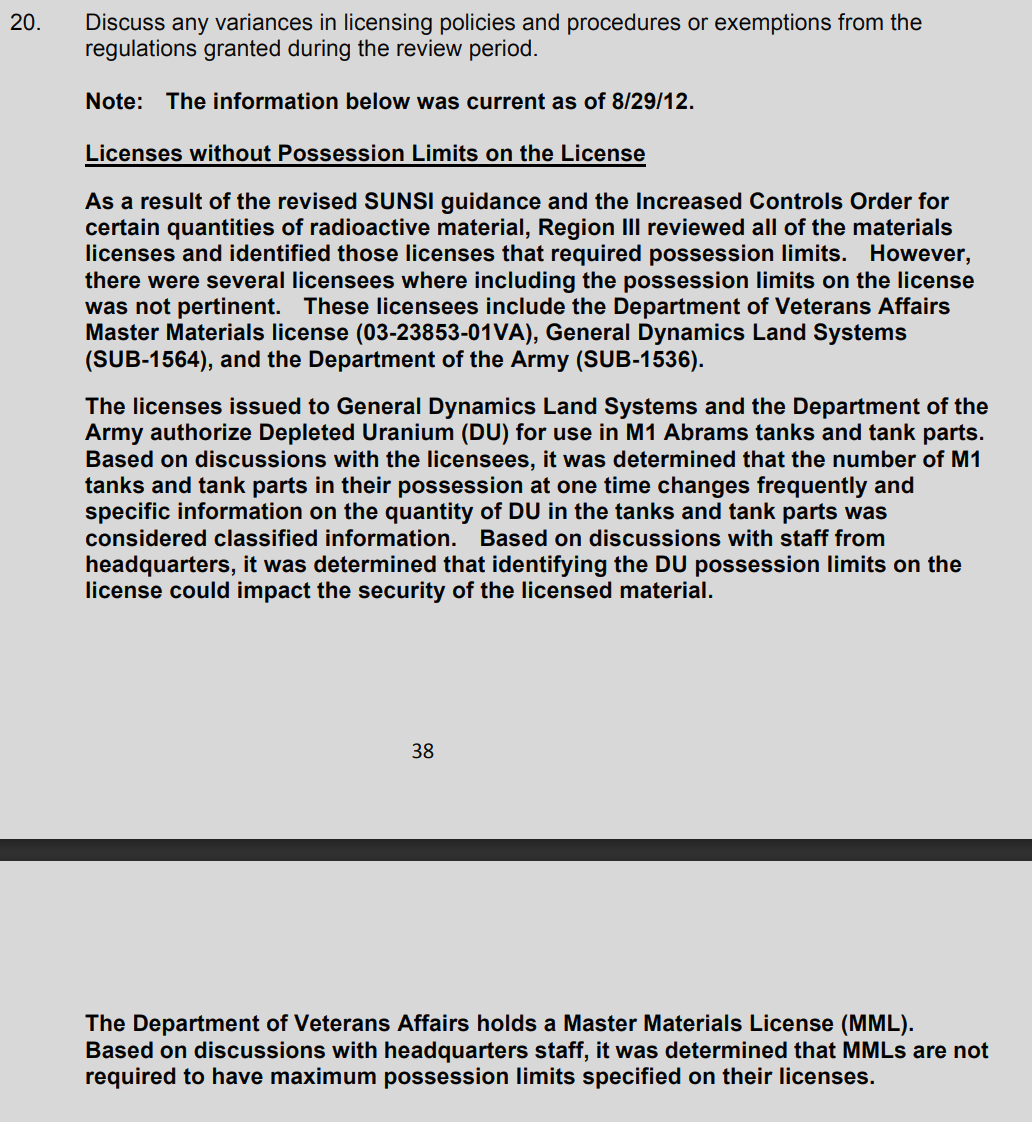
This matches exactly what your other source, the 2012 review, said on page 38: that the possession limits were removed because the number of tanks changes frequently and is now classified.
The number 5 is not a secret and it does not change frequently. You are using a 20-year-old note from a schoolhouse application to ignore the current legal reality. The Army is licensed for an unlimited, classified number of hulls. The CBO audit confirms they paid for those hulls. The 5 prototypes argument is over.
You are clearly getting emotional and resorting to one-word denials because the literal text of these documents contradicts your theory. I am not going to keep arguing with analogies about bikes and nails while you ignore federal law. I won’t respond again until you can explain why your own source says the inventory is a classified, frequently changing number if you honestly believe only 5 tanks exist. If you can’t explain that contradiction, you are just ignoring the evidence to protect an old decision.
No. I resort to one word answers as to not sound like a broken record and just repeat previous answers that have already since long disproved you singular logic track.
I’m not ignoring anything.
Turrets. They have frequent changes of DU in turrets. hulls stay 5.
No contradiction, i have said turrets 100 + times at this point.
Page 38 of the 2012 review says the number of M1 tanks and tank parts changes frequently. It does not say only turrets change. A tank includes the hull. If the hull count was permanently five, it would be a constant, not a frequently changing variable. There is also zero logic in making the number five a national security secret when it was public knowledge for decades. The quantity only became classified information because it shifted from five prototypes to the mass produced fleet.
Claiming the inventory is a secret frequently changing number while also claiming it is a public constant of five is a total contradiction. The CBO audit confirms the AIM fleet got the armor, the NRC says the quantity is now classified, and the 5 tank note hasn’t been the legal reality for twenty years. Since there is no explanation for why your own source calls the count a classified secret if you think it is still five, we really are done here. The documents are clear.
Gaijin dismissing these sources previously does not change the literal text of the documents. Those older developer responses rely almost entirely on the 2006 letter note about 5 hulls while ignoring the actual legal reason the NRC removed that limit. The 2012 NRC review explicitly states that possession limits were deleted because the number of tanks and parts is classified information and changes frequently.
If the hull count was a permanent, public constant of five, there would be no security risk and no reason to classify the number. A static number is not a frequently changing variable.
The CBO audit confirms the mass-produced M1A1 AIM fleet received Heavy Armor in the hull. That is a financial record of what the government actually paid for during the refurbishment of hundreds of tanks. Claiming the documents are inconclusive just because the developers chose to ignore them in the past is a circular argument.
The documents are consistent: the NRC license is unlimited and the quantity is classified because it is significant, and the CBO budget audit confirms the fleet-wide upgrade was performed. Past developer decisions based on older, more restrictive versions of the license do not override the current legal and financial records.
The answers still hold. None of the information you have provided are new things, read the THREADS and not just the top post. You have impossibly in this time read through thousands of responses and linked documents.
Yes, those reports were rejected, but look at the specific reason given in the screenshot. It says: Only 5 for Hulls… had DU in the hulls.
That reasoning is outdated based on the 2012 NRC Review linked earlier. Page 38 states the possession limits were removed because the number of tanks changes frequently and is classified. If the inventory was actually fixed at 5, it would not be changing frequently and it wouldn’t need to be classified.
So those previous rejections were based on incomplete data. You can’t use a 5 Tank rejection reason to dismiss a Classified Inventory reality. The source provided in this thread invalidates the reason those reports were closed.
And regarding the physical model, the CBO Report confirms the M1A1 AIM received Heavy Armor added to the hull. Yet in War Thunder, the M1A1 AIM hull armor layout is visually identical to the base M1 from 1980.
You are asking us to believe that the Heavy Armor upgrade paid for by Congress and audited by the CBO resulted in zero physical change to the tank’s protection layout after 20 years of development. Even if you refuse to accept it is DU, you have to admit the game is factually wrong for showing no changes to the hull after a documented Heavy Armor upgrade.
So based on gaijin’s logic, abrams should get his DU armor, i mean, kh38mt is in game without evidence of production, so whats the point to not fix m1 armor?
The 2012 NRC review states the number of M1 Tanks and tank parts changes frequently. It does not say Only Turrets. An M1 Tank consists of a hull and a turret. If the hull inventory was a static constant of five, the total count of tanks containing regulated material would not be a frequently changing, classified variable.
You also admitted that improvements were made for sure.
This brings us back to the CBO naming convention which you keep ignoring.
The CBO table lists the IPM1 upgrade as Improved composite armor.
The CBO table lists the AIM upgrade as Heavy armor added to hull.
We know the CBO has a specific vocabulary for non-DU hull upgrades: Improved Composite. They used it in the very same table.
If the AIM hull upgrade was just a non-DU composite improvement as you claim, why did the CBO switch terms to Heavy Armor?
They switched because the material changed. Heavy Armor is the Army’s term for the radioactive package.
You are admitting the armor should be better than the 1980 model, but you are refusing to accept the specific material named in the budget audit because it contradicts a 20 year old note about school tanks. The CBO named the improvement. It is Heavy Armor.
It doesn’t say the hulls change either. both can be true, thus it’s inconclusive.
If the turrets change it is.
I haven’t ignored it, please stop lying that i ignore things.
Still conjecture, nowhere is it explicitly stated that Heavy Armor = DU.
THE. TURRETS. How many times do i have to repeat THE TURRETS for it to stick ?
Here, ill help:
→ THE TURRETS! ←
For every thing your read, in all your documents, the turrets being the only component with DU will still logically cover EVERYTHING. Its not the only way to read it, but you very easily can so all your documents are inconclusive.
→ THE TURRETS! ←
Heavy Armor → SYSTEM ← It’s not defined as a material.
The CBO wrote: Heavy armor added to hull and turret.
If Heavy Armor refers only to the DU in the turret as you claim, then the sentence would read: DU-in-Turret added to hull and turret.
That is linguistically impossible. You cannot add a turret-exclusive feature to a hull.
When a sentence says Subject X added to Object A and Object B, it means Subject X is present in both objects.
You claim Heavy Armor is a System and not a material.
The Federal Register Section 2 explicitly calls it: the depleted uranium (DU) armor package.
A package is a physical item. The CBO says that package was added to the hull.
Screaming THE TURRETS does not change the fact that the CBO explicitly listed the Hull as a recipient of the Heavy Armor upgrade. If the hull just got composite, they would have written Composite added to hull. They didn’t. They wrote Heavy Armor because the material matches the definition.
I have no idea what you’re even trying to say at this point.
Yes, if Subject X is a multi part SYSTEM with several components of different materials the Object A can be a different material than Object B and the sentence still semantically works.
No, they do not equate the system to the package, the system might as well just contain the package among other things and the sentences semantically still work. CBO doesn’t mention the word “package” .
Which can be non-DU for the hull and DU for the turrets and all your sources would not be false or contradict each other in the slightest.
Speculation.
It’s enough for the turrets to be DU for that to hold true.
You keep saying it is a multi-part system where the hull is non-radioactive, but that ignores how the CBO actually wrote the table.
Look at the column for the IPM1. They explicitly wrote Improved composite armor. They have a specific vocabulary for non-DU upgrades and they used it right there.
But for the AIM, they switched the term to Heavy armor.
If the AIM hull was just the non-radioactive composite part of the system like you claim, why did they switch terms? Why not just write Improved Composite again? They changed the name because the material changed to the radioactive package defined in the Federal Register. Using the radioactive system name to describe a non-radioactive composite hull would be bad auditing.
And regarding the license, look at the specific grammar in Item 9. It authorizes DU material utilized as Armor in tank turrets and hulls.
It does not say DU is utilized in the Heavy Armor System. It says the material is utilized in the Hull. If the hull was just a steel bracket for a DU turret, the NRC would not list the hull as a utilization point for the uranium. They listed it because the uranium is physically integrated into it.
You already admitted that for the 5 prototypes, the Heavy Armor hull contains DU. The CBO states that the AIM fleet received Heavy Armor hulls. It makes zero sense for the Army to use the exact same specific name for the 5 real DU hulls and the 1,000 fake composite hulls in the same budget era. The simplest answer is that the fleet matches the prototypes.