Your logic requires the term Heavy Armor to act as a shapeshifter within the same sentence. You are arguing that when the CBO wrote Heavy armor added to hull and turret, the term Heavy Armor implies Depleted Uranium for the turret half of the sentence, but simultaneously implies Non-Radioactive Composite for the hull half of the sentence.
That is not a valid linguistic interpretation. If I say Steel armor added to hull and turret, it means both got steel. I don’t mean the turret got steel and the hull got plastic. The subject applies to both objects. By claiming the hull got a different material, you are rewriting the sentence to say Heavy Armor added to turret and Composite added to hull, but that is not what the CBO wrote.
And you are still trying to decouple the material from the location in the license. Look at the exact phrasing of Item 9 again. It authorizes DU material utilized as Armor in tank turrets and hulls.
It effectively defines the Hull as a component that utilizes DU material. It does not say the Hull is just part of a system that contains DU elsewhere. It links the specific radioactive material to the specific physical location. If the fleet hulls were non-radioactive as you claim, listing Hulls as a utilization point for DU would be factually incorrect. You are arguing that the Army maintains a federal license that falsely claims DU is utilized in hulls where it isn’t.
No, it requires it to refer to a System comprised of several parts.
Yes. This semantically and logically works since it’s a System comprised of several parts.
It is.
Correct, but the HAS is not a material, it’s System comprised of several parts.
If i buy a bike; the tires are rubber and the frame is aluminium. Both materials still covered by one term.
If a By a Terrain Upgrade Kit for the bike then that kit can be new rubber tires and new metal suspension. I can then say “Terrain Upgrade Kit added to wheels and frame” and it’s semantically correct and means two different materials.
→ AUTHORIZES ←
NOT
“all hulls magically have this now”
Doesn’t need to, it covers the 5 hulls they already had. It doesn’t mean all hull to ever have existed and will ever exist MUST have DU in them. If you are Authorized to have as many red cats as you want that doesn’t mean that you suddenly have to buy every red cat in the world.
No, that part is still needed for the 5 prototypes. if that part had not been there they wouldn’t have been allowed to have those 5 hulls anymore.
The links point directly to my sources. Unless you think an AI traveled back in time to forge the 2006 CBO report and the NRC license, your comment is pointless.
Attacking the poster instead of the evidence is just admitting you can’t actually debunk the sources. Read the documents or move along.
Your bike analogy fails because a “Terrain Upgrade Kit” is a marketing term, not a federally regulated item with a specific safety definition.
The “Heavy Armor System” is legally defined in the Federal Register.
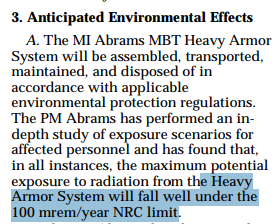
The document states: “…maximum potential exposure to radiation from the Heavy Armor System…”
The Army defined the System itself by its radiation output.
If the hull armor was just non-radioactive composite (the metal suspension in your analogy), it would not be part of the “Heavy Armor System” definition because it doesn’t emit radiation.
The CBO proves this distinction.
For the IPM1, they called the hull upgrade “Improved Composite.”
For the AIM, they called the hull upgrade “Heavy Armor.”
If the AIM hull was just the non-radioactive part of the kit (like the IPM1), the CBO would have kept calling it “Improved Composite.”
They switched names to “Heavy Armor” because the material changed to the radioactive definition found in the Federal Register.
You are arguing that the CBO decided to rename “Composite” to “Heavy Armor” for no reason, and that the NRC decided to license a non-radioactive hull for no reason.
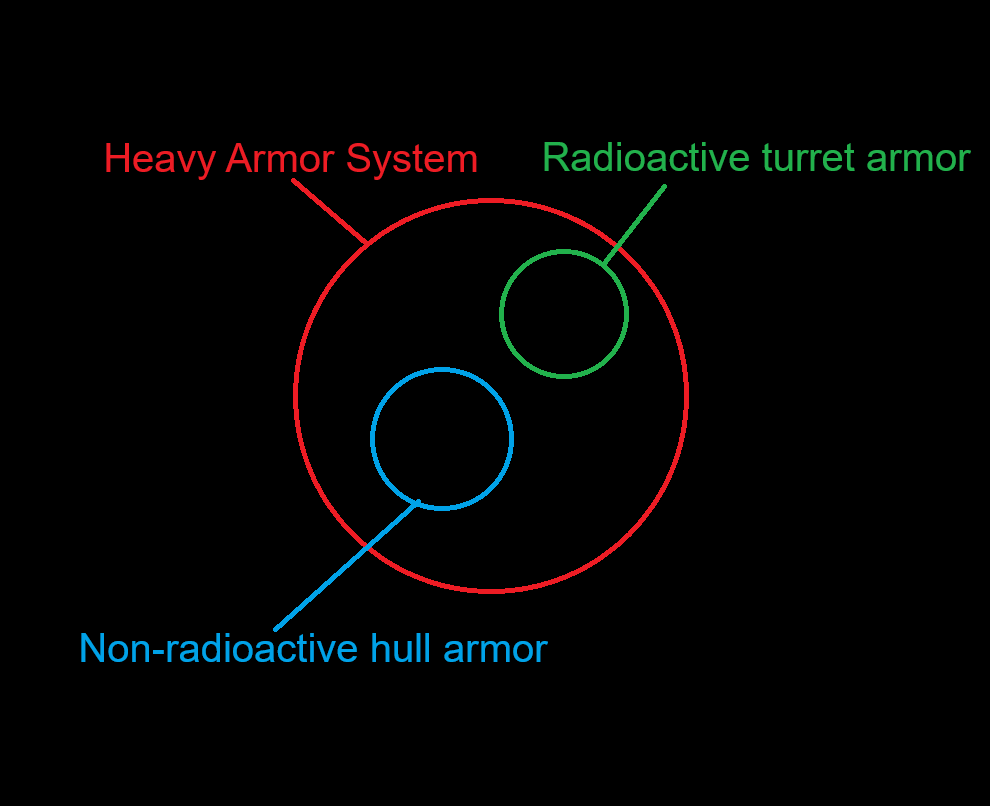
Yes, one of the parts of the HAS has DU in it (the turret part) thus the whole System will be radioactive.
one radioactive nail in a box of nails. The box is radioactive.
Logical fallacy.
No, it doesn’t. Logical fallacy.
Of one of the parts, not all of them.
The re-name because DU in turret. I’ve never argued otherwise.
You are misreading the grammar of Item 9 in Amendment 10.
The license authorizes the use of tank turrets and hulls as depleted uranium armor components.
The word as equates the Hull to the DU Component.
The NRC is legally defining the Hull itself as a Depleted Uranium component.
If your “Box of Nails” analogy were true, and the hull was just the non-radioactive box holding the radioactive nail, the NRC would not define the box as the radioactive component. They would license the nail.
By explicitly licensing the Hull as a Depleted Uranium component, the NRC confirms that the hull is the radioactive item. You cannot license a steel box as a uranium component. That would be a false classification.
So we have:
The NRC defining the Hull as a DU Component.
The CBO stating Heavy Armor was added to the Hull.
The Federal Register defining Heavy Armor as the radioactive system.
The Hull is the radioactive component. The license text proves it.
They do not install just one of the parts on any of the tanks, all tanks will get both parts. When the System is handled it is radioactive in all of it’s steps of handling due to it containing the turret armor.
For 5 tanks. It does not define all tanks in existence. It authorises.
They do not define all tanks. they authorise to have. it is covered by the 5 tanks.
Not in all instances of it’s existence.
They aren’t doing this. they are authorizing. they are not saying that all tanks are.
I ment that the box will emit radiation when handled due to having that one radioactive nail in it. look at any machine with just one radioactive component in it, then the machine is labeled as radioactive.
If you were to sell that box would you have a radioactive warning sign on the box? I think you would.
Like on an electron microscope. Is every part of that thing radioactive? Nope. The machine itself isnt at all. The samples are.
Section 3, Paragraph A explicitly says:
…in all instances, the maximum potential exposure to radiation from the Heavy Armor System will fall well under the 100 mrem/year NRC limit.
The government states right there that the Heavy Armor System emits radiation. Steel and ceramic do not emit radiation. Only the Depleted Uranium package emits radiation.
This proves that Heavy Armor System is the official name for the radioactive DU package.
So when the CBO Report from 2006 states Heavy armor added to hull and turret, it is stating that the radioactive armor system was added to the hull.
The CBO explicitly distinguishes between Improved Composite (IPM1) and Heavy Armor (AIM).
If the AIM hull was the “non-radioactive hull armor” blue circle in your diagram, the CBO would have labeled it Improved Composite, just like they did for the IPM1. They have a specific term for non-radioactive armor, and they used it in the very same table.
But for the AIM hull, they switched the term to Heavy Armor
Why would the CBO switch from “Composite” to “Heavy Armor” if the material remained non-radioactive composite?
They switched terms because the material changed to the Heavy Armor System , which the Federal Register defines as the system that emits radiation.
Regarding the license:
You admit that for those 5 tanks, the hull is legally defined as a DU component. That establishes the physical definition: A Heavy Armor Hull contains DU.
The CBO Audit confirms that the entire M1A1 AIM fleet received Heavy Armor in the hull.
So choose, either the CBO lied to Congress about the fleet receiving the Heavy Armor upgrade, or the fleet actually received the upgrade and the NRC license covers it because they removed the 5-tank limit in 2006.
“Radiation is contagious” is one of the most scientifically illiterate things posted in this entire thread. Depleted Uranium is primarily an alpha particle emitter. It does not emit high-energy neutrons capable of neutron activation. Steel does not become radioactive just because it is bolted to a radioactive turret. That is not how physics works.
The only way the hull falls under the “Heavy Armor System” radiation definition from the Federal Register is if the hull itself contains the radioactive material.
Item 9 of the license puts this to bed legally. It authorizes the storage of tank turrets and hulls as depleted uranium armor components.
It defines the hull as the component. It doesn’t say “hulls attached to DU turrets.” It explicitly categorizes the hull itself as the piece of hardware made of Depleted Uranium. The NRC isn’t licensing a steel box because it “caught” radiation from the turret. They are licensing it because it is filled with uranium.
Yes, because the former doesn’t have DU in turret while the latter does.
They don’t need to, there is already an all encompassing term for it, Heavy Armor System. Why use words to describe all the parts of the system when you can just mention the System and cover all parts?
The turret became DU.
As shown in my drawing doesn’t have to mean that all parts are DU.
Yes.
No, it doesn’t define the name the hulls of those 5.
You completely ignored the physics correction because it destroys your red circle diagram. You claimed the whole system is treated as radioactive just because the turret is there. That is scientifically false. Depleted Uranium is primarily an alpha particle emitter. It does not emit high-energy neutrons capable of activating steel. The hull does not become radioactive just by sitting next to a DU turret.
If the hull was just non-radioactive steel as you claim, it would be radiologically cold. The NRC does not license cold steel. They only regulate Source Material. By listing the Hull as an authorized use for Depleted Uranium in Item 9, the NRC confirms that the hull itself is a hot, radioactive component. Your diagram implies the NRC licenses non-radioactive parts just because they are nearby, which is not how nuclear regulation works.
You also admitted Correct to the fact that the license defines the hull as a DU component, but then you retreated to In those 5 tanks.
This traps you. You admit that a Heavy Armor Hull (as defined in the license for those 5 tanks) is a DU Hull.
The CBO Report confirms that the M1A1 AIM Fleet (hundreds of tanks) received Heavy Armor added to hull.
Since you admitted Heavy Armor Hulls contain DU in the prototypes, and the CBO says the fleet received Heavy Armor Hulls, logic dictates the fleet contains DU. You are back to arguing that the Army built 5 Real Heavy Armor hulls and 1,000 Fake Heavy Armor hulls and gave them the exact same name in the federal budget to fool the auditors.