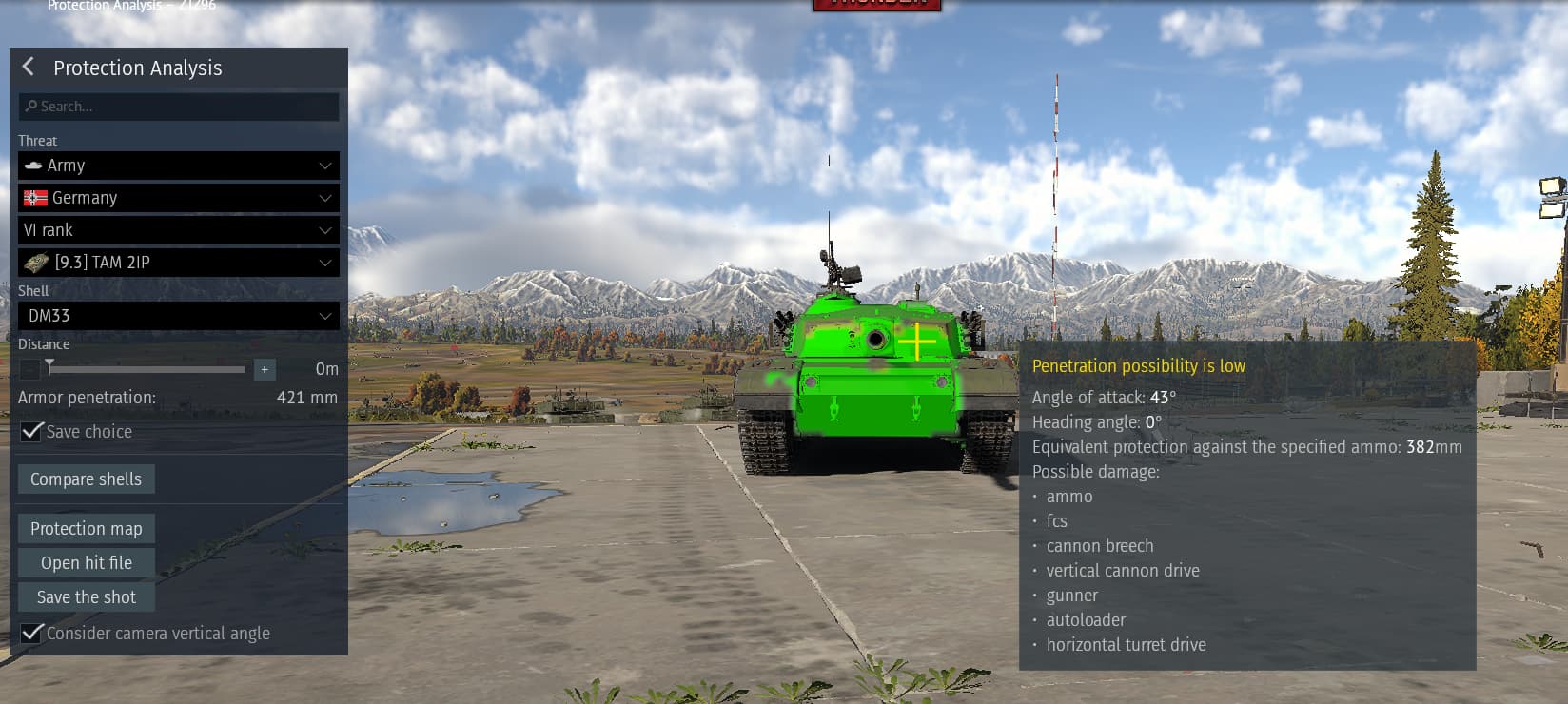
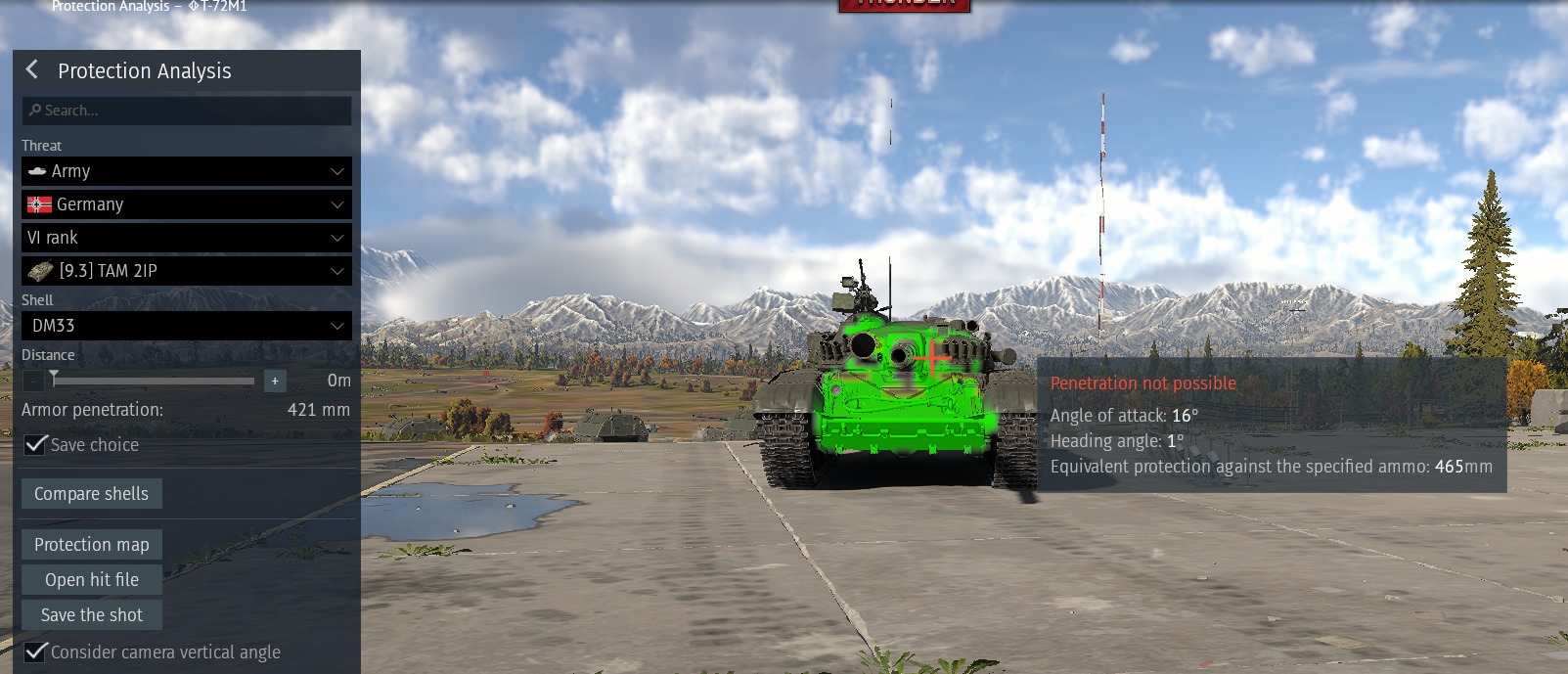
I was refering to this VS the T72M1, sorry not the leopard 2k vs the OF40.
OF 40 lacks a lot of protection compared to the Leo2k though as a lot of mobility, though has somehow a slighty better round (somehow 105mm DM33 is better than the DM23 120MM)
Yeah the ZTZ96’s turret armour has the same forehead weakspots as the T-72A, but only has ~380mm of KE protection for its turret cheeks, unlike the T-72A’s ~460mm:
Damn man , maybe cause I do the wiggle witht he 96 it doesn’t do as much, or folks miss more.
Didn’t realise it was as drastic a difference.
I think it’s more elevated or as you say more forwards slanted giving it the illusion it’s aiming down further, though I thought the T72 has -5 gun depression , apparently it’s -6 same as the ZTZ 96.
Good to know.
For the life of me cannot figure out why.
DM23 120 IRL is a better round xD Just cause how gaijin apparently models long rong penetrators.
It’s what happens when you rely entirely on spreadsheets calculating things based on average SL earnings rather than using a modicum of common sense.
Tbh, I agree the br system as it’s currently implemented is unsustainable and something should change. It won’t as that would require effort, but it should.
With the recent situation in top tier, queue times are clearly no longer a concern so there’s really no need to not add a setting to set a .7 br spread as a trial.
Establish a base line for a average vehicle lifetime, engagements, deaths, kills and possibly damage inflicted over time (will be hard due to the damage system, but everything has hit points and it can be worked out)
If a vehicle stands out against its peers and significantly deviates from those metrics, then it’s reviewed for a br change.
For example, say a 10.3 vehicle survives on average 4.5 minutes, has on average 1.1 kills per spawn and experiences 1.3 penetrations on average before death then something lasting 3.8 minutes would stand out, same if something lasted 8 minutes on average with 1.8 kills per death would also stand out.
Similar numbers, but a vehicle which consistently requires 3 penetrations per kill over say, one which does it in 1.8 on average would stand out as something not being right.
This allows the system to catch vehicles which are struggling much easier, rather than relying on just average SL earnings.
Sure it’s more work, but it’s nothing a decent statistical model can’t handle.
I was referring to shots fired by the vehicle in question. I.e if a vehicle requires on average (with sufficient data set size) significantly more penetrating hits to its target to get the kill over one which doesn’t then that would require looking at.
It may be correct (looks at 60mm apfsds), but the reason should be investigated. It’s also not the only metric being measured of course, survival of penetrating shots on the tank, survival of hits which donnt penetrate etc etc.
Using the statistics also requires the vehicle class to be taken into account of course - a large number of non penetrating hits from a gepard would be expected for example.
In your example, the is would see a lot of 1 penetrating hit kills, but the number of hits would be far lower than something which fires every 4 seconds for example.
I don’t think they solely rely on SL gain per game, since this would heavily bias against prems and rare vehicles with a high(er) average skill level.
E-100 (for example), while being better than the Maus, around twice the amount of SL gain, and has a much higher KPS / K/D, is still the same BR as the Maus – that being 7.7.
Either they forgot about it or they understand that demographic and use cases of vehicles vary, and they don’t just use SL gain for balancing.
I’m pretty sure they’re well aware that rare event vehicles aren’t comparable to TT ones when it comes to it’s player base, same with vehicles from minor nations. They also use more things than just SL for balance.
While we’re here, we’d like to give some additional context behind Battle Ratings and how they’re decided. Battle Ratings are decided based on how much a vehicle earns, but this is not purely economical.
If a vehicle has high efficiency, it’s outperforming its contemporaries in multiple ways the majority of times it spawns on the map, and as a result may have to be increased in Battle Rating. Whereas a vehicle with low efficiency is not performing well across the board against what it fights, and may be moved down. However this is not purely a data driven process, we often consider additional factors such as the volume of players using a certain vehicle, its lineup, new features that may be altering performance in different ways etc