Changes to Bomber Survivability Feedback and Discussion

Already had this argument before too.

Alright, so what does bring down mean, any clarification in these documents of yours?

Heres US statistics vs a B25 from 1947
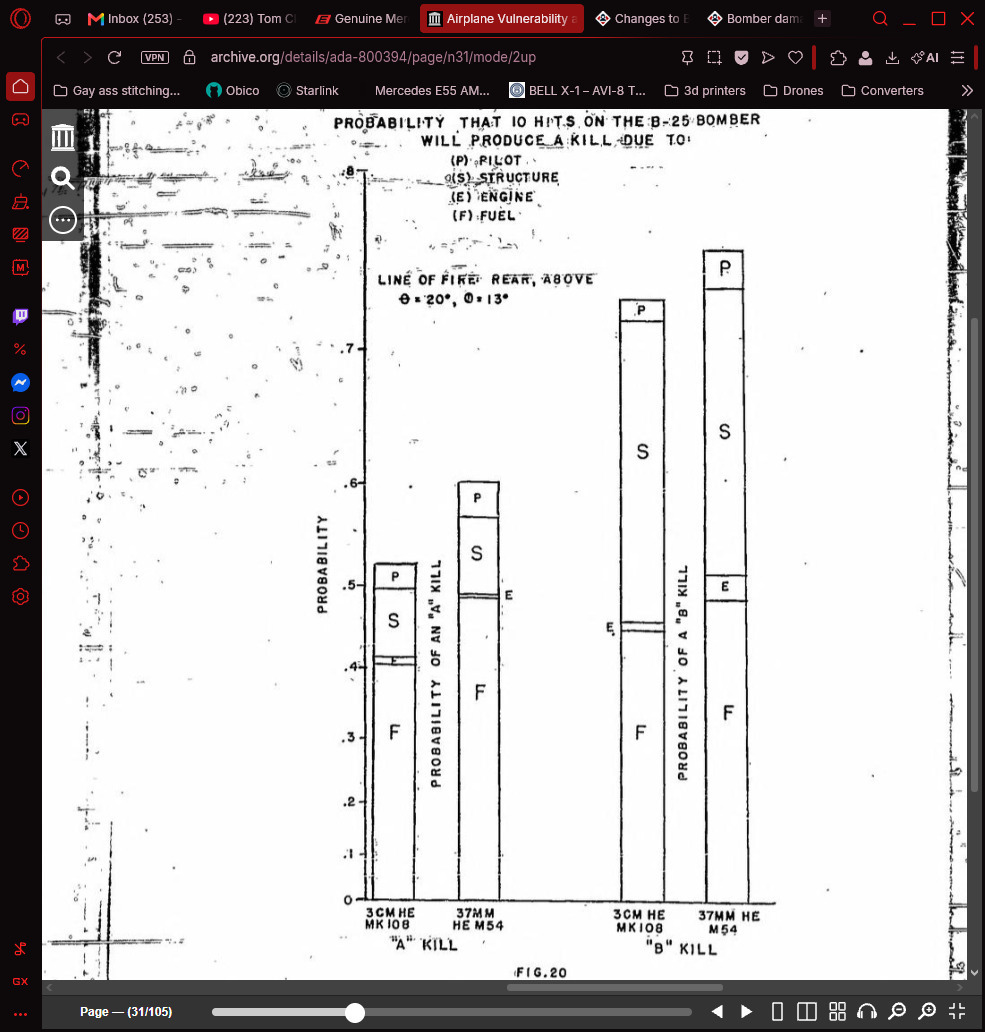
10 mk108 hits would cause a 53% chance for an “A” Kill, with the odds of the cause of that result.
“B” kill jumps, but is a less critical level of damage

“A” Kill is listed as a severe combat damage classification resulting in the aircraft being forced down or written off as a total loss post-mission, aka, not a structural breakup, infact here its only a 8% chance or so

“B” Kill Signifies a major component or system kill (such as an engine knock-out or critical fuel system failure) that forces the aircraft to abort its mission or make a forced landing, though the airframe itself may be repairable.

Both the main threats are Fire

The report also mentions “K” kills and “KK” kills, K being a total kill or complete destruction of the aircraft, rendering it completely unsalvageable or causing it to crash due to pilot fatality, loss of control, or fatal fire.

While KK is a catastrophic structural breakup resulting in an immediate and complete loss of the aircraft.

Best part? nowhere in this entire 105 page document is there any mention of a KK failure on the b25.
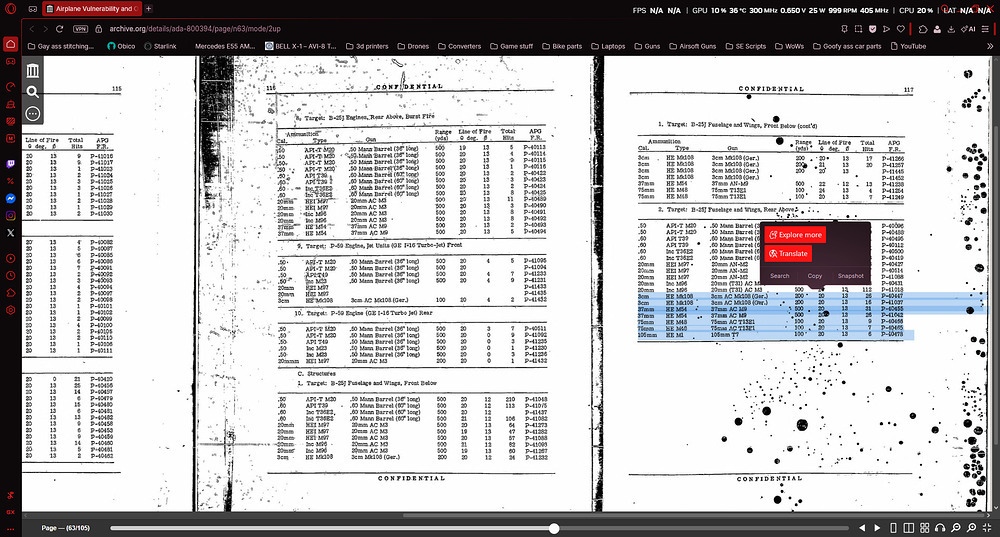
, and they were shooting this stupid thing with howitzers
image

Would a B25 fly after 6 105mm hits? HELL NO. BUT, the argument here is it didnt snap in half.

And the fact that on the dev server right now fires do next to nothing to the bomber meaning your only option is to 30mm the tail off means…?

Overall, I am satisfied with the current durability of bombers; however, there are two critical flaws that require URGENT fixing.
First.
This applies to all bombers and fighters: the control linkage systems need a rework.
Take the B-52, for example. It has redundant control linkages routed along opposite sides of the fuselage to minimize the risk of both being disabled simultaneously. Yet, not only is this redundancy ignored in the game… the elevator linkages are actually tied to the rudder linkages. This ensures that a hit to either system knocks out both at once.

Spoiler

This is the case for almost every aircraft—the Tu-95, Sea Vixen, F-117, F-16, Hawk… It doesn’t even matter which one. Whether it’s a 1970s British trainer or a 1930s American fighter, they all feature a primitive linkage system where the entire assembly takes damage at once.

Spoiler


image

Second.
Heat-seeking missiles. What do heat-seeking missiles lock onto? Engine heat, right? That makes sense. But where do they lock on in our game?

Spoiler

The geometric center of the aircraft. Why? It’s not a SARH missile. Why does it track a point where there is no heat emission?
Consequently, instead of hitting the engine, setting it on fire, and potentially severing the control linkages in that wing… it hits the tail and tears it off.
And don’t think this isn’t a relevant issue; the game features many bombers with engines mounted far out from the fuselage—prime targets for heat-seeking missiles. Canberras, Il-28s, Tu-14s, Yak-28s, Tu-95s, B-52s, B-66s, Ar-234s, Vautours, Tu-4s, B-29s… I might have forgotten a few others.

Why did I go off on such a tangent? Right. Simply increasing the HP of aircraft components isn’t enough as long as the basic survivability systems aren’t working correctly.

means fire damage needs a buff, what does that have to do with structure? my argument this entire time, every message ive sent, is structures are durable. I havent had any objections to engine durability, or against bombers taking damage from fires (albeit on live its too fast, dev pretty slow), and collisions

We can agree those three need adjustment. But wings and tails coming off from something that isnt genuinely airframe shattering? pff, PLEASE.

It means that if implemented in their current state in game, bombers will break it.

All homing weapons go for the geometric centre of vehicles currently. The AIM-4 and other weapons without proxy fuzes can (and will) miss certain aircraft because of this.

You can test this for yourself by test flying the F-106 and launching AIM-4s at the B-29s.

I am pretty sure Gaijin currently has no way to make IR seeking missiles go for the engines specifically-

bombers will break fire damage and collisions, so adjust those. im keeping the wings and tail glued on unless met with genuinely massive weapons or actual concentrated fire

Bombers DO die (when controlled by players) to fire and lighter damage than our test drive bots, simply because bots follow different rules. I have proven this with pictures posted before of the b52 and tu95 (two planes mentioned as being oddly fire resistant) taking damage overtime until they lose control, albeit the time it takes, will need further study, aluminum doesnt burn, but the airstream acts like a blowtorch, but it also cools the surrounding area, so wouldnt fire damage progress backwards outside, and outwards inside where its hidden from the airstream? I need to research this more to give a proper take

one 75mm HE hit IRL:
image

the same plane on dev, shot with a very similar cannon:

Looking through it again. The thresholds are absolute it shouldn’t matter on how much health the part has.

So basically.

Gaijin bugged fuel tanks somewhere.

That much is obvious. This seems completely unintended given what they said on the news post:

image

image

What source do you have on the PBJ-1H’s 75mm with 600g of tnt filler being similar to the “75mm” AA gun shooting at that? What makes you think its not an 88 with 1kg of filler

Shows as well that dedicated incendiary rounds need a higher base multiplier.

I’m not flying a PBJ.

Why would an 88mm be in the Pacific theatre?

Then what are you shooting it with

Also, thats in the pacific? The japanese army replaced the 1928 design 75mm with a 120mm in 1943
And the navy, well, you’re literally only finding 100mm and up on those ships

edit thats a lie a few light cruisers has 80mm

120mm was only present in small numbers and mostly limited to areas near japan; this B-24 was hit quite far away. The only AAA guns left in this location were 75mm, unless you want to argue that instead it was a 25mm AA autocannon.

The plane being used is the Ki-109, and its 75mm is derived from the AAA cannon of the same caliber.

Got a source for the guns present there

It was discussed earlier in the thread. You can scroll up if you want.

since ai seems to be enough for you
image

1 Like

thank you grok

This is also for the most stringent A kill requirements tracked in the report which included killing both pilots and both engines.

Basically the chances are that after 10 rounds of HE 30mm is that either both engines are dead, or one engine is dead and there is a massive fire.

The A kill figure you keep quoting is the one where there has to be a chance of multiple fires and both engines have to be killed. Even the lower figure that doesn’t require compound fire chance still requires both engines to be killed.

Chances of a B-25 surviving 10 rounds of 30mm HE is basically nil.