Oxy also mentioned that there is possible a bug with the pilots just bailing out after a little bit of damage.
https://www.youtube.com/live/gd-90M5NU3c?si=xzOR7gQle3uHh3M9&t=2311
Oxy also mentioned that there is possible a bug with the pilots just bailing out after a little bit of damage.
https://www.youtube.com/live/gd-90M5NU3c?si=xzOR7gQle3uHh3M9&t=2311
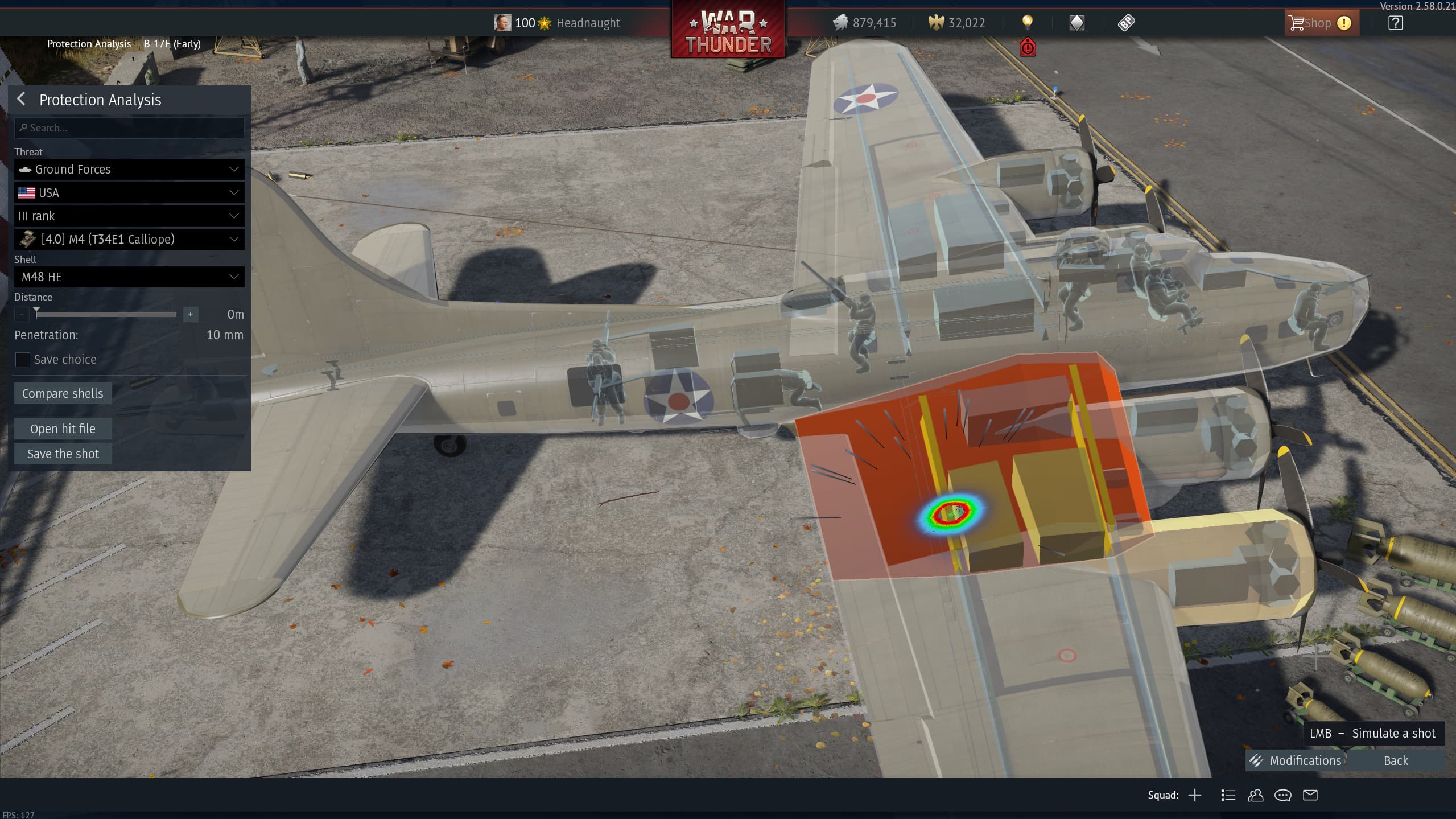
I tested the Hs 129 against DB-3’s. It was quite reliable, most planes only needed 1 or 2 hits in the wing. Managed to detonate the bombs inside one too.
Postwar we famously armed our interceptors, the planes specifically designed to shoot down bombers, with high explosive rockets because we just wanted to give Soviet strategic bombers a fair chance of making it over the States and dropping a nuclear bomb on our cities.
I tested Ki-109. It’s roughly the same. Without aiming for specific points, it can take up to 3, even 4 shots before causing some major structural damage.
I dunno man, I flew the 262, managed to single pass pe-8s pretty reliably with 4x30s, that makes some sense, yet it was much more resiliant to say, small single engined fighters tearing off their tails. Seems about right to me, its just interacting with fragmentation from flak and missiles a little weird
In any case, this shows just how difficult it was even for experienced pilots to land effective hits in real combat (though by simple probability, 15 committed fighters firing should have resulted in plenty of hits on critical components, unless, of course, round effectiveness against a B-17 was actually that low!).
It also makes me wonder how you can translate that into Air RB with accurate mouse aim in the mix. Would artificially nerfing damage indeed recreate such a historical combat instance that required multiple fighter passes and solid positioning just to bring a bomber down?
In theory, an AP shell is more suitable to reach for critical places in the bomber. Both will work, but they will work differentlly. If you want to pen all the main structure until the bomb bay, and AP should be able to enter from the rear turret until the bomb bay. Doing so with an HE is far harder (This was just an example)
Please now, with a straight face, tell me that this feels okay to you
Not counting that fire damage does nothing at all and you can fly any bomber with any amount of fire until it goes off dealing almost no damage at all
Watch them say that you are not using enough AP or that you should aim better. When It took around 3-5 rounds of that exact gun to down a B17 / B24.
"You should have used AP belts and aimed for the individual cylinders in the engine and physically dismantled them with a left hand rotation…this is actually realistic…if you don’t believe so then show me IRL footage of Me.262 shooting down Ju-188. " - Game Master / average WarThunder player.
I was checking out the 30mm Mk 108 with the night belt with 103g of TNT. Against a Shackleton it works pretty well.
And then I decided to try it on a B-10B… and those seem to be nearly invulnerable.
Tried another run on the exact same plane I was hitting in the previous video.
I also tested AIM-9’s against them and they do squat.
This is a 1.3 BR plane.
Should have side climbed
So literally ALL anti air systems since World War I are wrong and pacodiazortiz knows the truth
What calibre are you comparing between though.
Many anti-air aircraft guns were far larger than those on a fighter.
7.7mm to 20mm. HE is probably less effective, which is why typically a mix of AP/SAP and HE would be used.
if you are talking about a 40mm Bofors or 3.7" AA gun, then HE becomes radically more effective
Bro is talking about 75mm HE of the Hs129 doing nothing at bombers saying that you’re not supposed to use HE against bombers
I would be inclined to favour the APHE shells (default belt) rather than the pure HEI-T shells (ground belt) I think for that gun.
Pen the skin of the aircraft, then explode. So long as the APHE didnt overpen
Another factor to consider for AA guns, is that they werent likely to achieve direct hits, and so utelised HE-TF or HE-VT to explode near the target. There is also the issue that Shrapnel isnt modeled very well for said rounds and that the internal structure for aircraft doesnt really exist, things like hydraulic and oil lines , and later, electrical lines, arent modeled, this leaves large areas of empty space that HE doesnt damage.
Imo, the biggest issue with the current damage models is not that the structural resistance is too high, but that there isnt anything to damage beneath the surface of the airframe, nor can you punch holes into the airframe. The latter could be addressed by making the aircraft parts far smaller, and so damage is localised, allowing simulation of holes being punched into the wings and fuselage.
One thing that I don’t see a lot of people talk about, is about using the right belts. The best belt for bombers are belts that are mostly AP, while the belts that are the best for every other aircraft often have a lot more HE shells in the belt.
This means that you really have to be selective about what belt to bring, depending on what aircraft you want to focus on.
One of the exceptions is the America .50cals, where their best belts already focus mostly around AP.