You can blame the collapse in defence funding for that one. Look at our ASW Tech. I’ll grant you Sonar 2087 is still pretty top of the line, but it’s 20 years old. Replacement? Still under wraps, if indeed it is happening.
1 Like
They are doing the exact same thing with CR3, this was an opportunity for Britain and Germany to say lets build the first in service tank with 130/140mm gun lets get ahead of the USA and France and Russia and instead we have produced a tank that is at the same level as what our NATO colleagues have now without pushing the envelope and making something that could be exported and future proofed.
I mean it makes sense when the UK as an island nation with a shrinking army, very few MBTs currently in service, and part of NATO, why new all singing all dancing MBTs are top of the pecking order.
CR3 is just the UK attempting to bring itself back in line with already in service MBTs and will no doubt be delivered just in time to be behind the curve again.
When you’ve got similar readiness levels as the Panther D at Kursk, it is indeed a trainwreck.
The Chieftain was the heaviest of all the NATO MBT’s and thus carried significant tactical and strategic mobility limitations, and what did it have to show for it?
- The Chieftain still got penetrated through the most heavily protected areas (turret front) by a T-62 armed with it’s 115mm gun at combat ranges, that being a tank that entered service years before the Chieftain did and was produced in incredibly high numbers. It also did not even wield the most powerful gun in the Soviet arsenal as the 125mm entered service the same year the Chieftain Mk.3 did.
- The Chieftain was armed with a 120mm gun that still could not defeat the frontal armour of a T-64 or T-72 even at close ranges. It wasn’t until the mid/late '80s that a APFSDS round was developed to combat these tanks by which time the Soviets had already started up-armouring their vehicles to combat M111/DM23, and thus L23 as a consequence.
1 Like
and no one was surprised
Also, as far as I’m aware the Chieftains APDS could in fact penetrate the early model T72 and T64s at normal combat ranges. Issues arose at extremely long ranges and against uparmoured soviet T-Series tanks, hence why L23A1 was pushed into service.
Regardless, at the time most other NATO nations were using the 105mm L7 as their main tank gun, which had significantly worse performance than the 120mm on the Chieftain.
This was more of an issue with NATO underestimating the Soviets armour. The Chieftain regardless still had the best firepower of any NATO tank at the time and for quite a few years afterwards.
While this is true, you need to keep in mind that when the Chieftain entered service by far the most common Russian tank in service was the T54/T55. The Chieftains turret and upper hull provided good protection against the T55s AP, APDS and even early APFSDS rounds.
Sure it didn’t protect against all Russian tanks, but it did protect against their most common model at the time.
4 Likes
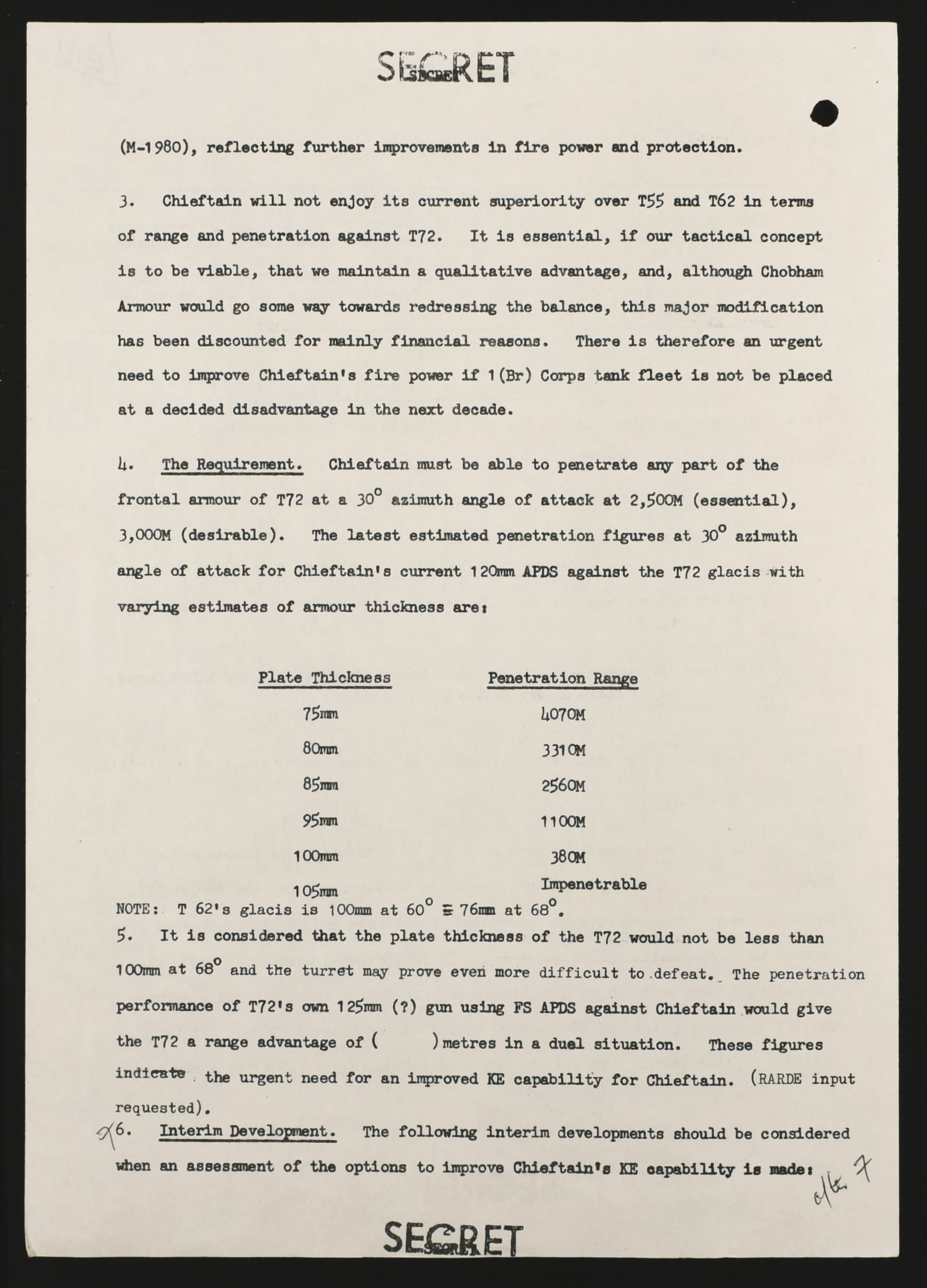
The T-64 and T-72 glacis in total achieved in excess of 100mm @ 68°, therefore it could not penetrate as per British estimates:
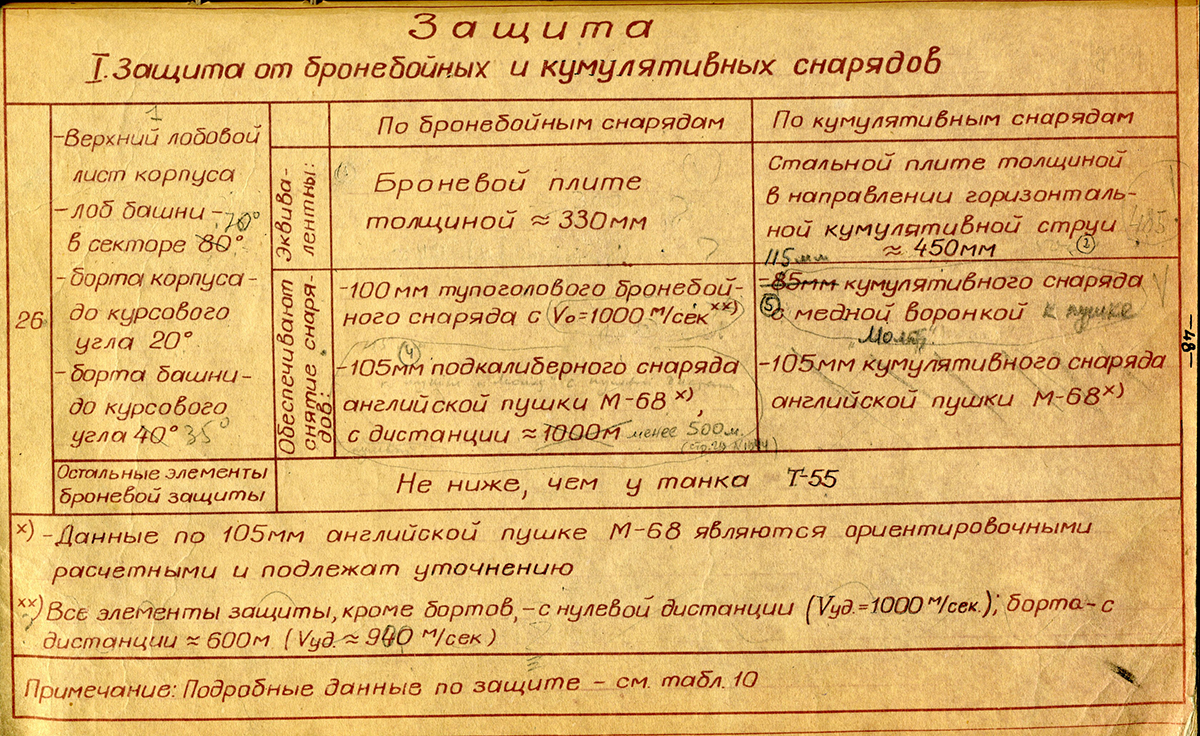
The T-64/T-72 glacis composite was equivalent to around 315-330mm against APDS-type threats.
L15A3 APDS achieved ≈110mm of penetration @ 68° @ 914 meters distance against a single target plate:
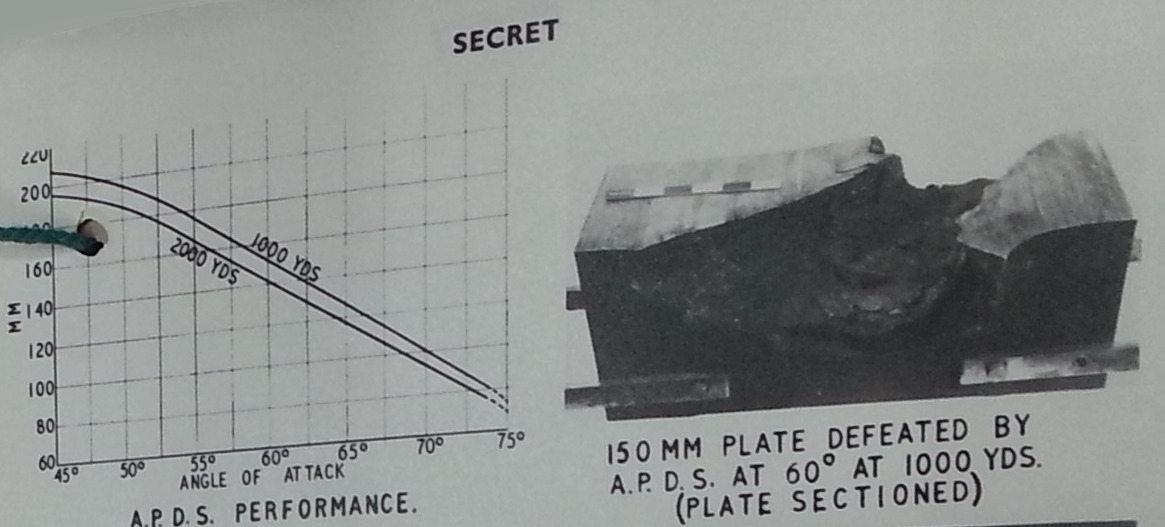
(British target plates were also of lower density than German or American test plates, and even Russian test plates if memory serves me right)
L15A3’s LoS penetration is thus 293mm at 68 degrees, but the T-72/T-64’s glacis is of course not a single homogeneous plate, it’s a composite consisting of layered RHA - STEF - RHA elements and thus L15A3 would suffer lower performance against such a composition.
What benefit does that truly bring when in practice it doesn’t allow the Chieftain to defeat it’s primary rivals, and only penetrates the same targets (T-62, T-55, etc.) that the L7 105mm could already penetrate.
The Leopard 1 fleet started receiving DM23 by the late '70s and allowed them to negate the 80-105-20 armour of the T-72’s well before L23 entered service.
So did the M60A1.
1 Like
Apparently perforation was possible with the service L15A5 round, however a later re-assessment in the later 70’s showed that the glacis was being improved to around 400mm’s against the L15 type, which prompted the need for L23A1.
4 Likes
The addition of textolite is not as effective as is often claimed.
6 Likes
I’d certainly take primary sources over a simulation every day of the week.
It does not have to be, the spaced effect of the RHA plates is the primary benefit of this composition.
The inner layer is primarily effective against CE threats.
1 Like
For penetration.

For textolite, T64A provides 305mm LOS protection.
L15 only gets 298mm of penetratrion in game so it cannot penetrate reliably, the protetcion in game varies between 290-310 so it can pen at close range in some cases.
5 Likes
You also need to recognise you are looking at very specific extracts from the sources, not the entire thing. Context matters especially when sources around these topics can be classified, making us miss the bigger picture.
L15A5 is mentioned in Soviet Technical manuals of the Iranian Chieftain MK.5P, so we know that this was an in service round. The exact values are up for debate, but it is evident that the development of APDS for the L11 gun did not stop at L15A3, which is the round your figures are from. Keep in mind that any values about the round in here are from the Soviet estimates and not from direct British testing.
The Chieftain examined was manufactered in 1974, with the Iranian revolution occuring in 1978-79 (preventing exports), so we can assume the shell was in service during the early-mid 1970s.
https://btvt.info/1inservice/chieftain/vop_chieeftain_opisanie.htm
Texolite does not have any significant impact on kinetic energy rounds, neither does spacing the armour plates from eachother as the distance inside the armour array is so small.
We are talking about APDS rounds here, so it is sort of irrelevant to bring up texolites chemical protection values.
2 Likes
Yes, that’s simply another page from the same document I linked.
60° also isn’t the best representation for the T-72’s glacis, and APDS will perform worse at a 68° angle of attack.
Protection provided is lower against monobloc penetrators than it is against ‘pot’ APDS designs.
That’s why the range of protection varies between 305-330mm.
I’m also not certain as to what changes were made to L15A5 in constrast to L15A3, and when L15A5 entered service. I do know that L15A5 was still in service by the mid '80s and is listed in the Challenger tank manual as an in-service round.
In every case I’ve seen, APDS performs worse against spaced arrays than it does against a single homogeneous plate.
IIRC it’s also why the Kpz/MBT-70 utilized spaced armour.
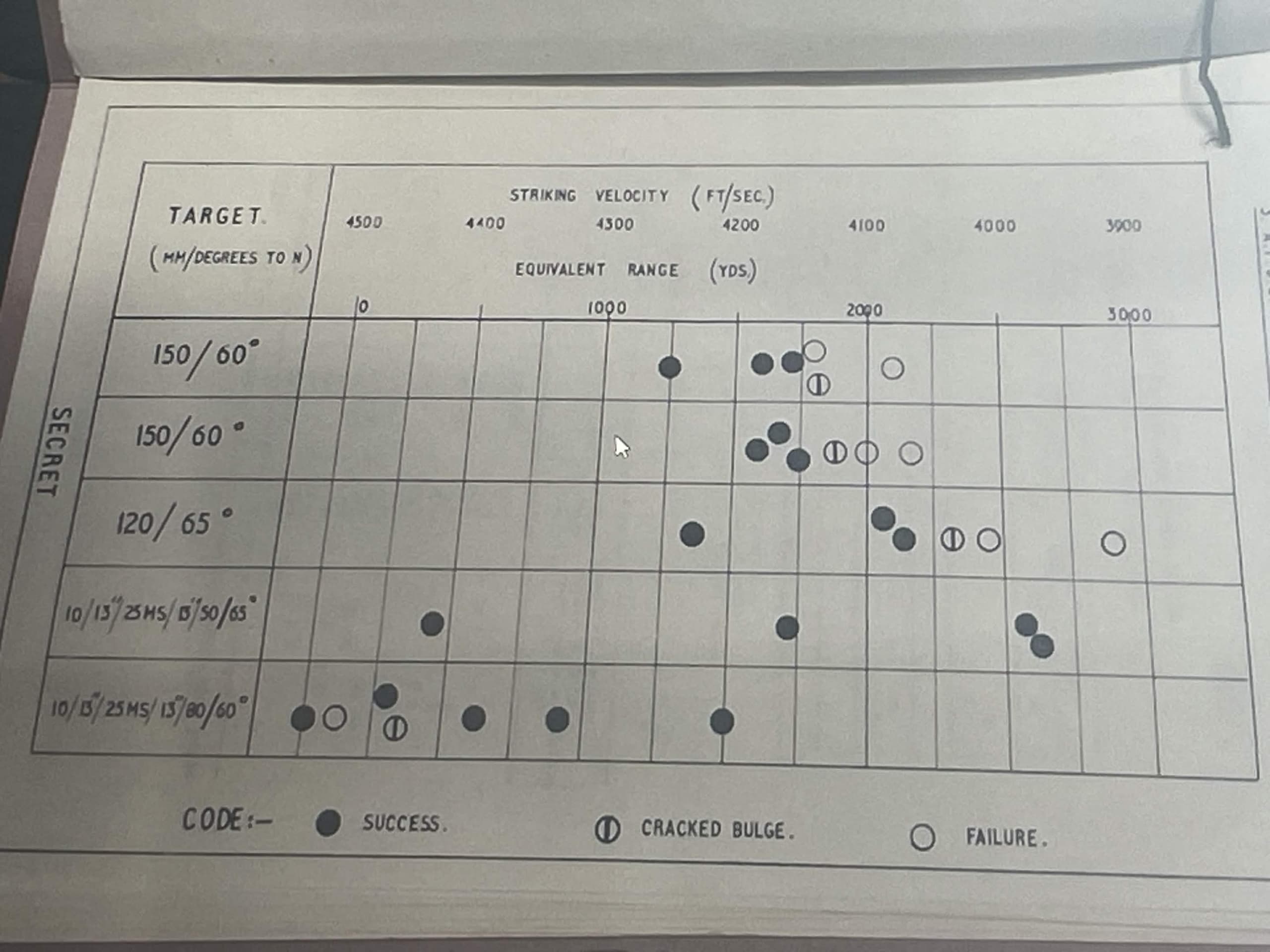
They provide tests of 120mm at 65 degrees… a much closer approximation. Which could be defeated out to 2100 yards. Note that L15 is underperforming very slightly, with 145mm at 1.5km, instead it should be about 150-152mm. This would cascade up and down to all other values, which would make penning T64A more reliable.
7 Likes
Firstly, we’re once again working under the assumption that the spaced armour contributes absolutely nothing to the KE protection provided by this array.
Even if this were somehow true, that still indicates L15A3 could only penetrate the glacis at 380m distance:
Secondly, I also already said that the British test plates are of a lower BHN/density than US, German and Russian ones. In reality the distance at which they would penetrate non-British test plates would be reduced.
Just noticed it says 30° azimuth? Is that not going to increase the effective slope of the armour?
1 Like
I could be wrong, but I’ve always taken that to mean ‘‘Within 60° (or even 30°) frontal arc’’. I.E., armour protection does not fall below the stated amount within the specified arc.
That would be similar to how a lot of other NATO MBT protection values are stated.
Thing is it says penetrate any part of the armour at an azimuth of 30°.
It’s strange wording but makes it sound like that includes the glacis at an effective angle of 71 degrees.
Which would be a decent bit harder, and would also explain why it basically can’t penetrate with L15A3/5?
1 Like

These sources prove literally nothing about texolites effectiveness against KE threats, you have an extremely vague extract and a title that doesn’t even state they are effective.
