do u think that clipping the commanders cupola would count as a single shot kill
I think any hit by a shell into the fighting compartment is considered a kill.
damn i guess that cr2 that had its lfp penned counts as a combat loss after all then
Well it is a good job the game doesn’t care about that by convention then isn’t it? If they did then it would be impossible to reload the Leclerc’s autoloader without rotating the turret 90° to the side for the entire duration of the reloading.
For refilling the ready rack, yes. But we’re talking about loading a shell in 5 seconds.
Well they finally are adding regenerative steering to Nato tanks…
EVERYTHING BUT THE DAMN CHALLENGER 2.
WHAT THE HELL IS GAIJINS PROBLEM.
2 Likes
So, MBT-80 should’ve been what went into service…?
I don’t know, I’m not sure what the most developed iteration of the MBT80 looked like and performed like.
I do know that the Challenger 1 was intended for export and was a significant improvement effort over the Chieftain. Once the export deal failed, the UK adopted the Challenger 1 themselves to support their industry which otherwise was at risk of collapsing IIRC.
It wasn’t the tank they wanted, but it’s the tank they ended up with, it’s probably also why it was replaced by the Challenger 2 so quickly, but again that wasn’t an especially great product itself and once again not necessarily the tank the army wanted.
2 Likes
Excited to see regen steering being rolled out…Shame it is only reserved for the most manoeuvrable tanks in the game!
2 Likes
This is just a test.
They seem to just have implemented it on the Leo 2 and Abrams due to them being so popular.
The Type 90 and Type 10 likely have it for the test as the Type 10 has a unique transmission which really benefits from it
The CR2 will almost certainly get it
maybe not the army, but iirc the defence secretary basically gave Vickers the list of requirements and priorities for the CR1 replacement so they would be able to offer something very attractive to the MoD. Tech developed with MBT-80 in mind was included on the Vickers Mk.7 and then in turn got included with CR2, CR2 was more in line with UK doctrine at the time (such as no charge stowage above the turret ring, and the electric turret traverse was seen as preferable to hydraulics) and was being offered for about half the cost of purchasing an export tank (though I think some people involved in the trials were quite keen on the Leo 2)
You got called a hater because you asked for sources, and provided your own evidence?
Followed by complete silence of course.
Typical.
It’s also quite typical that people are all to happy to engage in a discussion and attempt to poke holes in your arguments, but when you poke holes in theirs, suddenly it’s a problem and emotions get involved.
2 Likes
I’m not certain regarding the costs involved, but I do recall the option for Britain to produce the Leopard 2 domestically.
Not entirely sure why that option was dismissed, possibly to prop up domestic AFV design/production firms?
1 Like
I understand, I always wondered why not go with an MBT-80 with NATO comparability. But I guess it was a rusha type of situation. Not enough money, time, some corruption, and politics.
National pride, Britain tested the 2A4, the M1 was also offered with a diesel engine.
Britain wanted a British tank the testers wanted the Leopard 2, sadly a lot of the time the features the tank should have are not added until later and during service.
Being said though the CR1 and CR2 have both performed well in combat.
a mark against abrams was that the us wouldn’t allow replacement or modification of the composites. the leo 2A4 composite was also inferior to dorchester and a feasibility study into fitting Dorchester to the leo didn’t look too promising
5 Likes
I think tank performance is 60% crews, 40% the tank, and from what I’ve heard British tankers are/were very competent.
I would hesitate to use this argument so easily, it’s difficult to prove it either way.
Multiple countries prefer to produce various kinds of military equipment domestically even though buying off-the-shelf from the US is usually more cost effective and brings more advanced capabilities.
They do so because buying off the shelf from foreign nations causes the domestic military industries to atrophy, and when at some point in the future you need that industry, they’ll be gone.
That being said, I get the feeling Britain continually aims higher than they can reach, they simply don’t have the budgets for these complex projects yet they don’t seem willing to face that fact.
Then when it turns out the budget isn’t proportional to the desired capabilities, they end up with a half-baked vehicle.
2 Likes
Look at the timing, Britain at that point was still seen as a major NATO power.
To maintain that national prestige we have always chosen to produce our own hardware.
To chose a foreign option for your MBT invalidated that.
Germany offered to allow Britain to produce the Leopard 2, domestically so there would have been no job losses and further opportunities in that regard. They would have allowed us to call it something else, they offered a pretty good deal. But Vickers at the time had political sway and is wreathed in herritage, Britain wanted a British tank (well the politicians did)
Problem with buying US equipment is the restrictions, Britain genuinely believed the CR2 had export potential so much so they entered it into numerous tenders and won none of the major European ones.
Yes Britain has had these problems for military procurement excluding, Typhoon I cannot think of a British major programme that was delivered without being heavilly downgraded. CR2 with an infinite budget becomes an equal to the M1 and Leopard 2 it would have had the new designed hull, the new power plant, the new gun, the new thermals, the CITV the uprated armour. But they skimped on the cost and features to save money, they still did not build enough of them and it’s full potential was never realised.
They are doing the exact same thing with CR3, this was an opportunity for Britain and Germany to say lets build the first in service tank with 130/140mm gun lets get ahead of the USA and France and Russia and instead we have produced a tank that is at the same level as what our NATO colleagues have now without pushing the envelope and making something that could be exported and future proofed.
Grouping is a little different. What they do is multiply the accuracy by the area of the vehicle which can be penetrated at that distance. This is basically NEVER 100%. You are erroneously assuming that fire control ergonomics are not a factor in SSKP. SvS SSHP for M1A1 was assessed as 65%, and Leopard 2A4 as 80%, while SR(L) 4026’s requirement was also 80%. Accuracy degrades further on moving firing platforms and moving targets, inherently so.
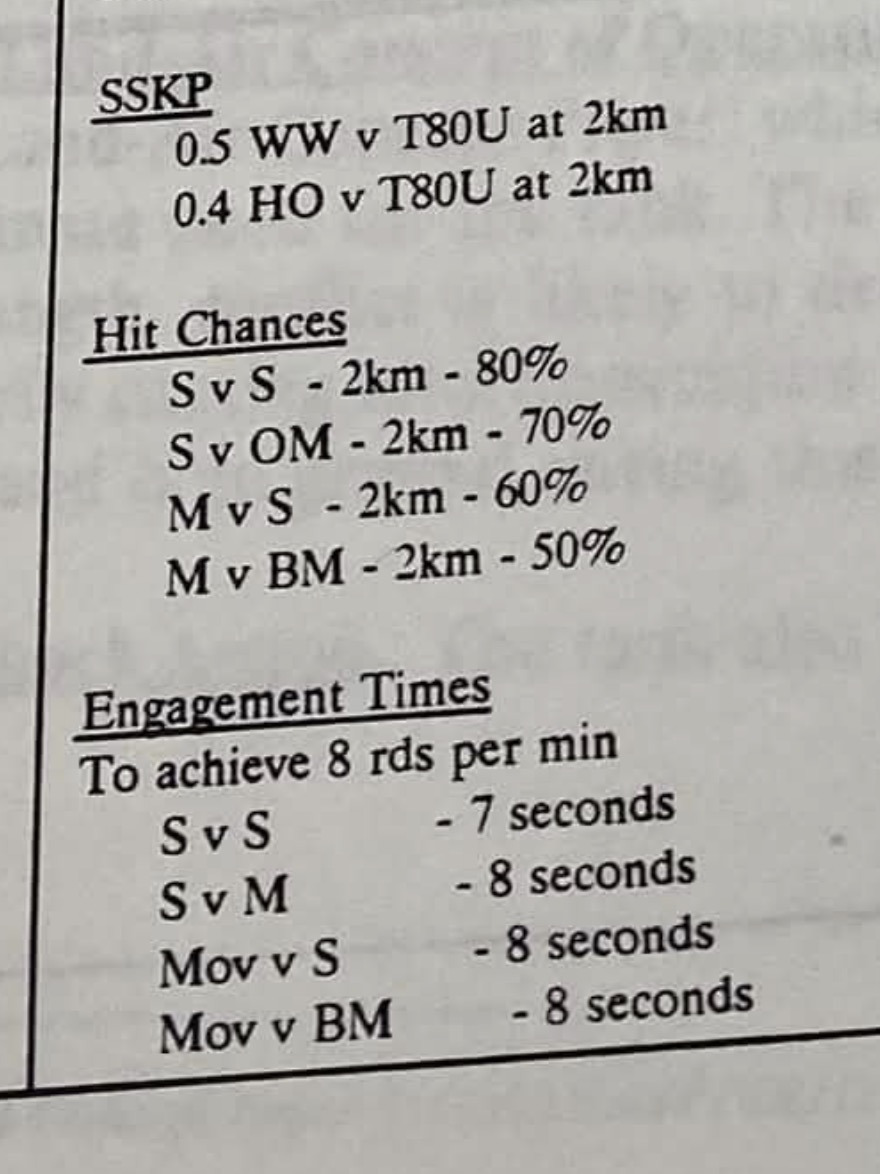
If we work off of this, there’s two scenarios: Either the SSKP is defined based on best case scenario (SvS, unlikely based on these requirements. I’ll explain why later here) or defined on the worst case scenario (MvBM). I’ll do both for ease of explanation:
On the assumption that it is on the best case scenario -
a 0.5 WW v T80U and 0.4 HO v T80U requirement means that, where a is the area penetrable:
0.8 x a=0.4 for the front
0.8 x a = 0.5 for the side
The conclusion to be made is in this scenario, 50% of the front is penetrable, and 62.5% of the side is penetrable. This is obviously quite unlikely, as the side of a T-80 isn’t exactly famed for it’s capacity to prevent APFSDS penetrations. Hence I believe the alternative is likely and on the assumption of the worst case scenario -
The same requirement means that, following the same convention:
0.5 x a = 0.4 for the front
0.5 x a = 0.5 for the side
This gives 80% of the front as penetrable, and 100% of the side as penetrable.
Spoiler
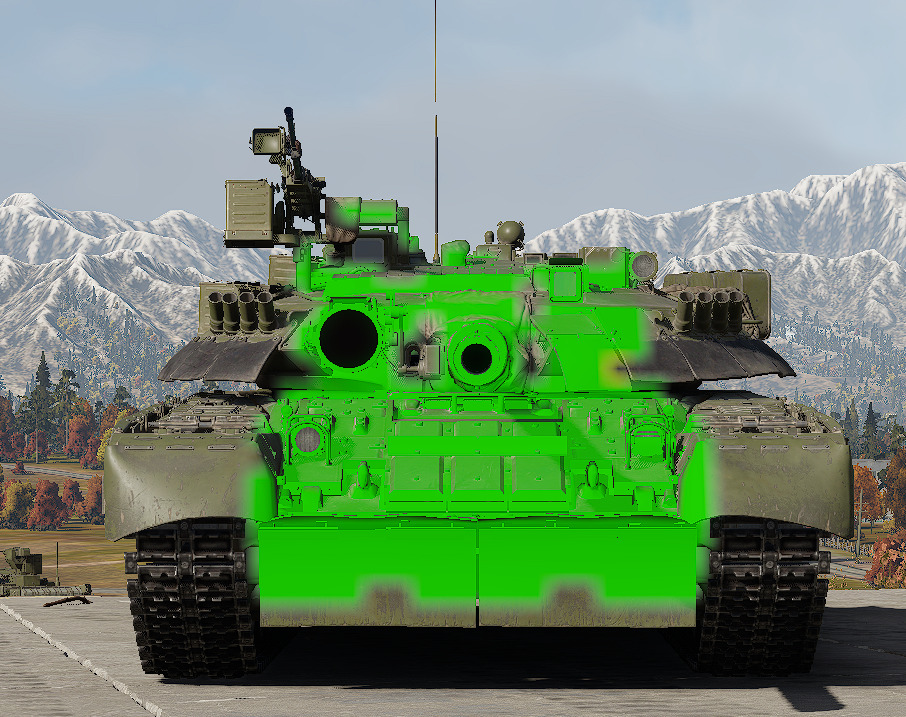
Just to help image visualisation, this is what 80% of the frontal profile looks like.
2 Likes