Even without the 1.5x structural strength, fighters like the Zero and P-51 (and many others) had an ultimate overload factor of 12G, and it was then affected by a safety margin down to ~8G. Between this 8G and 12G, the wings were expected to take some damage, but you could still get home safely.
Others like the Ki-61 just had extremely strong wings and if you could pull hard enough on the stick and not die doing it, could just go ahead and do 12G without any damage.
Yeah cuz that’s exactly how Air RB works, I should stay shooting the guy forever while 5 other dudes park on my six. Shame on me for positioning myself better and diving on poor Jimmy, the master of them all that’s for whatever reason infront of my guns.
Guess I did nothing to wear him down, no matter how weak guns are right?
This cannot be a serious take. Because the most popular sport in the world with centuries of established rules is the perfect analogy for War Thunder cannons???
Spoiler
Since you wanna talk about football, guess what… the same goes for War Thunder!
Let’s abolish the Olympics as well? Cuz a 100m sprint false start disqualifies you with no second chances.
I will pretend I did not read this abomination.
I also think there’s something related to the instructor, which means that in most planes you can’t turn enough to reach the G-force limit. For example, if you take an A6M2, dive it to reach 650 km/h, and then push the rudder to the maximum, it will turn until it reaches around 12 Gs, but it won’t turn enough to break the wings.
I remember a while ago, playing around with a P-40E, I did a dive to get at an enemy, but I was too high and close. By the time I was close, I was already going very fast. He turned to avoid me, and I followed him in the turn. My wings turned following the enemy, but the fuselage of the plane went straight, haha. That happened to me because I was going too fast and didn’t know the plane’s G-force limit. Something that doesn’t matter now, since it’s practically impossible to break the wings from G-forces.
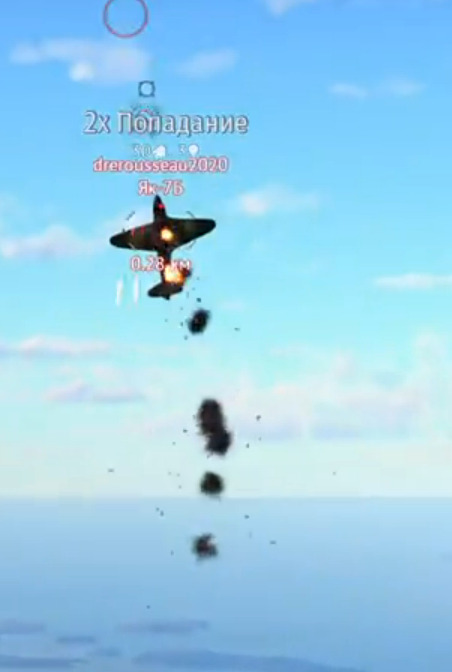
Wow, in that burst, more than one AP should have destroyed the pilot. It’s clear the damage models can’t be like that, but of course they can’t be as they are now either. With a burst like that, the logical thing would have been to destroy the plane in at least half the firing time, especially since it also hit the lower part of the cockpit.
Yeah I just showed this extreme example cuz the dude said no matter how weak the guns are it’s somehow my fault if I didn’t finish him off, apparently I didn’t outfly the dude that’s stalling out infront of me.
As for the guns, I prefer them very much how they are now instead of this. Under the current limited formula for HE and damage models it’s either a lot of damage or too little.
Of course there could be an overhaul that would present us the best middle ground possible, with more detailed damage and all, but frankly I don’t see it happening cuz gaijin switched to realshatter on their own.
I would prefer that the damage output be realistic, that the aircraft’s durability depend on factors like weight, and that the HE filler actually matter, since as it is now it’s irrelevant. Therefore, the logical solution, while maintaining the current damage output, is for all cannons to do the same damage (which is almost what happens), but also to give all cannons the same muzzle velocity, rate of fire, and accuracy, as an important factor of the weapons has been artificially balanced.
I believe damage should be based on the concentration of shots and the aircraft’s design. For example, when attacking a Yak-1 (made more than half of wood), it would take an average of two shots in the same area with an MG151/20 HE round to bring it down by rupture, while it would take four hits with the FI-T or six HE rounds (less explosive) from the Shvak to bring it down by rupture. If it were the same but against a Bf-109 (entirely metal), then it would take four HE rounds from the MG151/20 or between eight and twelve from the Shvak. It’s important to keep in mind that while the MG151 has double the damage, the Shvak has a higher rate of fire and muzzle velocity, so even doing less damage, it would be easier to land more bullets in the same spot. Of course, damage to internal modules or the pilot should also be taken into account. AP and HE fragments, apart from the possibility of setting the plane on fire, which I would personally increase a little in order to achieve casualties without necessarily tearing the enemy aircraft to pieces, something that did not always happen, since many pilots abandoned the aircraft because it was on fire or with damage that did not allow it to be handled even if it was in one piece.
We never called for the return of legacy damage systems, already a flaw if we see how even the amount of fragments could roll into a fucking 1,3 or even 0.
Current way explosive rounds works is closer to a hche round, thin cases are almost completely obliterated upon detonation.
Most early 20mm would have prioratized fragmentation instead of blast damage. Since if you want to amplify blast you need to sacrifice the ballistics of the round.
But even then the fragmentation of your cannons for such long time and vs areas where not a lot of armor is present would have minced internal modules, caused all kinds of severe leaks and killed the pilot pretty early on.
I believe the effects seen on the german 15mm and 20mm FI-T rounds are the closest to what at least I wish would see.
Problem is that time to kill is so fast that any firerate / filler upgrades are mostly obsolete outside of the “headon”.
You can check on a large bomber wing like the Yer-2’s that almost all 20mm explosive damage is the same barely any different.
here are a pair of examples where the modification, that sometimes even comes comes at an unjust BR gap or even repair cost in case of modifications
Spoiler
As long as your combined firerate of cannons is above 700ish RPM then any firerate mods are obsolete
Any filler upgrades past 7g is also obsolete
Let’s make a cannon example
Russian 20mm (ShVAK or B-20, pick any) vs Russian 23mm (NS-23)
One was the replacement of the other, meant to replace it in A2A duties, yet in game the filler difference is non-existent, with the only upside 23mm has is more range due to more mass and more inertia.
20mm beats in firerate, belts and usually ammo count since 23mm bullets take more space than 20mm.
Only when the NR-23 cannon shows up that 23mm becomes a respectable competitor to the old dinky WW2 soviet 20mm cannons.
Let’s look at armor plates too.
Since fragmentation basically doesn’t exist for more aircraft, thats one less threat the armor plates of aicraft can protect you from, add to that a wing will snap off from a 0.5 second burst of any 20mm, no matter the filler and that ends with most armor plates really only soft countering 50cal and below AP fire.
What I am actually against is nerfing guns in our current system, cuz it’s either all or nothing.
I am aware of your idea, but not everyone in the thread thinks the same as you - some ppl really want incredibly weak guns no matter what.
But to clarify, that extreme example I showed was to respond that take above that specifically said “No matter how weak guns are, if you couldn’t finish him off it means you didn’t outfly your enemy” which is pure bs.
poopooo’s idea above is not bad at all and it probably aligns with yours to a certain degree, but I just don’t see it being implemented cuz it would require a massive overhaul to damage models and each shell in the game would need their own values and we know how things are when it comes to the snail. That said am not against that kind of overhaul as long as guns are still reliable.
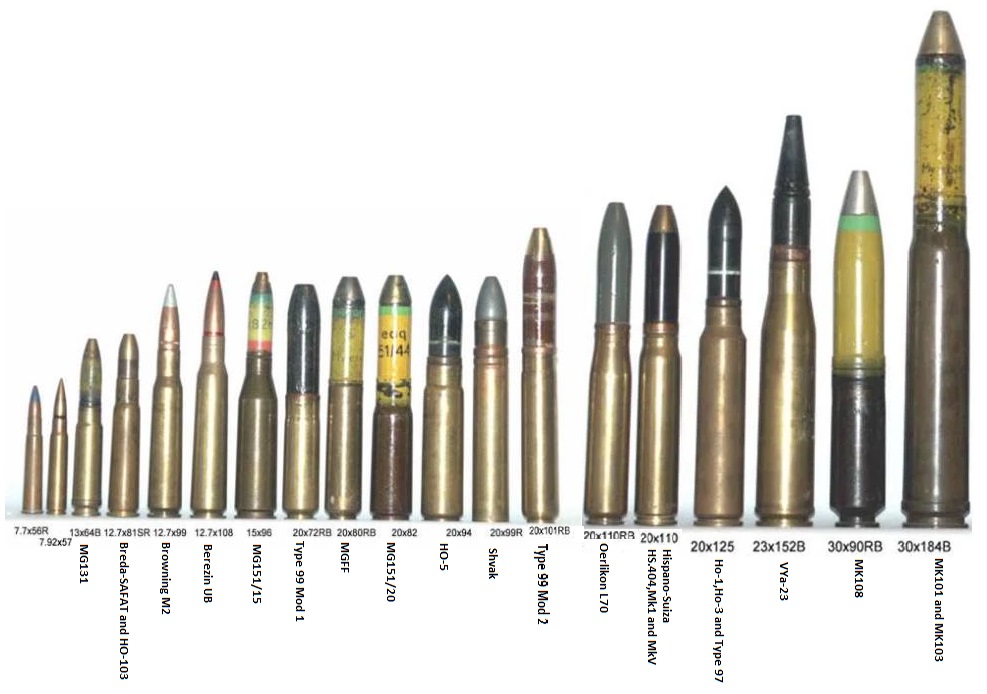
In case anyone is interested, here’s a comparison of different aircraft cannon projectiles, showing the sizes of the bullets and giving an idea of the amount of explosive they could carry.
Because thin walled lightweight shells could possibly not work that well with thread pitch of existing barrels, creating stability problems, would not match ballistically with any other shell types, would require setting up.entirely new production lines, as they were manufactured in a completely different way, and by 1943 it was obvious Germany is going to lose, and current weapons were doing good enough, especially since Brits were moving towards quad cannon setup (and 8 HE/SAPI shells will mess any Fw 190/Bf 109 just enough, and 8 shells would be like 0,09 to 0,18s of trigger time) so why bother.
In other words, that’s not a smart question.
Also post war planes were bigger, and 2cm M-geschoss works best when the target is of moderate size, because it blew open the wings via overpressure, bigger wing = less overpressure. Simple as this.
There were a lot of good designs that were discarded post WW2.
Japanese actually adapted their own M-geschoss and ADEN used high capacity 30mm shells, which clearly shows the idea was viable.
When even late-war japan, with all its resource shortages could cough up a new higher-capacity HE shell (not actually mineshell, but fuseless and relying on the shattering of the casing) to use in their existing cannons, the allies could have done so too with their vast network of un-bombed factories. The greatest advantage of the fuseless shells was that they were both cheaper and easier to make.
Planes did not get much bigger immediately. All the WW2 props stayed flying for years to come. 30mm cannons benefitted from the cube rule.
Lets see, Hoe-5 shell weight and speed vs Hispano.
Hoe-5 was simply compatible with design.
Hispano would spray all over the place past 300m and that’s assuming the weapon was generally compatible with such design.
Also Japanese production was fairly low scale and primitive compared to western allies, who were mass manufacturing 20mm ammo in very specific patterns. Germany was also pushing small scale production of all kinds of stuff by the end of the war, where large part of their industry was coming apart.
Japanese also got all the documents, safe and effective fuse design compatible with bursting charge with proper sized “sprengkapsel” all things allies would have to reverse engineer and redesign.
Meanwhile Soviets, who could have adapted M-geschoss due to similarities in ballistics, were quite damn happy with their own designs, because in stalinist regime you don’t exactly want to make the lead designer angry by pointing out the enemy did something better.
Also soviets mass produced plenty of "questionable"designs, so it’s not like they were “choosing the best”.
Once war ended, everyone was left with INSANE ammo surplus, huge hole in finances and general economic crisis.
Yeah, best time to introduce 20mm shell that has no future, as everyone knew even by late 1944 that jets will take over.
The much larger Ho-155 also worked with fuseless shells, so this is a baseless assumption.
The capture of the MG213 and related information, on top of countless examples of mineshells for MG FF/M and 151/20 cannons already provided the allies with such possiblities. Reverse engineering them would be trivial, not to mention a lot of those same engineers would go to other countries right after WW2.
Meanwhile the internals of the AK rifle are extremely similar to those of the M1 Garand rifle. Way too close to be a mere coincidence.
…And aircraft as late as the F9F Cougar, introduced in 1952, still used the WW2-era M3 20mm cannon. The Colt Mk12 and M24 cannons are further evolutions of the M3, keeping the same general design, caliber and very close cartridge dimensions; the Mk12 and M39 used lighter shells in order to achieve higher muzzle velocity. Does that ring a bell?
The M39 revolver cannon fired a 101g shell with 10.7g of RDX, which is ~16g TNTe, this shell is shared by the Vulcan. The Mk12 has 14g (18g) of Comp-B in a ~110g shell. Both have little incendiary filler, for the M39 it is only 1.3g in this particular shell.
Not very different than the Type 99’s non-tracer HEF shell and its 130g mass and 9.9g filler/ 12g TNTe. The british Hispanos have only ~6.5g expl. filler but as I understand it, there is an equal amount of rather weak (in terms of explosive force) incendiary filler in there, so ~12g total for a ~130g shell. The Ho-5 has the lightest shells here (~85g) and can go up to ~4.5g RDX and ~4g flash powder, for ~8g filler (flash powder is also an incendiary filler, that generally is not counted as explosive).
All of these shells have approximately 10% of their total weight be explosive filler, despite the massive gaps in just about every respect in terms of era, production quality, technology available, etc.
Obviously none of these are “mineshells” or HCHE. The M39’s and Mk12’s are on the high end of the range of WW2-era conventional cannon shells in terms of filler but are otherwise quite similar, instead relying on better explosive compounds for greater effectiveness, while reducing total shell weight for increased velocity.
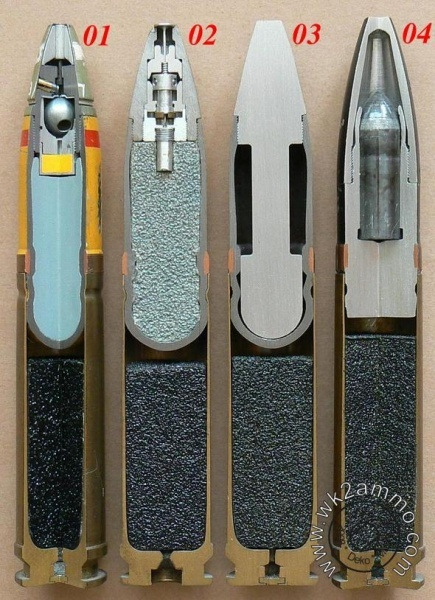
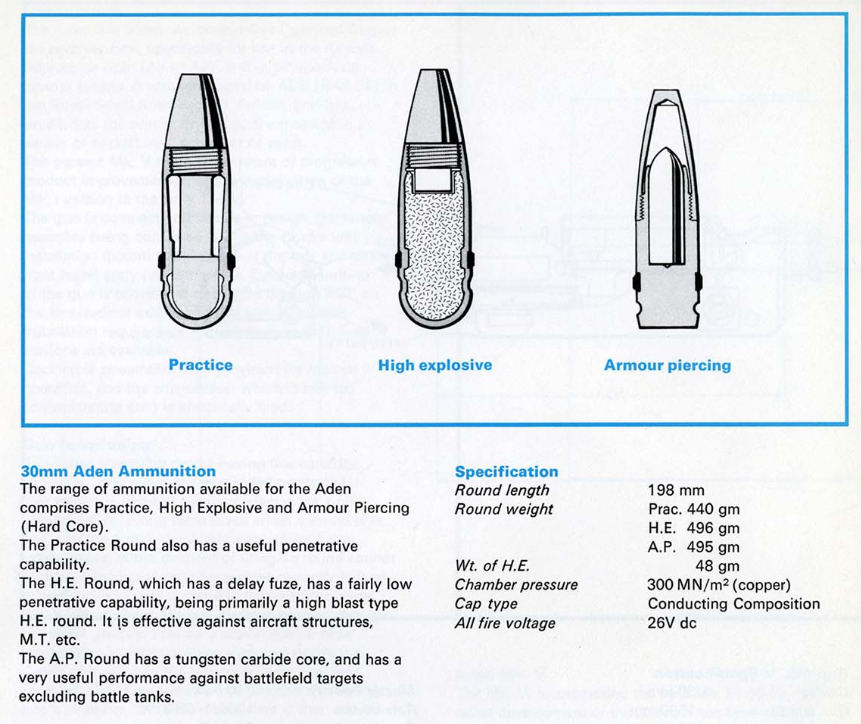
So even detached years from end of WW2 financial troubles (which for USA were minimal), they still did not use thin-walled, high-capacity shells. For reference a german 20mm mineshell would be a ~90g shell with 17g PETN or ~19g HA 41. In game we seem to have the latter, for a hair under 30g TNTe. It is by far the outlier at 21% of total weight being filler, and only matched in this by DEFA/ADEN’s HCHE shells.
To refute your earlier point about planes getting bigger: the intended target for the american 20mm cannons was primarily opposing soviet fighters, while for the M2 and M3 cannons we can assume it to be japanese fighters (the USN was their primary user, and saw the vast majority of their WW2 action in the Pacific).
The MiG-15 would be seen just a few years later in Korea and greatly impacted US military development. It is 10m long with also 10m wingspan; empty it weighs ~3700kg. I randomly chose the N1K1-J Shiden as more representative of a late war fighter, for a comparison - it’s 9m long, 12m wingspan, empty weight of ~2900kg. For the record, the Ki-84 was more common but has very similar dimensions and weight. They’re much closer than you’d think.
Early models of the M39 cannons were directly tested against MiG-15s in combat over Korea, so this cannon was well intended for a target the size of a WW2 fighter.
My current theory is that they DID try HCHE shells of 20mm caliber but that design simply wasn’t effective at that size, while the larger 30mm shells did benefit from it - after all they have over 3x the filler of a 20mm german mineshell, so there will be a much greater effect.
After WW2 planes have changes dramatically and nobody was going to design shells that won’t work vs new aircraft. A shell, that has bad ballistics BY DESIGN. I have already explained that.
Your “Hoe-155 is biggur” argument is pure trolling. We’re talking specifically about 20mm. In 30mm M-geschoss with tracer had no problems with ballistics in comparison to other shells, hence British post-war 30mm was also a Mine-shell.
That is one of the quotes of all times. They are extremely similar as in “gas operated” with a short stroke piston, and here the “extreme similarities” end.
Now regarding jet size - now add fuel to that Mig-15.
Thing is, with amount of fuel on jets, incendiary got a lot more important compared to trying to ruin aerodynamics.
And finally - even lighter shell or bullet can have decent ballistics. But 20mm M-geschoss, due to the way it was made, sacrificed everything for capacity. 30mm M-geschoss with tracer was one of the better HE shell designs around in comparison, featuring boattail and tracer and just the right angles at the nose.
If you tried making 20mm M-geschoss for Hispano, that would match other shell types at least at 500m (like 20mm M-geschoss did for MG151/20) you’d have to basically create a whole new shell anyway, if you ditched the way they made the body, you’re back at square one, because in 20mm you can’t have both large capacity and thick walls, and if you start sacrificing capacity and making walls thicker, your “overpressure” round loses its main ability very quickly, as ripoing thicker walls apart takes more energy, and also thicker walls, less explosive, so you may very well lose f.e…30-40% effectiveness while dropping 20% of explosive content, and now with aircraft generally getting bigger over time it gets worse.
The back of M-geschoss was rounded because of the way it was made. Rounded back is bad for ballistics. Without rounded back maybe the shell would deform during firing, we have no idea, as we are not exactly in possession of logic behind it. If it did that, it means it was already marginally strong for MG151/20, and Hispano has A LOT more powder charge behind the shell.
Overal - as I said, not worth the effort when your standard aircraft armanent is 4 cannons, while German standard fighters of 1944 have 1 (109) or 2 (Fw 190 D9).
Because of its lower weight? But as I clearly showed, this became something desirable.
You literally started with:
Therefore I won’t hear any more of this cope.
Long-stroke piston, actually. Kalashnikov’s own book talks about his inspiration for the AK rifle - it was an american named “Garand”. There’s a lot more extreme similarities between the two rifles, like how the recoil spring is mounted, how the bolt is rotated and actuated, the charging handle being on the BCG itself, and even the bolt has 2 locking lugs just like the Garand.
But you don't have to take my word for it, see for yourself.
The MiG carries more fuel sure, but it has shorter flight time at military power than the Shiden. And of course the assumption that “planes got bigger after WW2” is just wrong, so we can put that to rest. They didn’t even get much heavier.
Every WW2 cannon mentioned had pure incendiary shells available.
And you can just… not do that. You can preserve an aerodynamic profile with a thin-walled casing.
Uh huh. Which is why these new 20mm cold war cannons, using all new ammo and with complete knowledge that HCHE 20mm shells are very possible, chose to… just iterate on conventional WW2-era shells, instead of going for thin-walled ones that maximize filler?
Yeah no. Nobody was gonna just leave ~40% damage on the table when designing an all-new cannon and ammo for it, especially not years later with vastly better materials and manufacturing available.
ADEN cannon also used a rounded back in some shells, primarily explosive ones. Others had a boat tail. Clearly cold war weapons engineers did not find it to be such a significant downside.
And let it be known that at the time the ADEN was put into service, most if not all of the british fighters/interceptors using it did so in 4-gun installations.
Ok you are a troll. I am not going to waste any more of my time for a guy who doesn’t understand that adapting the 20mm design to a completely different 20mm cannon is completely different thing compared to creating new design for 30mm caliber.
I was explaining why Brits were not adopting a shell that simply was completely different from the ammo Hispano used, and pointed why it worked in Hoe-5.
You came up wirh Ho-155 which is a completely different case that has NOTHING to do with adopting 20mm M-geschoss for other 20mm cannons and tell me about coping.
Ignored until 2027, bye.
If we casually ignore literally every part is completely different size and shape, magazine is completely different, gun is different shape, sights are different, it’s manufactured differently, has different ergonomics, different caliber and ammo and 2 locking lugs and long stroke piston was used in other gun designs of the time simply because it worked, and all we have left is “oh look, the recoil spring mount is similar”.
This is comedy gold.
Meanwhile, reality is, firearms that work will usually be “extremely similar” from one point of view or another because there are only so many ways you can make a reliable gas operated firearm, and almost nobody’s going to re-invent everything just for the fun of it.
Meanwhile, the whole trick is to design all the parts with correct shapes, strengths, mounting points, design receiver that has the right combination of weight and strength for the caliber and intended use, plan for ergonomics thay work, design magazines that are strong, cheap and reliable. Also one has to think about the a viability of mass production.
Brandon Herrera spent SEVERAL YEARS with a bunch of other talented people making his “AK 50”. He took AKs action 1 to 1 and tried to make a .50 cal gun out of it. Turned out they had to redesign every part several times to make it work. Would you claim AK50 is “extremely similar” to AK?
I would not. It’s a whole different gun that has very few if any common parts with AK, most parts had to be designed from scratch, materials and manufacturing methods had to be reviewed, type of steel, hardness, dimensions. Because that’s actually the difficult part.
I know Kalashnikov was inspired by other designers, as every gun designer is inspired by people before him (some invent new things, some just make inventions of others actually work etc.). But claiming these weapons are “extremely similar” is just stupid.
German G43 had a very reasonable mode of operation, but was problematic to take down, was overgassed and generally a bad weapon. In other words - just because you have a good starting point (action that is strong and reliable by design) is just a small part of the success, since if you design your parts wrong/fail to fine tune springs, gas ports etc., your weapon will NOT be good.
And with ADEN you’re just discussing with yourself. I wasn’t the one claiming M-geschoss was not being copied, which suggested it wasn’t a very good shell design. I spent my time explaining why Soviets and Brits/Americans did not adapt German shell, as these were the cases that COULD be explained by “well, that’'s because 20mm M-geschoss was not that great”.
Meanwhile, there’s 0 indication that it wasn’t superior damage wise, but being inferior ballistic-wise could even things out or just make it “not better enough to adapt” (a LOT of designs during and after WW2 were not adapted because they did not offer ENOUGh improvement!) as it should in War Thunder, instead it’s inferior in ballistics and not better in damage, lmao.
Ans going back to ADEN - in 30mm the rate of speed bleed will be lower even if the shape is not optimal, shell walls can be way thicker while retaining high capacity, and ballistics seem to be fairly far down priority list for these guns, which sounds like Brits borrowed some German gun design philosophy.
There were 4 ADENs on jets, as firing window for jets was much shorter, jets are much tougher, so of course it makes sense to have a tons of guns, and during late 40’s and in 50’s nuclear jet bomber interception with cannons was also considered to be a very likely scenario, but I have no idea why are we talking about it.
We surely won’t in the future as I will not respond to you any more.