- Yes
- No
Hello everyone, and welcome to this new suggestion.
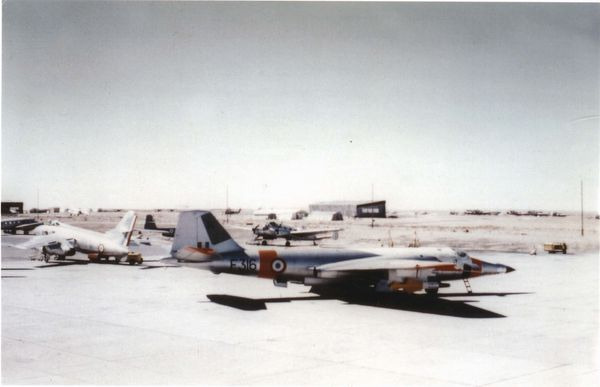
Today, I am presenting a rather unique aircraft used by France: the Canberra B.6 No. 316.
During the mid-1940s, the British company English Electric was tasked with developing a new jet-powered medium bomber to replace the Royal Air Force’s wartime piston-engined bombers. The result was the Canberra, one of the most successful military aircraft of the post-war era. Entering service in 1951, it combined excellent high-altitude performance, long range, and remarkable reliability, leading to its adoption by seventeen countries. The aircraft was even produced under license in the United States as the Martin B-57, with total production exceeding one thousand aircraft.
France was among the operators of the Canberra, acquiring six B.6 variants in 1954. Unlike their British counterparts, however, the French aircraft were never intended for operational bombing missions. Instead, they were assigned to the Centre d’Essais en Vol (CEV), France’s military flight test establishment. At the time, the CEV required a fast, reliable jet capable of carrying experimental equipment to high altitude and at high speed in order to support the development of new weapons, avionics, and radar systems. Three aircraft were purchased new, while three additional second-hand examples were acquired and extensively modified to serve as dedicated flying laboratories.
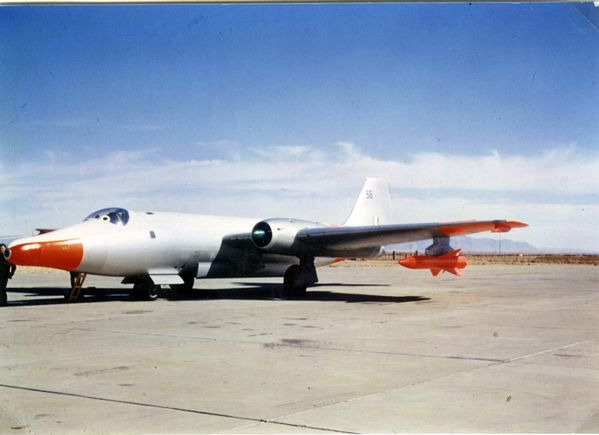
Among these aircraft, Canberra B.6 No. 316 became one of the most heavily modified and historically significant. Throughout its career at the CEV, it was repeatedly adapted to evaluate a wide variety of experimental systems. The aircraft received a redesigned nose section capable of accommodating different radar installations and electronic equipment, allowing engineers to validate technologies intended for future French combat aircraft. During one of its best-known test campaigns, No. 316 was equipped with a Mirage III radar installation, transforming it into an ideal platform for evaluating new air-interception and guidance systems under realistic flight conditions.
Perhaps its most notable contribution came during the development of the Anglo-French AS-37 Martel anti-radiation missile. As one of the principal flying testbeds assigned to the program, Canberra No. 316 carried the missile throughout numerous flight trials, allowing engineers to evaluate its aerodynamic behavior, guidance system, launch characteristics, and integration with onboard avionics. These tests played an important role in qualifying the missile before its introduction into operational service, where it became one of the first dedicated anti-radiation missiles employed by Western air forces.
Canberra B.6 No. 316 remained in service with the CEV for approximately twenty years, from 1954 until 1974. During this period, it contributed to the development of numerous French weapon systems and electronic technologies, far exceeding the role for which the aircraft had originally been designed.
Characteristics
Length : 19.96 m
Width : 19.51 m
Height : 4.77 m
Mass :
- Empty : 9 820 kg
- Full : 25 000 kg
The aircraft is powered by two Rolls-Royce Avon RA-7 Mk 109 engines, enabling it to reach a top speed of 933 km/h and an altitude of 15,000 m. It has a range of 1,300 km.
The crew consists of two people: a pilot and a weapon systems operator.
Equipment
In terms of equipment, this aircraft is particularly unusual; initially lacking detection systems, it was later fitted with a pointed nose housing various sensors for firing anti-radiation missiles. In the early 1960s, it was equipped with a Mirage III radar for testing purposes prior to that radar’s entry into service.
Weapons
The aircraft’s armament is notably simple; it served exclusively as a testbed for the AS-37 Martel anti-radiation missile, which could be mounted under the wings (with one missile carried under each wing).
In-game, this aircraft would be a particularly interesting addition, offering a truly unique machine capable of performing only one type of mission and unable to defend itself—making it an ideal candidate for an event or squadron vehicle (similar to the F-117 in the US tech tree).