No it just isnt
Better acceleration at all altitudes, better low altitude handling?
No it just isnt
Better acceleration at all altitudes, better low altitude handling?
From 275 km/h to 530 km/h at 100m altitude:
Yak-3U: 27:69 seconds.
Yak-3 VK-107: 31:65 seconds.
I get the strong sense you’re just making stuff up here.
Let’s deep this topic and any aircraft in turn will not be able to change engine thrust (you will need to wait and reduce maneuverability), change flaps position and other elements.
Also on World War II planes there is no HUD so you need to disable the interface with speed, altitude indicators and etc and add a separate button which dark your screen but you see your characteristics in flight (and reading the value will take separate periods of time something like analyzing objects in Project Zomboid)
Of course this is just farce. Any similar decisions on the balance of the aircraft based on usability should be common to all aircrafts and this will simply kill the game because even in DCS and IL-2 don’t do this
The only possible nerf of Zero’s handling is to disable using flaps when the landing gear is retracted because hydraulic system flap can only operate when pilot release landing gear.
Finally it was stated. I would also note that in game pilot power is more than common in IRL. It is why all statements about “let’s add compression on speed XX” is useless since in game all aircrafts need to be rechecked with compression.
Because of this we need to see not absolute data but comparings of Zero compression and other planes compression and wow it is correct. Early Zero are one of the worst in rolling while late one is pretty same in compare to US planes.
As I know story was a little bit different.
Speed was increased after making thicker wing skin as this was one of the measures to improve the aircraft’s flutter speed after the Shimokawa accident. The increased thickness of the skin increased its rigidity and the skin stopped being “pressed” into the internal strength of the wing. Therefore, the skin no longer looks like a waffle iron or waves on high speed and the absence of indentation removed the negative resistance from wing irregularities. Because of this the speed increased to 533 km/h.
Example of wing skin pressing on high speed or high G value
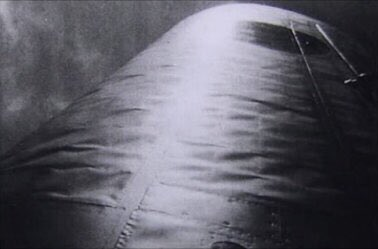
You are correct but with in a little another way. Japanese most of times measured maximum speed on Military (30 minute) mode which in game is made as 100% power of engine.
But that 510km/h and 533km/h speeds both measured on 100% power and was caused with wing construction changes.
Until it is proofed - it is absolutely not clear
I’ve not met it and if you will share it would be good. But this can be caused center of gravity of Hei version is closest to the center of aerodynamic power of the wing
A little note that Nakajima started placing 100 round drum mags in Autumn 1943, not in 1944
Again I read a little bit another story. It was removed after series of accidents where one plane was lost and another lost both ailerons but successfully landed. Issue was the ailerons destroying and because of this it was removed.
Yeah, interesting was it re-installed on later production A6M2? I don’t really know
I won’t be surprised if devs don’t know about all this story and don’t know about A6M2 510km/h and 533km/h speeds
It sounds interesting though I don’t understand it mainly.
Interesting can it simulate the real A6M elevator control feature where thanks to the stretching of the control cables the deflection angle varies at different speeds maintaining the “sameness” of the control
N1K had same system but without stretching and just with special mechanism
It got more thickness even earlier A6M5.
Afaik story of A6M2 evolution is very interesting but pretty untold
Yeah
Nobody is realistically doing this. At 2000 metres going to 560 the VK-107 beats the Yak-3U at any speed. At 1000 metres it beats it until ~450. Any altitude above 1000 metres the VK wins.
‘‘Trust me bro’’
How about you actually provide some evidence for these claims? That the VK-107 out-accelerates the Yak-3U at most altitudes as you previously claimed.
Roll rate:
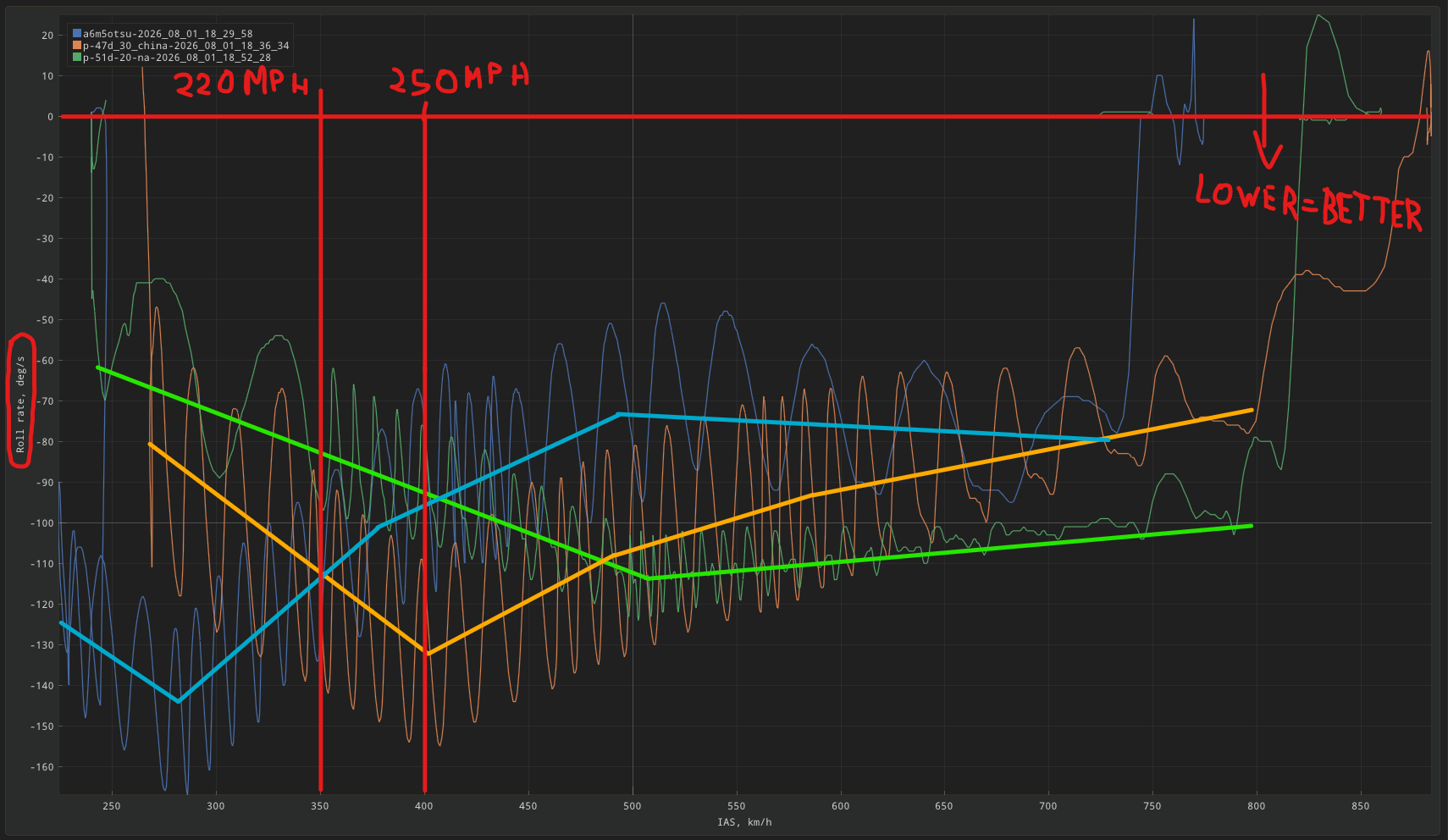
TAIC Report no.38 clearly states P-47 is equal to it at 250mph, better above and worse below this speed; P-51D equal at 220mph, better above and worse below this speed.
In-game:
A6M5 Otsu is equal in roll to P-47 at 220mph (wrong) and equal to P-51D at 250mph (wrong). The implication by the IRL report is that P-51D must be superior to P-47’s roll at these speeds, which is not the case in-game. So it is difficult to say according to which should A6M5’s performance be matched against, and which of the american planes is wrong.
I also don’t think it’s plausible that the TAIC guys confused a P-47 with a P-51 and noted down the wrong numbers - it’s much more likely one or both of the american planes are wrong here in WT. If it is worse than P-51 above 220mph it cannot match the faster rolling P-47 at 250mph.
Regardless, we can see A6M5’s roll rate decreases a lot with speed, and is generally inferior to both unless at pretty low speeds. The only change I would make is so that its roll rate continues decreasing past ~500kph, at a slow rate, similar to P-47’s, I cannot confidently alter its roll rate elsewhere due to lack of a good comparison.
Factors like aileron reversal (the Zeros suffered from this) are not modeled in WT for any aircraft so they’re irrelevant here (for the record, neither are P-38s losing all elevator authority, which is arguably worse).
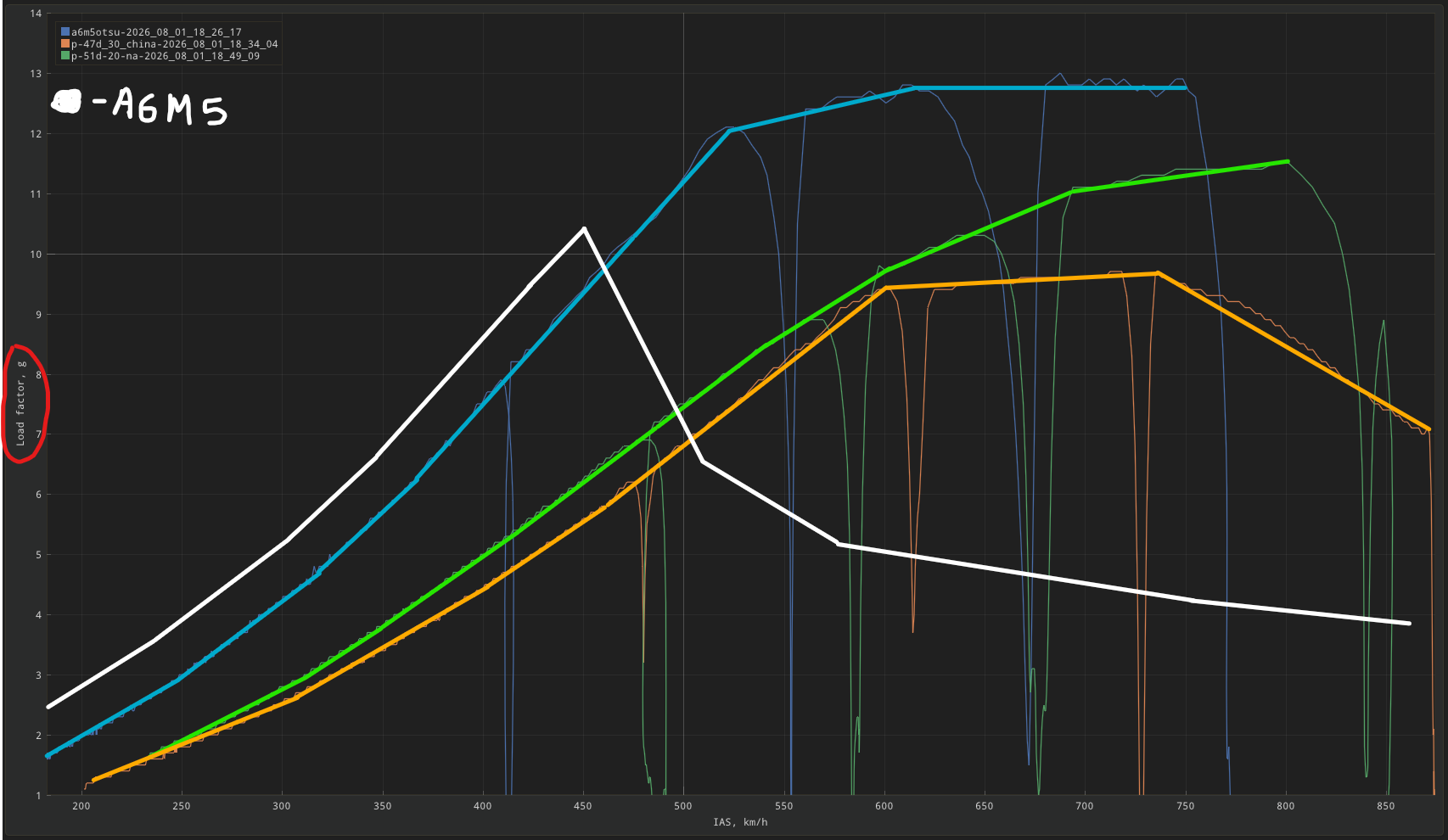
Instantaneous turn:
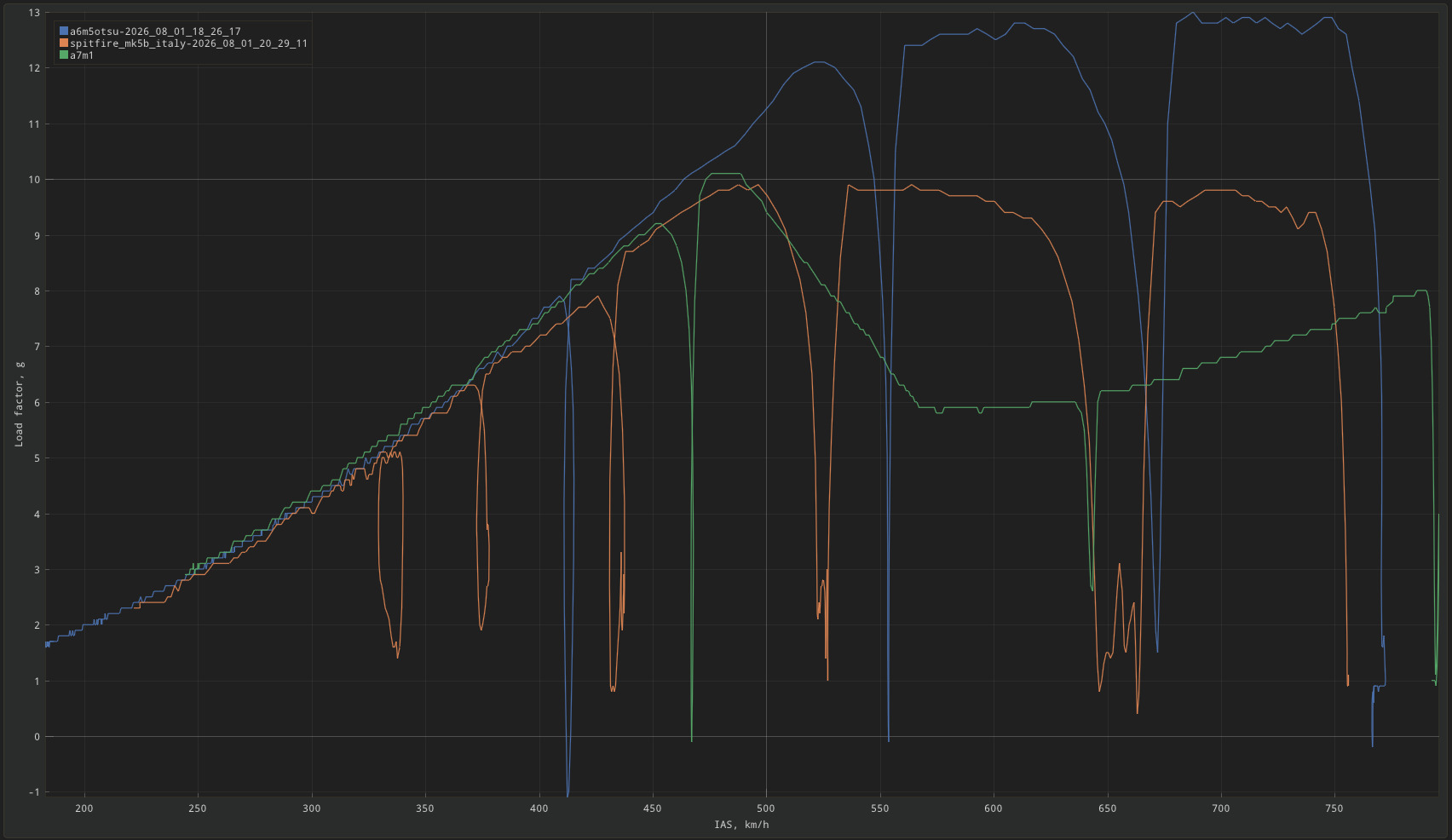
The elephant in the room is of course the maximum pull it can achieve even past 700kph. Though you can also see that it becomes much less responsive - the downward spikes are for resetting the pilot’s G-tolerance timer, and the A6M5 takes much longer to return to full pull than the other two. This is little excessive.
I have already taken the liberty of including a bold line in WHITE for my suggested load factor limits. These are taking into account general information to be used when fighting it, namely to maintain a MINIMUM of 300mph indicated when fighting it (and even at 300mph NEVER maneuver with the Zero unless already behind it); I also used the F4F-3, Ki-43-II, A7M1 as comparison points, as well as mock combat reports against allied aircraft, namely Wildcat and Spitfire. At and below 280mph (~450kph) it was said to be strictly superior to Wildcat and Spitfire, with most allied aircraft taking the lead above 300mph (~480kph).
The performance below 450kph was significantly increased to both match the Ki-43-II and to achieve the noted superiority to Spitfire and Wildcat’s turn performance that the Zero was known and tested for.
At 300mph it can be seen that its turn performance has degraded a lot and even the heavy P-51 and P-47 can keep their nose on target for a short time, just as on the reports.
Here are the separate comparisons against the aircraft mentioned above:
The quote from Sakai is specifically for WEP, maybe he was in an earlier A6M2 then when he recorded that speed.
I’ve seen that, but almost never hear it being talked about. In-game N1K2-J high-speed turn is nothing special.
EDIT: @Orangeblack_Box I’d like to hear what you think of what I showed above. I think it’s far better than throwing sources and claims at each other.
I mean that 510km/h and 533km/h is speed with same condition on 100%
With WEP both planes will show higher speed
I know, Sakai must have been in an earlier A6M2 with the thinner wing skin since his claim was that it achieved 510kph on 100%, and 540-550kph on WEP.
I would not be so sure.
About A6M2 speed issue is that in many official performance data it was still written as 510km/h and there could be situation that Sakai flew later A6M2 variant but in plane passport was written older “official” speed data.
It is because getting ~40km/h only by WEP it pretty much especially for 950hp Sakae engine. I would more expect 15-20km/h
Was there a known cutoff for the newer A6M2s with thicker skin? In-game A6M2 only does 510kph if you have a cold engine or completely close the cowl flaps manually.
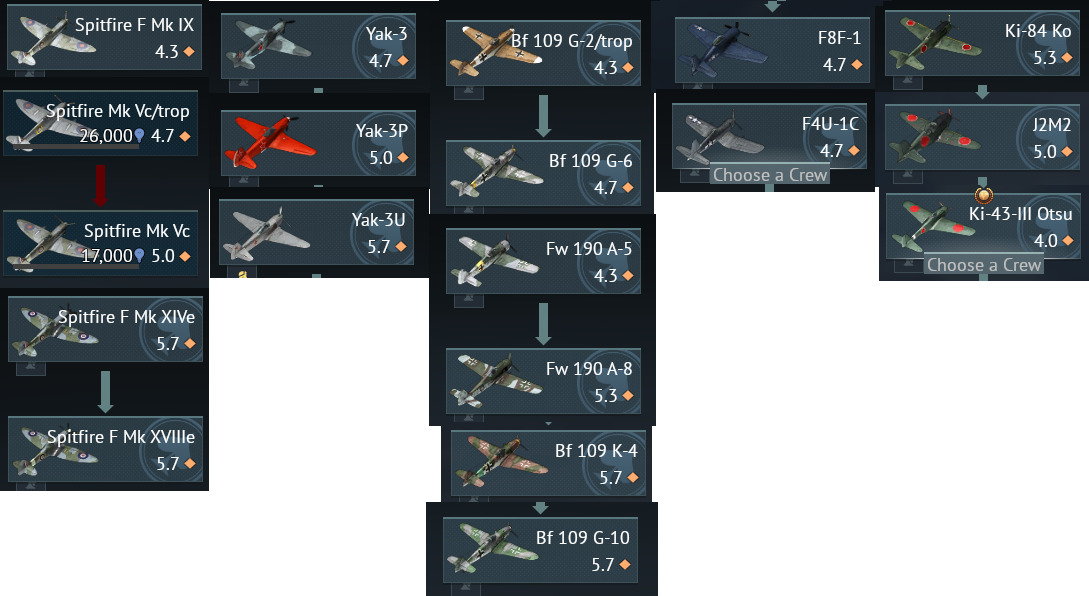
To be honest, Ignoring all the talk of incorrect high speed compression etc, even in their CURRENT IMPLEMENTATION the A6M5 Ko/Otsu aren’t worth 6.0. Or even 5.7. Heck they are still overtiered at 5.3. 5.0 is fair for them in their current implementation.
I mean just look at the competition they have around that BR:
there are probably a lot more, such as the La-7s etc but I am unsure of how their performance compares exactly. But can anyone really say with a straight face that the A6M5s AS THEY ARE RIGHT NOW are currently outright better than all of these planes? I mean look at all the spitfires ffs. They can do exactly what the A6M5 does, they can flip on enemies just as quick, and they are faster literally everywhere, even the 4.3 F Mk IX. Meanwhile the A6M5 Ko/Otsu are going to be a higher BR than GRIFFIN SPITS
Meanwhile Yak3 at 4.7, Yak3P at 5.0, and Yak3U at 5.7. There isn’t a single reality in this world where the base Yak3 should be at a lower BR than the A6M5 Ko/Otsu. None. They should be at worst the same BR. The Yak3s should be 5.0/5.3/6.3.
Raising the A6M5s to 6.0 is completely ludicrous.
Then the A6M2 without the revised ailerons had its top speed even lower than 510kph at normal power settings. It just happened to be the same number randomly. Otherwise, do you have any findings over the aileron redesign records. About 3600 A6M2s are built, and only 129 and few extra A6M2s had its wings with the faulty ailerons(causing aileron flutter at extremely low IAS speed). So Gaijin is just mistaking the normal power speed for Max take-off power speed at altitude then?
No wonder, because Gaijin is not very good at reading Japanese sources even if they have hands on them. As an example, Sakae 21 engine for later models of zeroes and J1N1 is having a fuel consumption rate of 0.52kg/hp per hour which is significantly higher than any other contemporarily engines, because Gaijin couldn’t read 立 as liter. The real engine’s fuel consumption rate at take-off power (1130hp) is supposed to be 0.31. Gaijin messes up a lot with zeroes.
About J2M’s lower-than-expected speed, it’s because the fuselage is not even streamlined well. They didn’t have enough research over the prop wash interaction and the fuselage shape wasn’t actually that good for reducing the drag at higher speed. At-least worse than Ki-44 based on claims of post-war Japanese researchers.
The laminar wings are not used on the whole wings, but the specific parts of the profile just like D4Y (It was for a stall control). And the LB(light blue) laminar airfoil used on Japanese aircraft almost never worked, it was a faulty airfoil design. And a laminar design never worked in real life even for a test aircraft, because the normal maneuvering load caused malformation of the outer-skin. The once stretched skins deformed, it was a found issue on multiple Japanese aircraft due to the relatively thinner skins. And not only that, even wings with normal airfoil can be made laminar, laminar wings are partially laminar to begin with, with just ever so slightly increased surface area that could theoretically be laminar. So J2M is just aerodynamically worse in drag by using the laminar wing design.
TAIC concluded J2M3 could reach 670km/h, it is based on mare calculations. But from looking at the state of the aircraft irl, it’s super inflated. The newly designed propellers caused a severe vibration from rpm-synced oscillation between the engine and props. They had to resort to using a lessor performing propellers as a temporal fix. Although, just like a war-condition ki-84 had 580-624km/h speed margin irl, it could be that a J2M2 in a very good condition can be a tad bit faster than it is claimed by Japanese sources. But it is debatable.
A bit off-topic though. It is worth sharing.
Also “Can turn with it” claims from frontline pilots could be interpreted as “I had a distance so a slight nose angle change could keep my aim on the target.” US aircraft approached Japanese fighters at a relatively higher speed generally. The field reports may not be about actually having a tighter turn in a circle. Though I see many sources claiming the heavy control scheme for Japanese aircraft when tested by US. One clear thing is that an average Japanese man is 10cm shorter on average (5 ft. 3-1/2), they prob had a malnutrition factor on the exerted arm strength. No offence, no racism. This is just well expected.
The famous Japanese J2M ace? was a buff guy.
Interesting, do you have any links to further reading on J2M? I still find it very unbelievable that a plane like that was barely faster than an A6M5 and slower than Ki-44.
This is coming from the section of a testing report that provides recommendations to pilots on how to fight the Zero. Maneuvering with them at all was only when behind and at a minimum of 300mph, so I aimed to make their available load factor similar at that speed. If both pull fully, the plane behind can get its nose on target.
pretty sure you have this backwards
Thanks, but I’m unable to do researches for a day. I’ll make a post later.
Please @ me when you do, if you remember.
The in-game N1K fms are so bad in pitch from what I can tell, so I have made a tool to modify the elevator’s max deflection angle based on the speed, so that the joystick mapping can be stretched at lower speed to allow for a more precise control. I’m yet to test this in a RB match, as this could be perceived as a form of cheating. This is definitely not what you described as a control adjustment device, but it can absolutely adjust the control mapping at varying speed.